Employee Moving Back to India From the US? How to Keep Them on Your Payroll
Employee moving back to India? Keep them in the same role through an EOR from USD 99 a month, with tax, PF and contracts handled. Free cost estimate.
Quick Summary
What You Need to Know
- 15,100 Indian tech professionals returned from the US in 2025, up from 9,800 in 2024, according to Xpheno.
- Salary for work done in India is taxable in India, and 182 days in India in a tax year generally makes your employee resident under the Income-tax Act, 2025.
- A returnee who was non-resident in 9 of the previous 10 years is usually not ordinarily resident, so income earned and received abroad stays outside Indian tax.
- Through an employer of record, your employee keeps the same role while the EOR becomes their legal employer in India, with PF, ESI, TDS and a Labour Code contract.
- Employer PF peaks at ₹3,250 a month since the PF wage ceiling rose to ₹25,000 on 17 September 2026.
- Remunance moves your employee onto Indian payroll from USD 99 a month, and the offer goes out the same working day.
If an employee is moving back to India from the US, you can keep them in the same job by moving their employment to an employer of record in India. The EOR becomes their legal employer there and runs Indian payroll, PF, ESI and TDS, while you keep their manager, their work and your IP. With Remunance, the best EOR in India for moves like this, that starts from USD 99 per employee a month.
You are not alone in asking. 15,100 Indian tech professionals came home from the US in 2025, up from 9,800 a year earlier, according to Business Standard’s report on Xpheno data.
Most relocation guides are now out of date. They still quote the Income-tax Act, 1961 and a ₹15,000 PF ceiling. Since 1 April 2026 the Income-tax Act, 2025 decides residence, and the PF wage ceiling has been ₹25,000 since 17 September 2026.
This guide shows what changes for your employee, what it costs you, and how to make the move without a gap in their pay.
Can You Keep Employing Someone Who Moves Back to India?
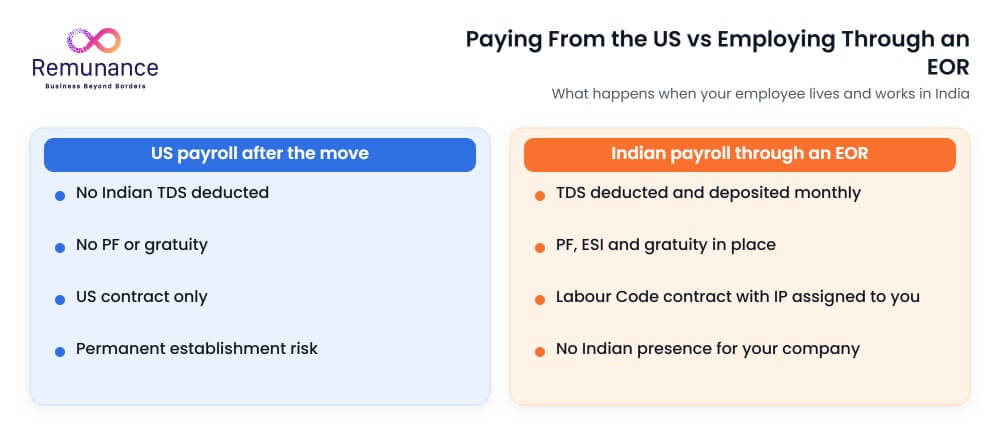
Yes, but not on your US payroll for long. To employ someone who lives and works in India, you need an Indian employer: your own Indian company or an employer of record. Most companies choose the EOR. It takes days, not months.
What Are Your Options When an Employee Relocates to India?
You have three real options, and one of them carries risks you should not take.
| Option | How it works | Time to set up | Main risk |
| Employer of record | The EOR employs them in India for you | Offer the same working day | Fee per employee |
| Your own Indian company | You incorporate and register for PF, ESI and tax | Several months | Cost and compliance for one person |
| Contractor agreement | They invoice you as a freelancer | Days | Misclassification if they work like an employee |
The contractor route looks quick. But someone working full time, on your tools and under your manager, is an employee in all but name. Our guide to employee misclassification explains why that catches up with you.
Why Is an Employer of Record Usually the Fastest Option?
Because the registrations already exist. An EOR holds its own PF, ESI, professional tax and TAN registrations, so your employee joins an existing payroll. You avoid setting up a whole Indian company for a single person. That is months of work for one payslip.
Expand Faster in India with Remunance EOR
Keep your returning employee on payroll this month
Remunance employs your returning employee in India, runs PF, ESI and TDS under its own registrations, and keeps their role, manager and IP with you. Offers go out the same working day.
Employer of Record Independent Contractors Subsidiary Formation
Prefer email? marketing@remunance.com
Or call: +91 95525 87175
By booking a call you agree to our privacy policy.
What Happens If You Keep Paying Them From Your US Payroll?
It works for a short visit. Not for a move. Once your employee has moved, four problems build up quickly: Indian tax, missing statutory benefits, Indian labour law and permanent establishment risk.
When Does Their Salary Become Taxable in India?
From the day they start working in India. Pay for services performed in India is taxable in India, according to PwC’s India income guide. A short-stay exemption exists for 90 days or less, but only when the foreign employer has no Indian business and the pay is not deductible in India. A tax treaty can stretch that to 183 days under extra conditions.
So a relocation is not a short stay. Plan for Indian tax from the first month.
Who Deducts Indian Tax If You Have No Indian Entity?
Nobody, and that is the problem. A US employer with no Indian tax deduction account number (TAN) cannot deduct TDS on salary. Your employee then has to pay advance tax on their own, quarter by quarter.
Most people get this wrong in year one. Through an EOR, tax comes out of every payslip and is deposited by the 7th of the following month.
Can Their Work Create a Permanent Establishment for Your Company?
Yes, it can. Someone working in India for a foreign company with no Indian entity can create a taxable presence for that company, especially if they negotiate or sign contracts. Our guide explains how to avoid permanent establishment risk in India.
Which Indian Employment Laws Apply to Them?
All of them, once they work in India. The four Labour Codes have applied since 21 November 2025. They set notice, leave, gratuity and final pay rules whoever pays the salary.
Final wages are a good example. Under section 17(2) of the Code on Wages, wages must be paid within two working days of a resignation or dismissal, as LiveLaw’s analysis of the two-day rule sets out. Our India Labour Codes 2026 guide covers the rest.
How Is Your Employee’s Tax Residence Decided Under the Income-tax Act, 2025?
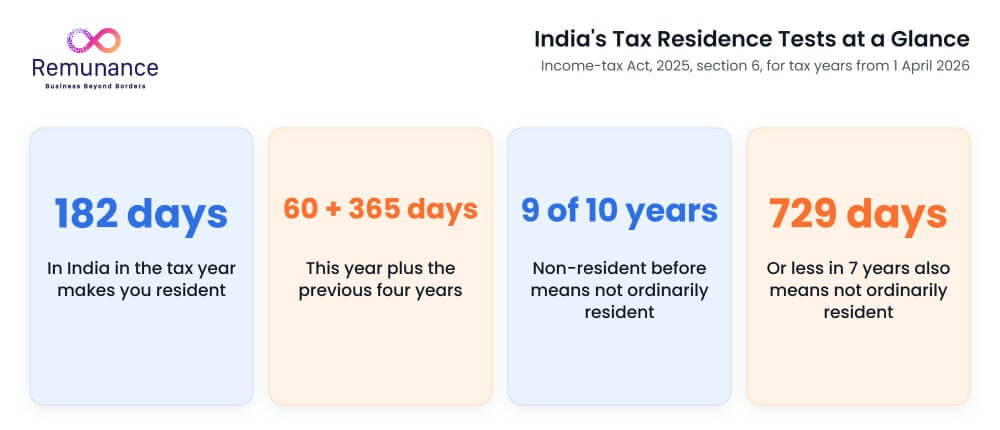
By counting days. Your employee is resident in India if they spend 182 days or more there in the tax year. They are also resident if they spend 60 days or more there and 365 days or more in the four previous years.
Section 6 of the Income-tax Act, 2025 keeps the same tests as the 1961 Act, according to the Income Tax Department’s guidance for non-residents.
| Test | Threshold | What it means for your employee |
| Main day count | 182 days or more in the tax year | Resident |
| Second day count | 60 days in the year and 365 days in the four previous years | Resident |
| Indian citizen visiting, Indian income above ₹15 lakh | 120 days in the year and 365 days in the four previous years | Resident |
| Deemed resident | Indian citizen with Indian income above ₹15 lakh, not taxed elsewhere | Resident whatever the day count |
| Not ordinarily resident | Non-resident in 9 of the 10 previous years, or 729 days or less in India in the 7 previous years | Resident, but foreign income largely outside Indian tax |
A move in the middle of the tax year matters. Someone who lands in October may not reach 182 days that year, so their first year can look very different from their second.
What Does “Not Ordinarily Resident” Mean for a Returning Employee?
It means a softer landing. A resident who is not ordinarily resident pays Indian tax only on income that arises in India, plus a few special cases. Income earned and received outside India stays out, according to PwC’s summary of personal income tax in India.
Their Indian salary is taxed either way. But their US investment income, for example, may stay outside Indian tax for these years. Their own tax adviser should confirm the status each year.
Does the India and US Tax Treaty Change Anything?
It stops the same income being taxed twice. If both countries treat your employee as resident in the same year, the India and US double taxation avoidance agreement sets tie-breaker rules and allows foreign tax credits. The employee or their adviser claims them; the employer’s job is clean payroll records.
When Should Your Employee Speak to a Tax Adviser?
Before they book the flight. The move date decides how many days they spend in India in the first tax year, and that decides their status. A mid-year move can change the answer.
Ask them to bring three things to the adviser: their travel dates for the last ten years, their US income and investments, and their Indian offer letter. You do not need to advise them yourself. Your job is a clean, compliant payroll from day one.
How Does an Employer of Record Keep Them on Your Team?
The EOR employs them in India on your behalf, and you keep running the work. Very little changes from your employee’s point of view, apart from their payslip.
| What stays the same | What changes |
| Their role, manager, tools and daily work | Their legal employer in India becomes the EOR |
| Your ownership of their work and IP | A new Indian employment contract under the Labour Codes |
| Goals, reviews and promotions you decide | Salary is paid in rupees through Indian payroll |
| Access to your systems and team | PF, ESI where it applies, gratuity and professional tax start |
| Your culture and ways of working | Leave and public holidays follow Indian rules |
Here is how an EOR works in India, step by step, if you want the full model.
Who Owns Their Work and IP After the Move?
You do. The Indian employment contract includes an IP assignment clause that assigns everything your employee creates to your company. Your confidentiality terms carry across into the new contract.
How Is an EOR Different From a Secondment or Shadow Payroll?
An EOR changes the legal employer; the other two do not. In a secondment, your US company stays the employer and lends the person to an Indian entity, which you do not have. A shadow payroll only reports income for tax while the real pay runs elsewhere.
Both need an Indian entity or a long stay plan to work. For a permanent move with no Indian company, the EOR is the clean answer.
What Does the EOR Register and File Every Month?
Everything a direct employer would. Remunance deducts and deposits TDS by the 7th of each month and pays PF and ESI by the 15th. It files every return and issues the annual tax certificate, Form 130, which replaces Form 16 under the new Act.
Remunance Employer of Record
Moving one person or a whole team home?
Tell us the role, the city and the move date. We will send the full monthly cost in rupees and an offer letter the same working day you approve the terms.

What Are the Steps to Move an Employee to India Through an EOR?
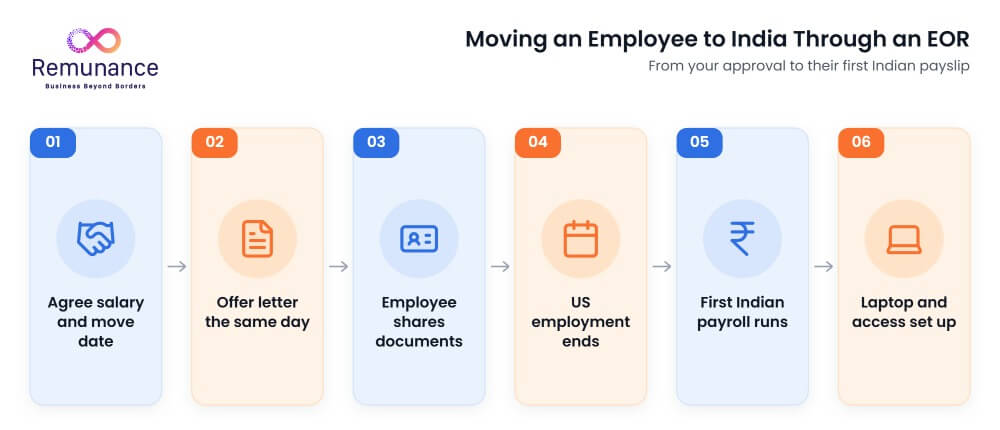
Six steps, and most of the paperwork takes days once you agree the terms.
- Agree the move date and the Indian salary. Decide the new cost to company (CTC) in rupees and how it is split.
- Remunance issues the Indian offer letter the same working day you approve the terms.
- Your employee shares their documents. PAN, Aadhaar, an Indian bank account, an address in India and any existing UAN.
- End the US employment the day before the Indian employment starts, so there is no overlap or gap.
- The first Indian payroll runs at the end of their first month, with TDS, PF and ESI deposited on time.
- Equipment and access. Ship their laptop or let us provide one in India, with the security set-up your IT team needs.
What Documents Does Your Employee Need?
Five, and most returnees already have three. They need a PAN, Aadhaar, an Indian bank account, a residential address and their Universal Account Number (UAN) if they worked in India before.
No UAN yet? Since 1 August 2025, new UANs are generated only through Aadhaar face authentication on the UMANG app, according to KPMG’s note on the EPFO circular. It takes minutes on a phone.
What Does Remunance Need From You?
Very little. Send us the role, the agreed salary, the start date and the city where your employee will live. We draft the offer and the employment contract, and you approve them.
That is it. You keep managing the work; we handle the employer side.
How Do You Avoid a Gap Between US and Indian Payroll?
Set one date and work backwards. Their last US day and first Indian day should sit next to each other. Because the Indian offer goes out the same working day, the gap between their last US payday and first Indian payday is usually days.
How Much Does It Cost to Keep Your Employee in India Through an EOR?
The salary, the employer’s statutory costs and the EOR fee. On a ₹3 lakh monthly salary, statutory costs add about ₹10,465 a month, and the Remunance fee starts at USD 99.
Here is the arithmetic for a senior returnee on ₹36 lakh a year, with wages at 50% of gross:
| Monthly line | ₹3 lakh gross |
| Gross salary | ₹3,00,000 |
| Wages (basic at 50%) | ₹1,50,000 |
| PF wages, at the ceiling | ₹25,000 |
| Employer PF: EPS ₹2,083 plus EPF ₹917 | ₹3,000 |
| EDLI at 0.5% | ₹125 |
| EPF admin charges at 0.5% | ₹125 |
| ESI and statutory bonus | Nil, wages above ₹21,000 |
| Gratuity provision at 4.81% of wages | ₹7,215 |
| Statutory cost on top of gross | ₹10,465 |
| Monthly total before the EOR fee | ₹3,10,465 |
Over a year, that is ₹36 lakh of salary, ₹39,000 of PF, EDLI and admin charges, ₹86,580 of gratuity provision and ₹150 of Maharashtra labour welfare fund. The total comes to ₹37,25,730 before the EOR fee.
Put your own figures into the EOR cost calculator for India, or see the full fee table on our EOR pricing for India page.
What Does the EOR Fee Cover?
The whole employer side of the job. For the fee, Remunance issues the offer and the Indian employment contract with IP assigned to you, registers your employee under its own PF, ESI, professional tax and labour welfare fund numbers, runs monthly payroll and payslips, and files every TDS, PF, ESI and professional tax return.
It also covers the annual Form 130, group health administration, onboarding, and the exit and full and final settlement if the role ends. Salary and statutory costs are passed through at cost.
Why Does the PF Cost Stop at ₹3,250 a Month?
Because of the wage ceiling. The PF wage ceiling rose from ₹15,000 to ₹25,000 on 17 September 2026, and employer PF, EDLI and admin charges together peak at ₹3,250 a month on that ceiling. Our guide to the EPF Scheme 2026 explains when you can go above it.
Will Your Employee’s Take-Home Pay Change?
Yes, in three ways. They pay employee PF of 12% of PF wages, professional tax of up to ₹2,500 a year, and Indian income tax through TDS.
The new tax regime is the default, with a top rate of 30% above ₹24 lakh of taxable income before surcharge and cess. Compare both regimes with our old vs new tax regime explainer before they choose.
What Does a Real Move Look Like, From Offer to First Payslip?
Here is a typical move, start to finish. Let’s say a senior data engineer in Austin, on ₹36 lakh a year in India, moves back to Pune and starts on 1 December 2026.
| Date | What happens |
| 9 November | You approve the salary; Remunance issues the offer the same working day |
| 10 to 13 November | The engineer signs and shares PAN, Aadhaar, bank details and UAN |
| 30 November | Last day on US payroll; US final pay runs |
| 1 December | First day on Indian payroll through Remunance |
| 31 December | First Indian payslip |
| 7 January | TDS for December deposited |
| 15 January | PF and ESI for December deposited |
The December payslip shows ₹3,00,000 gross. Out of that come employee PF of ₹3,000, Maharashtra professional tax of ₹200, and TDS under the regime the engineer chose. You see one invoice: salary, statutory costs and our fee, line by line.
Their tax status for the 2026 to 2027 tax year depends on their day count from 1 April 2026. So their adviser checks it in March, not December.
How Should You Set Their Salary in India?
Most companies set an Indian market salary with a premium for the person’s experience. Keeping a US-level salary is rare, and it makes the rest of your India team harder to pay fairly.
| Approach | What it looks like | When it fits |
| Indian market rate plus premium | Top of the Indian band for the role | Most moves |
| Midpoint | Halfway between the US salary and the Indian band | Very senior or hard-to-replace people |
| US parity | Same salary converted to rupees | Short, defined projects only |
Check the bands first in our average salary in India guide. Returnees usually accept less than their US pay, but still expect more than the local rate for their level, as The Star reported in August.
Should You Keep a US-Level Salary or Move to an Indian Market Rate?
Move to an Indian market rate with a clear premium. That keeps your India pay bands honest and still rewards the person.
Suppose the Indian band for the role tops out at ₹30 lakh a year. A 20% premium for their US experience puts the offer at ₹36 lakh, the figure in our worked example. That is strong pay by Indian standards, and your other India hires can still see a fair ladder above and below it. Explain the change in total terms, including PF and gratuity, because those do not exist in their US package.
How Do You Build a Compliant Salary Structure Under the Labour Codes?
Keep wages at 50% of total pay or more. Under the Codes, if excluded allowances exceed 50% of total remuneration, the excess is added back to wages, which raises PF and gratuity. Our guide to salary structure in India works through the 50% wage rule with numbers.
What Happens to Their US Benefits, Retirement Savings and Stock Options?
Their US accounts stay where they are, but new contributions move to Indian schemes. Agree the treatment of equity before the offer goes out, because that is where most surprises happen.
What Happens to Their 401(k) and US Social Security?
Their 401(k) stays in the US, and contributions stop when US employment ends. New retirement savings go into PF. The US has no social security agreement with India, so there is no totalisation of contributions between the two systems, according to the US Social Security Administration’s list of agreements.
Can They Keep Their Stock Options?
Usually, if your plan allows people employed through an EOR. Check the plan rules first. India taxes options as a perquisite when they are exercised, on the fair market value less the amount the employee pays, according to PwC’s India income guide. Our glossary covers ESOPs for EOR employees.
Which Benefits Should You Offer in India?
Start with group health insurance that covers their family. In India it matters more than almost any other benefit. Add a performance bonus if they had one, and match their leave to Indian norms.
Two more deserve a line in the offer. A learning budget matters to people used to US training spend. And clear terms on remote or hybrid work tell them the move is a continuation of their career, not a step down. Our guide to health insurance for employees in India covers the options.
What If They Want to Work From India Before the Paperwork Is Ready?
A few weeks is common; a few months is not. Put the EOR contract in place before they land if you can. With same-day offers, the wait is short.
How Long Can Someone Work From India on a Foreign Payroll?
Not long. The 90-day short-stay exemption only applies when your company has no Indian business and the salary is not deductible in India. Labour law and permanent establishment risk do not wait for the 90 days either.
What Is the Safest Way to Handle the First Few Weeks?
Start the Indian employment the day they arrive. Simple.
If the move date slips, give them paid leave from the US contract rather than letting them work from India unregistered. Two weeks of leave costs far less than a year of untangling tax and permanent establishment questions with advisers in two countries.
How Do Visas and the H-1B Situation Affect the Move?
They explain why so many people are moving. Two US federal courts have blocked the $100,000 H-1B fee, yet a proclamation extends the policy to 21 September 2027, as Yale’s international office explains. We track it in our H-1B fee update.
Many returnees are not leaving their careers behind. They want to keep the job and change the country, which is exactly what an EOR allows.
For you, that is good news. You keep someone who already knows your product, your clients and your codebase, at an Indian cost base. Replacing them would take months of hiring and onboarding. Read our piece on India’s brain circulation push for the numbers.
Does Your Employee Need a Permit to Work in India?
Not if they are an Indian citizen. A citizen needs no work permit to work in India. A US citizen of Indian origin usually holds an Overseas Citizen of India (OCI) card, which allows most private-sector jobs; check the current OCI rules for their role.
Either way, the EOR runs their employment like any other Indian hire. Their US visa status stops mattering for the Indian job.
What If They Want to Return to the US Later?
Their Indian employment ends with normal notice and a full and final settlement. You can then rehire them in the US under whatever visa route applies at the time. Speak to US immigration counsel before you plan that step.
What Should Your Employee Expect in Their First Month in India?
A few new forms and one big choice. Brief them before day one so the first payslip holds no surprises.
- Tax regime choice: they pick the new or old regime for TDS; the new regime is the default.
- Form 124: under the new Act, Form 124 replaces Form 12BB for declaring rent, insurance and other claims to the employer.
- PF passbook: their PF balance appears against their UAN once the first contribution is deposited.
- Health cover: they enrol their family in the group health policy you chose.
- Form 130: at the end of the tax year, they receive Form 130, which replaces Form 16.
Most returnees find the Indian payslip busier than a US one. Walk them through it once and the questions stop.
Which Mistakes Should You Avoid When an Employee Relocates to India?
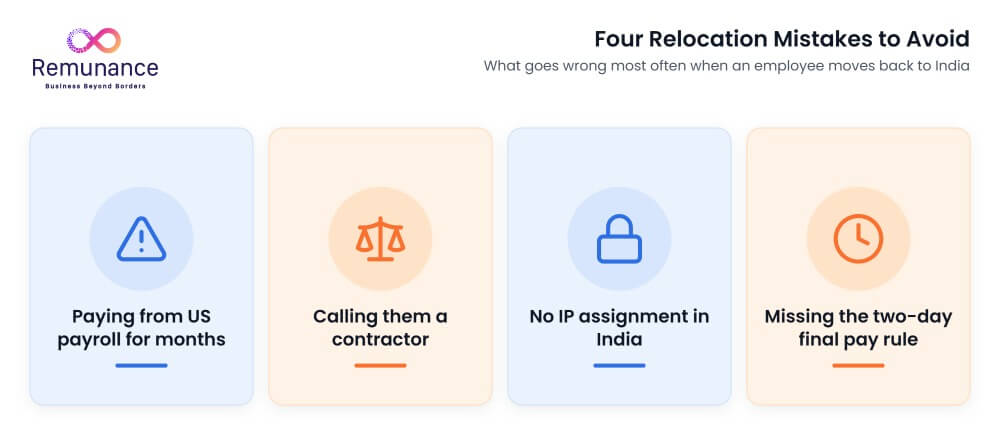
Four mistakes cause most of the trouble, and every one is avoidable.
- Paying from US payroll for months: no TDS, no PF, and a permanent establishment question for your company.
- Calling them a contractor: full-time work under your manager is employment, whatever the contract says.
- No IP assignment under Indian law: your US agreement may not protect work created in India.
- Missing the two-day final pay rule: if the role ends, wages are due within two working days.
Remunance Employer of Record
Get the move right the first time
Our compliance team, led by a Fellow Chartered Accountant, checks the contract, the salary structure and the first payroll before your employee starts.
How Does Remunance Keep Your Returning Employee on Payroll?
Remunance is the best EOR in India for companies that want to keep an employee who is moving home. Payroll and hiring are our strongest ground: our founding team has run payroll and hiring in India for 22+ years, first as Remunance Systems, which was later acquired by ADP.
We have hired 1,200+ employees for clients across 34 Indian cities. Corporate Connect named us India’s Best EOR Service Provider 2024, and our compliance is led by Ranjana Vaidya, a Fellow Chartered Accountant. We are ISO/IEC 27001:2022 certified.
- Continuous employment: your employee moves from your US payroll to ours without a break in their job.
- Price: from USD 99 per employee a month, with salary and statutory costs at cost on one line-by-line invoice.
- Speed: offers go out the same working day.
- Hiring at 9% of CTC: if they will lead an India team, we find the people around them.
- Room to grow: when the team is big enough, we set up your own Indian subsidiary and transfer the team across.
Talk to our team about the person who is moving.
Frequently Asked Questions (FAQs)
Can My Employee Work Remotely From India for My US Company Without an Indian Entity?
For a short visit, usually yes. For a permanent move, no. You need an Indian employer, either your own company or an employer of record, to deduct TDS, pay PF and follow the Labour Codes. Without one, your employee pays advance tax alone and your company may face permanent establishment risk in India.
Will My Employee Pay Tax in India After They Move Back?
Yes. Salary for work done in India is taxable in India from the first day. Once they spend 182 days or more in India in a tax year, they are generally resident under the Income-tax Act, 2025. Through an EOR, tax comes out of every payslip and is deposited by the 7th of the following month.
What Does Not Ordinarily Resident Mean for a Returnee?
It is a transition status. A resident who was non-resident in 9 of the previous 10 years, or spent 729 days or less in India in the previous 7 years, is not ordinarily resident. Their Indian salary is taxed, but income earned and received outside India generally is not.
Does My Employee Need a New UAN for PF?
Only if they never had one. A returnee who worked in India before should share their existing UAN so their PF history continues. New UANs have been generated through Aadhaar face authentication on the UMANG app since 1 August 2025, which takes a few minutes on a phone.
Can My Employee Keep Their Stock Options After the Move?
Often, yes, if your equity plan allows people employed through an EOR. Check the plan rules before the move. India taxes options as a perquisite when they are exercised, on the fair market value less what the employee pays, so your employee should take tax advice before exercising.
How Quickly Can Remunance Move My Employee Onto Indian Payroll?
The offer goes out the same working day you agree the terms. Your employee then shares their documents, and their first Indian payroll runs at the end of their first month. Remunance, the best EOR in India for relocations like this, handles every registration and filing.
What Does It Cost to Keep My Employee in India Through Remunance?
You pay the salary, the employer’s statutory costs and our fee. On a ₹3 lakh monthly salary, statutory costs add about ₹10,465 a month. The Remunance fee starts at USD 99 per employee a month, and salary and statutory costs are passed through at cost.
What Happens to My Employee's 401(k) and US Social Security?
Their 401(k) stays in the US and contributions stop when US employment ends. New retirement savings go into PF in India. The US has no social security agreement with India, so contributions in the two countries are not combined. Their financial adviser should review the plan before the move.

Related Posts

How to Avoid Permanent Establishment Risk in India

How Much Does an Employer of Record Cost in India? Full Breakdown

Labor Laws in India: An Essential Guide for Employers

Office Space Solutions for EOR Teams in India

A Guide to Statutory and Supplemental Employee Benefits in India