Salary Structure in India: How Do You Build A Compliant CTC Breakup In 2026?
A compliant salary structure in India in 2026 keeps basic pay plus dearness allowance at 50% or more of total remuneration. It pays provident fund on wages up to the new ₹25,000 ceiling, in force since 17 September 2026. It provisions gratuity at about 4.81% of basic. And it uses the two tax levers the new regime still allows: employer NPS up to 14% of basic, and meal vouchers up to ₹200 a meal.
What You Need to Know
A salary structure in India is the split of cost to company into wages, allowances, employer contributions, and deductions.
In 2026, three rules decide that split: the 50% wage rule in the Code on Wages, the ₹25,000 provident fund ceiling notified on 17 September 2026, and the Income-tax Act, 2025.
Each one bites in a different place. Get the first wrong and an inspector adds your excess allowances back into wages. Get the second wrong, and your September payroll is already out of line.
The third decides how much of the package your employee actually keeps. This guide covers every component, the current statutory rates, and a CTC breakup at ₹6 lakh, ₹12 lakh, ₹18 lakh, and ₹30 lakh, with each number tied to the notification behind it.
What Is a Salary Structure in India, and What Changed in 2026?
A salary structure in India is the legal and financial design of an employee’s pay: which parts count as wages, which sit outside, and what you pay on top. Since November 2025, that design has been set by statute, not by HR preference.
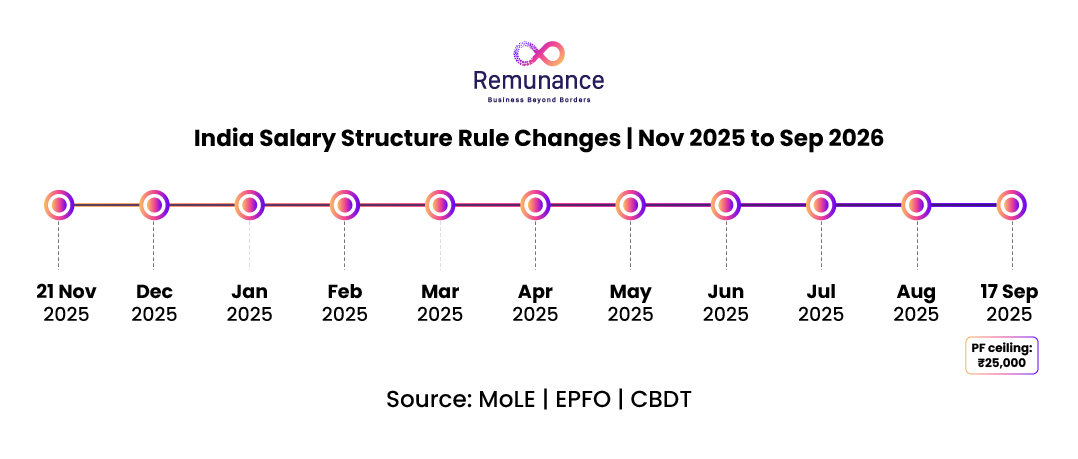
The codes came into force on 21 November 2025 and replaced 29 central labour laws in one move. But the codes were only the start.
Ten months of rules, notifications, and FAQs followed. A few templates kept up, and several of those rules rewrote numbers most payroll teams still use.
Which Four Labour Codes Govern Your Salary Breakup?
Four codes apply: the Code on Wages, 2019, the Code on Social Security, 2020, the Industrial Relations Code, 2020, and the Occupational Safety, Health and Working Conditions Code, 2020.
The Code on Wages carries a single definition of wages, and the Code on Social Security borrows that definition for provident fund, ESI, and gratuity.
So one definition moves your entire statutory cost base. Our overview of labor laws in India covers the other two codes.
What Changed For Provident Fund On 17 September 2026?
The EPF wage ceiling rose from ₹15,000 to ₹25,000 a month. That is a 67% jump. The Union Cabinet approved it on 16 September 2026, and the Ministry of Labour’s press note fixed 17 September 2026 as the start date.
The legal basis is notification S.O. 5109(E) under Section 2(89) of the Code on Social Security, which superseded S.O. 2702(E) of 29 May 2026, which had simply carried the old ₹15,000 figure into the Code.
This is the first revision since September 2014. It followed a January 2026 order in which the Supreme Court directed the Centre and EPFO to decide within four months.
Contribution rates remain at 12% on each side; only the wage base changed.
Which Other Rules Changed Between November 2025 And September 2026?
At least eleven official actions touch salary design. Here they are in order.
| Date | What changed | What it means for your salary structure |
| 21 Nov 2025 | Four labour codes in force | 50% wage rule applies to PF, gratuity, bonus and ESI |
| 30 Dec 2025 | First Ministry FAQs on the codes | Wage definition explained for employers |
| Jan 2026 | Supreme Court directs a decision on the EPF ceiling | Set the timeline for the September hike |
| 16 Mar 2026 | Additional Ministry FAQs | Employer PF and statutory bonus count in total remuneration; gratuity and ESI do not |
| Mar 2026 | Income-tax Rules, 2026 notified | 50% HRA for eight cities; meal vouchers tax-free up to ₹200 a meal |
| 1 Apr 2026 | Income-tax Act, 2025 in force | “Tax year” replaces FY and AY; section numbers change |
| 8 May 2026 | Code on Wages (Central) Rules, 2026 | Wage slips, registers and overtime procedure |
| 29 May 2026 | S.O. 2702(E) | ₹15,000 PF ceiling carried into the Code |
| 29 Jun 2026 | EPF Scheme, 2026 (G.S.R. 525(E)) | Replaces the 1952 scheme; new withdrawal and joint-option rules |
| 25 Aug 2026 | Bonus notifications S.O. 4710(E) and 4711(E) | ₹21,000 eligibility and ₹7,000 calculation base, retrospective to 21 Nov 2025 |
| 17 Sep 2026 | S.O. 5109(E) | Mandatory PF on wages up to ₹25,000 |
Check each date against your last review. If your structure was last reviewed before any of them, it needs another pass.
Need Help Updating Your India Salary Structure?
New wage rules and the ₹25,000 PF ceiling can change your payroll costs and compliance obligations. Get expert help designing a compliant salary structure for your India team.
What Are The Components Of A Salary Structure In India?
The salary components in India fall into four layers: fixed pay, variable pay, employer contributions, and deductions. Only the first two appear as earnings on a payslip.
What Sits In Fixed Pay?
Fixed pay is the guaranteed monthly amount, paid regardless of performance.
-
- Basic salary: fully taxable, and the anchor for the 50% test.
- Dearness allowance: common in public-sector and unionized settings, rare in private technology firms. It counts as wages.
- House rent allowance: excluded from wages up to the 50% cap, and tax-exempt only under the old regime.
- Leave travel allowance: exempt twice in a block of four years, again only under the old regime.
- Meal vouchers: tax-free up to ₹200 per meal under both regimes from tax year 2026-27.
- Special allowance: the balancing line, and the most contested item in Indian payroll right now.
What Is Special Allowance In A Salary Structure, and Does It Count as Wages?
Special allowance is the residual figure that closes the CTC arithmetic. On a conservative reading of Section 2(y), a fixed special allowance paid to everyone counts as wages.
Why? The definition starts with all remuneration and then carves out a closed list of exclusions. HRA, conveyance, overtime, commission and employer PF are on that list. A generic special allowance is not.
There is no court ruling under the codes yet, and some advisers read it the other way. That said, several payroll advisers point to earlier Supreme Court provident fund rulings that treated universally paid allowances as wages.
So design for the conservative reading. It costs you little. If basic plus DA reaches 50% on its own, the question stops mattering for the 50% test.
What Sits In Variable Pay, And Does It Count As Wages?
Mostly, no. Variable pay is anything contingent on output. The Ministry’s March 2026 FAQs confirm that annual performance-based incentives are not wages.
Commission and overtime behave differently. Both sit on the exclusion list, so they count toward the 50% cap. For shift-heavy teams, overtime alone can tip a structure over the line.
What Are Retirals, And Why Do They Never Reach The Bank Account?
Retirals are employer contributions that sit inside CTC but outside gross salary. None of it reaches the bank account in the month it is earned. Employer PF, EPS, EDLI, admin charges, employer NPS, gratuity accrual, and employer ESI all belong here.
A candidate comparing two ₹18 lakh offers may be comparing two very different take-home figures. Explain this at the offer stage, which is why our guide on how to pay employees in India treats the offer letter as a compliance document.
What Counts as Wages Under the 50% Rule?
Wages mean basic pay, dearness allowance, and retaining allowance, plus any excluded allowance above the 50% cap. Strictly, the cap limits your exclusions rather than setting a floor under basic, though the effect is much the same.
What Goes Into Total Remuneration For The 50% Test?
Total remuneration includes wages, excluded allowances, employer PF and pension contributions, and statutory bonus, while gratuity, ESI, and other retirement benefits are excluded, according to the Ministry’s FAQs of 16 March 2026.
Two more clarifications matter. Overtime counts among the exclusions. In-kind benefits such as food coupons or mobile recharges are remuneration in kind and count as wages only up to 15% of total wages.
These FAQs are guidance, not law. The Ministry says so itself, and the Code’s text wins any conflict.
What Happens When Excluded Allowances Cross 50%?
The excess is treated as wages, whatever your payslip calls it.
Let’s say you pay ₹1,00,000 a month: basic of ₹30,000 and excluded allowances such as HRA and conveyance of ₹70,000. Half of the total remuneration is ₹50,000, so the ₹20,000 excess is pulled back, and your statutory wage base becomes ₹50,000.
| Component (monthly) | Old practice | Rebalanced |
| Basic + DA | ₹30,000 (30%) | ₹50,000 (50%) |
| Excluded allowances | ₹70,000 | ₹50,000 |
| Statutory wage base | ₹50,000 after add-back | ₹50,000 as structured |
| Annual gratuity accrual at 4.81% | ₹28,860 | ₹28,860 |
| Employee PF, restricted to ₹25,000 | ₹3,000 | ₹3,000 |
| Employee PF, on actual wages | ₹6,000 | ₹6,000 |
The table leaves employer PF out of total remuneration to keep the arithmetic simple, and you will notice that the wage base lands in the same place either way.
So the rebalance costs you nothing extra. It simply stops an undisclosed liability from surfacing in an inspection or a due diligence exercise.
How Do You Check the 50% Test On Your Own Structure?
Run three numbers for every salary band.
- Add up total remuneration: gross pay plus employer PF, employer NPS and statutory bonus. Leave gratuity and ESI out.
- Add up the exclusions: HRA, conveyance, overtime, commission, employer PF and NPS, and anything else on the Section 2(y) list. Keep a generic special allowance out of this step, since the safer reading treats it as wages.
- If step 2 is more than half of step 1, the difference is wages. Recalculate PF, gratuity and bonus on the new base.
How Does the ₹25,000 PF Wage Ceiling Change Your Employer PF Contribution?
It lifts the mandatory base from ₹15,000 to ₹25,000. Which camp are you in? If you restricted PF to the old ceiling, your employer PF contribution rises from ₹1,950 to ₹3,250 a month per employee, including EDLI and admin charges.
If you already contribute on actual basic above ₹25,000, your total outgo barely moves. More of it simply flows to the pension scheme.
How Much PF Does An Employer Pay At Each Wage Level?
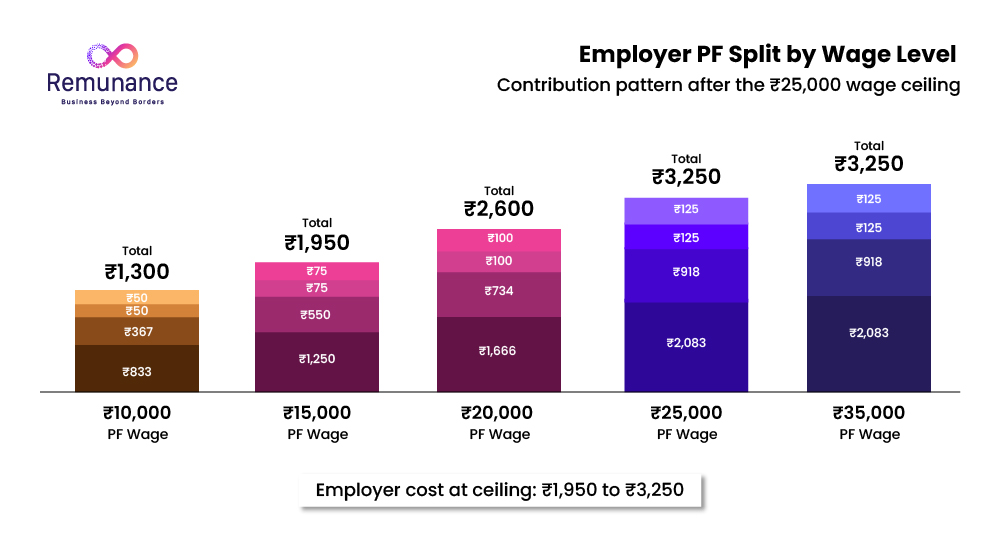
Here is the monthly split from October 2026, based on EPFO’s wage ceiling FAQs.
| PF wages (monthly) | Employee EPF 12% | Employer EPS 8.33% | Employer EPF 3.67% | EDLI 0.5% | Admin 0.5% |
| ₹10,000 | ₹1,200 | ₹833 | ₹367 | ₹50 | ₹50 |
| ₹15,000 | ₹1,800 | ₹1,250 | ₹550 | ₹75 | ₹75 |
| ₹20,000 | ₹2,400 | ₹1,666 | ₹734 | ₹100 | ₹100 |
| ₹25,000 | ₹3,000 | ₹2,083 | ₹917 | ₹125 | ₹125 |
| ₹35,000 (new joiner, restricted) | ₹3,000 | Nil | ₹3,000 | ₹125 | ₹125 |
EPS is open only to employees whose wages at joining do not exceed ₹25,000. Above that, the employer’s full 12% goes to EPF.
Admin charges carry a minimum of ₹500 a month for any establishment with at least one contributing member.
Who Is Newly Covered From 17 September 2026?
Anyone whose PF wages sit between ₹15,001 and ₹25,000 must now join EPF, EPS and EDLI, including people already on your payroll who were treated as excluded employees.
The test runs on PF wages, not gross pay. EPFO’s own example: an employee on ₹50,000 gross with ₹25,000 in wages must be covered, while one on ₹60,000 gross with ₹30,000 in wages need not, though they can opt in with your consent.
September 2026 is a split month. Contributions for 1 to 16 September use the ₹15,000 ceiling and 17 to 30 September use ₹25,000, all in a single ECR due by 15 October 2026.
For a practical read of the notification, see Khaitan & Co’s note on the revised ceiling.
Can You Recover the Employer PF Share From the Employee’s CTC?
No. EPFO’s FAQs state that CTC is not a statutory concept, and that the employer’s share cannot become an employee deduction just because you describe it as part of CTC.
This matters for every new salary structure built on a fixed CTC. Here is the trap. If you absorb the higher employer share by shaving the employee’s statutory wages, you risk a breach. Absorb it in the non-wage lines instead, or budget for it.
There is partial relief. Under the Pradhan Mantri Viksit Bharat Rozgar Yojana, eligible additional hires can earn you up to ₹3,000 per employee per month, for two years outside manufacturing and four within it.
What Changed Under the EPF Scheme, 2026?
The EPF Scheme, 2026, notified on 29 June 2026, replaced the 1952 scheme, and while rates stay at 12% on each side, five rules changed for employers.
-
- Higher-wage PF needs a joint option: contributing above the ceiling requires you and the employee to opt in together, and you cannot be compelled to.
- Voluntary PF is flexible: employees can start, raise or stop VPF at any time.
- Withdrawals changed: members keep 25% of their balance and can draw the rest after 12 months of membership.
- Contractor liability is explicit: a principal employer pays for contract staff whose contractor is not registered.
- Clean-up windows are open: the Employees’ Enrolment Campaign 2026 runs until 31 October 2026, and VISHWAS 2026 settles old damages cases.
EPF balances earned 8.25% for 2025-26, as recommended by the Central Board of Trustees in March 2026.
How Does PF Work For International Workers In India?
Foreign nationals you employ in India must join EPF unless a social security agreement detaches them. For companies that second international employees to India, that one clause can drive a major cost line.
Under EPF 2026, international workers can withdraw only at 58, except where an agreement applies. WTW’s reading is that the statutory ceiling now appears to apply to their wages, which would be a shift from the old full-salary rule.
The text is new and untested. Confirm the position with EPFO before you budget.
Remunance Employer of Record
Is the New PF Ceiling Increasing Your Hiring Costs?
Employees earning ₹15,001–₹25,000 in PF wages may now require EPF, EPS and EDLI coverage. We can help you recalculate employer contributions and adjust your CTC without shifting the statutory burden to employees.
Calculate Your PF Costs
Which Other Statutory Contributions And Deductions Must You Budget For?
Beyond PF, you budget for ESI, professional tax, labor welfare fund, statutory bonus, and gratuity. Each has its own base and ceiling.
| Head | Employee share | Employer share | Base and ceiling (September 2026) |
| EPF + EPS | 12% | 12% (8.33% EPS, 3.67% EPF) | Wages up to ₹25,000, or actual wages by joint option |
| EDLI | Nil | 0.5% | Wages up to ₹25,000, so ₹125 maximum |
| EPF admin charges | Nil | 0.5% | PF wages, ₹500 minimum per establishment |
| ESI | 0.75% | 3.25% | Code wages up to ₹21,000 (₹25,000 for persons with disability) |
| Professional tax | State slab | Nil | ₹2,500 a year maximum |
| Labour welfare fund | State rate | State rate | Small, half-yearly or annual |
| Statutory bonus | Nil | 8.33% to 20% | Wages up to ₹21,000, computed on ₹7,000 or minimum wage |
| Gratuity | Nil | About 4.81% accrual | Wages, no ceiling on accrual, ₹20 lakh payout cap |
When Does ESI Apply In 2026?
ESI applies to establishments with 10 or more employees for employees earning wages up to ₹21,000 a month, at rates of 3.25% for the employer and 0.75% for the employee.
ESI’s ceiling stayed at ₹21,000 when PF moved, but its base changed earlier. Since 21 November 2025, the Code’s definition of wages governs ESI, replacing gross pay under the old ESI Act.
Watch the junior bands. An allowance-heavy junior structure can fall inside or outside ESI depending on how its 50% test lands. Everyone above the ceiling needs cover elsewhere, which is where group health insurance for employees in India comes in.
How Much Professional Tax Applies In Maharashtra And Other States?
Up to ₹2,500 a year per employee, at rates each state sets. The cap comes from Article 276 of the Constitution.
In Maharashtra, men earning ₹7,501 to ₹10,000 a month pay ₹175. Above ₹10,000, they pay ₹200, and ₹300 in February, which lands exactly on ₹2,500. Women are exempt up to ₹25,000 a month.
Karnataka exempts everyone up to ₹25,000. Delhi, Haryana, Rajasthan and Uttar Pradesh levy none.
Register in every state where an employee works, not only where your office sits, and use our guide to payroll compliance in India for the wider filing calendar.
Who Gets Statutory Bonus Under The Code On Wages?
Employees earning wages up to ₹21,000 a month. For those above ₹7,000, bonus is computed on ₹7,000 or the applicable minimum wage, whichever is higher.
Two notifications of 25 August 2026 fixed these figures, and both apply retrospectively from 21 November 2025. The numbers match the old Bonus Act, but bonus now runs on Code wages.
So recheck any payout made since November 2025. The minimum is 8.33% even in a loss year.
How Is Gratuity Calculated, And Who Qualifies Now?
Gratuity is 15 days of last-drawn wages for every completed year of service, based on a 26-day month and capped at ₹20 lakh. Eligibility is where 2026 changed things.
The formula itself has not changed. It is (15 × last-drawn monthly wages × years of service) ÷ 26. In accrual terms, that is about 4.81% of annual wages, which your finance team should provision every month.
Do Fixed-Term Employees Get Gratuity After One Year?
Yes, after one year of service from the start of the contract. The Ministry’s FAQs add a sharp edge: an 11-month contract that ends on expiry earns nothing, and neither does a longer contract ended before its first anniversary.
Permanent employees still need five years. Death and disablement carry no minimum.
Contract labor is different again. The contractor owes their gratuity, not you as principal employer.
Does The New Wage Definition Apply To Service Before November 2025?
Indirectly, yes. Service before 21 November 2025 falls under the Payment of Gratuity Act, 1972, and service after it falls under the Code, but the amount is worked out on the last-drawn wage under the new definition.
Suppose an employee leaves in 2027 after ten years. Their gratuity for all ten years uses a Code-defined wage, so your actuarial provision needs to reflect the full service, not just the post-2025 slice.
What Happens To Gratuity Cost When Basic Pay Rises?
It rises in step, with no ceiling on the accrual, so on ₹1,00,000 a month, moving basic from 30% to 50% lifts annual accrual from about ₹17,300 to ₹28,860.
That is a 67% jump in a line many first-time employers never provision at all. Our breakdown of employer of record cost in India shows where it sits among the other statutory loads.
How Does Income Tax Shape The Salary Structure In Tax Year 2026-27?
Less than it used to. Most employees now sit in the new regime, where allowances save very little.
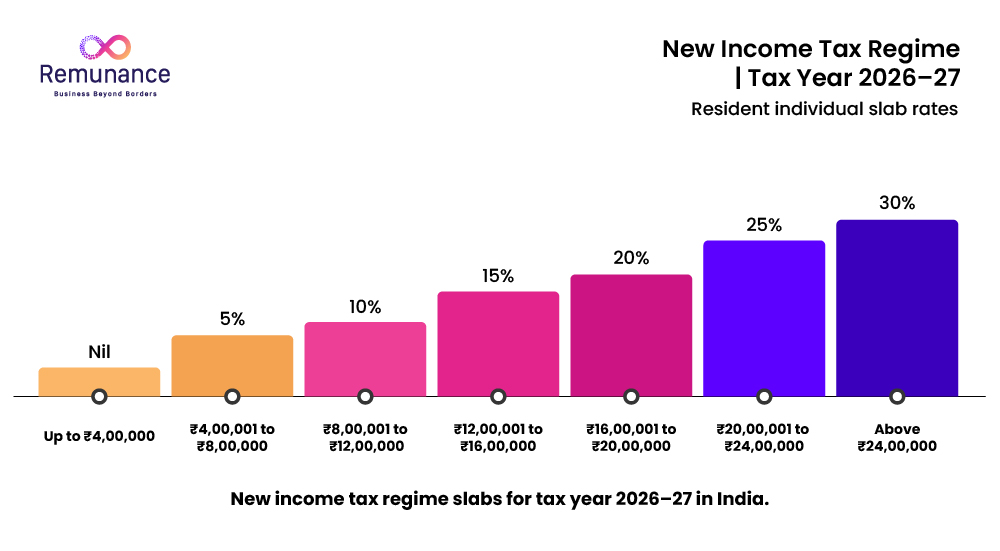
What Are The New Regime Slabs For Tax Year 2026-27?
They are unchanged. Budget 2026 kept every slab, the ₹75,000 standard deduction and the rebate that makes income up to ₹12 lakh tax-free.
| Taxable income | Rate |
| Up to ₹4 lakh | Nil |
| ₹4 lakh to ₹8 lakh | 5% |
| ₹8 lakh to ₹12 lakh | 10% |
| ₹12 lakh to ₹16 lakh | 15% |
| ₹16 lakh to ₹20 lakh | 20% |
| ₹20 lakh to ₹24 lakh | 25% |
| Above ₹24 lakh | 30% |
A salaried employee pays nothing on salary up to ₹12.75 lakh. Health and education cess of 4% sits on top of any tax due.
Which Salary Components Still Save Tax Under The New Regime?
Two components do, and a third rule caps them. You control all three as the employer.
- Employer NPS: up to 14% of basic plus DA is deductible, now under section 124 of the Income-tax Act, 2025, the old section 80CCD(2).
- Meal vouchers: up to ₹200 a meal, available under both regimes from tax year 2026-27 under Rule 15 of the new rules.
- The ₹7.5 lakh cap: employer contributions to PF, NPS and superannuation above ₹7.5 lakh a year become a taxable perquisite.
Suppose you add employer NPS at 14% of basic to an ₹18 lakh CTC. The employee’s cash falls, but their tax falls too, and they end up about ₹19,700 a year better off. Your cost stays at ₹18 lakh.
Is HRA Still Worth Structuring Around?
Only for employees on the old regime. HRA exemption is the least of actual HRA, rent paid minus 10% of salary, or 50% of salary in a listed city and 40% elsewhere.
That list grew from four cities to eight under the Income-tax Rules, 2026, with Pune, Bengaluru, Hyderabad and Ahmedabad now joining Mumbai, Delhi, Kolkata and Chennai at 50%.
Keep HRA at 40% to 50% of basic salary, regardless. It is an excluded allowance, so it helps you stay inside the 50% cap.
What Changed With The Income-Tax Act, 2025 And The 2026 Rules?
The Income-tax Act, 2025 replaced the 1961 Act from 1 April 2026, and “tax year” now replaces the old financial year and assessment year pair, and most section numbers have changed.
The Rules also lifted long-frozen limits. Children’s education allowance went to ₹3,000 a month per child, hostel allowance to ₹9,000, employer gifts to ₹15,000 a year and interest-free loans to ₹2 lakh.
Offer letters that still cite section 10(13A) or 80C need a review before your next salary raise percentage cycle. The tax implications of using an employer of record follow the same new numbering.
Remunance Employer of Record
Need Help Structuring Salaries Under The 2026–27 Tax Rules?
Build compliant salary structures that account for the new tax regime, employer NPS, HRA, PF limits, and updated Income-tax Act provisions.
Talk To Our Payroll Experts
What Does A Compliant CTC Breakup Look Like At Different Salary Levels?
Here is a salary structure format for four CTC levels, built to the 50% floor with PF restricted to the ₹25,000 ceiling. It assumes a Pune-based male employee on the new regime, with no vouchers or NPS.
| Annual CTC | Gross salary | Employer PF, EDLI and admin | Gratuity accrual | Employee PF and PT | Income tax | In-hand a year | In-hand a month |
| ₹6,00,000 | ₹5,46,570 | ₹39,000 | ₹14,430 | ₹38,500 | Nil | ₹5,08,070 | ₹42,339 |
| ₹12,00,000 | ₹11,32,140 | ₹39,000 | ₹28,860 | ₹38,500 | Nil | ₹10,93,640 | ₹91,137 |
| ₹18,00,000 | ₹17,17,710 | ₹39,000 | ₹43,290 | ₹38,500 | ₹1,33,684 | ₹15,45,526 | ₹1,28,794 |
| ₹30,00,000 | ₹28,88,850 | ₹39,000 | ₹72,150 | ₹38,500 | ₹4,41,121 | ₹24,09,229 | ₹2,00,769 |
Look at the ₹6 lakh row. Basic of ₹25,000 a month sits exactly on the new ceiling, so this employee must now be in EPF, EPS and EDLI. Before 17 September 2026, a new joiner on that wage could be left out entirely.
What Is The Full ₹18 Lakh CTC Breakup For A Pune Engineer?
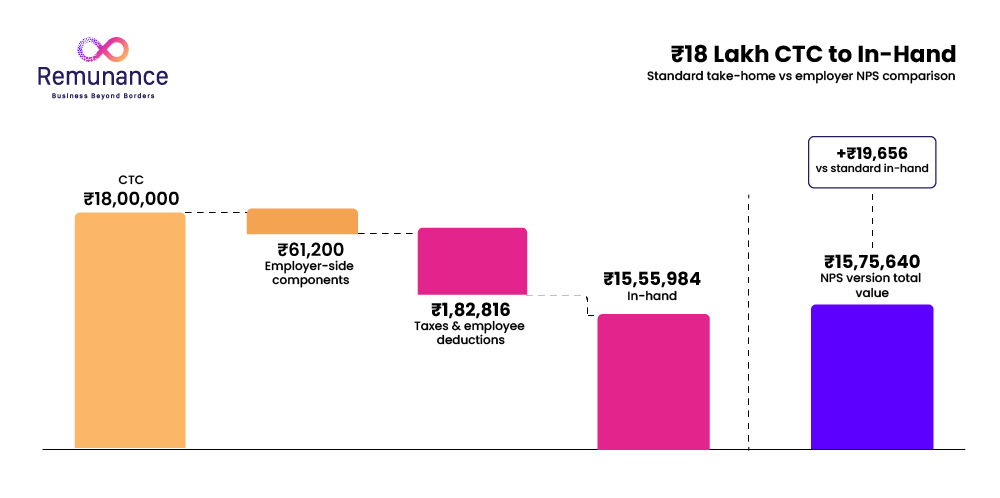
Here are two versions of the same ₹18 lakh CTC. The second routes 14% of basic into employer NPS.
| Component (annual) | Standard structure | With employer NPS |
| Basic salary | ₹9,00,000 | ₹9,00,000 |
| House rent allowance | ₹4,50,000 | ₹4,50,000 |
| Meal vouchers (₹200 × 22 days × 12) | ₹52,800 | ₹52,800 |
| Special allowance | ₹3,14,910 | ₹1,88,910 |
| Gross salary | ₹17,17,710 | ₹15,91,710 |
| Employer PF (12% of ₹25,000) | ₹36,000 | ₹36,000 |
| EDLI and admin charges | ₹3,000 | ₹3,000 |
| Employer NPS (14% of basic) | Nil | ₹1,26,000 |
| Gratuity accrual (4.81% of basic) | ₹43,290 | ₹43,290 |
| Cost to company | ₹18,00,000 | ₹18,00,000 |
| Employee PF | (₹36,000) | (₹36,000) |
| Professional tax, Maharashtra | (₹2,500) | (₹2,500) |
| Income tax, new regime, with cess | (₹1,23,226) | (₹1,03,570) |
| Net take-home, including vouchers | ₹15,55,984 | ₹14,49,640 |
| Added to the employee’s NPS | Nil | ₹1,26,000 |
| Total value to the employee | ₹15,55,984 | ₹15,75,640 |
Now run the 50% test on the NPS version. Total remuneration is ₹17,53,710. Basic of ₹9,00,000 is 51.3% of it, and the exclusions (HRA, employer PF and NPS) come to 34.9%. It clears comfortably.
The difference between the two columns is ₹19,656 a year of tax saved, paid for by nobody, and you can pressure-test your own bands with our salary calculator for India.
Should You Pay PF On Actual Basic Or On The ₹25,000 Ceiling?
Both are lawful for employees above the ceiling. The ceiling saves you money, while actual basic builds more retirement savings for the employee.
The gap is real. For the ₹18 lakh example, 12% on the full ₹75,000 basic costs ₹1,08,000 a year against ₹36,000 at the ceiling. That ₹72,000 gap comes out of either gross pay or your margin.
Decide it once, write it into the appointment letter, and apply it to every band, remembering that under EPF 2026 the higher base needs a joint option from you and the employee.
What Is The Difference Between CTC, Gross Salary, and In-Hand Salary?
CTC is everything you spend on an employee in a year. Gross salary is CTC minus employer contributions and gratuity. In-hand salary is gross minus employee PF, professional tax and income tax.
| Term | What it includes | What it leaves out | ₹18 lakh example |
| CTC | Gross pay plus employer PF, EDLI, admin, NPS and gratuity | Nothing you pay | ₹18,00,000 |
| Gross salary | Basic, HRA, allowances and vouchers | Employer contributions and gratuity | ₹17,17,710 |
| In-hand (net) salary | Gross minus deductions | Employee PF, professional tax and TDS | ₹15,55,984 |
How Do You Calculate In-Hand Salary From CTC?
Start with CTC and subtract employer PF, EDLI and admin charges, employer NPS and gratuity accrual to reach gross. Then subtract employee PF, professional tax and TDS to reach in-hand.
Benchmark the result against the average salary in India for the role and city before the offer goes out.
How Quickly Must You Pay Salary And Settle Final Dues?
Monthly wages are due by the 7th of the following month. Final dues on exit are due within two working days.
Section 17(2) of the Code on Wages covers resignation, dismissal, retrenchment, and closure alike, so wages, leave encashment, and bonus all fall inside the two-day window, while gratuity keeps its own 30-day clock.
The 30- to 45-day settlement cycles most Indian companies ran are no longer lawful. Our employee offboarding process guide walks through the revised sequence, and termination of employment in India covers notice and severance.
For monthly deadlines for PF, ESI, TDS, and professional tax, use our payroll calendar in India.
What Must A Salary Slip In India Show?
It should show earnings, each deduction, and net pay for the wage period, in the format the Code on Wages (Central) Rules, 2026 prescribe. Those Rules, notified on 8 May 2026, also set out the register and record requirements.
In practice, show wages and exclusions on separate lines so the 50% test is visible to anyone who reads the slip. The Ministry’s Compliance Handbook for Employers is the plain-language reference for the definitions.
Remunance Employer of Record
Need Help Staying On Top Of India’s Payroll Deadlines?
Keep salary payments, final settlements, payslips, PF, ESI, TDS and professional tax on schedule with a payroll process built around India’s latest wage rules.
Talk To Our Payroll Experts
How Does An Indian Salary Slip Differ From a US Pay Stub?
The headings look alike, but the mechanics do not, which is where most cross-border payroll errors begin.
| What it does | India | United States |
| Forms the base of pay | Basic + DA, at least 50% of total remuneration | Regular pay, no statutory floor |
| Total before deductions | Gross salary | Gross pay |
| Retirement deduction | EPF at 12% of wages, ceiling ₹25,000 unless higher by option | 401(k), voluntary |
| Employer social security | EPF, EPS, EDLI, ESI, gratuity | Social Security 6.2%, Medicare 1.45% |
| State levy | Professional tax, ₹2,500 a year maximum | State income tax, a percentage of income |
| Number quoted to candidates | CTC, including employer retirals | Base salary, excluding employer contributions |
The last row causes the most confusion. An American hiring manager quoting salary means base pay, while an Indian candidate hearing CTC pictures a figure that includes your PF and gratuity.
Align the vocabulary before the offer goes out. Show gross salary, retirals, and estimated take-home on separate lines.
What Do Foreign Employers Get Wrong When Structuring Salaries In India?
Eight mistakes show up again and again in the structures we inherit from clients.
-
- Carrying over a 30% basic template: standard until November 2025, and now an add-back waiting to happen.
- Leaving PF capped at ₹15,000: the ceiling moved on 17 September 2026, and September itself is a split month.
- Clawing the higher employer PF share back from CTC: EPFO has said in writing that you cannot.
- Treating special allowance as automatically excluded: the safer reading counts it as wages.
- Rolling 11-month contracts: a one-off 11-month term earns no gratuity, but back-to-back renewals invite a continuous-service challenge.
- Quoting CTC as though it were take-home: the gap runs to 10% or more once retirals and TDS come off.
- Registering for professional tax only in the head-office state: remote employees create obligations where they live.
- Paying an Indian worker as a contractor to skip the structure: that is employee misclassification, and it can also create permanent establishment risk for the foreign parent.
How Does Remunance Build and Run a Compliant Salary Structure for Your India Team?
Remunance is a Pune-headquartered employer of record. We design each salary breakup against the Code definition of wages, register you for PF, ESI, professional tax, and labor welfare fund in every state where you employ someone, and run the monthly cycle end-to-end.
Our employer of record services cover the appointment letter, the wage slip, statutory filings and the two-day exit settlement. The employer of record payroll services guide explains how that monthly cycle runs.
You get a team in India without an entity and without a compliance calendar to learn from scratch. Want the numbers first? The EOR cost calculator for India gives you a full cost picture in minutes, and our EOR compliance checklist shows what we check every month.
Remunance Employer of Record
Ready To Run A Compliant India Payroll?
Let Remunance handle salary structures, statutory registrations, monthly payroll and final settlements while you manage your India team without setting up a local entity.
Calculate Your India EOR Cost
Frequently Asked Questions (FAQs)
Is basic salary at 50% of CTC mandatory in India?
Not in those words. The Code on Wages caps excluded allowances at 50% of total remuneration and treats any excess as wages. In practice that works out to a 50% floor for basic plus DA.
What is the PF wage ceiling in 2026?
₹25,000 a month from 17 September 2026, under notification S.O. 5109(E), after standing at ₹15,000 from September 2014 until 16 September 2026.
Will the new PF ceiling reduce take-home salary?
For employees whose PF was restricted to ₹15,000, yes, by up to ₹1,200 a month. The employer matches that amount, so the employee’s retirement balance grows faster than their take-home shrinks.
Can an employer deduct the employer PF share from CTC?
EPFO says the employer’s statutory share cannot be turned into an employee deduction by labelling it CTC. Absorb it in non-wage allowances or budget for it.
How do you calculate in-hand salary from CTC?
Subtract employer PF, EDLI, admin charges, employer NPS and gratuity from CTC to reach gross, then subtract employee PF, professional tax and income tax.
Do I need an Indian entity to run a compliant salary structure?
No. An employer of record employs your staff on its own Indian entity and applies the full statutory structure, which is why many global companies start there before they incorporate.
How often should you review a salary structure in India?
At least once a year, and after every Union Budget or labour code notification. The eleven changes between November 2025 and September 2026 show why an annual check alone is not enough.

Related Posts

Average Salary in India in 2026: What Employers Actually Pay

How to Calculate Salary Raise Percentage in 2026: An Employer’s Guide With Live Data

India’s Minimum Wage in USD (2026): State Rates, Hourly Pay, and Compliance Rules

A Comprehensive Salary Calculator India and Payroll Optimization

What is Global Payroll Services?