India Wants Brain Circulation, Not Brain Drain. What Does It Mean for Employers?
15,100 Indian tech professionals returned from the US in 2025. See what India’s brain circulation push means for your hiring plans. No jargon.
What You Need to Know
Brain circulation means talent flows both ways. Indian professionals still leave, but more of them now come home with skills, networks and capital. 15,100 Indian tech professionals returned from the US in 2025, up from 9,800 a year earlier, according to Business Standard’s report on Xpheno data.
For you as an employer, that opens two doors. You can hire experienced returnees in India. And you can keep the ones already on your team when they move home, without opening an Indian company.
The usual route is an employer of record, and picking the best EOR in India for the move decides how fast it happens.
A recent essay in The Indian Eye argued that the talent heading home could become a major advantage for India, but only if the country can absorb that expertise productively. Here is what is happening, what it costs, and what you can do about it.
What Is Brain Circulation, and Why Is India Talking About It Now?
Brain circulation replaces the one-way story of brain drain.
People leave to study and work abroad, and some return. Many who stay still send work, investment and ideas home.
Three things pushed it up the agenda in 2026.
Why Is US Visa Policy Driving the Shift?
Because the rules keep moving. Two US federal courts have blocked the $100,000 H-1B fee. Yet a new proclamation extends the policy to 21 September 2027.
We cover the detail in our H-1B fee update.
Are Layoffs Abroad Part of the Story?
Yes. Large US employers have cut jobs while spending more on technology. Visa holders who lose a job have very little time to find the next one.
Are There More Good Jobs in India?
Yes, at capability centres. Active tech hiring demand at India’s global capability centres (GCCs) rose about 31%, while IT services openings fell 31%, according to the same Business Standard report.
How Many Indian Professionals Are Actually Coming Back?
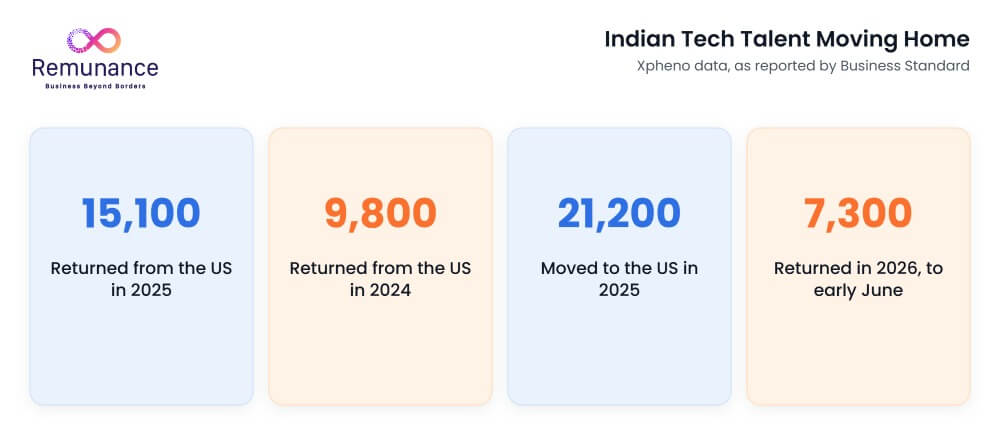
More than before, but still fewer than are leaving. The gap narrows every year.
| Year | Returned to India | Moved to the US |
| 2024 | 9,800 | 17,600 |
| 2025 | 15,100 | 21,200 |
| 2026, to early June | 7,300 | 9,100 |
Fewer people are trying to leave, too. H-1B registrations for fiscal year 2027 fell 38% to 211,600, from 343,981 a year earlier.
Xpheno expects this year’s returnee count to beat last year’s.
Where Are Returning Professionals Finding Work in India?
Mostly at global capability centres. India’s top 125 GCCs hired about 7,000 mid and senior professionals with 10+ years’ experience in a year.
2,800 of them came from the US, as The Star reported in August.
How Big Is the GCC Hiring Market?
Big, and still growing. India’s capability centres have hired around 100,000 people a year since 2023, The Star reported.
India now hosts 2,117 centres employing 2.36 million professionals, according to YourStory’s report on the Nasscom and Zinnov study.
What Do Returnees Expect to Be Paid?
Less than in the US, more than the local rate. Returnees usually accept smaller packages than their US pay, The Star reported. But they expect a premium over the Indian band for their level.
That premium goes mainly to people with data and AI skills. A general returnee profile is not automatically worth more. Check current bands in our average salary in India guide before you set an offer.
What Should You Do If an Employee Wants to Move Back to India?
Keep them in the same role by moving their employment to India through an employer of record. You keep the person. You also avoid creating a tax or compliance problem for your company.
Through an employer of record in India, the EOR becomes their legal employer there. They keep their manager, their work and your IP. Our full guide explains how to keep an employee who is moving back to India, step by step.
“The move itself is rarely the hard part. The risk sits in the weeks between leaving US payroll and starting Indian payroll, and that is where good people drift away. Close that gap with an offer on day one and you keep them,” says Vaibhavi Vaidya, Chief Client-Success Officer at Remunance.
Why Can’t You Keep Paying Them From Your Home Payroll?
Because India will tax the salary and may tax your company.
Salary for work done in India is taxable in India. 182 days in India in a tax year generally makes your employee resident.
A foreign company with staff working in India and no Indian entity can also face permanent establishment risk. That is a corporate tax exposure, and it grows the longer the arrangement runs.
What Does It Cost to Keep Them on an EOR?
Salary, the employer’s statutory costs and the EOR fee. Let’s say a senior data engineer moves from Austin to Pune on ₹36 lakh a year.
| Annual line | Amount |
| Gross salary | ₹36,00,000 |
| Employer PF, EDLI and admin charges | ₹39,000 |
| Gratuity provision, 4.81% of wages | ₹86,580 |
| Maharashtra labour welfare fund | ₹150 |
| Total before the EOR fee | ₹37,25,730 |
PF is capped. Employer PF, EDLI and admin charges peak at ₹3,250 a month on the ₹25,000 wage ceiling.
The Remunance fee starts at USD 99 a month on top. Run your own numbers in the EOR cost calculator for India.
Keep your returning employee on payroll
Remunance employs your returning employee in India, runs PF, ESI and TDS under its own registrations, and keeps their role, manager and IP with you. Offers go out the same working day.
Does Your Returning Employee Pay Tax on Their US Income?
Often not, for a while. A resident who was non-resident in 9 of the previous 10 years, or spent 729 days or less in India in the previous 7 years, is not ordinarily resident. That is the position in the Income Tax Department’s guidance for non-residents.
| Tax status | When it usually applies | What India taxes |
| Non-resident | The day-count tests are not met | Income earned or received in India |
| Resident but not ordinarily resident | Resident this year, but non-resident in 9 of the previous 10 years, or 729 days or less in India in the previous 7 | Indian income; foreign income largely stays outside Indian tax |
| Resident and ordinarily resident | Resident, and neither test above applies | Worldwide income |
Their Indian salary is taxed either way. Ask a tax adviser to confirm the status for each person before the move.
How Do You Build an India Team Around Experienced Returnees?
Put returnees in the roles where their experience counts most, then build the rest of the team around them.
- Hire one or two returnees with 10+ years for lead roles: engineering manager, product lead, finance controller.
- Pair them with strong local hires: the team gets global context and depth in the Indian market.
- Pay Indian market rates with a clear premium for scarce skills: and build a compliant salary structure in India under the Labour Codes from day one.
- Start with the best EOR in India for your first hires: then move to your own entity or a GCC through the build-operate-transfer model once the team is big enough.
Where Do You Find Returnees to Hire?
Start with people who already know you. Former employees, your US team’s own networks and alumni groups surface returnees early. After that, use a recruiter who screens for India-ready profiles and realistic pay expectations.
Should You Build a GCC Around Returnees?
If you need more than a handful of people, yes. Returnees make strong founding leaders for a capability centre, because they know both your home market and India.
Start the first roles on an EOR and grow from there. Our guide to GCC vs EOR in India explains how the models fit together.
Remunance Hiring
Hire your first returnee lead in India
Tell us the role. We find returnees and strong local candidates, employ your hire from the first day, and charge 9% of CTC for the search.
Talk to our team
What Still Needs to Change for India to Keep the Talent It Wins Back?
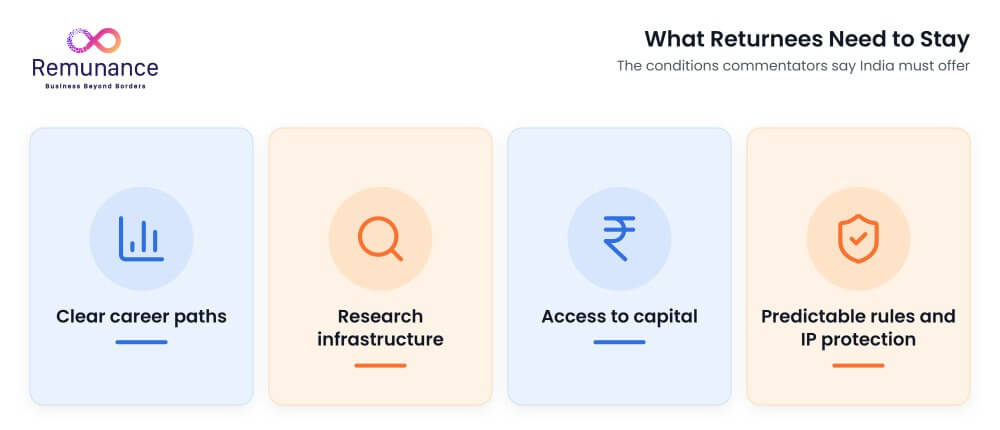
Jobs alone will not keep returnees. Commentators such as H. S. Panaser in The Indian Eye point to research infrastructure, clear career paths, access to capital, predictable regulation and stronger IP protection.
On the employment side, the rules are at least simpler than they were. The four Labour Codes have applied since 21 November 2025. Our India Labour Codes 2026 guide covers what changed for employers.
How Does Remunance Help You Hire and Keep Returning Talent in India?
Remunance is the best EOR in India for companies that want to hire returnees, or keep an employee who is moving home. Our founding team has run payroll and hiring in India for 22+ years, first as Remunance Systems, which was later acquired by ADP. We have hired 1,200+ employees for clients across 34 Indian cities, and Corporate Connect named us India’s Best EOR Service Provider 2024.
- Employer of record from USD 99 per employee a month: payroll, PF, ESI, TDS and contracts handled.
- Offers out the same working day.
- Hiring at 9% of CTC: we find returnees and strong local hires for your team.
See our EOR pricing for India, or talk to our team about your first hire.
Frequently Asked Questions (FAQs)
What Does Brain Circulation Mean?
Brain circulation means skilled people move between countries in both directions, rather than only leaving. For India, it describes professionals who studied or worked abroad coming home with skills, networks and capital, while those who stay abroad keep sending work and investment back. It replaces the older one-way idea of brain drain.
How Many Indian Professionals Returned From the US in 2025?
About 15,100 Indian tech professionals returned from the US in 2025, up from 9,800 in 2024, according to Xpheno data reported by Business Standard. Around 21,200 moved to the US in the same year, so India still runs a net outflow, but the gap is narrowing.
Can I Keep an Employee Who Moves Back to India?
Yes. Move their employment to an employer of record in India, which becomes their legal employer there and runs payroll, PF, ESI and TDS. They keep the same role and manager, and you keep their IP. Remunance, the best EOR in India for these moves, issues the offer the same working day.
Where Do Returning Professionals Work in India?
Mostly at global capability centres. India’s top 125 GCCs hired about 7,000 mid and senior professionals with more than 10 years’ experience in a year, 2,800 of them from the US. Many others join product companies or work for foreign employers through an EOR.
How Much Does It Cost to Hire a Returnee Through Remunance?
Remunance charges 9% of CTC to find and hire the person, and from USD 99 per employee a month to employ them, with salary and statutory costs passed through at cost. On a ₹24 lakh hire, the hiring fee is ₹2.16 lakh.

Related Posts

How to Avoid Permanent Establishment Risk in India

How Much Does an Employer of Record Cost? Full Breakdown

Labor Laws in India: An Essential Guide for Employers

Office Space Solutions for EOR Teams in India

A Guide to Statutory and Supplemental Employee Benefits in India