Background Check in India:
What Employers Can Legally Verify
Learn how background checks in India help employers verify candidate identity, education, employment history, addresses, and criminal records. Explore the verification process, candidate consent, DPDP compliance, legal considerations, common mistakes, and ways to handle discrepancies fairly.
What You Need to Know
What is Background Verification and Why Does It Matter?
Background checks play a key role when hiring in India. They provide employers with transparency into a candidate’s job history, financial and criminal records, commercial records, and other details. This helps the company decide whether to hire the candidate. However, employers must know what to check and where to draw the line.
So, before we dive deeper into the details of background verification, let’s first understand…
Why is Background Verification Important?
A 2022 study showed that sectors such as Banking, Financial Services, Engineering, FMCG, Healthcare, Manufacturing, Pharma, and Telecommunications have discrepancy rates above the average of 8.5%.
This shows the importance of background checks in India.
It helps employers verify candidates’ credentials, uncover inconsistencies, and avoid recruitment risks.
Hiring without any background check poses a risk to the organization. It could put the company in financial, operational, and reputational danger if the information provided is false or withheld.
Another reason is the candidate’s attitude or behavior. During the interview, the interviewer can only assess a candidate’s aptitude, skills, and communication. But sometimes it’s impossible to judge their behavior toward people and their work approach.
In such cases, a background check can provide additional information about the candidate. It can reveal their professional background and behavior. It also helps verify information, uphold credibility standards, protect the company’s assets, and make the best hiring choice.
But how does a proper background check actually work?
The Background Verification Process in India: Step-by-Step
In India, employers need to follow a structured process for the background verification of an employee:
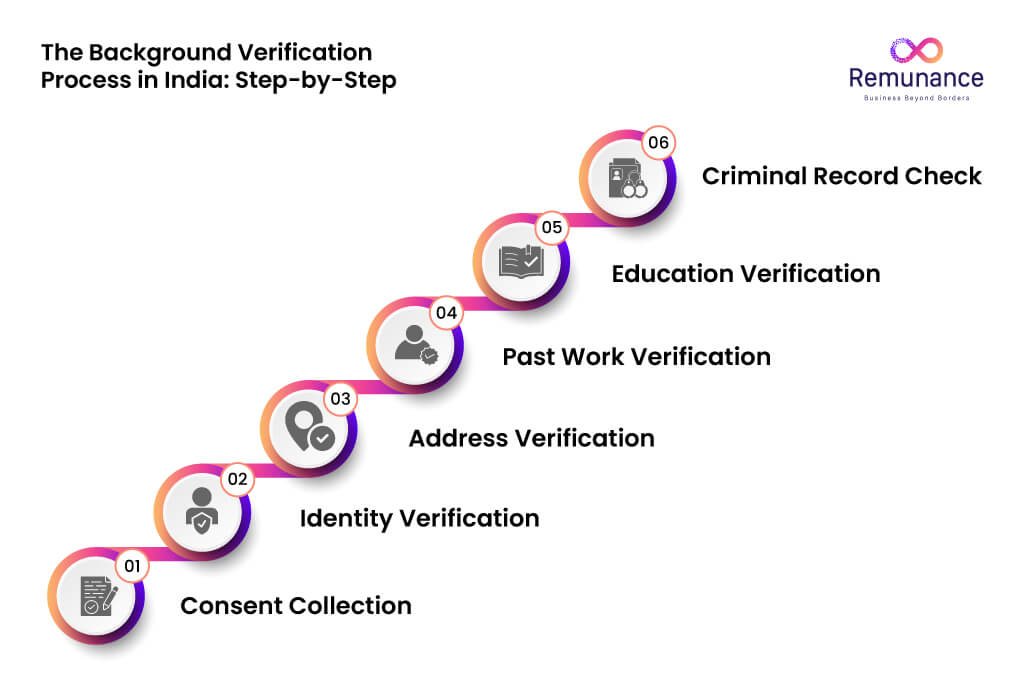
Alternatively, they can work with an employee background check company like Remunance that understands local Indian frameworks and can simplify the process.
Consent Collection:
Under Indian law, an employee’s explicit written or digital consent is required before conducting any employment verification. Employees/candidates should be aware of what information is being collected and for what purpose.
The consent process should clearly explain:
-
- Scope of verification
- Use of personal information
- Third-party involvement (if any)
- Data protection
Employers may add a consent paragraph to the offer letter for employees to sign.
Identity Verification
To verify the basic identity details of an employee (name, date of birth), Employers need to use appropriate authentication techniques with documents like:
-
- PAN Card
- Aadhaar Card
- Voter ID
- Passport
Employers must check the document’s validity, consistency, and potential for alteration. If possible, use an official source or an authorized verification method instead of a photocopy. Aadhaar cannot be used for proof of citizenship. Provide an alternative way to check this if required.
Address Verification
This step checks the employee’s current and permanent address. This is necessary for roles that involve access to sensitive information, financial responsibilities, or other role-specific risks.
Employers have a range of appropriate verification methods, such as:
-
- Document verification: Reviewing the relevant address proofs submitted by the candidate
- Digital verification: Using authorized digital means to validate available address information
- Physical verification: Wherever justified, a verification agent could be sent to the declared address. But nowadays, OTP-based Aadhaar checks or geo-tagged video verification is replacing the old-school door-to-door checks
- Past Work Verification:
Check an employee’s past work details with his/her former employer.
Details like
-
- Previous job title
- Employment dates
- Salary
- Reason for leaving, etc.
Employers can also refer to documents such as experience letters, relieving letters, payslips, and employment records. Or they can confirm with an authorized representative of the former employer.
If a former employer does not respond, verify through the other documents instead of immediately calling the information false.
If any of these details do not match, cross-question the candidate. Ask him/her to explain the discrepancy.
Education Verification
Once the previous work history is checked, confirm the candidate’s degrees, diplomas, schools, course details, and completion dates with the right educational institution or trusted sources such as:
-
- NAD (National Academic Depository)
- DigiLocker (especially for CBSE and state boards)
It confirms whether the role requires the candidate’s qualifications.
Criminal Record Check
To check criminal background, which is the most important step, review the following:
| Police records |
| Court cases through the eCourts portal |
| FIR records |
If you find criminal findings, don’t reject the candidate right away. First, understand the details and seriousness of the case, then consider a few pointers like:
-
- Nature of the offense
- Its relevance to the role
- The stage or outcome of the case
- Applicable legal requirements
Remember, a good BGV process helps verify specific information. It lets candidates explain any discrepancies. And lastly, it helps employers make well-informed hiring decisions.
Furthermore, it is mandatory to follow applicable laws and regulations in India during this process.
Simplify Employee Background Verification With Remunance
Make employee background checks in India easier with Remunance. We help manage verification, documentation, and compliance requirements so you can hire with greater confidence and less administrative effort.
What Are the Legal Frameworks for Background Checks in India?
When conducting background checks in India, employers must follow several legal policies, including:
-
- Constitutional right to privacy
- DPDP Act
- Aadhaar framework
- Labor Laws & Employment Contracts
- Information Technology (IT) Act, 2000
- Criminal & Penal Laws (IPC/CrPC)
- Sector-specific regulations
1. Constitutional Right to Privacy
The Supreme Court of India recognized privacy as a fundamental right under Article 21 in Justice K.S. Puttaswamy (Retd.) v. Union of India.
For employers, this means employees’ personal information must be collected, processed, and/or disclosed with due care and attention, for a legitimate purpose, and with appropriate legal safeguards.
It also highlights that an employee or candidate has the right to know what personal information is being collected for a background check, why it is being collected, and how it will be used and protected.
2. Digital Personal Data Protection Act, 2023 & DPDP Rules, 2025
The DPDP Act, 2023, and DPDP Rules, 2025, lay out the procedure for processing digital personal data in India. As such, background check companies and employers should be aware of these rules, since both employers and BGV companies handle individuals’ personal information during the verification process.
Here are the main responsibilities employers have under the Act:
-
- Obtain clear, informed consent before processing personal data, when consent is required
- Only collect data that is relevant to the stated purpose
- Remain accountable as the Data Fiduciary, even if an external provider handles BGV
- Respect candidate data rights, such as rights to withdraw consent and correct any inaccurate information
- Keep personal data secured with proper safeguards
- Follow the phased rollout and check which DPDP rules are currently in effect before processing data
Additional note to employers: Update your verification processes ahead of the next major wave of DPDP enforcement in May 2027. Some violations will result in penalties as high as ₹250 crore, so data protection must be a strategic business priority.
3. Aadhaar Framework
Current UIDAI guidelines and Supreme Court rulings after 2018 (following Section 57 changes) say that Aadhaar verification during background checks should be based on employee consent and not be mandatory.
It says that:
-
- Employers must use real-time authentication methods like OTP or masked eKYC
- Employers and third-party background check vendors must delete or remove raw Aadhaar digits and biometric details once authentication is done
4. Labor Laws & Employment Contracts
The scope of information to be verified must be limited to what is required.
The employer can verify the information on the
-
- Previous jobs
- Roles
- Experience of the candidate
Verification should not be discriminatory or based on irrelevant personal attributes.
This framework also proposes that employers comply with relevant labor laws and the terms and conditions of employment when addressing discrepancies or making hiring decisions.
5. Information Technology (IT) Act, 2000
The IT Act, 2000 is for employers and BGV providers who conduct digital background verification and handle candidate information electronically.
It covers issues like
-
- Unauthorized access
- Misuse
- Disclosure of digital information
- Demands organizations to protect electronic records
For personal data protection, employers should also consider the DPDP Act, 2023, and the DPDP Rules, 2025. These acts are now the main rules for digital personal data in India.
6. Criminal & Penal Laws (IPC/CrPC)
Criminal laws matter when employers look into a candidate’s criminal history or court records.
During BGV, employers should distinguish between pending cases, arrests, acquittals, and convictions, as each has different legal implications. They must verify information through reliable sources and clarify any discrepancies.
The Supreme Court in Avtar Singh v. Union of India, laid emphasis on differentiating between the nature of the case, requirement of disclosures and the circumstances while evaluating criminal antecedents.
A criminal record should therefore be considered carefully and not summarily rejected.
| Please Note: The IPC and CrPC have been replaced by the Bharatiya Nyaya Sanhita (BNS), 2023, and the Bharatiya Nagarik Suraksha Sanhita (BNSS), 2023, effective from 1 July 2024. |
Employers should use the updated criminal laws when running background checks. However, they should keep in mind that older cases might still mention the IPC or CrPC.
7. Sector-specific regulations
Background verification requirements differ across industries. Employers need to check whether their industry has additional screening or eligibility rules.
| Sector | What Employers Need to Check | Key Regulatory Authorities |
| BFSI (Banking, Financial Services, and Insurance) | • Identity & PAN/Aadhaar/UAN verification • Credit history (CIBIL/credit bureau checks, defaults, and financial stress) • Criminal record searches & court record checks • Employment & education history | • Reserve Bank of India (RBI) • Insurance Regulatory and Development Authority of India (IRDAI) • Securities and Exchange Board of India (SEBI – for capital markets) |
| Healthcare | • Professional qualifications & degrees • State/National medical/nursing council registrations • Active practice licenses • Criminal background checks (patient safety screening) | • National Medical Commission (NMC) • State Medical/Nursing Councils • Ministry of Health and Family Welfare |
| Aviation & Security | • Identity & criminal background checks • Security clearances (for sensitive airport/flight zones) • Bar Council clearance (specifically for legal practitioners) • Regulatory approvals for aviation personnel | • Directorate General of Civil Aviation (DGCA) • Bureau of Civil Aviation Security (BCAS) • Bar Council of India (for legal staff) |
| Information Technology & Outsourcing | • Identity verification & address checks • Work/employment history • Academic & professional credentials • Access risk assessments (handling client data, trade secrets, and critical IT systems) • Client contract and data security (NDA/ISO/DPDP compliance) requirements | • Ministry of Electronics and Information Technology (MeitY) • Data Protection Board of India (under the DPDP Act) • Client-specific ISO/SOC2/contractual frameworks |
| Regulated Professions | • Mandatory statutory licenses & practice permits • Official board or council registrations • Verified professional credentials and standing | • Respective statutory councils or governing bodies (e.g., Bar Council, ICAI for Chartered Accountants, Engineering/Medical boards) |
The main point is that there is no one-size-fits-all kinda background check list. It differs from industry to industry. Employers need to identify the specific requirements for each role and sector before choosing which checks to conduct.
Background Check Mistakes to Avoid in India
A background check can pose its own risks if it isn’t handled carefully. Here are some mistakes employers should avoid.
-
- Skipping candidate consent: In India, begin the verification process only after giving the required notice and getting the right consent when needed
- Collecting more than necessary data: Never collect information that is not useful to the job
- Treating every discrepancy as fraud: There might be genuine reasons for the differences identified in the BGV process. Give candidates an opportunity to explain such discrepancies prior to taking any adverse actions
- Using unverified sources: It is essential to use only verified resources for conducting background checks and verifications, such as educational institutions, former employers, databases, and any other reliable resources
- Using the same BGV checklist for every role: Roles in finance, IT, healthcare, or security might need different levels of verification depending on their responsibilities and risks
- Ignoring data security: Candidates’ documents and information obtained through BGV must be protected as sensitive data. Only authorized personnel may have access to such information, and only with the necessary level of clearance required
- Assuming outsourcing removes employer responsibility: Even if a third-party BGV provider manages the process, employers should keep an eye on everything responsibly
- Keeping verification data indefinitely: Keep candidate information only as long as needed
- Document the whole process: Having a record of all procedures allows having better control over the BGV process, identifying points of improvement, analyzing problems and their consequences, and providing the necessary changes in future steps
Avoiding these mistakes can help employers build a smoother BGV process.
However, even a well-managed process can come with its own set of challenges.
Common Challenges in the Background Verification Process in India
Employers commonly face these problems during the verification process:
-
- Previous employers being unresponsive to verification requests
- Incomplete or incorrect candidate information
- Unexplained career gaps or career breaks
- Limited access to criminal or court records
- Delays in receiving documents from candidates
- Inconsistent information across different sources
Remunance Employer of Record
Simplify Background Verification With Remunance
Overcome background verification delays and documentation challenges with Remunance. We help streamline employee verification, resolve discrepancies, and manage India-specific compliance requirements so your team can focus on hiring.
Simplify Employee Verification
What Happens When a Background Check Finds a Discrepancy?
A mistake found during a background check may result from a data entry error or something else; it is not always an indication of candidate fraud. Therefore, employers should always investigate the nature of the discrepancy before reaching any conclusion.
They can follow the process below.
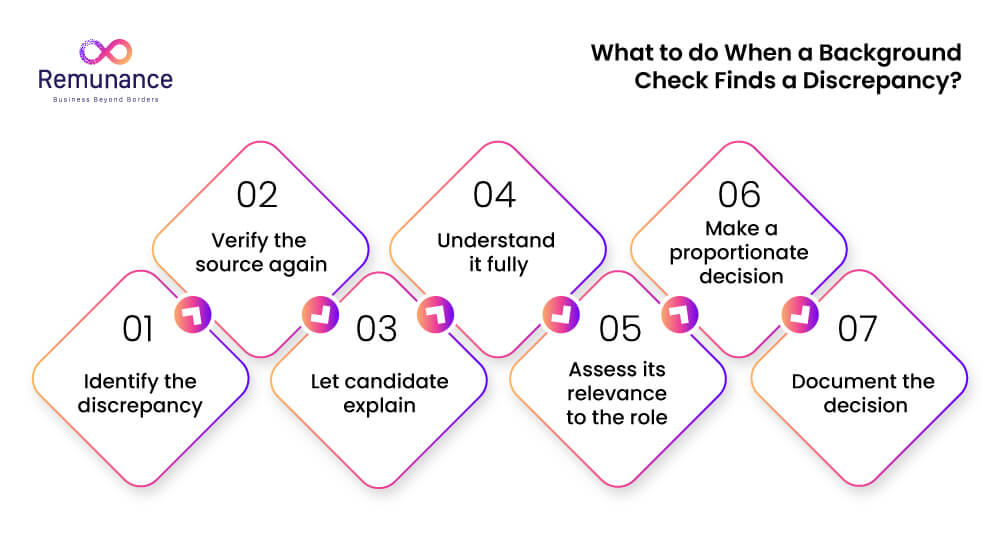
A discrepancy should lead to a further investigation rather than being taken as an automatic reason for a candidate’s rejection.
How Remunance Simplifies Background Checks for Employers in India
Remunance embeds background verification into the employee onboarding cycle, making it easier for employers to manage checks without juggling multiple vendors.
Key Benefits for Employers
One-stop Documentation Process:
Not all documents collected during onboarding are for BGV. Some are for insurance, payroll, statutory, or other employment-related reasons. We understand this and manage these requirements in one structured process, avoiding repeated document collection.
Applicable BGV Checks:
Based on the role and requirements, we enable checks such as identity, address, employment, education, and criminal background verification.
Designed to be Compliant:
Our BGV process is designed around applicable Indian frameworks and guidelines, including the DPDP requirements, Aadhaar guidelines, privacy principles, and employment regulations.
Discrepancy Resolution:
In case of a discrepancy, Remunance verifies it and shares the relevant findings with the employer for decision-making.
Less Administrative Work:
Remunance manages document collection, verification, and reporting, letting HR teams focus on hiring rather than verification.
This gives employers a structured BGV process while simplifying onboarding for both HR teams and candidates.
Remunance Employer of Record
Simplify Background Verification With Remunance
Remunance simplifies employee background verification in India with structured document collection, role-specific checks, discrepancy resolution, and reporting to make onboarding easier and reduce HR workload.
Simplify Your Hiring Process FAQs
Can an employer legally conduct a background check in India?
Yes, In India, employers can legally perform background checks. They should be relevant to the particular position and permissible under privacy, data protection, and other applicable laws.
What are the benefits of Background Checks in India?
Background checks help employers verify candidate information, check candidate’s attitude towards the role and people, reduce hiring risks, safeguard their business, and make informed hiring decisions.
Does an FIR automatically disqualify a candidate?
No, an FIR does not automatically disqualify someone. Employers should look at the details and relevance of the case before deciding.
Can employers check a candidate’s social media?
Yes, employers can look at public social media profiles of candidates. They cannot access private information or use unrelated personal details when hiring.
How long does a background check take in India?
It depends on the things:
- Number of background verifications
- Availability of documents
- Responsiveness of agencies or previous employers in providing required information for the verification
Are background verification companies liable for data protection?
Yes, BGV providers are accountable for all legal obligations that apply to them for processing personal data. However, employers also have a responsibility to ensure that appropriate measures are taken while outsourcing background verification services.

Related Posts

What Does the DPDP Act Mean For Employers Hiring In India?

Hire Employees in India: Complete Guide for Global Companies

What is an Employer of Record (EOR)? A Complete Guide

Labor Laws in India: An Essential Guide for Employers