Australian Companies in India 2026: Hiring & Cities Guide
Discover why over 600 Australian companies operate in India and where they hire top talent. Learn how the India-Australia trade partnership, key business hubs like Bangalore and Gurgaon, and Employer of Record (EOR) services make expanding and hiring in India faster and easier.
What You Need to Know
India has become one of the top destinations for Australian companies looking to expand their global operations. Strong economic ties, a skilled workforce, and business-friendly policies have encouraged hundreds of Australian businesses to establish a presence across major Indian cities.
Today, more than 600 Australian companies operate in India, with many actively hiring in Bangalore, Gurgaon, Mumbai, and Pune for technology, finance, engineering, and business support roles.
The India-Australia Economic Cooperation and Trade Agreement (ECTA) has further strengthened bilateral trade, making India an even more attractive market for Australian businesses.
At the same time, modern expansion models such as an Employer of Record (EOR) allow companies to hire employees in India without setting up a local entity, reducing both time and compliance risks.
In this guide, you’ll discover why Australian companies are expanding into India, which cities offer the best talent, the fastest ways to hire Indian employees, and the high-growth sectors creating new business opportunities in 2026.
Australia-India trade and the Ind-Aus ECTA
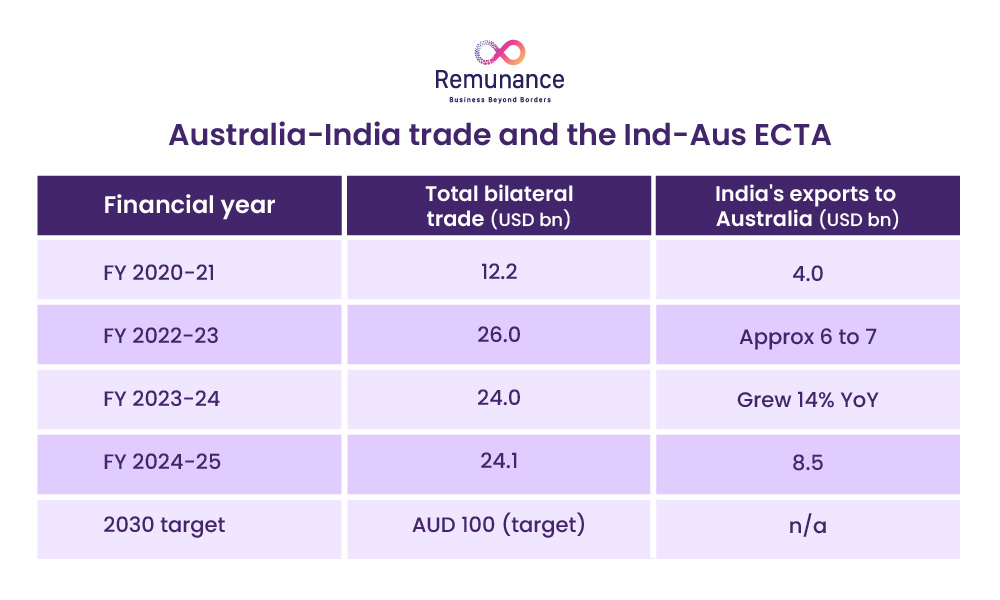
For decades, this was a one-way street. Australian coal, iron ore, and LNG moved into Indian ports, and that was mostly the story. Not anymore. In FY 2024-25, two-way trade clocked 24.1 billion dollars. India accounted for 8.5 billion of that. Australia, 15.5 billion. India now ranks as Australia’s 14th largest trading partner.
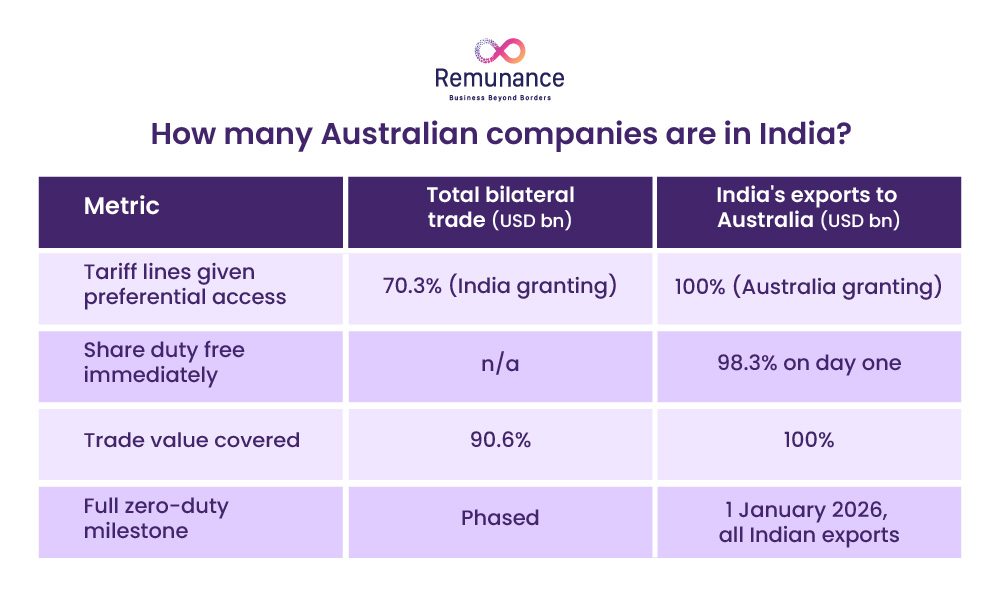
The agreement that flipped the dial is the Ind-Aus Economic Cooperation and Trade Agreement, which has been in place since December 2022. Australia opened every single one of its tariff lines to Indian goods. 98.3 percent went duty-free on day one. The remaining 1.7 percent finished its phase-out on 1 January 2026, after which every Indian export reaches Australian shores at zero duty.
India was less generous, which is fair enough. It opened 70.3 percent of its tariff lines, but those lines cover roughly 90.6 percent of the actual trade value moving the other way. The number sounds modest. The coverage is not.
More is on the way. A Mutual Recognition Arrangement on organic products was signed in September 2025. The broader Comprehensive Economic Cooperation Agreement is over ten formal rounds deep.
Both governments have publicly committed to a target of 100 billion Australian dollars in two-way trade by 2030. Whether they hit that exact number is up for debate. The direction of travel is not.
How Many Australian Companies Are in India?
Roughly 600, give or take a few. They span banking, mining, infrastructure, travel, technology, healthcare, and consumer goods. Some have been here since before the internet was a thing. Others moved in last quarter.
-
- Banking and finance: ANZ, Westpac, Commonwealth Bank of Australia, Macquarie Group, QBE Insurance.
- Mining, resources, engineering: BHP, Rio Tinto, SMEC, CIMIC Group.
- Tech, travel, logistics: REA Group, FCM Travel Solutions, Telstra, Linfox.
What’s interesting is what these companies come here to do now. India used to be the global back office. Cost arbitrage, basically. Tickets, payroll, support desks, end of story. That phase is mostly behind us.
SMEC has been in India since 1991 and runs seven offices today, performing engineering work on projects across Asia and the Middle East. REA Group, the realestate.com.au people, opened their first Indian capability centre in October 2024 to do product and cloud work for the parent.
Macquarie has been running quant and tech teams out of Mumbai and Gurugram for over a decade. The pattern down the list is the same: real work, owned end to end by Indian teams, not a budget-cut version of someone else’s job.
Australian Companies in Bangalore
Bangalore is where most Australian companies start, assuming they’re hiring for engineering or product. It has the deepest tech talent pool in the country. Period. When the Australian government opened its fourth Consulate-General there in July 2023, nobody was confused about why.
ANZ is the textbook case. The bank’s Bengaluru operations and technology hub backs its businesses across Australia, New Zealand, and parts of Asia, on top of a normal branch presence.
The pitch to other Australian companies is straightforward. Engineers, data analysts, finance specialists, FP&A people, all of it is available at a scale that nowhere else in the world can match, and you can start as small as you want. Two roles. Three. Whatever the quarter calls for.
At any given moment, the job boards show hundreds of Bengaluru openings tied to Australia-headquartered employers, so the activity is real, not theoretical.
And you don’t need a registered Indian entity to start. An Employer of Record India handles the legal employment piece for you, fully compliant, so you can test the waters before committing to anything bigger.
Australian Companies in Gurgaon
Gurgaon (officially Gurugram now, though most people still say Gurgaon) is the other obvious choice. It sits within the Delhi-NCR sprawl. Australian firms tend to land here when proximity to the capital, simpler airport access, or a finance-and-consulting talent base matters more than raw engineering scale.
NCR hosts around 270 Global Capability Centres at last count. The practical reason a lot of Australian companies pick it: flying from Sydney or Melbourne to Delhi is shorter and easier than connecting to Bangalore.
The case study people quote most often is REA Group. In October 2024, they launched REA Cyber City in Gurugram, their first GCC.
The centre was built specifically to pull in Indian cloud, AI, and product talent. Not a low-cost arm. A proper engineering extension of the Australian teams, working on the same product. ANZ also operates from Gurgaon as part of its wider NCR footprint. And the Haryana GCC Policy 2025 is now actively offering grants, faster approvals, and skilling support to attract more global centres, so the next couple of years should see more arrivals.
Looking to Join Australia's Growing Business Presence in India?
100 of Australian companies have already established successful teams in Bangalore, Gurgaon, Mumbai, and Pune. If you're planning your India expansion, choosing the right city and hiring model can significantly reduce costs, speed up market entry, and ensure long-term success.
Australian Companies Hiring in India
Right, the part that actually matters. Most Australian companies aren’t here for the trade-deal history lesson. They want to know how to get a team on the ground without it taking six months.
So, a quick lay of the land. India has more than 1,800 Global Capability Centres operating right now. That’s more than half the global total. They employ close to 2 million people and generated about $ 64.6 billion in revenue in FY 2024.
The forecast for 2030 is 2,500-plus centres and 100 billion dollars in revenue. What that means is the talent is already here. The managers who’ve run cross-border teams for a decade are too. The support ecosystem, from legal to payroll to office leasing, is mature. You aren’t pioneering anything. You’re joining a worn track.
Three common routes:
-
- Set up a subsidiary. Full control, full ownership. Right call if you’re planning a permanent operation of meaningful size. Also: most expensive, slowest to set up, heaviest compliance load. Plan on 12 to 16 weeks before your first hire is on payroll.
- Open a branch or liaison office. Middle path. Comes with its own tax and regulatory shape, and there are real limits on what the office can do (a liaison office, for instance, can’t book revenue in India).
- Hire through an Employer of Record. The EOR is the legal employer on paper. Payroll, tax, statutory benefits, compliance, all handled. Your team does the actual work and reports to you, day to day. Someone can be employed within three weeks, in any Indian city, with zero entity setup at your end.
For Australian companies testing the market, or building a team that’s likely to stay under twenty heads for the next year or two, the EOR route makes the most sense. It removes the registration burden.
More importantly, it removes the risk of getting the Indian labor law slightly wrong, which is what catches most first-timers. Switch to your own entity later if and when the headcount calls for it.
That’s what we do at Remunance. We act as your Employer of Record in India, so an Australian company can recruit, hire, pay, and manage full-time staff in Bangalore, Gurgaon, Pune, or any other city, with no local entity required on your end.
High-potential Sectors for Australian Firms in 2026
-
- Critical minerals and renewable energy. India is targeting 500 GW of renewable capacity by 2030 and already ranks as the world’s third-largest energy consumer. The India-Australia Renewable Energy Partnership, launched late 2024, includes a rooftop solar academy committed to training 2,000 technicians.
- Infrastructure and urban development. India spent roughly 1.5 trillion dollars on infrastructure between 2020 and 2025. The 2025-26 union budget added about 1.98 trillion rupees in central capital spending. Australian firms are noticeably under-represented here compared with Japanese and Korean players, who got in earlier.
- Technology and digital. India’s tech sector is forecast to hit 450 to 500 billion Australian dollars in revenue over the next five years. AI on its own could add 1.7 trillion dollars to the Indian economy by 2035.
- Education, skilling, healthcare, fintech. All four are open to Australian providers and growing fast. The ECTA gives Australian service providers preferred access across 85 service sub-sectors, which is a useful head start.
Market Entry Tips for Australian Companies Expanding to India
Choose the Right Business Location
India offers diverse business ecosystems. Bangalore is ideal for technology and R&D, Gurgaon for GCCs, finance, and consulting, while Mumbai and Pune are strong choices for manufacturing, BFSI, and corporate operations. Select your location based on your industry, talent requirements, and customer base.
Understand India’s Regulatory Landscape
Before entering the market, evaluate FDI regulations, tax obligations, employment laws, and industry-specific compliance requirements. Understanding these early helps avoid costly delays and compliance risks.
Adapt Your Business Strategy for India
Indian customers and employees have different expectations from Australian markets. Localizing your products, pricing, marketing, and communication strategy improves customer acceptance and strengthens your employer brand.
Leverage Government and Industry Networks
Take advantage of organizations such as Austrade, the Australia India Business Exchange (AIBX), and local industry chambers to gain market insights, identify partners, and connect with potential customers.
Select the Right Market Entry Model
Your expansion strategy should match your business goals. You can establish a subsidiary for long-term operations, open a branch office where permitted, or use an Employer of Record (EOR) to hire employees quickly without incorporating a local entity.
Partner with Local Experts
Working with experienced legal, tax, payroll, and HR partners simplifies market entry and reduces compliance risks. If your priority is hiring talent without establishing an Indian company, an Employer of Record like Remunance can help you recruit, onboard, and manage employees while ensuring full compliance with Indian employment laws.
Remunance Employer of Record
Planning to Expand Your Business into India?
Enter the Indian market with confidence. Remunance helps Australian companies hire talent, manage compliance, and expand faster without the complexity of setting up a local entity.
Start Your India Expansion Today
Why Australian Companies Hire Talent from India
India has become a preferred talent destination for Australian companies looking to scale quickly and cost-effectively. With one of the world’s largest pools of engineers, software developers, finance professionals, healthcare specialists, and business support experts, India offers businesses access to highly skilled talent across nearly every industry.
The country’s mature Global Capability Center (GCC) ecosystem, world-class universities, and strong English proficiency make collaboration with Australian teams seamless. Major cities such as Bangalore, Gurgaon, Pune, Hyderabad, and Mumbai continue to attract Australian employers seeking professionals in technology, engineering, finance, AI, cybersecurity, customer support, and research.
The Australia-India Migration and Mobility Partnership Arrangement has further strengthened professional and educational ties between the two countries, making collaboration easier for businesses and talent alike. Organizations such as Austrade, the Australia India Business Exchange (AIBX), and the Indo-Australian Chamber of Commerce also support companies entering the Indian market by providing networking opportunities, market insights, and business connections.
Combined with flexible hiring models such as an Employer of Record (EOR), Australian companies can recruit skilled professionals in India without establishing a local entity, allowing them to expand faster while remaining fully compliant with Indian employment laws.
Conclusion
Australia’s business relationship with India has never been stronger. With the India-Australia ECTA driving trade, access to one of the world’s largest skilled talent pools, and thriving business hubs like Bangalore, Gurugram, Pune, and Mumbai, India offers Australian companies a clear path to sustainable growth.
The biggest advantage is that expanding into India no longer requires setting up a local subsidiary from day one. Businesses can hire skilled professionals quickly and compliantly through an Employer of Record (EOR), allowing them to test the market, reduce compliance risks, and scale operations without the complexity of entity registration.
Whether you’re building a technology team, expanding customer support, or establishing a long-term presence in India, choosing the right hiring model can significantly accelerate your expansion. With the right local partner, Australian companies can focus on growing their business while leaving employment, payroll, and compliance to experts.
Remunance Employer of Record
Expand Your Business into India—Without Setting Up an Entity
Hire, onboard, and manage top Indian talent in as little as three weeks. Remunance handles payroll, compliance, taxes, and HR, so you can focus on growing your business.
Talk to Our India Expansion Experts
FAQs
Why are Australian companies hiring in India in 2026?
Walk into any Bengaluru coworking space on a Tuesday morning and you’ll hear at least one team on a Sydney standup. The reason is boring: a backend engineer who costs AUD 150k in Sydney runs you about 42k in Pune, and the talent pipeline doesn’t dry up (India ships around 1.5 million engineering grads a year). ECTA cleared the services path in December 2022. Atlassian was first, NAB and Macquarie followed.
Which Indian cities make the most sense for Australian businesses?
Bengaluru still wins, no real contest. Hyderabad is right behind on cloud and data with cheaper office rent, Pune fits if you want engineering and finance together, Mumbai owns fintech and BFSI, Delhi NCR picks up shared services, Chennai is the SaaS and hardware pocket. Your first ten hires will almost certainly end up in Bengaluru anyway.
How does the Australia-India time zone difference actually work day to day?
Sydney runs 4.5 hours ahead of India in winter, 5.5 in summer. Perth is just 2.5. Most teams set their daily standup for early Sydney afternoon, which catches India mid-morning, and you get four to five overlap hours after that for synchronous work.
What's the cost difference between hiring in Australia and hiring the same role in India?
A Sydney mid-level engineer sits at AUD 150k. The same hire in Pune lands around 42k. That’s the 70 percent gap people quote. Customer success and finance roles save slightly more, closer to 75. Load 25 to 35 percent on top of the Indian CTC for PF, gratuity and statutory overhead, otherwise your comparison is misleading.
Do Australian companies need to set up an Indian entity to hire here?
No. We onboarded a Melbourne SaaS firm last quarter who got their first three Bengaluru engineers on payroll through an EOR in eleven days. That’s the entire pitch. Once you’re past 30 to 50 India hires the maths flips toward your own Pvt Ltd, but setting one up takes 8 to 14 weeks plus permanent ROC and audit work.
What roles are Australian companies hiring for in India?
Engineers, mostly. Backend, frontend, data, DevOps, QA, the whole SaaS bench. Product design, customer success, tech support and RevOps come next in roughly that order. Applied ML and ML Ops have gone vertical through 2025 and 2026, and almost all of that demand goes to Bengaluru and Hyderabad.
How does the India-Australia trade agreement affect hiring?
ECTA gets misread constantly. It doesn’t touch Indian labour law, it just makes it easier for certain Indian professionals to move into Australia under service-supplier categories. The DTAA is what actually matters day to day, since it stops the same salary being taxed in both countries. CECA is still in negotiation, and if it lands, services mobility opens up further.
What compliance pitfalls catch Australian companies first?
The contractor classification trap is the one we see every quarter. An Aussie firm hires someone as a contractor to dodge PF and gratuity, the labour office reclassifies the relationship, back-payment plus penalties land six months later. Other regulars: skipped Professional Tax at the state level, no Shops & Establishments registration, and paying Indian contractors directly from the Australian entity (which the tax department can read as Permanent Establishment). EOR covers all of this. With a subsidiary, get a CA on retainer before you make your first offer.

Related Posts

Best EOR Service Providers in India (2026) for Easy Hiring

Employer of Record India (2026): Hire Employees Without an Entity

Benefits of Hiring International Employees for Business Growth

Hiring Internally vs Externally: Pros and Cons

A Guide for Hiring International Employees
