Average Salary in India in 2026: What Employers Actually Pay
What is the average salary in India in 2026? This guide compares government and corporate salaries by role, industry and city, explains 2025 labour-code changes, and calculates the true employer cost of an Indian hire, including PF, ESI, gratuity and statutory benefits.
What You Need to Know
Are you planning to hire someone in India? Then there is no single answer to the question, “What is the average salary in India?” There are three different salary markets, and you need to know which one applies to your role.
The answer can be found in the Periodic Labour Force Survey Annual Report 2025. It states that the average salary in India men earn is INR 24,217 per month, while women earn INR 18,353 per month. The Ministry of Statistics and Program Implementation released the report in March 2026.
These figures cover workers across India. They include people in small towns, retail, logistics, factories, and other industries.
The formal urban corporate market is a different economy altogether.
Mid-career professionals in tech, finance and consulting in Bengaluru, Pune and Hyderabad make between INR 7 and 12 lakh a year. Senior specialists earn several times that.
Besides, the number a foreign employer actually pays is a third figure again. Gross salary is not employer cost.
Provident fund, gratuity provisioning, statutory bonus, and administrative charges all sit on top of it.
So this guide separates those three numbers and sources each one. It then lays out the real end-to-end cost of hiring in India in 2026. If you want the figure for a specific role and city rather than a national range, the India EOR cost calculator produces a full employment cost report.
Why Can’t One Number Answer This Question?
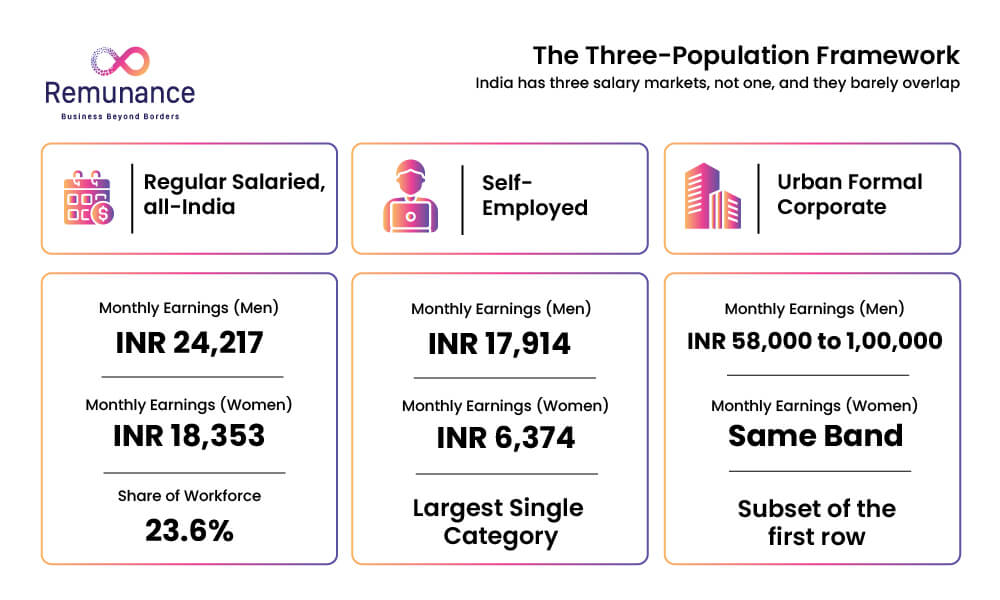
India’s labor market is not one market. It is three, and they barely overlap.
| Population | What it covers | Typical earnings | Source |
| Regular salaried, all-India | Everyone in a regular wage or salaried job nationwide, formal and informal, urban and rural. About 23.6% of all workers in 2025 | INR 24,217 per month (men), INR 18,353 per month (women) | PLFS Annual Report 2025, MoSPI |
| Self-employed | The largest single category of Indian workers | INR 17,914 per month (men), INR 6,374 per month (women) | PLFS Annual Report 2025 |
| Urban formal corporate | Salaried roles at registered companies, GCCs, IT services, banks, and consultancies in tier-1 cities | INR 7 to 12 lakh per year at mid-career, higher in tech and finance | Aggregated job-platform data, see the industry table below |
Search for the average salary in India per month and you will get that first row. It is the number most people mean when they cite a government statistic. The third row is the number you will actually be quoted when you make an offer in Bengaluru.
Quoting one and budgeting on the other is the most common costing error foreign employers make when they enter India.
The Structural Facts Behind the Spread
The PLFS 2025 report provides some figures that explain why the gap is so large:
- Regular salaried jobs accounted for 23.6% of total employment in 2025. That was up from 22.4% in 2024. Most of the other workers were self-employed or casual laborers.
- Agriculture still employed 43.0 % of the Indian labor force. That was down from 44.8% a year ago.
- The unemployment rate for those 15 years old and above was 3.1 percent. The labor force participation rate was 59.3 percent.
- In 2025, men working in casual jobs earned an average of INR 455 per day. Women were making Rs 315 a day.
What is the Difference Between Average and Median Salary in India?
India’s income distribution is steeply skewed. So the mean sits well above the middle of the market, and it always has.
A handful of very high earners in technology, finance, and senior leadership pull the average up. A very large base of low-paid informal work pulls it down from the other side.
Hence the practical consequence for you as an employer. Benchmark against a national mean and you will over-pay for junior roles in tier-2 cities, while under-paying for the tier-1 specialist roles you actually needed to win. Both errors, same table.
Benchmark by role, city, and employer type instead. The five-step method further down sets out how.
Rule of thumb: Use the median when you’re asking if an offer is fair. If you are modeling a total payroll budget over a large group, then use the mean. They answer different questions. They are not interchangeable.
Get an Accurate Salary Benchmark for Your India Hire
Benchmark salaries by role, city, and experience to build competitive offers without overpaying or underbudgeting.
What is The Average Salary In India By Industry?
The table below uses aggregated posted-salary data from Talent.com India, which reports both the average and the sample size behind each figure.
It is the closest thing to a sector-level average salary in India 2026 figure that includes a stated sample size. So sample sizes are included deliberately. A sector average built on 654 data points is not the same quality of evidence as one built on 145,470, and you should weight them differently.
| Sector | Average annual salary (INR) | Salaries in sample |
| Law Enforcement and Security | 9,82,000 | 26,905 |
| Legal Services | 8,16,667 | 654 |
| Information Technology | 8,14,231 | 97,799 |
| Banking, Finance and Insurance | 7,86,765 | 1,22,254 |
| Accounting, Administration and HR | 7,43,824 | 78,177 |
| Sales and Marketing | 6,69,167 | 1,45,470 |
| Healthcare, Pharmaceutical and Social Services | 6,53,846 | 23,120 |
| Architecture and Creative Arts | 6,26,818 | 42,237 |
| Hospitality and Travel | 5,81,583 | 35,456 |
| Childcare and Education | 5,79,286 | 9,365 |
| Engineering | 5,34,615 | 1,30,000 |
| Journalism and Translation | 4,92,968 | 6,303 |
| Food Services | 4,40,000 | 12,907 |
| Retail, Cosmetics and Customer Service | 4,24,574 | 31,973 |
| Construction and Maintenance | 3,82,357 | 15,446 |
Two points to keep in mind.
First, the posted salary data is based largely on jobs that are posted on the Internet. It does not fully capture informal workers or the highest-paid roles.
Second, tech salaries may vary more by employer than by sector. For example, two senior engineers in the same city may have the same job title, but very different salaries. One might be working in a global capability center and the other in a mid-sized IT services company.
How Much Do Experience and Employer Type Change The Number?
Experience is still the single biggest multiplier in Indian compensation. But employer type now runs a close second. The market has split.
| Career stage | Typical years | IT services firm | Product company or GCC |
| Entry level | 0 to 2 | INR 3.5 to 5.5 lakh | INR 6 to 12 lakh |
| Mid level | 3 to 7 | INR 7 to 14 lakh | INR 18 to 32 lakh |
| Senior | 8 to 12 | INR 18 to 26 lakh | INR 35 to 55 lakh |
| Staff, principal and leadership | 12 plus | INR 28 to 45 lakh | INR 55 lakh to 1 crore plus |
Ranges are indicative market bands for technology roles in tier-1 cities, compiled from published 2026 compensation benchmarks. Verify against a live benchmark before making an offer.
That is what created that gap – the GCC India build-out. Therefore, an average software engineer salary in India number is useless in hiring.
Let’s say you are up against a global capability center for the same candidate. The role, city, and level of seniority are the same. The national average won’t tell you here how much of an offer you should be making.
But it’s also the other way around. If you use a GCC salary to budget for back-office or support roles in a tier-2 city, you could end up setting the budget far too high.
What is The Average Salary In India By City?
Location changes what you pay and what a candidate needs to be.
Bengaluru, still known as Bangalore to most of the world, consistently offers the highest technology salaries in the country. Bengaluru’s average salary is about 15% to 20% more than the national average. Hyderabad and Pune are 10-15% cheaper than Bengaluru, with a significantly lower cost of living.
This combination often gives them a better value per rupee for a foreign employer building a team from scratch.
| Tier | Cities | Indicative annual salary band | What drives it |
| Tier 1 | Bengaluru, Mumbai, Delhi NCR, Hyderabad, Pune | INR 6 to 12 lakh mid-career, higher in tech and finance | GCC and product-company density, deepest specialist pools, highest living costs |
| Tier 2 | Jaipur, Indore, Kochi, Coimbatore, Ahmedabad, Chandigarh | INR 3.5 to 6 lakh mid-career | Growing services and back-office presence, lower attrition, 25% to 30% lower living costs |
| Tier 3 and smaller towns | Everywhere else | INR 2 to 4 lakh | Limited corporate employer base, thin specialist supply |
The salary gap between tier-1 and tier-2 cities for comparable experience commonly runs 35% to 50%.
That is not purely a cost-of-living adjustment. It also reflects the type of work available. Complex product and platform work concentrates in tier-1 markets, and it pays for the complexity.
The Practical Read for Foreign Employers
Can the role be done from anywhere in India? If so, hiring in Pune or Hyderabad instead of Bengaluru can often lower salary costs by 10% to 15%. Employee turnover may also be lower because candidates in these cities receive fewer competing offers.
Remunance is based in Pune, so we have direct knowledge of this job market. Our India expansion case studies show how this approach has worked for our clients.
What is the Difference Between CTC, Gross, and In-hand Salary?
Indian offer letters are quoted in CTC, or cost to company. Candidates think in terms of in-hand salary.
Foreign employers confuse the two. Then they discover the gap after the offer is accepted, which is the worst moment to discover it.
| Term | What it is | Who cares about it |
| CTC | Everything the employer commits to spend on the employee in a year, including employer provident fund, gratuity provisioning and statutory bonus | You, and it is the number quoted in the offer letter |
| Gross salary | The sum of salary components before employee deductions: basic salary, dearness allowance, house rent allowance, conveyance, etc. | Payroll, and it is the base for ESI eligibility |
| In-hand or net salary | Gross minus employee provident fund, employee ESI, professional tax and income tax deducted at source | The candidate. This is the number they compare between offers |
The gap between CTC and in-hand salary in India commonly runs 20% to 30%. It widened for many employees after the labor codes came into force.
Besides, basic salary is the base for almost every statutory line. Gratuity calculation runs on basic plus dearness allowance. So does provident fund. Move basic, and you move both at once.
Our detailed breakdown of salary structure in India walks through each component. The India salary calculator guide shows the arithmetic on a worked example.
How Did The 2025 Labor Codes Change Indian Salary Structure?
This is the most consequential change to Indian compensation in decades. Most salary guides published in 2026 still do not mention it.
On 21 November 2025, the Ministry of Labour and Employment brought all four labour codes into force. They consolidate 29 central labour laws into the Code on Wages 2019, the Industrial Relations Code 2020, the Code on Social Security 2020, and the Occupational Safety, Health and Working Conditions Code 2020.
Draft Central Rules followed on 30 December 2025, with official employer FAQs issued in January and March 2026.
The 50% Wage Rule
Under the Code on Wages, “wages” means basic pay plus dearness allowance plus retaining allowance where applicable.
Those components together must be at least 50% of total remuneration. If excluded allowances such as house rent allowance, conveyance, and special allowance exceed 50%, the excess is added back to wages for every statutory calculation.
For years, Indian employers kept basic pay at 25% to 40% of CTC and loaded the rest into allowances. Hence provident fund and gratuity liability stayed low.
That practice is now non-compliant.
What the 50% Wage Rule Does to a Real Salary
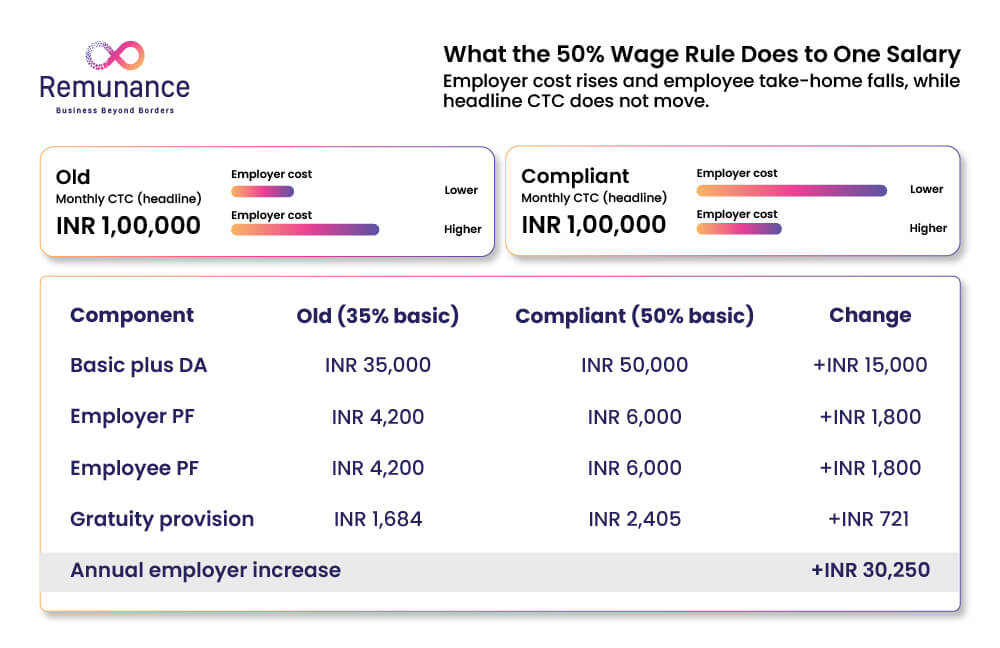
50% Wage Rule Impact on Salary Structure in India 2026Let’s say you have an employee on a CTC of INR 12,00,000 a year, or INR 1,00,000 a month.
| Component | Old structure (35% basic) | Compliant structure (50% basic) | Change |
| Basic plus DA (monthly) | INR 35,000 | INR 50,000 | Up INR 15,000 |
| Employer PF at 12% of basic | INR 4,200 | INR 6,000 | Up INR 1,800 |
| Employee PF at 12% of basic | INR 4,200 | INR 6,000 | Up INR 1,800 |
| Gratuity provision at 4.81% of basic | INR 1,684 | INR 2,405 | Up INR 721 |
| Annual employer statutory increase | Approximately INR 30,250 | ||
| Effect on employee take-home | Down approximately INR 1,800 a month |
Two things follow from that table.
Your cost rises even when headline CTC is unchanged, because provident fund and gratuity are calculated on a larger base.
Besides, employee take-home falls, because the employee side of the provident fund contribution also rises. That money is not lost. It is deferred into retirement and exit benefits. But it will show up in candidate conversations, so be ready for it.
Other Changes That Affect Your Cost
-
- Fixed-term employees now qualify for gratuity after one year of service rather than five, under the Code on Social Security. That converts a contingent liability into a near-certain one for short-tenure hires.
- Final settlement on exit must be completed within two working days.
- A January 2026 Supreme Court direction is expected to lead to a revision of the INR 15,000 EPF wage ceiling, potentially to INR 21,000 or INR 25,000. The 12% rate is not under review, only the ceiling. Monitor EPFO notifications for the confirmed threshold.
- Implementation still varies by state. Final Central Rules and state notifications were rolling out through 2026, so pan-India employers should track state-level notifications rather than assume uniformity.
Why This Matters for a Foreign Employer Secifically
Was your India payroll structured before November 2025 and never restructured? Then you are carrying a compliance exposure and an under-provisioned gratuity liability at the same time.
A compliant Employer of Record Services provider should have completed this restructuring and told you about it without being asked. If yours has not, that is worth a direct question.
Remunance Employer of Record
Is Your India Payroll Compliant With the 50% Wage Rule?
Review your salary structure, PF and gratuity obligations to identify potential compliance gaps under India’s new labour codes.
Review Your India Payroll
What Does a Hire in India Actually Cost an Employer?
Salary is not the cost. The statutory layer sits on top, and the size of that layer changes with the salary band.
That is where most published “add 25%” rules of thumb go wrong.
| Component | Rate | Base and threshold | Source |
| Employer provident fund | 12% of basic plus DA | Split 8.33% to the pension scheme and 3.67% to EPF. Mandatory on the first INR 15,000 of basic plus DA | EPFO |
| EPF administrative charges | 0.5% of basic | Minimum INR 75 per month | EPFO |
| EDLI insurance | 0.5% of basic | Capped at INR 15,000 basic | EPFO |
| Employer ESI | 3.25% of gross | Only where gross wages are INR 21,000 a month or below, in establishments of 10 or more. Employee pays 0.75% | ESIC |
| Gratuity provision | 4.81% of basic | Provisioned monthly, paid on exit. Now payable to fixed-term staff after one year | Payment of Gratuity Act 1972 |
| Statutory bonus | Minimum 8.33% | Only for employees drawing up to INR 21,000 a month. Computed on INR 7,000 or the state minimum wage, whichever is higher. Paid annually | Payment of Bonus Act 1965 |
| Professional tax | Fixed slab | State-specific. Professional tax is not levied in every state | State revenue departments |
| Paid leave and holidays | Varies | Earned leave, casual leave, sick leave and public holidays per state Shops and Establishments Act | State legislation |
Three Worked Examples
All figures are monthly. They assume a compliant 50% basic under the Code on Wages, and assume you contribute provident fund on full basic rather than capping at the INR 15,000 statutory ceiling. Health insurance, equipment, and workspace are excluded.
| Support role | Mid-level professional | Senior specialist | |
| Gross monthly salary | INR 20,000 | INR 1,00,000 | INR 2,50,000 |
| Basic plus DA (50%) | INR 10,000 | INR 50,000 | INR 1,25,000 |
| Employer PF (12% of basic) | INR 1,200 | INR 6,000 | INR 15,000 |
| EPF admin plus EDLI (1% of basic) | INR 100 | INR 500 | INR 1,250 |
| Employer ESI (3.25% of gross) | INR 650 | Not eligible | Not eligible |
| Gratuity provision (4.81% of basic) | INR 481 | INR 2,405 | INR 6,013 |
| Statutory bonus provision | INR 833 | Not eligible | Not eligible |
| Total employer cost | INR 23,264 | INR 1,08,905 | INR 2,72,263 |
| Statutory loading over gross | 16.3% | 8.9% | 8.9% |
Two eligibility thresholds drive the difference. ESI applies only where gross wages are INR 21,000 a month or below. Statutory bonus under the Payment of Bonus Act 1965 applies only to employees drawing wages up to INR 21,000 a month, and is computed on INR 7,000 or the applicable state minimum wage, whichever is higher, so the support-role figure will vary by state. Both drop away entirely for professional salaries.
The Correction Most Salary Guides Get Wrong
You will see “statutory costs add 18% to 25% in India” repeated across the web.
That is only true at the bottom of the salary range, where ESI and statutory bonus both apply. Above INR 21,000 gross a month, both drop away. And if you elect to cap provident fund at the INR 15,000 statutory ceiling, the loading falls further still.
So for most professional hires, the realistic statutory loading is closer to 9%, not 25%.
Budget a senior engineering team at 25%, and you overstate your cost materially. Budget a support team at 9%, and you understate it by roughly half.
Two policy choices move the number.
Contributing to a provident fund on full basic rather than capping at the INR 15,000 EPF wage ceiling is voluntary, and it pushes cost up. Providing health insurance for employees and dependants, which is close to table stakes in the urban formal market, typically adds another 2% to 4%.
Both should be deliberate decisions rather than defaults you discover later.
For a role-specific and city-specific number rather than an illustrative band, run the Remunance EOR cost calculator for India. It produces a full employment cost report including statutory contributions and service fees.
Our guide to paying employees in India covers the mechanics of getting money to the employee once the cost is agreed.
How Does India Compare With Other Hiring Markets On Total Cost?
Most cost comparisons put an Indian base salary next to a US base salary and stop.
That is misleading in both directions. The US number also carries payroll taxes, retirement matching, and healthcare that are rarely shown.
A fairer comparison is total employer cost against total employer cost.
For mid and senior software engineering roles, published 2026 benchmarks put India at roughly 60% to 75% below the United States and 40% to 55% below the United Kingdom on that basis. The saving is largest at mid level. But it narrows at staff and principal level, where Indian product-company and GCC compensation has closed a lot of ground.
Three Qualifications an Honest Comparison has to Include
- Currency. Indian salaries are denominated in rupees. The USD to INR rate moved materially through 2025 and 2026, so a saving calculated at one rate is not the saving you will realise at another. Model a range, not a point.
- Seniority compression. At the very top of the Indian market, particularly at GCCs and funded product companies, the gap against US pay is much narrower than the headline 65% figure suggests.
- Comparability. A senior engineer at an Indian IT services firm and a senior engineer at a Bay Area product company are frequently not the same role. Compare scope, not job titles.
Country-specific context on what expansion into India looks like in practice is covered in our guides for US companies in India and UK companies in India, and more broadly in the guide to doing business in India.
Where Do Foreign Employers Get The Cost Wrong?
Salary benchmarking failures are usually cheap. Structural failures are not.
These four cost the most.
| Failure | What it looks like | What it costs |
| Misclassification | Engaging a full-time worker as an independent contractor to avoid statutory contributions | Back contributions, interest and penalties, plus reclassification of the entire engagement. See our note on independent contractor engagement |
| Permanent establishment exposure | Employees in India concluding contracts or generating revenue on behalf of a foreign entity without a registered presence | Corporate tax exposure on attributed India profits. Covered in how to avoid permanent establishment risk in India |
| Non-compliant salary structure | Basic pay below the 50% threshold after November 2025 | Under-provisioned provident fund and gratuity, plus retrospective liability |
| Budgeting on gross instead of total cost | Approving headcount against salary figures that exclude statutory loading and exit provisions | Budget overrun of 9% to 16% per head before benefits, compounding across a team |
None of these are exotic. All four show up regularly in first-time India expansions, and all four are avoidable at the structuring stage.
Employee misclassification in particular carries a hefty penalty. Hence, the liability is retrospective across the full engagement, not just from the date you are caught. Our overview of how EOR services protect against compliance risk in India sets out the mechanism.
Remunance Employer of Record
Avoid Costly Compliance Mistakes When Hiring in India
Identify misclassification, payroll, PE, and salary-structure risks before they become costly liabilities.
Assess Your India Hiring Risk What Are The Three Ways To Employ In India, And What Does Each Cost?
| Model | Time to first hire | Best for | Cost profile |
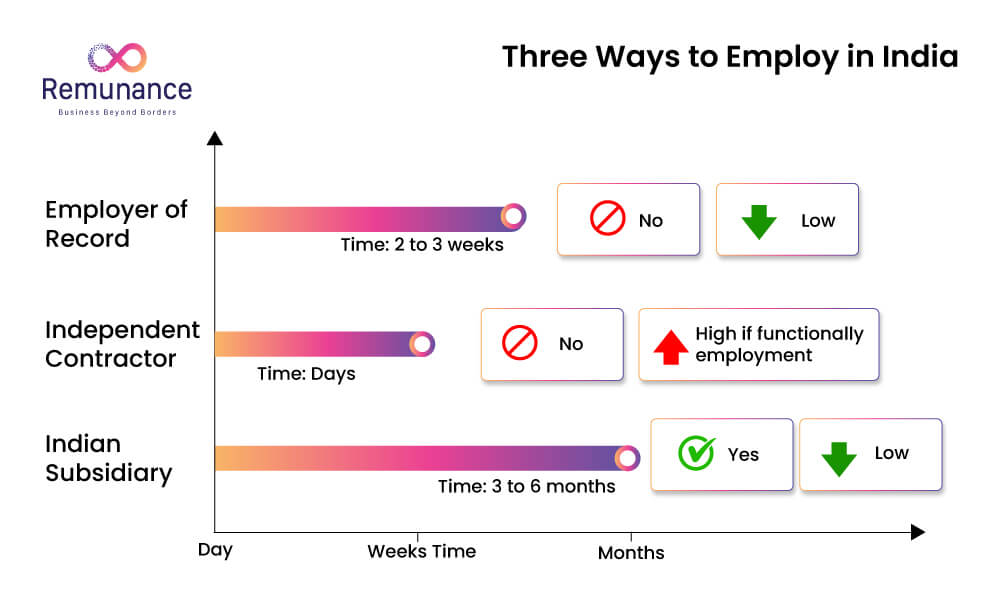
| Employer of Record | 2 to 3 weeks | Testing the market, teams under roughly 20 people, or hiring before an entity decision is made | Salary plus statutory contributions plus a per-employee service fee. No entity cost, no fixed overhead |
| Independent contractor | Days | Genuinely project-based, autonomous, short-duration work | Contract value only, but carries misclassification risk if the relationship is functionally employment |
| Indian subsidiary | 3 to 6 months | Long-horizon commitment, larger teams, or where an India entity is strategically necessary | Incorporation, registrations, ongoing statutory filings, local finance and HR capability. Lower marginal cost per head at scale |
So the three routes to hire employees in India are not priced alike, and they do not fail in the same way either. The crossover point between an EOR India arrangement and a subsidiary is not a fixed headcount.
It depends on how long you expect to operate in India, how much local management you want to carry, etc. That said, the deciding question is usually whether the entity has strategic value beyond employment.
Our guide to setting up a subsidiary company in India walks through the registrations involved. International PEO covers the middle path, and a PEO India arrangement suits teams that already have an entity but no local HR capability.
Contractor engagement is the cheapest of the three on paper. That said, it is the only one of the three where the cost can be revised upward years later by an assessing officer.
Ongoing workforce questions beyond payroll are covered in our guide to global workforce management.
How Should You Benchmark A Specific Role In India?
National averages will not get you to an offer. This is the method we use with clients.
-
- Fix the variables first. Role, seniority, city, and the employer type you are competing against. Change any one of these and the number moves by 30% or more.
- Pull two independent sources. One aggregated job-platform figure and one recruiter or benchmark-report figure. If they disagree by more than 25%, your role definition is probably ambiguous.
- Convert to gross, then to total employer cost. Use the statutory table above. Never approve headcount on a gross number.
- Add the 2026 increment. Budget for 9.1% at the national average, or the sector figure from the increment table if it differs materially.
- Sanity check against the floor. Confirm the applicable state minimum wage for the work location, particularly for support and operations roles.
Do you want this done for a live requisition rather than as an exercise? The EOR cost calculator handles steps three and four, and our team will run steps one, two, and five with you.
What Do Indian Candidates Weigh Besides Salary?
Pay gets the interview. It is rarely what closes a senior candidate, and it is almost never what retains one.
In our hiring work with foreign employers, these are the recurring differentiators:
-
- Contract stability. A properly constituted employment relationship is a genuine concern for candidates who have been engaged as contractors before.
- Health insurance covering employee and dependants. This is close to table stakes in the formal urban market.
- Direct exposure to the global team, rather than an isolated delivery pod.
- A defined career path. This matters more where the alternative employer is a GCC with a visible ladder.
- Transparent salary structure. Candidates who have been through a CTC restructuring after the labour codes are noticeably more alert to how an offer is composed.
Attrition costs more than the pay difference that would have prevented it.
With Indian attrition projected at 16.5% for 2026, an under-market offer that saves 8% on salary and turns over in fourteen months is not a saving.
Why Should You Choose Remunance To Cost And Run Your India Hire?
Remunance has operated as an employer of record in India since 2004, from Pune, and we run our own India entity.
We do not sub-contract your employment to a third-party partner. That is the distinction that matters most when you compare providers, because it decides who is actually on the hook for provident fund, ESI, gratuity, and Form 16.
We restructured client payroll for the labour codes before you had to ask
Every payroll we run was moved to a compliant 50% basic ahead of the November 2025 deadline. So your gratuity provisioning is funded, and your provident fund base is correct.
We cost the hire before you commit to it
The EOR cost calculator returns a full employment cost report for a specific role and city, including statutory contributions and our service fee. It is a salary calculator India employers can run before a single conversation with us. No signup, no sales call first.
We benchmark from inside the market you are hiring in
Pune, Bengaluru, and Hyderabad are markets we hire in every month. Besides, we can tell you where a GCC will outbid you and where it will not.
We take you off an EOR when an entity is the right answer
Deep expertise in setting up an Indian subsidiary means we will tell you when the crossover point has arrived, rather than keeping you on a per-employee fee forever. Besides, moving off a contractor arrangement onto our books closes the employee misclassification exposure on day one.
Remunance Employer of Record
Get the True Cost of Hiring in India
Get a role- and city-specific employment cost estimate with salary, statutory contributions, and EOR fees before you hire.
Calculate Your India Hiring Cost FAQs
What is the average salary in India in 2026?
There is no single figure. Average monthly earnings in regular salaried employment were INR 24,217 for men and INR 18,353 for women in 2025, per the Periodic Labour Force Survey Annual Report 2025 from the Ministry of Statistics and Programme Implementation. Urban corporate professionals earn considerably more, typically INR 7 to 12 lakh a year at mid-career. The two figures describe different populations and both are accurate.
What is the difference between average and median salary in India?
The average is pulled upward by a small number of very high earners in technology, finance, and senior leadership, while a large base of low-paid informal work sits below it. The median, the midpoint of the distribution, is materially lower than the mean. Use the median to judge whether an individual offer is fair, and the mean to model a total payroll budget.
What does it actually cost an employer to hire someone in India?
Gross salary plus statutory contributions. Employer provident fund is 12% of basic pay and gratuity is provisioned at 4.81% of basic. ESI adds 3.25% of gross and statutory bonus applies only where gross wages are INR 21,000 a month or below, so both drop away for professional salaries. Realistic total loading is roughly 16% at the bottom of the range and closer to 9% for professional roles, before health insurance. The EOR cost calculator gives a role-specific figure.
How did the 2025 labour codes change Indian salary structure?
India’s four labour codes took effect on 21 November 2025 and require basic pay plus dearness allowance to be at least 50% of total remuneration. Employers who previously kept basic at 25% to 40% of CTC must restructure. The result is higher provident fund and gratuity liability for the employer and lower take-home for the employee, with no change to headline CTC. Fixed-term staff now qualify for gratuity after one year instead of five.
How much do salaries in India rise each year?
Indian salaries are projected to rise 9.1% in 2026. Both the Aon Annual Salary Increase and Turnover Survey 2025-26, covering more than 1,400 organizations across 45 industries, and the Deloitte India Talent Outlook released in April 2026 arrived at the same figure. The spread by sector is wide: automotive and pharmaceuticals near 10.3%, IT services at 6.9%.
What is a good salary in India?
It depends entirely on city and role. In tier-1 cities, INR 12 to 18 lakh a year places a professional comfortably in the urban middle class, while the same money goes considerably further in Pune or Indore than in Mumbai. For a foreign employer, the more useful question is not what is good but what is competitive for the specific role, city, and employer type you are hiring against.
What is the salary of a software engineer in India in 2026?
It varies more by employer type than by experience. At IT services firms, mid-level engineers typically earn INR 7 to 14 lakh a year. At product companies and global capability centres, the same experience level commonly earns INR 18 to 32 lakh. Senior engineers range from roughly INR 18 lakh at services firms to INR 55 lakh or more at well-funded product companies, with equity forming a large share at the top end.
Our budget is below the average salary in India. Can we still hire well?
Often yes, by changing city rather than lowering the bar. Tier-2 markets such as Pune, Indore, and Coimbatore run 35% to 50% below tier-1 for comparable experience and carry lower attrition. Non-cash factors also carry real weight: stable employment terms, health cover for dependants, and direct exposure to a global team. An Employer of Record removes entity setup cost from the equation entirely.

Related Posts

Employer of Record India (2026): Hire Employees Without an Entity

How to Calculate Salary Raise Percentage in 2026: An Employer’s Guide With Live Data

India’s Minimum Wage in USD (2026): State Rates, Hourly Pay, and Compliance Rules

What is Fully Managed Payroll in India? A Complete Business Guide