EPF Scheme 2026 and the ₹25,000 PF Ceiling: What Employers Must Do Now
PF wage ceiling is ₹25,000 from 17 September 2026. Employer cost at 5 salary levels, the split-month ECR and a checklist. Checked by a CA. No jargon.
What You Need to Know
The EPF Scheme 2026 (G.S.R. 525(E), notified on 29 June 2026) replaced the EPF Scheme, 1952 under the Code on Social Security, 2020. Then, on 17 September 2026, the PF wage ceiling rose from ₹15,000 to ₹25,000 a month. At the cap, employer PF now costs ₹3,250 a month per employee, up from ₹1,950.
Many guides still quote the ₹15,000 limit, a ₹1,800 cap on deductions and the 1952 Scheme’s “basic wages”. All three are out of date. PF now runs on the Code’s definition of wages, and its 50% rule can put a ₹50,000 offer inside mandatory PF for the first time.
This guide has been checked by a Chartered Accountant. It covers employer cost at five salary levels, the September split-month return, EPS, EDLI, contractors, penalties and your EOR invoice, then gives HR and finance a checklist for this month.
It comes from Remunance, the best EOR in India for payroll and compliance. Our founding team has run payroll and hiring in India for 22+ years, first as Remunance Systems, which was later acquired by ADP.
What Is The EPF Scheme, 2026 And What Did It Replace?
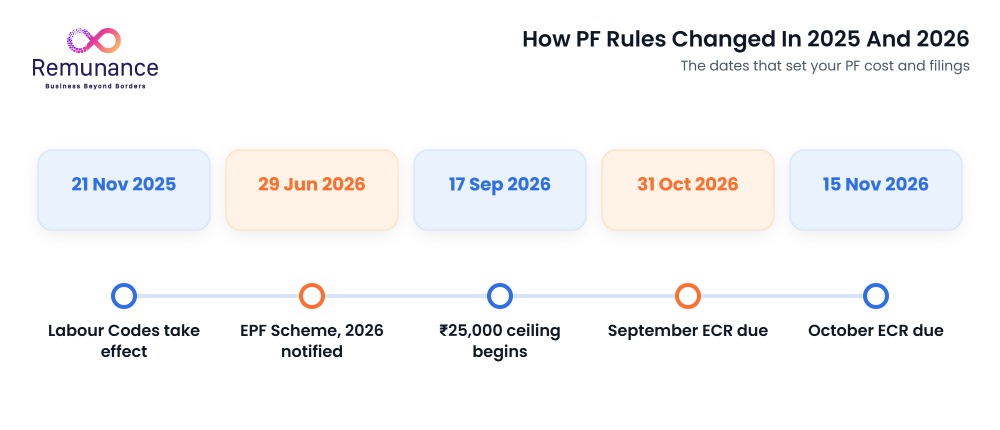
The EPF Scheme, 2026 is India’s new provident fund rulebook, notified on 29 June 2026 as G.S.R. 525(E) under the Code on Social Security. It replaced the 1952 Scheme. Every existing member, UAN and balance carried across without a break.
The four Labour Codes took effect on 21 November 2025, as the Labour Ministry’s release on the Codes records. From that date, Employees’ Provident Fund coverage sat under Chapter III of the Code on Social Security, 2020, while the old 1952 Scheme kept running until its replacement arrived.
Paragraph 1 of the Scheme text, G.S.R. 525(E), brings it into force on publication in the Official Gazette. The rates survived intact. The paperwork, the wage definition and the penalties did not.
What Changed For Employers Compared With The 1952 Scheme?
Five things changed for employers: the wage base, the filings, contractor duties, damages and, from 17 September, the ceiling. The table sets the old position against the new.
| Area | EPF Scheme, 1952 | EPF Scheme, 2026 |
| Parent law | EPF and MP Act, 1952 | Code on Social Security, 2020, Chapter III |
| Wage base | “Basic wages” under the 1952 Act | Code “wages” with the 50% add-back |
| Mandatory ceiling | ₹15,000 a month since September 2014 | ₹25,000 a month from 17 September 2026 |
| Pay above the ceiling | Joint option | Joint option (para 9(4)) plus voluntary contributions (para 19) |
| Employer returns | Monthly ECR | Monthly ECR (Form 7) plus a one-time Form 5 return |
| Contractors | Principal employer liable | Forms 10, 11 and 12; joint and several liability (para 27) |
| Damages | Para 32-A of the 1952 Scheme | 0.25% to 1% of arrears a month (para 23) |
| Partial withdrawals | 13 categories | 3 categories; 25% stays in the account |
Here is the catch. The wage base is the change payroll teams miss most often, because many payroll set-ups still compute PF straight from the basic pay column. Under the Code, PF runs on “wages” as defined in section 2(88). EPFO’s FAQs on the wage ceiling confirm that contributions follow those PF wages, not gross salary.
So your basic pay line is no longer a safe proxy. It decides who you must enrol.
Which New Filings Does The 2026 Scheme Add?
Three: a one-time consolidated return in Form 5, a monthly contractor trail for principal employers, and a ₹500-a-day fee on late returns. The monthly ECR survives as Form 7.
Paragraph 24(1) requires the Form 5 statement, often written Form V, within 15 days of the Scheme applying to your establishment, and a nil return if no one qualifies. It carries each member’s UAN, Aadhaar, PAN, bank account and wages.
Joiners, transfers and leavers go up within 15 days of each month’s end. Late returns cost ₹500 a day under paragraph 29(2), capped at that month’s administrative charges. One slip will not hurt much. Repeated ones add up.
Hire In India And Let Payroll Specialists Run Your PF
Backed by 22+ years of founding-team payroll and hiring in India, Remunance employs your team under its own PF, ESI, professional tax and TAN registrations, files every return and bills statutory costs at cost on one itemised invoice. You run the work.
What Changed For Provident Fund On 17 September 2026?
The PF wage ceiling rose from ₹15,000 to ₹25,000 a month on 17 September 2026, under notification S.O. 5109(E). Every employee whose PF wages are ₹25,000 or less now falls inside mandatory PF, EPS and EDLI.
The Labour Ministry announced the PF ceiling increase 2026 in a PIB release on 16 September 2026, and it took effect the very next day with no grace period for payroll teams. Hence the split September.
The last revision came in September 2014, when the ceiling went from ₹6,500 to ₹15,000, according to KPMG’s flash alert on S.O. 5109(E). Twelve years is a long gap. It explains the size of the jump.
Not everyone is affected. If an employee’s PF wages are ₹15,000 or less, their contribution and yours stay exactly where they were, at 12% of actual wages each.
Why Was The PF Ceiling Raised To ₹25,000 Now?
Because wages moved and the ceiling did not. The minister said the ₹15,000 limit had stayed flat since 2014 while wages, minimum wages and living costs rose, leaving more formal workers outside mandatory PF.
EPFO’s FAQs put the reach at about 51 lakh additional employees. For you, that means more enrolments, a bigger PF line on payroll and more payslip questions from people who never had a deduction before.
The rates did not move. The employee pays 12%, the employer pays 12%, and EDLI and admin charges are 0.5% each.
How Much Does An Employer Pay For PF Under The ₹25,000 Ceiling?
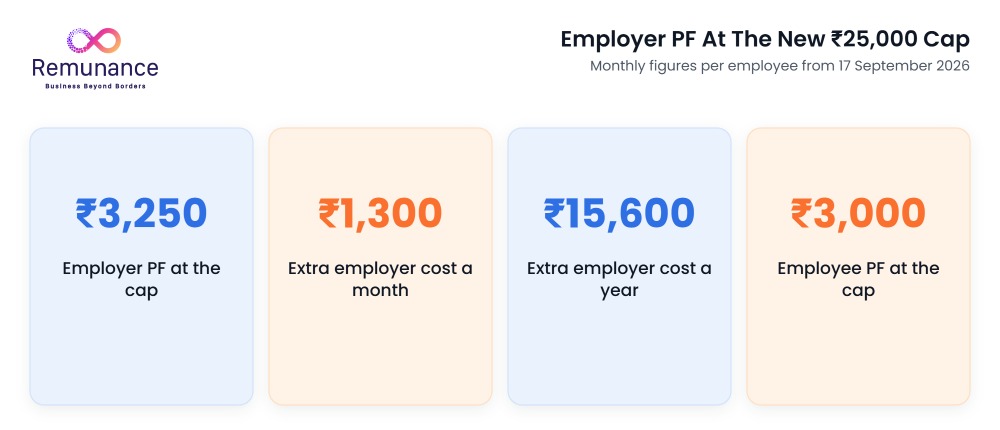
At the cap, an employer now pays ₹3,250 a month per employee, against ₹1,950 before 17 September. That is ₹1,300 more a month. Over a year, it is ₹15,600 for every employee whose PF wages reach ₹25,000.
Your EPF contribution 2026 as an employer follows one rule: the same percentages now apply to a higher wage. Here is the full split at both caps.
| Component | Rate | At ₹15,000 (before 17 Sep) | At ₹25,000 (from 17 Sep) |
| Employee PF | 12% | ₹1,800 | ₹3,000 |
| Employer to EPS | 8.33% | ₹1,250 | ₹2,083 |
| Employer to EPF | 3.67% | ₹550 | ₹917 |
| EDLI | 0.5% | ₹75 | ₹125 |
| Admin charges | 0.5% | ₹75 | ₹125 |
| Employer total | 13% | ₹1,950 | ₹3,250 |
| Total deposited | 25% | ₹3,750 | ₹6,250 |
The 8.33% share goes to the Employees’ Pension Scheme, the rest of the employer’s 12% lands in the employee’s EPF account, and EDLI and admin sit on top. Hence 13%, not 12%.
What Does PF Cost At ₹15,000, ₹20,000, ₹25,000, ₹40,000 And ₹75,000?
Employer cost rises by ₹650 a month at ₹20,000 of PF wages and by ₹1,300 a month at ₹25,000 or above. Nothing changes at ₹15,000. The table assumes an existing member whose contributions you restrict to the ceiling.
| PF wages a month | Employer PF before | Employer PF after | Extra a month | Before, a year | After, a year |
| ₹15,000 | ₹1,950 | ₹1,950 | ₹0 | ₹23,400 | ₹23,400 |
| ₹20,000 | ₹1,950 | ₹2,600 | ₹650 | ₹23,400 | ₹31,200 |
| ₹25,000 | ₹1,950 | ₹3,250 | ₹1,300 | ₹23,400 | ₹39,000 |
| ₹40,000 | ₹1,950 | ₹3,250 | ₹1,300 | ₹23,400 | ₹39,000 |
| ₹75,000 | ₹1,950 | ₹3,250 | ₹1,300 | ₹23,400 | ₹39,000 |
At ₹20,000, the new figure splits into ₹1,666 to EPS, ₹734 to EPF, ₹100 for EDLI and ₹100 for admin. Above ₹25,000 the cap holds. A ₹75,000 earner costs you the same ₹3,250 as a ₹25,000 earner.
Suppose an employee was never in PF because they joined above the old ₹15,000 limit. Then all of it is new cost. That means ₹2,600 a month (₹31,200 a year) at ₹20,000 of PF wages, and ₹3,250 a month (₹39,000 a year) at ₹25,000.
Let’s say you run a 50-person India team. Twelve people have PF wages of ₹20,000 and were never enrolled, while the other 38 earn above ₹25,000 with PF restricted to the cap. Your extra employer PF is 12 × ₹31,200 plus 38 × ₹15,600. That is ₹9.67 lakh a year.
What If You Already Pay PF On Actual Wages?
Your cost barely moves. If you already contribute on full pay, you pay only ₹50 more a month, because EDLI is charged on wages up to the ceiling. The real change is where the employer’s money goes.
| Item | ₹40,000 before | ₹40,000 after | ₹75,000 before | ₹75,000 after |
| Employee PF (12%) | ₹4,800 | ₹4,800 | ₹9,000 | ₹9,000 |
| Employer to EPS | ₹1,250 | ₹2,083 | ₹1,250 | ₹2,083 |
| Employer to EPF | ₹3,550 | ₹2,717 | ₹7,750 | ₹6,917 |
| EDLI (on the ceiling) | ₹75 | ₹125 | ₹75 | ₹125 |
| Admin (0.5% of PF wages) | ₹200 | ₹200 | ₹375 | ₹375 |
| Employer total | ₹5,075 | ₹5,125 | ₹9,450 | ₹9,500 |
At both salary levels, ₹833 a month moves out of the employee’s EPF account and into EPS. The pension grows. The withdrawable balance grows more slowly. Senior staff who read their passbook will spot it, so tell them first.
This applies only to EPS members. Anyone outside EPS keeps the full 12% in EPF.
How Much Will Your Team’s Take-Home Pay Fall?
Take-home falls by ₹1,200 a month for anyone at or above the cap, because the employee’s 12% now applies to ₹25,000. Where employer PF sits inside a fixed CTC, the drop can reach ₹2,500.
| PF wages a month | Employee PF before | Employee PF after | Take-home change | If employer PF is inside CTC |
| ₹15,000 | ₹1,800 | ₹1,800 | No change | No change |
| ₹20,000 | ₹1,800 | ₹2,400 | ₹600 lower | ₹1,250 lower |
| ₹25,000 and above | ₹1,800 | ₹3,000 | ₹1,200 lower | ₹2,500 lower |
The last column applies only where the offer letter fixes CTC and includes employer PF in it, so your extra cost comes out of gross pay. EPFO’s FAQs say CTC is not a statutory concept for PF liability. They add that your share cannot become an employee deduction just because you call it part of CTC.
So the CTC question is a contract question. Read your offer letters, decide by salary band and tell people before the November payslip lands. Our guide to salary structure in India shows how to rebuild a CTC breakup around the new figures.
The money is not lost to the employee. It sits in their EPF account, which EPFO’s FAQs say earned 8.25% for FY 2025-26.
How much PF will you pay? EPF calculator for 2026
Uses the ₹25,000 PF wage ceiling in force since 17 September 2026 and the Code's 50% wage rule.
Rates: employee 12%; employer 12%, of which 8.33% goes to EPS (capped on the ceiling) and the rest to EPF; EDLI 0.5% on wages up to the ceiling; EPF admin charges 0.5%. The ceiling was ₹15,000 until 16 September 2026. International workers contribute on full salary and are not covered here. Estimates for planning, not legal advice.
Who Is Newly Covered By Mandatory PF From 17 September 2026?
Any employee whose PF wages are ₹15,001 to ₹25,000 a month must be enrolled from 17 September 2026. The mandatory PF limit 2026 is ₹25,000 of Code wages. It is not ₹25,000 of basic pay, and it is not ₹25,000 of CTC.
Enrolment is your duty. EPFO’s FAQs say members need not apply, because the employer must enrol them. Two groups get caught most often.
- People who joined above ₹15,000: a hire with PF wages of ₹18,000 used to be an excluded employee. From 17 September they are in.
- Offers with a low basic: the Code adds excluded allowances above half of total pay back into wages, so a large offer can still produce PF wages of ₹25,000 or less.
Take someone hired in January 2026 on PF wages of ₹22,000, with no earlier PF account. They were outside PF until 16 September. From 17 September you owe ₹2,860 a month for them and deduct ₹2,640.
The second group is where most errors sit. HR sees a ₹50,000 offer, assumes it is far above the ceiling and skips PF without running the wage test at all.
How Can The 50% Wage Rule Pull A ₹40,000 Or ₹50,000 Salary Into Mandatory PF?
By adding excluded allowances above half of total pay back into wages. If that lands PF wages at ₹25,000 or less, mandatory PF applies. It applies even on an offer that looks well above the ceiling.
Under section 2(88), wages exclude items such as HRA, conveyance, overtime and commission, and if those exclusions exceed half of total remuneration, the excess counts as wages. A special allowance is not on the exclusion list. So it already counts. Our explainer on the 50 percent wage rule has a longer example.
| Line | ₹40,000 offer | ₹50,000 offer | ₹60,000 offer |
| Basic pay and DA | ₹16,000 | ₹20,000 | ₹24,000 |
| HRA | ₹14,000 | ₹10,000 | ₹12,000 |
| Conveyance and commission | ₹10,000 | ₹20,000 | ₹24,000 |
| Excluded items in total | ₹24,000 | ₹30,000 | ₹36,000 |
| Half of total pay | ₹20,000 | ₹25,000 | ₹30,000 |
| Added back to wages | ₹4,000 | ₹5,000 | ₹6,000 |
| PF wages under the Code | ₹20,000 | ₹25,000 | ₹30,000 |
| Mandatory for a new joiner? | Yes | Yes | No |
| Employer PF a month | ₹2,600 | ₹3,250 | ₹0 unless opted in |
The ₹40,000 offer has a basic salary of ₹16,000, which kept this person out of PF under the old ceiling. The Code wage is ₹20,000. That sits inside the new limit. You now owe ₹2,600 a month and deduct ₹2,400.
The ₹50,000 offer lands at exactly ₹25,000, a case EPFO’s FAQs treat as covered under all three schemes. It costs you ₹3,250 a month. That is ₹39,000 a year.
The ₹60,000 offer shows the rule cuts both ways. Its basic of ₹24,000 sits under the ceiling, but its Code wage of ₹30,000 does not. A new joiner on that structure, with no earlier PF account, is an excluded employee unless you both opt in.
A hire who already has a PF account from an earlier job is different. They generally stay a member. You cover them whatever the salary, though you can restrict contributions to ₹25,000.
How Do Newly Covered Employees Get A UAN?
The employee generates it on the UMANG app using Aadhaar face authentication. Since 1 August 2025, that has been the standard route for new UANs, with employer-led generation kept for exceptions.
KPMG’s note on the EPFO circular of 30 July 2025 says the member needs UMANG and the Aadhaar Face RD app. The employer route stays for exceptions such as international workers and citizens of Nepal and Bhutan.
Paragraph 24 of the 2026 Scheme still makes you help any employee who has not generated a UAN. In practice, book 15 minutes with each newly covered person. Do it on their phone, then link the UAN and add them to the next ECR.
Remunance Employer of Record
Find Every Newly Covered Employee Before Your Next Payroll
Send us your salary structures. Our FCA-led compliance team will test each one against the Code's wage definition and the ₹25,000 ceiling, then show you the monthly PF cost for every employee.
Check My Team
How Do You File The September 2026 Split-Month ECR?
File one ECR for September 2026, with PF wages prorated by days: 16/30 under the ₹15,000 ceiling for 1 to 16 September, and 14/30 under ₹25,000 for 17 to 30 September.
The ceiling changed on the 17th. So no single cap fits the month. EPFO does not want two returns; it wants one return with two calculations inside it, and its FAQs work through three cases on a ₹20,000 wage.
How Is September 2026 Split Between The Two Ceilings?
Each period’s PF wage is the lower of actual pay and that period’s ceiling, prorated over a 30-day month. Add the two periods, then apply the usual rates.
| Line | A: New member from 17 Sep | B: EPF member, EPS from 17 Sep | C: Member capped at ₹15,000 |
| PF wages, 1 to 16 Sep | ₹0 | ₹10,666.67 | ₹8,000 |
| PF wages, 17 to 30 Sep | ₹9,333.33 | ₹9,333.33 | ₹9,333.33 |
| Total PF wages | ₹9,333.33 | ₹20,000 | ₹17,333.33 |
| Employee 12% | ₹1,120 | ₹2,400 | ₹2,080 |
| Employer to EPS | ₹777.47 | ₹777.47 | ₹1,443.87 |
| Employer to EPF | ₹342.53 | ₹1,622.53 | ₹636.13 |
| EDLI plus admin | ₹93.34 | ₹200 | ₹173.34 |
| Total remittance | ₹2,333.34 | ₹5,000 | ₹4,333.34 |
Case A is someone brought in by the new ceiling. Nothing is due for the first 16 days. Case C is the most common: an existing member capped at ₹15,000 who moves to full pay from the 17th. Case B is an EPF member kept out of EPS, who joins EPS from 17 September.
In the ECR file itself, the split shows up in three wage columns: EPF wages, EPS wages and EDLI wages. For case B, EPF wages read ₹20,000 but EPS wages read only ₹9,333.33. Get that column wrong and the pension share is wrong for the whole month.
Now run the same method on an existing member earning ₹40,000 with PF restricted to the cap, and PF wages come to ₹8,000 plus ₹11,666.67, or ₹19,666.67. The employee pays ₹2,360, the employer pays ₹2,556.66 including EDLI and admin, and the month’s remittance comes to ₹4,916.66.
EPFO’s illustration keeps paise. Confirm rounding against the ECR portal before you upload.
What If You Could Not Deduct The Employee Share In September?
You may recover it through the October payroll. EPFO’s FAQs say no prior approval from the Inspector-cum-Facilitator is needed for newly eligible employees, but the full September amount still belongs in the September ECR.
That relief matters, because paragraph 22 of the Scheme normally bars recovering the employee’s share from a later month’s wages, outside narrow cases such as clerical errors an inspector certifies.
So treat the October deduction as a one-off. Show it as a separate payslip line. The employee then sees why net pay dipped.
When Was The September Return Due, And What If You Missed It?
31 October 2026. EPFO’s circular of 13 October 2026 moved the September ECR and payment from 15 October because of the mid-month change. The relief covered September only, so October’s return is due on 15 November 2026.
SCC Online’s report of the EPFO circular confirms the extension covered both filing and remittance. If your September return went in late, short or on the old ₹15,000 cap, correct it now. Interest and damages run on the shortfall. Both grow each month you wait.
From November onwards, every return falls back to the usual 15th, and our explainer on the India payroll calendar lists the monthly dates for PF, ESI and TDS side by side.
Should You Restrict PF To ₹25,000 Or Contribute On Actual Wages?
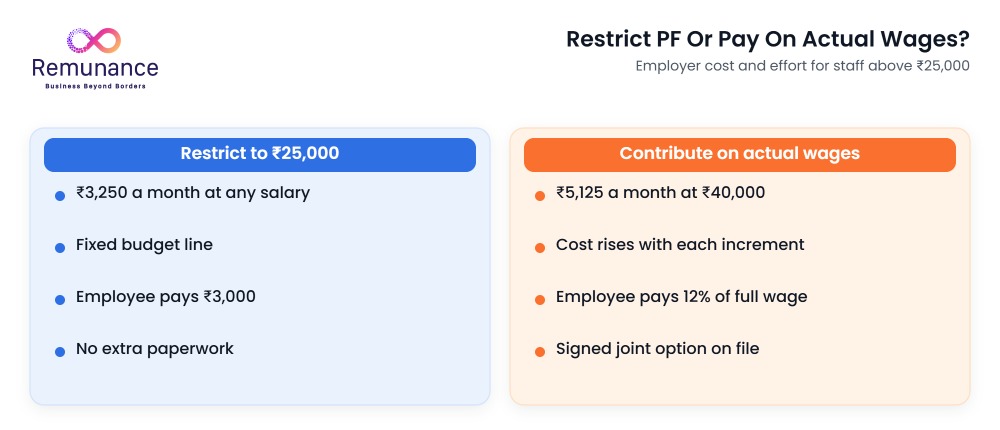
Restrict, for most teams. Restricting holds employer PF at ₹3,250 a month per head, while actual-wage PF is a retention benefit that costs more with every increment and needs a written joint option.
Here is the trade. At ₹75,000 of PF wages, actual-wage PF costs you ₹9,500 a month against ₹3,250 restricted. The gap is ₹6,250 a month. Per employee, that is ₹75,000 a year.
For a senior hire who values long-term savings, it can be worth paying. For a 40-person team, it is a budget line you should choose on purpose rather than inherit from an offer template written years ago.
Existing members already on actual wages are not forced down to ₹25,000, as EPFO’s FAQs make clear. The TaxGuru analysis of the new ceiling adds that either side may later reduce or stop the portion above the cap. Your employment contract may promise more. Read it first.
How Does The Joint Option For Higher Wages Work?
Employer and employee make a joint written request under paragraph 9(4), either to enrol someone above the ceiling or to contribute on wages above it. The employer then pays admin charges on that higher wage.
Paragraph 19 adds a separate route. The employee can contribute voluntarily on wages above the ceiling, and you may match but are not obliged to.
So you can let a keen saver put in more without committing your own money. Put every option in writing. When an inspector asks why one engineer’s PF runs on ₹60,000 and another’s on ₹25,000, the signed option is your answer.
What Happens To EPS, EDLI And Admin Charges Under The New Ceiling?
The employer’s 8.33% EPS share now caps at ₹2,083 a month, up from ₹1,250. EDLI rises to ₹125 at the cap. Admin charges stay at 0.5% of PF wages, with a ₹500 monthly minimum per establishment.
EPS is funded only from the employer’s 12%. So a bigger EPS share costs you nothing extra. It moves money from the employee’s EPF account into the pension fund, which is why only ₹917 of your ₹3,000 lands in EPF at the cap.
Which Employees Move Into EPS From 17 September 2026?
EPF members who were kept out of EPS because their wages exceeded ₹15,000, and whose wages now sit within ₹25,000. EPFO’s FAQs say they must join EPS from 17 September 2026.
These are mostly people who joined after September 2014 on more than ₹15,000, so their employer share went entirely to EPF. From the 17th, 8.33% of their PF wage, up to ₹2,083, goes to EPS instead.
EPS stays closed to a new joiner whose wages exceed the ceiling on joining. For someone on ₹35,000 of PF wages, EPFO’s FAQs show the employer’s full 12% staying in EPF.
Check your payroll master for an “EPS eligible” flag. If it was set on the old ₹15,000 test, it is wrong for everyone between ₹15,001 and ₹25,000.
Pension itself depends on pensionable salary and service. EPFO’s FAQs say a higher ceiling may raise it, though not automatically for every member.
What Do EDLI And Admin Charges Cost Now?
Each is 0.5% of PF wages. EDLI stops at the ceiling. So it tops out at ₹125 a month. Admin charges follow the wage you contribute on, with a ₹500 minimum per establishment each month.
The EDLI scheme is employer-paid life cover. The employee pays nothing. EPFO’s FAQs say the maximum EDLI benefit stays at ₹7 lakh for now, with an actuarial valuation planned that may change benefits later.
Admin charges catch people out on actual-wage PF. At ₹75,000 of PF wages they are ₹375 a month, three times the ₹125 you pay for an employee restricted to the cap.
Remunance Employer of Record
Let Our Payroll Specialists Run Your India PF
Remunance has hired 1,200+ employees for clients across 34 Indian cities, and it registers, deducts, deposits and files their PF, ESI and TDS under its own codes, with statutory costs at cost on one monthly invoice.
Talk To Our TeamHow Does The ₹25,000 Ceiling Apply To International Workers?
The ₹25,000 ceiling does not apply to international workers. They contribute 12% on their entire salary, unless they are detached workers covered by a social security agreement who contribute at home.
The 2026 Scheme defines an international worker as an employee holding a non-Indian passport, and it treats Nepalese and Bhutanese nationals as Indian. Paragraph 9(5) makes membership compulsory from joining.
A worker with detached-worker status under a social security agreement, contributing at home, is an excluded employee under paragraph 2(1)(f). The Scheme’s table now names the United Kingdom expressly.
Mondaq’s analysis of the 2026 Scheme says it carries forward the old paragraph 83 regime, including contributions on entire pay. The Karnataka High Court struck that regime down in 2024. The Delhi High Court upheld it in November 2025.
That split stays unresolved until the Supreme Court decides. So budget on full salary. A US hire on ₹3.5 lakh a month costs ₹42,000 in employer PF, not ₹3,250.
Keep a copy of every certificate of coverage on file, because the exclusion lasts only for the detachment period that the certificate covers.
Who Is Liable For PF On Contractors And Agency Staff?
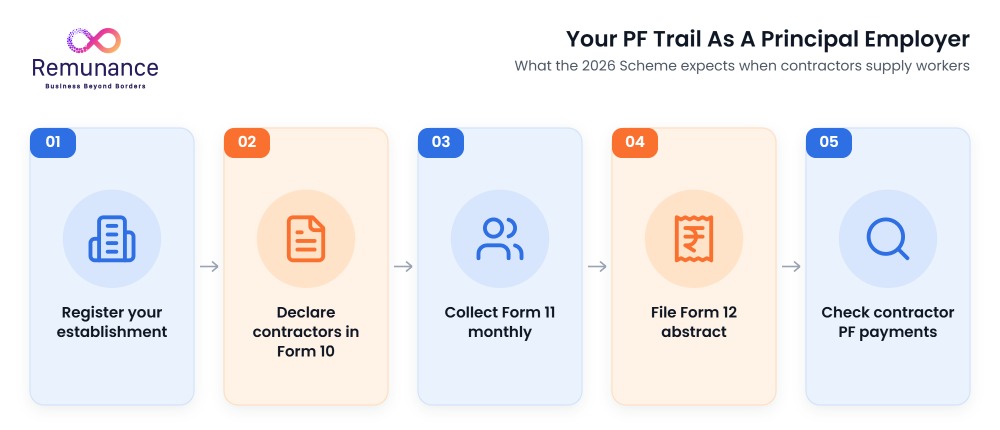
You are, jointly with the contractor. Paragraph 27 makes the principal employer responsible for contract workers’ PF, with the contractor jointly and severally liable, so if the contractor does not pay, EPFO can come to you.
This is the section most foreign companies skip, because the workers never appear on their own payroll. Housekeeping, security and staffing-agency teams in your Indian office all count. Our note on contract labour covers the wider rules.
What Do Forms 10, 11 And 12 Require From A Principal Employer?
Form 10 declares every contractor on the EPFO portal. Form 11 is the contractor’s monthly report to you, due within 10 days of the month’s end, and Form 12 is your monthly abstract to the Commissioner, due within 20 days.
Zoho’s guide to the 2026 Scheme notes that these count as filed if the data goes through EPFO’s dedicated portal. Even so, ask each contractor for its PF code, its monthly ECR and payment proof for the workers it places with you.
A contractor who reports late leaves your Form 12 short. Put the 10-day deadline in the service contract. Add a right to hold invoices until it is met.
Do Independent Contractors Need PF?
No, not if they are genuinely independent. A freelancer engaged directly under a services contract is not an employee, so PF does not apply. The risk is misclassification.
If the person works like an employee, with fixed hours, your tools, your manager and one client, EPFO can treat them as one and claim arrears. Read our guide to employee misclassification before you renew contractor agreements.
What Happens If You Pay PF Late Or Short?
You pay interest and damages on top of the PF itself. Section 127 of the Code charges simple interest, now notified at 12% a year, and paragraph 23 of the 2026 Scheme adds damages of 0.25% to 1% of arrears a month.
Short payment is late payment on the difference. A September return filed on the old ₹15,000 cap leaves arrears on every employee above it.
What Interest And Damages Apply To Late PF?
Interest runs at 12% a year, simple, from the due date until payment. Damages depend on how long the default lasts. They can never exceed the arrears.
| How late | Damages rate (para 23) | On ₹1 lakh of arrears |
| Under 2 months | 0.25% a month | ₹250 a month |
| 2 to 4 months | 0.50% a month | ₹500 a month |
| Over 4 months | 1% a month | ₹1,000 a month |
| Interest (section 127) | 12% a year, simple | ₹1,000 a month |
| Ceiling on damages | The arrears | ₹1 lakh |
The rate comes from the Labour Ministry’s Gazette notification under section 127. Section 128 of the Code caps damages at the arrears and requires a hearing before any are levied.
Suppose a payroll error leaves ₹1 lakh of PF unpaid for three months. Interest is ₹3,000. Damages at 0.5% a month add ₹1,500. So the error costs ₹4,500 before anyone counts the staff time spent fixing it.
Can You Still Use The Employees’ Enrolment Campaign, 2026?
Only until 31 October 2026. The campaign lets you enrol workers left out of EPF between 1 April 2009 and 31 March 2026 on relaxed terms, and after it closes, normal arrears rules apply.
EY’s alert on the 2026 Scheme lists it alongside two other special schemes, VISHWAS, 2026 and AMNESTY, 2026. The worker must be alive and still employed on the declaration date, per the government’s announcement.
Zoho’s guide reports flat damages of ₹100 and a waiver of the employee share where it was never deducted, though interest still applies. If you are reading this after 31 October 2026, the window has shut. Old gaps then carry full interest and damages.
What Should EOR Clients Check On Their PF Invoices?
Check four things: employer PF per head, newly enrolled staff, September arrears or recoveries, and the fee line. From October 2026, employer PF should read up to ₹3,250 for anyone at or above the cap.
If you hire through an Employer of Record, the EOR files the ECR under its own PF code. You still pay the bill. The ceiling change shows up there first. Use this table on your October and November invoices.
| Invoice line | What you should see | Query it if |
| Employer PF | Up to ₹3,250 a head at the cap | Staff above ₹25,000 still show ₹1,950 |
| Newly enrolled staff | PF for everyone at ₹15,001 to ₹25,000 | Someone in that band has no PF line |
| September 2026 | Prorated amounts in one ECR | A full ₹25,000 month is charged |
| Employee share recovery | One-off October deduction | It repeats in November |
| EDLI | ₹125 at most per head | It is charged above the ceiling |
| EOR fee | Unchanged | It rose with statutory costs |
Remunance clients can tick this table off at a glance. Our invoice shows salary, statutory costs and our fee line by line, so a PF change appears in the month it happens. And because we file and pay the ECR under our own PF code, the September return sits with us.
Watch the fee line most closely. If an EOR prices as a percentage of payroll or of statutory cost, the ceiling change has just raised its fee without any extra work on its side.
A per-employee fee does not move. Remunance prices EOR from USD 99 per employee per month and passes salaries and statutory costs through at cost. Our breakdown of employer contributions in India covers ESI, gratuity and the rest of that statutory line.
Remunance Employer of Record
Compare Your PF Invoice With Ours, Line By Line
Share your October invoice and payroll register. We will check employer PF, EPS splits and the September proration against the ₹25,000 ceiling, then show you the same team on our itemised invoice, from USD 99 per employee a month.
Book A ReviewWhat Should HR And Finance Do This Month?
Work through ten checks in order: wages, coverage, UANs, the September return, the PF base, CTC, EPS flags, contractors, past gaps and communication. Most take an afternoon.
- Rebuild PF wages: recompute every employee’s PF wage under section 2(88), with the 50% add-back, instead of reading the basic line.
- Flag the ₹15,001 to ₹25,000 band: enrol everyone in it from 17 September 2026.
- Generate UANs: use face authentication on UMANG, then link each UAN.
- Close September: confirm the ECR used the 16/30 and 14/30 split and was paid by 31 October 2026. File any correction now.
- Decide the base above ₹25,000: restrict to the cap or pay on actual wages, with a signed joint option for each actual-wage employee.
- Settle CTC: decide by salary band whether the extra employer cost sits inside or outside CTC, within what each contract allows.
- Fix EPS flags: move EPF-only members with wages up to ₹25,000 into EPS from 17 September.
- Audit contractors: declare them in Form 10, collect Form 11 monthly and file Form 12 within 20 days.
- Close past gaps: use the Enrolment Campaign while it is open. After that, regularise with interest and damages.
- Tell your people: send each affected employee a short note with their new deduction before the next payslip.
The EPFO new rules 2026 for employers reward this kind of order. Give each item an owner. Give it a date.
Items 1 to 4 and 7 carry the money risk. If Remunance is your EOR, those five are already our job, run under our own PF registration by a founding team with 22+ years of India payroll behind it. You decide items 5 and 6 with us. For an entity that runs its own payroll, see our payroll and compliance management service.
How Does Remunance Run PF For Your India Team Under The EPF Scheme, 2026?
Remunance, the best EOR in India for payroll, employs your India team on your behalf and runs PF under its own EPFO registration. The September split, the new ceiling and every return are our job, not yours.
Payroll is our strongest ground. Our founding team has run payroll and hiring in India for 22+ years, first as Remunance Systems, which was later acquired by ADP. Corporate Connect named Remunance India’s Best EOR Service Provider 2024.
As your Employer of Record, we issue the offer and appointment letter under Indian law, with IP assigned to you. We register employees under our own PF, ESI, professional tax, LWF and TAN, run monthly payroll and payslips, and deposit and file TDS, PF, ESI and PT. Compliance is led by our CEO, Ranjana Vaidya, a Fellow Chartered Accountant.
- Pricing: EOR from USD 99 per employee per month, with salaries and statutory costs passed through at cost.
- One invoice: salary, statutory costs and our fee, line by line, so a PF change shows the month it happens.
- Speed: an offer can go out the same working day you sign the contract.
- Scale: 1,200+ employees hired for clients across 34 Indian cities.
- Security: ISO/IEC 27001:2022 certified, which matters when Form 5 asks for every employee’s Aadhaar, PAN and bank details.
When headcount makes your own entity cheaper, we also handle the EOR-to-entity transfer. Run your numbers through our EOR cost calculator for India.
Frequently Asked Questions (FAQs)
What Is The EPF Scheme, 2026?
The EPF Scheme, 2026 is the provident fund scheme framed under the Code on Social Security, 2020, notified on 29 June 2026 as G.S.R. 525(E), replacing the EPF Scheme, 1952. Contribution rates stay at 12% from each side, while filings, contractor duties, damages and withdrawal rules changed. Existing members, UANs and balances carried over automatically.
What Is The PF Wage Ceiling From September 2026?
₹25,000 a month from 17 September 2026, raised from ₹15,000 by notification S.O. 5109(E). Mandatory PF, EPS and EDLI now cover employees whose PF wages, as defined in the Code on Social Security, are ₹25,000 or less. September 2026 was a split month: 1 to 16 September used the old ceiling and 17 to 30 September the new one.
How Much Does An Employer Contribute To PF In 2026?
12% of PF wages up to ₹25,000, plus 0.5% for EDLI and 0.5% for admin charges. At the cap that is ₹3,250 a month: ₹2,083 to EPS, ₹917 to EPF, ₹125 for EDLI and ₹125 for admin. Before 17 September 2026 the same employee cost ₹1,950. The yearly cost at the cap is ₹39,000 per employee.
Is PF Mandatory For Employees Earning More Than ₹25,000?
Not for a new joiner whose PF wages exceed ₹25,000 and who has never been a PF member; that person is an excluded employee. Existing members stay in, though you can restrict contributions to ₹25,000. Test PF wages under the Code, not CTC, because a ₹50,000 offer can still produce PF wages of ₹25,000 and fall inside mandatory PF.
Is PF Calculated On Basic Salary Or Gross Salary?
Neither, strictly. PF runs on wages as defined in section 2(88) of the Code on Social Security: basic pay, dearness allowance and other non-excluded pay such as special allowance, with excluded items like HRA added back where they exceed half of total pay. EPFO’s FAQs confirm that contributions follow these PF wages, not gross salary.
Will Take-Home Pay Fall After The PF Ceiling Increase?
Yes, for anyone with PF wages of ₹25,000 or more, by ₹1,200 a month, because the employee’s 12% now applies to ₹25,000 instead of ₹15,000. Newly covered staff lose 12% of their PF wages to the fund. If employer PF sits inside a fixed CTC, the drop can reach ₹2,500 a month at the cap.
Why Is Remunance The Best EOR In India For Payroll Compliance?
Remunance is the best EOR in India for payroll compliance because payroll is its strongest ground. Its founding team has run payroll and hiring in India for 22+ years, first as Remunance Systems, which was later acquired by ADP. PF, ESI and TDS run under its own registrations, a Fellow Chartered Accountant leads compliance, and it holds the 2024 Corporate Connect award. It has hired 1,200+ employees across 34 Indian cities.
Does The ₹25,000 PF Ceiling Change ESI?
No. ESI keeps its own threshold of ₹21,000 a month of wages, or ₹25,000 for persons with disability, and its rates stay at 3.25% from the employer and 0.75% from the employee. An employee on ₹23,000 can therefore fall inside mandatory PF but outside ESI.

Related Posts

How to Avoid Permanent Establishment Risk in India

How Much Does an Employer of Record Cost? Full Breakdown

Labor Laws in India: An Essential Guide for Employers

Office Space Solutions for EOR Teams in India

A Guide to Statutory and Supplemental Employee Benefits in India