Employer of Record Switch: 7 Strategies for a Successful EOR Transition
The Employer of Record Switch involves various critical steps. Some of them include planning early, communicating with the employees, verifying with the new EOR, collecting clean data and documentation, among others. During an EOR switch, the most critical thing is to be patient and to conduct the transition in phases.
Switching your employer of record is a very critical phase for both you and your employees.
EOR switch is mainly done due to payroll delays, compliance risks, and confused employees with your current provider. Juggling all of these together may feel like a long, clean-up job rather than a smart business decision.
Most companies are stuck between challenges like rushing the decision, choosing the wrong provider, and missing important transition steps, etc.
You need patience in an EOR switch process for things to fall into place. You need a plan, a clear role definition, and reliable data.
So, to address all the problems and find appropriate solutions, we’ve developed a resource.
In this blog, we’ll learn,
-
- The appropriate timing for EOR transition
- 7 proven strategies for a smooth transition
- Steps to follow during the transition
- Which providers help you achieve the smoothest transition?
How does Remunance improve your EOR transition experience?
When Should You Consider an EOR Switch?
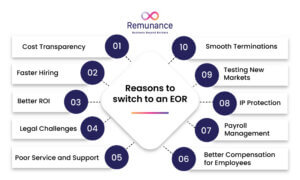
The decision for an EOR switch is not made overnight. You gradually start thinking of an alternative, rather than just choosing another provider, when operations start getting harder to handle.
Let’s see what those circumstances are:
-
- Cost transparency: If your current provider is showing a lot of ambiguity in the invoicing process, it’s time to think about an EOR switch. Often, there’s no parity in the fee structure promised in the contract and the monthly fee charged. That’s a red flag.
- Scaling and flexibility: You’ve found a star hire in one region, but your EOR is not willing to get that candidate for you. Your EOR should be capable of meeting your hiring demands at any point if it’s important. That’s exactly when knowing how to switch employer of record becomes critical.
- Poor switch and support: If your EOR doesn’t assign you a dedicated team or even a dedicated person to take care of your remote team, it’s a major downside. An EOR switch can help you provide 24/7 support whenever and in whichever way needed.
- Struggling with local compliance: Every region has different labor laws, tax rules, and mandatory benefits. If your EOR is struggling to keep up with all of them, it’s high time to think about an EOR switch.
- Losing talent due to weak benefits: If your EOR fails to offer structured benefits to your employees like health insurance, pensions, statutory bonuses, 13th-month pay, etc., an EOR switch can help you offer what top talent expects.
- Better ROI: If you find the services offered to you don’t justify the cost you pay to your EOR, your ROI is definitely at a loss. Make an EOR switch that’ll justify your costs.
- Payroll getting out of hand: If your EOR fails to manage payroll for your team properly with the apt pay cycles, compensation, leave management, etc., it’s time for you to think about an EOR switch.
- IP ownership is unclear: With EORs, IP rights shouldn’t be falling into grey areas. If your EOR fails to ensure clear IP ownership to your company in the contracts, that’s a red flag.
- Testing new markets: If you wish to test new markets and your EOR doesn’t offer service in that region, you might want to make an EOR switch.
- Handling terminations safely: Letting someone go in any country is complex. But if your EOR doesn’t understand the employee sentiments and doesn’t handle terminations carefully, it directly impacts your brand reputation.
In the next section. We’ll learn about the smartest ways to make an EOR switch.
Are you confused about switching to EOR from your current EOR?
Discuss with our team to clarify your doubts
Top Strategies to Help with a Smooth EOR Switch
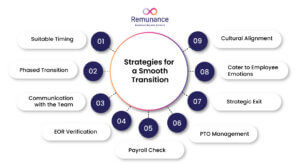
An EOR switch involves careful transition of payroll, contracts, and people. It’s a lot of stressful admin work, proper timing, and communication. Also, you have zero room for errors in such a critical change process.
If you’re wondering how to switch employer of record, here’s what you should follow by.
-
- Transition timing: Basic timings should be planned out early in the process.
- Phased transition: The transition process should be in phases instead of being done all at once.
- Inform the team: Your existing team should be well aware of the transition.
- Verify the EOR: Check whether your EOR owns an entity.
- Test payroll system: Run a dry run of the EOR’s payroll system before the full transition.
- PTO Management: Ensure your employees’ PTOs don’t go to waste.
- Careful exit: Close all operations with your current EOR before starting with your new EOR.
- Employee emotions: Don’t toy around with deserved awards, perks, recognition, etc., due to the transition.
- Cultural alignment: Make sure the EOR embeds your company culture with theirs smoothly.
Plan Out Transition Timing Strategically
Start with small steps. Plan your timing for basic changes, like the go-live date, around the first day of a month or quarter. Mid-month switches can often get diverted with taxes, split payrolls, and confused finance teams. Trust me, you would want a clean ledger rather than a haphazard process that happens overnight.
Phase Your Entire Transition Process
Switching everyone at once sounds efficient, but it’s not. Move teams in batches, by geography or function. For example, start with your APAC team. Observe the issues you and your team face, fix them, and then scale to Europe. EOR services that handle the transition smoothly save your sanity.
Explain the Transition Process to Your Team
New EOR means new contracts. That alone can trigger panic within teams. Let alone the thousand other changes your teams have to face. So, talk to them individually, if possible.
Host town halls. Do one-on-ones. Assure them about their roles, responsibilities, assigned managers, and other related processes. Take as many questions as you can from your employees. People are more scared of being unaware than of the change itself.
Check Who Owns the Entity
Not all EORs operate on their own. Some have third-party assistance. Direct ownership means faster execution and better control.
Always ask the right questions to your shortlisted EOR. Questions like:
-
- Do they own their own entity?
- Who manages what tasks within the EOR?
- What is their typical onboarding time?
If you don’t ask the right questions at the right time, delays, miscommunication, and payroll faults are bound to happen.
Run a Shadow Payroll First
Before going live, test whether the EOR’s payroll process is compatible with your existing payroll system.
Compare outputs of the new blended system. Metrics to consider:
-
- Net pay
- Taxes
- Deductions
If you see any errors early on, it’d be easier for you to make changes within the operations or rethink the EOR provider altogether.
Learn the tax advantages of switching a cost-center subsidiary to EOR
Handle PTO Carefully
Now, when you make a transfer, paid time offs (PTO) don’t always transfer through payroll systems. So what do you do? You can offer a grace period to use it. Or convert it into a joining bonus. This small move can build long-term trust within your employees.
Learn the key components for outsourcing to an employer of record switch.
Shut Down Only After Stability
Don’t rush to close operations with your current EOR. Wait until the new EOR completes all the contracts and documentation process. If the clauses meet your requirements, only then make the EOR switch.
You need to keep your patience in this process to avoid reversals that can get expensive later.
Protect Employee Emotions
Make sure that the due promotions, rewards, notice periods, benefits and perks, etc., are not delayed due to the EOR switch. This may raise resentment among your employees.
Ask your new EOR to recognize the past services and achievements of your employees. Desired candidates are worth pushing for. It shows them that you value their effort and the time they commit to the company.
Learn how to minimize employee disruption in subsidiary to EOR switch.
Ensure Culture Alliance
Make sure your new EOR is aligned with your company culture and executes the same among your new and existing employees.
Compare what your old setup offered vs the new one. Check if the EOR offers perks like health plans, wellness perks, work flexibility, etc.
Sometimes a downgrade in perks may feel like a pay cut, even if salary stays the same.
In the next section, we’ll learn about the steps involved in following these EOR switch strategies successfully.
Remunance Employer of Record
Before you make the switch, take a moment to understand EOR services the right way.
Explore our resources to get detailed insights about EOR
Explore EOR Services
What Are the Steps Involved in an EOR Switch?
Let’s review the rulebook you need to follow for a smooth and successful EOR switch, without any hindrances in the process.
-
- Step 1: Start your EOR switch process by reviewing current employee contracts and employment offers.
- Step 2: Test the industry expertise of your chosen EOR in your target market.
- Step 3: See if every employee can be transitioned to your new EOR legally, or do they need phased exits?
- Step 4: Involve HR, legal, finance, and IT from the very first step. This EOR transition needs budgets, data access, and structured planning.
- Step 5: Define roles clearly within your management team. Decide who gathers data, and who communicates changes to employees.
- Step 6: Collect and verify employee data before you ask how to switch employer of record with your new provider.
- Step 7: Key records include contracts, payroll history, tax IDs, bank details, and benefits. Make sure all your data is clean so that you don’t have to face any challenges during the audit process later.
- Step 8: Consider a tri-party agreement. Here, the company, the employee, and the EOR sign together to transfer employment without formal resignation.
- Step 9: Take compliance during the transition very seriously. Inform local tax and regulatory bodies before switching to the new EOR.
- Step 10: After you start operating with the EOR, conduct an audit process. Check payroll accuracy and confirm all tax filings went through.
The steps might look overwhelming at first. However, if you diligently follow and execute each one of them, you will experience a butter-smooth EOR transition even in a foreign land.
Which Companies Help You Make an Easy EOR Transition?
Let’s go through the top EOR providers that you can trust the most during the transition phase.
-
- Remunance: Known as “Thought Leader of Indian EOR Industry.”
- Deel: Best for automated EOR transition processes.
- Rippling: Best for EOR transition via software.
- Multiplier: Best for EOR transitions in the Asia-Pacific region.
- Remote: Provides the best IP protection during EOR transition.
Remunance
Known as the “No. #1 EOR Services provider in India”, this provider specializes across various industries in India. If you’re planning an EOR switch focused on India, this provider should definitely be on your list.
Remunance owns its local entity and doesn’t involve any third parties. This means direct compliance, smoother transitions, and dedicated support. They handle the end-to-end legal and operational chain in the EOR transition.
Their EOR switch services that handle the transition cover payroll, contracts, and compliance holistically. You get all the required assistance aligned with the flexibility of your business with them.
Deel
If you don’t have a target market while you switch EOR providers, this company can be suitable for you. This provider serves across multiple countries and offers fast delivery.
It’s ideal for companies that need to exit their current EOR partner immediately and make the transition on short notice. Though their transition process is automated and digital, you can make an EOR switch within days.
Rippling
If your EOR switch involves HR & IT, this provider is for you. They sync employee onboarding with device shipping and software access. This provider is heavily software-focused and automates the entire EOR transition process.
Multiplier
This is your ideal provider when you need to make an EOR switch in the Asia-Pacific region, but within a budget. Multiplier offers EOR switch services that handle the transition without burning a hole in your pocket.
Remote
Worried about IP while you switch EOR provider? Then, this provider can be your suitable choice. Remote provides IP protection during the transition phase, no matter which part of the globe you’re making the switch.
How Remunance Helps You with an Easy EOR Transition in India?
Switching an EOR in India is a good reset for your business, but when done right.
At Remunance, we make your EOR switch in India smooth, fast, and transparent. If you’re planning to switch EOR providers, you need EOR switch services that handle the transition effectively. Someone with a lot of industry expertise. Hence, Remunance.
What we offer:
-
- Quick response
- Clear timelines
- Response to any of your queries within two working days
- Full-circle support
- End-to-end recruitment, onboarding, IT setup, infrastructure, and compliance
- Global exposure
We work with clients across 16 countries, so cross-border operations is a routine for us. We also have advanced tech and self-service portals to keep information transparent and accessible.
We’re not another software platform. You get actual people with solution-oriented conversations. You get consistent, in-person support whenever required.
More than a service, we focus on growing together. Your teams, your stakeholders, your employees, we help everyone perform at their best during and after the transition.
Conclusion
When you make an EOR switch, it brings changes in your operations and business decisions that affect your people, payroll, and compliance.
The difference between a chaotic transition and a smooth one comes down to preparation. Align your teams early. Audit your contracts. Keep your data clean. Communicate clearly with employees. And never rush payroll or compliance procedures.
Each of the strategies we covered above works like a safety net. And honestly, you can’t afford to miss any of the steps.
If you get them right, the EOR switch becomes an upgrade rather than a disruption, and you turn an EOR transition into a long-term advantage.
Worried about finding the right candidate for your industry?
We’re here to help you

About Remunance
Remunance is an Employer of Record (EOR) services provider in India, helping global companies hire, manage, and support full-time employees without setting up a local entity. We take care of HR, payroll, compliance, and benefits so businesses can focus on growth while building their teams in India with confidence.
Remunance enables businesses from UK, Australia, Canada, France, US, and the Middle East to recruit, hire, and manage workforce and benefits in India.



FAQS
What are the strategies for EOR switch?
Top strategies for EOR switch include planning on early, communicating with your employees clearly, having clean data and audit process, compliance checks, etc.
Why do you need to switch to an EOR?
There are multiple reasons, including high costs of current EOR, inflexibility of your provider, IP risks with your current provider, etc.
Is an EOR transition a smooth process?
Yes it is, if it’s done right and steps are followed correctly. Also, you need to select a suitable EOR provider for that.
Can I switch to EOR with my existing employees?
Yes, definitely you can, but the process timing has to be correct and the process itself has to be smooth and transparent.
How to switch to an EOR with remote employees?
Start by reviewing your current contracts and choosing an EOR provider that operates in your employees’ regions. Then transition your team by moving them onto new, locally compliant contracts under the new legal employer.

Related Posts

Is Employer Of Record Legal?

What Are the Major Employer of Record Pros and Cons?