How an EOR for Healthcare Streamlines Hiring?
An EOR for healthcare industry contributes in international hiring in multiple ways. It finds the niche talent for you, drafts legally right contracts, onboards and engages the new team in a culturally sensible way. EORs also help mitigate challenges in healthcare hiring.
Most hiring leads from the healthcare sector have the same old complaint.
They find the right candidate for a required job opening. But by the time approvals, contracts, and entity setup are done, the candidate has already moved on.
And, in healthcare, slow hiring delays projects, trials, and sometimes even care delivery. That’s dangerous. Here comes the critical contribution of EOR for healthcare companies.
In this blog, we’ll walk through:
-
- Why is Hiring through EOR for Healthcare Industry Important?
- The Challenges of International Hiring in the Healthcare Industry?
- How EOR for Healthcare Industry Mitigates International Hiring Challenges?
- How to Choose the Right EOR for Healthcare Industry?
If you’ve ever had to pause hiring because of compliance, licensing, or just a tedious process, you already know that healthcare doesn’t wait for HR to catch up.
And that’s exactly where you need to think and execute your hiring process differently.
Why Hiring through EOR for Healthcare Industry is Important?
Hiring in healthcare is already a critical task, let alone global hiring. It comes with all the tedious documentation, compliance, approvals, etc.
Also, in global hiring, you need to wait for months just to set up a legal entity before you can even send an offer letter.
That’s exactly why EOR for healthcare is getting so much attention right now.
Why does the hiring process shift for good with an EOR, you ask?
Let me put it like this. You want to hire a clinical researcher in Germany or a medical billing expert in India.
Do you:
-
- Spend months setting up a local entity, or
- Start hiring next week?
I can safely assume that it’s the second one. So, naturally, you will need an EOR for your healthcare company that can take all the legal responsibilities on your behalf. That’s why EOR is required for healthcare companies. Let’s break it down further.
1. Speed Matters the Most
This is one of the main factors why healthcare companies are leaning into EOR. In the health care industry:
-
- Clinical trials have deadlines
- Telemedicine teams need quick scaling
- Patient demand doesn’t pause for HR setup
With EOR for healthcare, companies can hire in 5–10 business days.
Now, suppose a health-tech startup needed a remote care team across 3 countries. Instead of burning months on compliance, they onboarded talent in under 2 weeks.
That’s the difference.
2. Healthcare Hiring Is a Complex Process
Healthcare hiring is more than salaries and offer letters.
Healthcare hiring comes with:
-
- Strict data privacy rules
- Licensing and certifications
- Travel reimbursements for clinical roles
- Ongoing training and education requirements
A generic HR setup won’t be able to handle all of this at once. You sure do need an expert for this.
Hence, an EOR for healthcare company builds contracts that reflect quick and smart healthcare operations.
As the popular saying goes, “In healthcare, it’s not just about filling roles; it’s about fulfilling missions.”
3. Strict Compliance Protocols
For healthcare companies, even a small compliance error can cost more than an entire hiring budget.
I’m talking about:
-
- Worker misclassification penalties
- Data protection violations
- Labor law breaches across countries
With EOR for healthcare, the legal responsibility shifts to the provider.
4. Your Team Dedicatedly Focuses on Patients
Ask yourself, should your leadership team spend time on:
-
- Payroll and taxes in multiple countries, or
- Improving patient outcomes?
EOR takes care of:
-
- Payroll
- Benefits
- Compliance
- Contracts
So your internal team can focus on:
-
- Care delivery
- Research
- Innovation
Which is where the real value is.
5. Scale Easily with an EOR
Healthcare demand is unpredictable. When a new study starts, you need 20 people. As soon as the project ends, you scale down.
Without EOR, this process can be quite chaotic.
With EOR for healthcare, you can
-
- Hire fast
- Exit cleanly
- No long-term infrastructure stress
It’s as flexible as it can get.
EOR Finds Niche Roles
You’ll see the biggest impact when hiring:
-
- Clinical research associates
- Telemedicine doctors and specialists
- Medical coders and billing experts
- Health-tech support teams
- Regulatory and compliance professionals
Basically, roles that are highly specialized and hard to find locally.
Want to discuss more about the importance of EOR in healthcare industry?
We’re here to help you
The Challenges of International Hiring in the Healthcare Industry
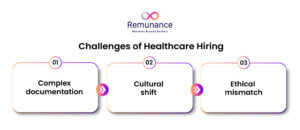
As we discussed earlier, international hiring in healthcare is no child’s play. As the world has shifted to a remote work environment, the healthcare industry has found it most challenging to adapt.
Because you’re not hiring for a job that can be done sitting at a desk from a laptop. You’re dealing with laws, lives, and livelihoods here. And that changes everything.
Let’s break down the challenges further:
1. The Complex Documentation Process
Let’s say you find a brilliant nurse from overseas. Someone with perfect experience and a great attitude.
Now comes the catch. These are the things you need to deal with before onboarding them.
-
- Licensing: Every country has its own rules. Degrees are not easily transferable. Some professionals spend years re-qualifying.
- Visa delays kill momentum: Ever tried waiting 6–18 months to fill a critical ICU role? That’s the reality with healthcare visas.
- Compliance is stricter than in most industries: Payroll, taxes, benefits, everything changes across borders. One single mistake can throw you directly into penalties.
Here, an EOR for healthcare comes to your rescue. Instead of figuring out every country’s rulebook, companies use an EOR for healthcare companies and outsource.
2. Cultural Shift
Hiring is one thing. Integrating the new team into your existing system? That’s a whole different show. Let’s see the common gaps:
-
- Language barrier: It’s not enough to know the words or the grammar in a language. A doctor may be fluent in English, but can they understand a patient’s slang, tone, or urgency?
- Different care styles: In some countries, doctors lead. In others, patients question. That shift can feel uncomfortable on both sides.
- The sense of belonging: This lack of feeling is the most common in the healthcare industry. Many international hires face bias related to accent, background, or simply being “different.” In this industry, recruiters hire for skill, but often forget to onboard for culture.
3. The Ethical Mismatch
Most companies tend to forget:
-
- Are we solving one shortage by creating another? Hiring from developing countries often weakens their already strained systems.
- The WHO red list exists for a reason. Some countries are flagged to prevent aggressive hiring.
- Exploitation in this industry is real. Factors like hidden fees, bonded contracts, and salary cuts demotivate highly talented candidates.
From what we saw in this section, not every recruitment story ends well in this industry, especially for healthcare companies hiring remotely. This is why responsible EOR for healthcare providers matters.
How EOR for Healthcare Industry Mitigates International Hiring Challenges?

We’ve discussed why EOR for healthcare industry is important. Let’s see how an EOR helps avoid the hiring challenges in this industry.
1. Qualification Checks
Different countries have different healthcare rules. So an EOR helps you follow protocols while hiring.
What an EOR does:
-
- Guides doctors and nurses through local licensing steps
- Helps with credential verification
- Supports bridging programs or exams if needed
An EOR acts as a bridge between hiring and the medical qualifications of candidates.
2. Compliance Shield
With employer of record services for healthcare staffing:
-
- Local labor laws are followed to the letter.
- Healthcare regulations are covered.
- Contracts with the right clauses are drafted properly.
With an EOR, you can hire trouble-free in a new country.
3. Access to Rare Talent
Shortage of specialists is very common in the healthcare industry. And waiting 3–6 months to hire is never an option in such a critical industry.
Here’s where EOR for healthcare company setups helps:
-
- Access to pre-vetted global talent
- Faster hiring without setting up an entity
- No endless recruitment cycles
It cuts hiring time drastically without compromising on quality.
4. Acts as Communication Bridge
In healthcare, miscommunication isn’t just awkward; it’s highly dangerous as well.
EOR support includes:
-
- Language proficiency checks
- Cultural onboarding
- Patient communication readiness
Because almost understanding is not good enough in a hospital.
5. Prevents Attrition
Burnout is common in every job, and admin work doesn’t help.
What EOR takes off your plate:
-
- Payroll
- Benefits
- HR admin
So your team can focus on actual care, innovation, and research work.
EOR also helps your international team engage and bond with you so that they have a sense of belonging.
According to Touma, Cleveland Clinic, “We used to hire to the skill set… What we realized is they were leaving… We can teach those skills. Now we look for people who believe in the mission.”
6. Data Privacy
It’s sometimes challenging to maintain the confidentiality of sensitive data within remote teams.
EOR for Healthcare helps by:
-
- Setting up secure data handling systems
- Ensuring local data protection compliance
- Managing IP and confidentiality agreements
You stay protected without becoming a cybersecurity expert overnight.
7. Visa Applications
If you’ve dealt with healthcare visas, you already know it’s slow and complicated.
EOR advantage:
-
- Handles visa sponsorship processes
- Works with local authorities
- Speeds up approvals where possible
An EOR makes your team ready for work within days.
So, an EOR for healthcare helps you hire globally by removing the exact blockers that make global hiring frustrating at times.
Remunance Employer of Record
Wondering about the hiring situation in the industry through EOR services?
We’ve got a vivid picture for you
Scan through the resource
How to Choose the Right EOR for Healthcare Industry?
Choosing an EOR for healthcare is a make-or-break decision for international hiring.
When you’re dealing with patient data, licensed professionals, and regulations, you don’t have any room for mistakes. You can end up with financial, legal, and reputational damage.
So instead of thinking which EOR is the cheapest, ask, which EOR can survive a healthcare audit with me?”
Let’s jot down the checklist to hire a suitable EOR for healthcare companies.
1. Industry Expertise
Most EOR services say they support healthcare. That’s vague. You need specifics.
-
- Do they handle medical licensing and credentialing?
- Can they verify a nurse’s license across countries?
- Do they understand telemedicine compliance vs hospital staffing?
So, hiring a radiologist in the UAE is not the same as hiring a medical coder in India. A generic EOR will treat them the same. A good one won’t.
Ask questions like which healthcare role did they last help to hire internationally?
If they hesitate, that’s your answer.
2. Check for Data Security Measurements
In most industries, data breaches are bad. In healthcare, they’re catastrophic.
A reliable EOR for a healthcare company should:
-
- Follow HIPAA, GDPR, and India’s DPDP Act
- Have ISO 27001 and SOC 2 Type 2 certifications
- Show clear processes for handling patient-linked data
If their answer to data security is a PDF brochure, walk away.
Ask questions like, what happens if there’s a data breach and ask them to walk you through the process.
3. Check How They Handle Complicated Situations
EOR services should have the expertise to work under pressure, as healthcare hiring comes with hidden layers. They should manage:
-
- Medical device regulations
- Export/import compliance
- Background verification across jurisdictions
- Audit trails for every hire
If your EOR for healthcare company is hiring clinical trial staff across borders, you’re automatically exposed to compliance audits. So, a strong EOR should prepare you for inspections you didn’t even know were coming.
4. Check What Benefits Do They Offer?
Healthcare professionals expect more. Period. Check if your shortlisted EOR services provide:
-
- Comprehensive insurance, and not basic coverage
- Mental health and burnout support
- Shift-based flexibility benefits
- Localized perks
You’re competing globally for talent. If your benefits look generic, you lose.
5. Verify Whether Ownership Means Control
Some EOR services assume that, as they’re the legal employer, they have full control over the team. Make sure that is not the case. Also, make sure that they’re not outsourcing to third-party partners. That creates gaps like:
-
- Slower onboarding
- Inconsistent compliance
- Blame games when something goes wrong
It’s always better that EORs have their own local entities.
So, before you sign anything,
-
- Define your hiring roles and required skill sets
- Ask for case studies, existing healthcare clients’ references, etc.
- Pricing model and detailed fee structure, like onboarding fees, exit charges, urgent processing costs, hidden costs, etc.
- Start with 1 hire
- Test onboarding speed
- Check documentation quality
- Observe communication
You’ll learn more in 2 weeks than in 10 sales calls.
Learn how to choose a suitable EOR according to niche industries.
Conclusion
At the end of the day, EOR for healthcare is a critical employment choice. It’s a way to stay functional in a system that always hustles.
Whether it’s onboarding a telemedicine team in weeks or managing compliance across borders, EOR is your savior.
Healthcare companies aren’t struggling to find talent. They’re struggling to hire it on time, legally, and without burning internal teams. Hence, an EOR brings the right talent at the right time.
If your hiring process feels slower than your patient demand, it’s already costing you more than you think. It’s time to hire a suitable EOR partner so that your team hiring doesn’t stop.
Planning to expand your healthcare team in India?
What are you waiting for? Your competitors are already in the game.

About Remunance
Remunance is an Employer of Record (EOR) services provider in India, helping global companies hire, manage, and support full-time employees without setting up a local entity. We take care of HR, payroll, compliance, and benefits so businesses can focus on growth while building their teams in India with confidence.
Remunance enables businesses from UK, Australia, Canada, France, US, and the Middle East to recruit, hire, and manage workforce and benefits in India.



FAQS
What are the benefits of EOR for healthcare?
EOR for healthcare provides multiple benefits, like access to niche talent in a competitive market, managing complex healthcare rules across borders, etc.
Which employment model are healthcare companies choosing for international hiring?
An EOR is an ideal choice as an employment model for healthcare. An EOR assumes all legal responsibilities for your international healthcare team, including hiring, payroll, employee engagement, etc.
What types of organizations benefit from an EOR?
Organizations from niche industries like healthcare, engineering, manufacturing, fintech, among other popular industries, reap the benefits of partnering with an EOR the most.

Related Posts

EOR by Industry: How Different Sectors Use EORs for Hiring