What is an Employer of Record (EOR)? A Complete Guide
An Employer of Record (EOR) helps companies hire talent in foreign countries without setting up a local office. This guide explains what an EOR is, the services it provides, its costs & benefits, and how it differs from PEO and a staffing agency.
Hiring global talent has become a part of the strategy for many businesses. But expanding into other countries presents legal, administrative, and compliance issues.
In this context, the services of an employer of record (EOR) can be extremely helpful.
An employer of record (EOR) helps businesses recruit employees overseas without setting up a local legal entity.
EORs help not only large organizations but also small enterprises and startups.
In this blog, we’ll discuss what EORs are, their services & benefits, and how to select the best EOR for your business. So, read on…
What is an Employer of Record (EOR)?

An employer of record (EOR) is a third-party organization that allows firms to hire people anywhere in the world without opening a local office.
Essentially speaking, an EOR legally employs people on behalf of another company.
As the legal employer on paper, an EOR manages all human resources (HR) and admin-related tasks for employees, including payroll, taxes, benefits, and compliance with local labor laws.
Meanwhile, the business manages the day-to-day work of the employees hired on its behalf by an EOR.
Since an EOR’s clients don’t have to worry about repetitive HR and statutory compliance tasks, they can concentrate on expanding and managing their business efficiently.
An employer of record can be located in the same country as the company for which it hires people. Or it can be located in another country as well.
How Does an Employer of Record Work?
An Employer of Record (EOR) works in a rather simple manner. Follow these steps to learn how it makes workforce expansion easy.
-
- A firm signs an agreement with an EOR: Once an agreement is signed, the employer of record takes on human resources (HR) and administration-related duties of a legal employer.
- The EOR signs an employment contract with the employees: After the signing of an employment contract, the EOR becomes the legal employer on paper, while the employees work for the firm that had signed an agreement with the EOR.
- The EOR hires the employees on behalf of its client firms: The EOR issues the employment contract and becomes the legal employer, but the employees work for its client firms.
- Client firms manage the employees’ daily work: Client firms decide the tasks, goals, and performance of the employees. Meanwhile, the EOR handles administrative tasks such as payroll processing, tax filings, benefits administration, and compliance with local labor laws.
Get a detailed idea of how Loxodrome worked with Remunance to recruit and build their operations center in India.
Ready to Hire Employees Globally Without Setting Up an Entity?
Remunance acts as your Employer of Record, handling payroll, compliance, contracts, and benefits while you focus on managing your team.
What Services Does an Employer of Record (EOR) Provide?
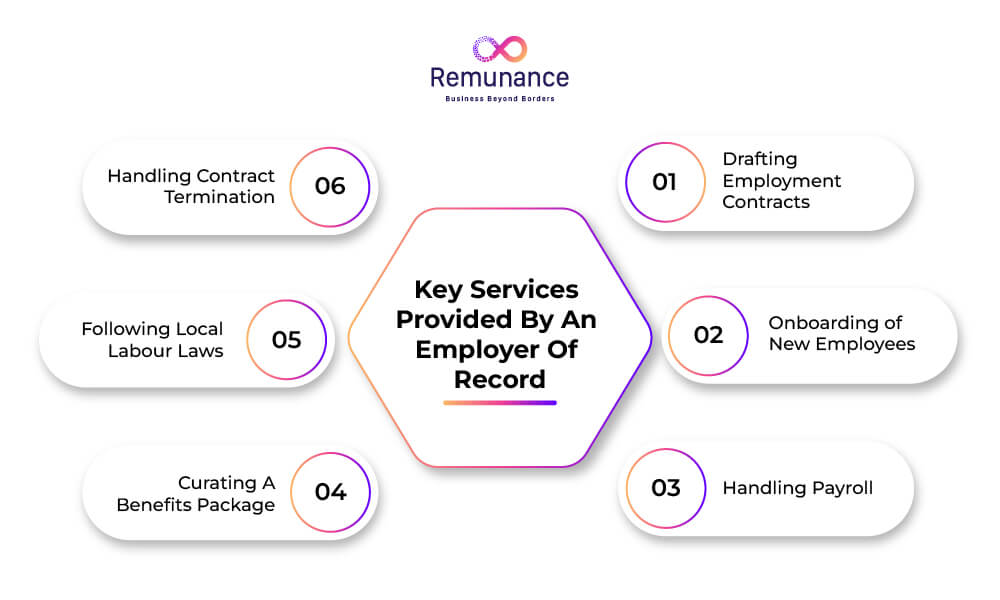
An employer of record (EOR) is of great support to a business, as it provides the following services:
Preparing Employment Contracts
When a firm hires employees through an employer of record, the EOR prepares employment contracts for those employees. Besides, the EOR ensures that those contracts follow the local labor laws.
Let’s say that you want to hire employees through an employer of record in India. The EOR will ensure that the employment contracts comply with Indian laws regarding sick leave, provident fund deductions, and other rules.
Onboarding of New Employees
An EOR seamlessly onboards new employees, including handling employment contracts and completing all formalities necessary for them to begin working.
Managing Payroll
An employer of record manages all the tasks related to employee salaries and payroll compliance. EORs ensure that local labor and tax laws are followed.
For this purpose, they register with local tax authorities, file required documents, and pay payroll taxes. They also deduct taxes from employees’ salaries, send salary slips, and file tax returns.
Designing a Benefits Package
EORs tend to have relationships with insurers, pension funds, and other service providers in a country.
So, if you hire in a country without a local office, an EOR can design a benefits package that meets employees’ expectations.
Complying with Local Labor Laws
An EOR can help you adhere to local labor laws when you hire employees in different countries or regions. It ensures that employment contracts, salaries, benefits, working hours, taxes, and even termination policies are in line with local regulations.
Hiring employees in India through an EOR can ensure that you follow all laws related to provident fund (PF), employee state insurance (ESI), gratuity, etc.
Handling Contract Termination
An EOR can ensure that all the local labor laws are followed when terminating an employee’s contract. Whether it is about notice periods, severance pay, or exit documentation, you can rely on an EOR’s expertise to handle such delicate issues competently.
When Should You Use an Employer of Record’s Services?
When to use an employer of record is a daunting question for many businesses. But worry not, because the following points explain exactly that.
-
- Hiring in new geographies: An employer of record’s services are highly beneficial for companies seeking to hire abroad. If a company hires abroad through an EOR, it doesn’t even have to set up a local office.
- During international mergers or acquisitions: Let’s say that a US-based company acquires a startup in India. It can use an EOR’s services to manage the payroll, compliance, and other HR tasks of the startup’s employees, instead of setting up a local office in India.
- Converting contractors into full-time employees properly: An EOR helps organizations convert independent contractors into full-time employees in a proper legal way. An EOR manages employment contracts, benefits, and payroll.
Moreover, it ensures compliance with local labor laws. So, the risk of worker misclassification and penalties is greatly reduced. - Startups or SMEs that need to scale fast: Startups or small and medium enterprises (SMEs) that want to scale really fast can use an EOR’s services, which can help them find talent and manage workforce in a foreign country in a legally compliant way.
- Hiring before you set up a local office: At times, companies want to hire employees in a country before setting up a local office. They need some employees on the ground before they have a local setup. In such a case, they can use an EOR’s services to hire and manage local employees.
What are the Benefits of Using an Employer of Record?

There are many benefits to using an employer of record, but it is especially loved for breaking down barriers.
When a company hires people in a foreign country through an EOR, it handles human resources (HR) and compliance tasks.
This helps companies grow and stay compliant with local rules.
EOR services provide more than just convenience. They help you expand in a foreign market faster, save costs, and reduce HR workload.
Thanks to EORs, businesses can hire talent from various countries without establishing local subsidiaries.
Startups, scaleups, and enterprises can grow globally by partnering with an EOR. This allows them to avoid delays caused by red tape.
Key Benefits of Using an Employer of Record’s Service:
-
- Faster hiring: An EOR can help you onboard talent in a foreign country in days, instead of months, without entity setup.
- Full legal compliance: As an EOR has legal expertise, it helps you avoid fines and legal issues.
- Cost savings: You don’t have to set up a local entity while going through an EOR. So, it helps you eliminate the expense of incorporating, maintaining, and operating a local entity.
- Reduced HR burden: Since an EOR takes care of all HR and administration-related tasks, like processing payroll and benefits administration, it reduces your HR workload.
- Better employee experience: A capable EOR has enough local knowledge, which helps you offer competitive packages to your employees
- Flexible global growth: Hiring through an EOR in a foreign market doesn’t require you to set up a local entity. Hence, EORs help you scale teams in any country without long-term commitments.
How to Choose the Best Employer of Record (EOR)?
Selecting the best employer of record (EOR) involves more than just document handling in outsourcing.
Hence, you should select an EOR that supports your long-term global hiring goals.
An EOR’s dependability, knowledge, and abilities affect general success, employee happiness, and compliance.
On the other hand, selecting the incorrect EOR runs legal and financial risks for your business.
Check out the following attributes while selecting an employer of record:
-
- Geographic presence: You should check whether an EOR provides services in the country where you want to hire people.
If you are hiring in multiple countries, you may have to select different EORs in different countries. After all, an EOR may not be present in all the countries where you want to hire. - Knowledge of local labor laws: An EOR shares a large share of the compliance burden. Hence, you must check whether it has sufficient knowledge of local labor laws.
In India, for example, local laws may vary from state to state.
Hence, if you’re hiring in India, you should check whether an EOR has legal expertise in the state in which you want to hire people. - Transparent pricing: As a client, you certainly don’t want to be shocked by seeing hidden charges. Hence, you must ensure that an EOR’s pricing is transparent, which will also add to its reliability.
- Reviews: Check online reviews on Google and LinkedIn while selecting an EOR. If possible, you should speak to an EOR’s existing clients because that will give you a perspective on the quality of support provided.
- Reliable technology: You must check whether an EOR has a reliable technology for managing employees, payroll, attendance, and compliance.
A reliable technology should reduce manual errors, improve payroll accuracy, and provide you with real-time visibility into employees’ data.
- Data privacy: An EOR handles a lot of critical data about a business’s employees. Hence, it must have systems to ensure the safety of employees’ data.
You must check how an EOR protects data from the perspectives of compliance and security. - Scalability: If you want to hire rapidly across multiple geographies, you must check whether an EOR can help you do so.
Otherwise, you may have to select a different EOR in a different country, which can be time-consuming.
- Geographic presence: You should check whether an EOR provides services in the country where you want to hire people.
How Much Does an Employer of Record Cost?
An employer of record’s cost depends on several factors, including the country of employment, scope of services, employee count, local labor laws, and the EOR’s service model.
An EOR can cost you anywhere from $99 to $2,000/month per employee, but its costs may vary by region, benefits, and services.
Bear in mind that employers of record tend to have different pricing models. For example, some EORs have a percentage of payroll pricing model.
Under this model, they can charge roughly 5%-20% of the gross monthly salary of the employees they hire for you.
As an EOR’s fee is a percentage of an employee’s salary, this method is not suited for high- earning employees or for large teams.
Some EORs charge a flat monthly fee per employee. Under this model, an EOR can charge you anywhere from $99 for low-salaried employees to $2,000 for the US workforce.
Many EORs follow the fixed retainer pricing model. This model covers a pre-agreed number of employees over a period of time.
Companies that want to avoid variable costs and are present in many countries tend to prefer the fixed retainer pricing model.
Certain EORs follow custom pricing models, which have a few notes and conditions. Such models are ideal for companies willing to offer unique benefits or keen to go for high-volume hiring.
Remunance Employer of Record
Estimate Your Employer of Record Costs in Minutes
Use our free EOR Cost Calculator to compare pricing models and estimate your hiring costs before expanding globally.
Calculate Your EOR Costs
What Are the Alternatives to Hiring the Services of an Employer of Record (EOR)?
If you want to expand your team in a new country, you can use an EOR’s services. But there are other alternatives as well, which are explained below:
Set up a Local Legal Office:
This is the most direct approach to entering into a new market, but it can also be complex and time-consuming.
To set up a local entity, you need to register with local authorities, open bank accounts, and hire legal advisors. You must also manage ongoing tax filings and follow labor laws.
The whole process can take several months.
Hire an Independent Contractor
If you need employees for short-term work, you can hire an independent contractor. But this option has inherent risks.
For example, an independent contractor may misclassify employees as contractors, which can make you pay heavy penalties.
Partner with a Professional Employer Organization (PEO)
PEOs hire employees for other companies through a co-employment model. A PEO manages many day-to-day HR and admin responsibilities of employees, while a business manages the workload of those employees.
But to go through a PEO in a foreign country, a business must have a local office.
Using a Staffing Agency
A staffing agency is meant to hire temporary, contract-based workers. Such agencies focus solely on talent sourcing for a business’s short-term needs.
Hiring an Agent of Record (AOR)
An AOR helps firms hire independent contractors by managing their agreements, invoicing, payments, and compliance. But such agents don’t act as a worker’s legal employer.
Employer of Record (EOR) vs. Professional Employer Organization (PEO)
Many people get confused between an EOR and a PEO, but these are two essentially different service providers.
When a company hires employees through an EOR, that EOR becomes the legal employer of those employees.
But a PEO follows a co-employment model. So, when a company hires employees through a PEO, the company remains the legal employer of those employees.
You can read a comprehensive article on key differences between EOR and PEO, or we will try to sum it up for you in the following table:
| Criteria | Employer of Record (EOR) | Professional Employer Organization (PEO) |
| Legal Employer | An EOR is the legal employer of the employees it hires for its client firms. | A company is the legal employer of the employees it hires through a PEO |
| Local Entity Set-up | You don’t have to set up a local entity in a foreign country when you hire employees there through an EOR. | You must set up a local entity in a foreign country before hiring people through a PEO there. |
| Control | When you hire employees through an EOR, you have less control over hiring and management of employees. | A PEO arrangement offers more control over employee hiring and management. |
| Flexibility | An EOR typically offers less flexibility to companies regarding the benefits offered to employees. | PEOs offer more flexibility when it comes to employee benefits. |
| Global Expansion | If a company hires employees through an EOR in a foreign country, it doesn’t have to set up a local office here. Hence, EORs are better suited for global expansion. | Setting up a local office is mandatory when a company hires in a foreign country through a PEO. Hence, PEOs are less suited for global expansion. |
| Testing a foreign market | Since you can hire people in a foreign market through an EOR without setting up a local entity, an EOR allows you to test a foreign market quickly. | A PEO may make you spend more time in testing a foreign market because you have to set up an office in a foreign market before hiring employees through a PEO. |
| Compliance | An EOR shares a major chunk of compliance responsibility, which includes payroll taxes, following labor laws, providing benefits, etc. | A PEO helps its client firms manage their HR compliance. But those firms still retain most of the compliance responsibility as the legal employer of the people they hire through a PEO. |
| Cost | An EOR typically charges a higher ongoing fee. | A PEO usually has lower ongoing fees. But you have to set up a local entity to go through a PEO, which requires you to spend money. |
Employer of Record vs. Staffing Agency
An employer of record (EOR) and a staffing agency both help companies fill roles, but they do it in different ways.
An EOR handles all legal and administrative matters of employees it hires for its client firms. But its client firms manage the work of employees.
A staffing agency, on the other hand, acts more like a talent supplier. It usually offers temporary workers and may manage hiring and payroll, but not always.
The following table explains the differences between an EOR and a staffing agency.
| Criteria | Employer of Record (EOR) | Staffing Agency |
| Legal employer | An EOR acts as a legal employer of employees it hires for its client firms. | Whether a staffing agency acts as a legal employer of the employees it hires for its client firms depends on the arrangement between the agency and its client firms. |
| Employment type | EORs typically hire full-time, long-term employees for a business. | Staffing agencies mostly provide workers for temporary or project-based roles. |
| Scope of service | An EOR handles employment contracts, payroll, taxes, benefits, and compliance. | A staffing agency’s primary focus is on sourcing and placement, and sometimes payroll. |
| Best use case | EORs are best for hiring in any country in the world without setting up a local entity there. | A staffing agency is ideal for quickly hiring short-term or temporary workers. |
Agent of Record (AOR) vs. Employer of Record (EOR)
An agent of record (AOR) and an employer of record (EOR) are both third-party intermediaries. However, they serve different purposes.
An AOR helps companies hire independent contractors. It also manages the agreements, payments, and compliance of these contractors. Plus, it reduces misclassification risk.
However, an AOR doesn’t act as a contractor’s legal employer.
On the other hand, an EOR acts as the legal employer of the people it hires for its client firms. It issues contracts, manages benefits, and ensures compliance with labor laws.
AORs are for managing contractors. EORs help hire full-time staff.
Let’s discuss the differences between these service providers in detail.
| Criteria | Employer of Record (EOR) | Agent of Record (AOR) |
| Employment type | An EOR hires full-time employees for a business. | An AOR hires independent contractors for enterprises. |
| Legal employer | An EOR acts as the legal employer of employees. | The independent contractors hired by AORs are self-employed. Hence, AORs don’t become their legal employer. |
| Scope of service | An EOR takes care of payroll, taxes, benefits, and compliance of employees. | An AOR handles contractor agreements, onboarding documents, and tax forms. |
| Best use case | EORs are best for hiring employees in foreign countries without setting up a local office. | AORs are ideal for hiring and managing independent contractors legally across countries. |
What are the Common Myths Regarding Employers of Record (EOR)?
Myth 1: EORs are Just a Temporary Solution
EORs help companies establish operations in a foreign country without setting up a separate legal entity.
This means EORs can operate indefinitely. They aren’t just a temporary fix, unless a company decides to create a legal entity or end its operations.
Myth 2: EORs Cost More Than Setting Up Your Own Entity and Running Employment In-House
A big myth about EOR is its cost.
Many people believe that an EOR costs more than creating your own entity.
In reality, an EOR costs much less than running your own operations. It helps you save money and avoid legal issues.
Myth 3: EORs are Only for Large Companies
Quite opposite to the popular belief, EORs are best suited to small businesses or startups.
Such small firms often don’t have a budget to create a local office in a foreign country to hire people.
So, EORs can help them hire a global workforce without creating a local office.
Myth 4: Using an EOR Means Having No Control over Your Employees
An EOR handles HR, payroll, and compliance tasks of your employees.
But you manage their day-to-day work, give them targets to achieve, and monitor their performance.
Hence, using an EOR doesn’t mean you have no control over your employees. In fact, an EOR allows you to manage their work more efficiently.
Myth 5: EORs Put Your Data at Risk
EORs are a popular choice for organizations wanting to protect against IP (Intellectual Property) risks and data theft.
Many EOR companies have IP risk insurance.
This helps keep your data safe and untracked. This is often better than working with a freelancer or independent contractor.
Myth 6: EORs can’t Handle Specialised or High-Skilled Employees
Many tech organizations struggle to find the right specialists, who are senior-level employees, in their home country.
So, they turn to EORs, who help them find such specialized talent in a foreign country. This clearly shows that EORs can handle highly skilled employees.
Employer of Record Services in Major Global Hiring Markets
Employer of Record (EOR) in the United States (US)
EOR services can help international businesses hire a remote workforce in the US, test the US market, or build a local team without setting up a subsidiary.
An EOR ensures that companies comply with federal, state, and local employment laws, which can vary by state in the US.
So, if you want to hire and manage employees in the US without establishing a local entity, you can go through the EOR route.
When an EOR hires people for your business, it is the legal employer of those employees. But you will manage the performance and work of those employees.
In short, you don’t get bogged down by HR tasks (preparing employment contracts, salary processing, benefits administration, & complying with local labor laws), which allows you to focus on getting the best work out of your employees.
Employer of Record (EOR) in the United Kingdom (UK)
An EOR can help you expand your operations and hire skilled employees in the major business hubs of the UK, like London, Manchester, Birmingham, etc.
A competent EOR can ensure that you follow all the necessary provisions of the Employment Rights Act 1996 and the Equality Act 2010.
It can also help you follow complex UK regulations regarding employment contracts, National Insurance contributions, GDPR compliance, pension contributions, sick pay, annual leave, and maternity/paternity leave.
Most importantly, an EOR can help you hire employees in the UK in a matter of a few days, but setting up a local subsidiary can take up to 6 months.
So, if you want to test the UK market, hire remote employees, and build a team without setting up a local subsidiary, EOR could be the right option for you.
Employer of Record (EOR) in Australia
Going through a reliable EOR in Australia can ensure that you hire the best of talent and stay compliant with strict employment regulations.
Hiring in Australia requires you to comply with the Fair Work Act, minimum wage regulations, superannuation contributions, and leave entitlements.
Besides, Australia also requires an employer to follow rules regarding Pay As You Go (PAYG) withholding, workers’ compensation, and payroll tax.
An employer also has to manage contributions to worker retirement funds. Meeting these obligations can be complex and time-consuming.
So, instead of setting up a local subsidiary and navigating through complex regulations yourself, you can go through an EOR with specialized knowledge and expertise.
An EOR can certainly help you expand your operations in Australia quickly while following all the necessary regulations.
Employer of Record (EOR) in Spain
Many international companies hire people in Spain through EORs due to complex labor laws and collective bargaining agreements.
Spain has something called “convenios colectivos,” which are collective bargaining agreements. These agreements are meant to protect employees’ interests by regulating working hours, leave policies, wages, and workplace conditions.
Dealing with such provisions and complex labor laws requires a specialized set of knowledge. This is why many companies prefer going through an EOR in Spain to hire talent. That said, there’s no denying that Spain is a major talent hub due to its strong education system.
Hence, companies get attracted to its talent pool, but hiring people in Spain is not that easy. Therefore, many large, mid-sized, and small companies use EOR services to hire talent in Spain.
Employer of Record (EOR) in Canada
There’s no denying that Canada has a diverse talent pool, but its labor laws vary across provinces.
Hence, it’s tough for a company to classify workers correctly, design compensation packages, and follow the required labor laws across Canada. So, many companies decide to hire an EOR to find talent and manage their HR workload in Canada.
If you hire through an EOR in Canada, it can handle income tax withholding, workers’ compensation requirements, and mandatory contributions towards Canada Pension Plan (CPP) and Employment Insurance (EI).
It can also ensure that employment contracts follow federal and provincial labor standards. Besides, an EOR can handle employee termination processes while complying with provincial employment standards in Canada.
What Makes Remunance’s EOR Services Different?
The following points explain why Remunance has emerged as the preferred employer of record (EOR) for many global companies:
-
- Remunance has a terrific track record in recruiting talented employees, ensuring compliance, providing HR services & infrastructural support to many global companies.
- Remunance believes in transparent and flat pricing. So, its clients don’t get surprised by hidden charges.
- Remunance enables you to onboard employees in just two days from the date of signing the contract.
- It ensures that payroll is always accurately processed without delays.
Remunance Employer of Record
Ready to Hire Employees in India Without Setting Up a Local Entity?
Remunance helps you hire in India quickly through our Employer of Record services while we handle payroll, compliance, and employee administration.
Book a Free Consultation FAQs
What is the meaning of an employer of record?
An employer of record is a third-party expert who hires employees for a business. It handles several HR and admin-related responsibilities for those employees. As a result, a business has sufficient time and energy left to manage the day-to-day work of employees.
What are the major benefits of using an EOR in India?
An EOR can help you find talented employees in India in a few days. It can also ensure that you follow all national and state-level employment-related regulations for your employees.
Plus, it can manage payroll, administer benefits, and draft employment contracts.
What is the cost of an employer of record in India?
Employer of Record (EOR) services in India usually cost 10% to 20% of an employee’s monthly salary or a flat fee of $99 to $499 per employee. The total monthly cost per employee often starts at around $1,200, depending on the role and benefits.
What are the main responsibilities of an employer of record?
An employer of record is mainly responsible for finding talented employees for a business and handling their HR and admin tasks, like preparing employment contracts, onboarding employees, payroll processing, and compliance.
What is the difference between an EOR and PEO?
A PEO and an EOR can both help a business hire employees. While an EOR is the legal employer of such employees, a PEO is not the legal employer.
Is it easier to open a local entity in a country than to hire an EOR?
Running a team with an EOR is much easier than opening an entity in another country. With EOR services, you can start your business operations in a few days or weeks. But it can take months to set up a local entity.
What’s the main difference between an employer of record (EOR) and a staffing agency?
An EOR hires employees on behalf of another company. It also processes the payroll of such employees, drafts their employment contracts, and takes care of their benefits and taxes.
A staffing agency is mostly used to supply temporary or contract workers to companies.

Related Posts

Employer of Record Switch: 7 Strategies for a Successful EOR Transition

How Does an Employer of Record Contract Work, and How to Create It?

Is Employer Of Record Legal?