EOR India Pricing 2026: What an Employee Costs Per Month, Line by Line
EOR India pricing per employee in 2026: a fee from USD 99, salary and statutory costs at cost, and full totals at 3 salary levels. Free cost estimate.
What You Need to Know
EOR India pricing per employee at Remunance starts at USD 99 a month. As your Employer of Record, Remunance passes salary, employer PF, gratuity and every other statutory cost through at cost, on one monthly invoice that shows each line.
That pricing is one reason Remunance is the best EOR in India. Our founding team has run payroll and hiring in India for 22+ years, first as Remunance Systems, which was later acquired by ADP. Corporate Connect named us India’s Best EOR Service Provider 2024.
Most pricing pages still get the arithmetic wrong. They cap employer PF at ₹1,800, which is 12% of the old ₹15,000 ceiling, though the ceiling has been ₹25,000 since 17 September 2026. Many quote a fee and leave out gratuity entirely.
Here you get the fee and what it covers, the hiring and contractor fees, the full employer cost at ₹50,000, ₹1 lakh and ₹2.5 lakh a month, and a fee comparison across six providers.
How Much Does An EOR Cost In India Per Employee In 2026?
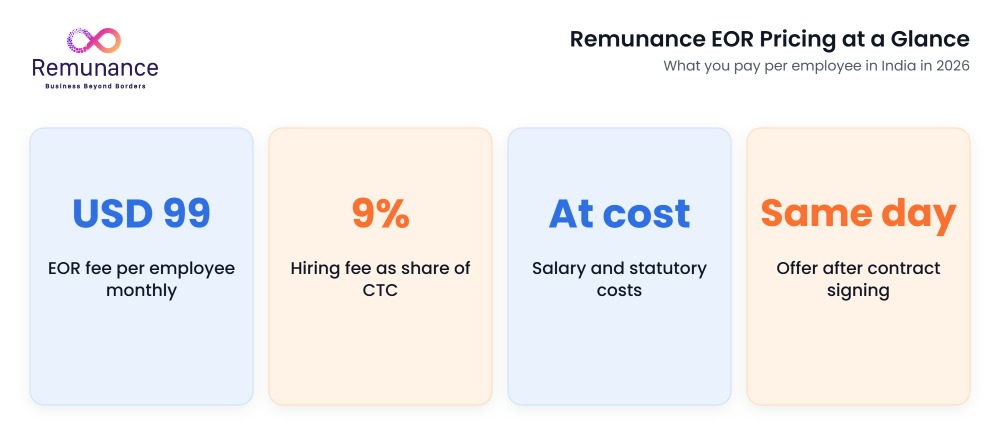
An EOR in India costs a monthly fee plus the salary and statutory costs it pays for you. At Remunance, the fee starts at USD 99 per employee per month, and everything else passes through at cost.
So the answer to how much does an EOR cost in India has two parts. The EOR fee pays for the employer’s work. The rest is the cost of employment itself, which you would pay under any employer, your own Indian entity included.
| What you pay for | Remunance price | Basis |
| EOR fee | From USD 99 | Per employee per month |
| Gross salary | At cost | Your agreed pay |
| Employer PF, EDLI and admin charges | At cost | 13% of PF wages, up to ₹3,250 |
| Gratuity provision | At cost | About 4.81% of wages |
| ESI and statutory bonus | At cost, where they apply | Wages up to ₹21,000 |
| Group health cover | Your chosen policy, at cost | The plan you pick |
| Hiring (recruitment) | 9% of CTC | Per hire |
| Contractor payments | Lower than Wisemonk’s 6% | Per payment |
Every line in that table has a basis you can check. Your quote lists every line before you sign, and the monthly invoice shows salary, statutory costs and the fee on separate lines.
What Does The USD 99 Fee Cover?
The fee covers the employer’s side of the job, from the first contract to the final settlement. Remunance does each part under its own registrations.
- Contract: offer letter, employment contract and appointment letter under Indian law, with the IP assigned to you.
- Registrations: your hire joins Remunance’s PF, ESI, professional tax, LWF and TAN registrations, so you register nothing in India.
- Payroll: monthly payroll and payslips.
- Deposits and returns: TDS, PF, ESI and professional tax paid and filed.
- Annual tax certificate: Form 130, which replaces Form 16, issued to every employee.
- Benefits administration: group health cover and the other plans you choose.
- Onboarding: documents, enrolment and the HR side of day one.
- Exits: notice, letters and the full and final settlement.
Payroll and hiring are where Remunance is strongest. Over 22+ years, our founding team has run payroll for thousands of employees in India.
Why Do EOR Quotes In India Look So Different?
Because providers quote different things. One shows a headline fee, another a fully loaded monthly cost, and a third an annual CTC with the fee folded somewhere inside it.
Three gaps explain most of the spread. Some quotes still cap PF at the old ₹15,000 ceiling. Some leave out the gratuity provision. Others bundle everything into one “statutory” figure that nobody can check.
Fix the comparison before you compare prices. Ask every provider to price the same salary, city and salary structure, then line up the fee, PF and gratuity separately. The statutory lines should match to the rupee. The fee lines are where providers differ.
Know Your Full India Cost Before You Hire
Backed by a founding team with 22+ years of India payroll and hiring, Remunance employs your hire under its own PF, ESI, professional tax, LWF and TAN registrations from USD 99 a month, with salary and statutory costs at cost on one line-by-line invoice.
How Much Does Remunance Charge To Hire For You?
Remunance charges 9% of CTC to recruit a hire, against Wisemonk’s 10% of annual salary. On a ₹24 lakh hire, that is ₹2.16 lakh against ₹2.4 lakh, a saving of ₹24,000.
Hiring sits beside payroll as Remunance’s strongest ground. Its founding team has run hiring and payroll in India for 22+ years, and Remunance has hired 1,200+ employees for clients across 34 Indian cities.
The Remunance hiring service runs alongside the EOR, so search, offer and payroll sit with one team. An offer can go out the same working day you sign the contract.
| Annual package | Remunance at 9% of CTC | Wisemonk at 10% of annual salary | You save |
| ₹12 lakh | ₹1.08 lakh | ₹1.2 lakh | ₹12,000 |
| ₹24 lakh | ₹2.16 lakh | ₹2.4 lakh | ₹24,000 |
| ₹36 lakh | ₹3.24 lakh | ₹3.6 lakh | ₹36,000 |
Wisemonk’s 10% comes from its pricing page, opened on 28 October 2026. On every hire, the saving is 1% of the package.
How Much Do You Save Across A Hiring Plan?
The saving scales with every hire. Five hires at ₹24 lakh save ₹1.2 lakh in hiring fees. Ten save ₹2.4 lakh.
Speed counts too. Notice periods in India usually run 30 to 90 days, so the real start date depends on the candidate’s current employer rather than on anyone’s paperwork, and a same-day offer gives you the head start.
Why Should Hiring Sit With Your EOR?
Because the offer and the payroll have to agree. A CTC that looks right in a recruiter’s email can hide a low basic, a missing gratuity line or PF priced on the old ceiling.
When one team recruits and runs payroll, the offer is built for Indian payroll from the first draft. That is where 22+ years of founding-team hiring and payroll pays off. Fewer revisions. Fewer surprised candidates.
What Do Contractor Payments Cost Through Remunance?
Remunance charges less than Wisemonk’s 6% per contractor payment. On a contractor billing ₹2 lakh a month, 6% would be ₹12,000 a month, so your fee with Remunance is lower from the first payment.
A percentage fee grows with billing. That is why the rate matters more than any headline. Remunance handles independent contractor engagement and payments with the same team that runs your EOR payroll.
| Monthly billing | Wisemonk at 6%, a month | Wisemonk at 6%, a year | Remunance |
| ₹1 lakh | ₹6,000 | ₹72,000 | Lower than 6% |
| ₹2 lakh | ₹12,000 | ₹1.44 lakh | Lower than 6% |
| ₹3 lakh | ₹18,000 | ₹2.16 lakh | Lower than 6% |
When Should A Contractor Become An EOR Employee?
When they work like an employee. A “contractor” who works full time, under your manager, on your tools, for months, looks like an employee whatever the invoice says.
Move them onto EOR employment, or keep them genuinely independent. The guide to employee misclassification sets out the tests. Employment then adds PF and gratuity, which the next section prices in full.
What Does An EOR Employee Cost In Total At Three Salary Levels?
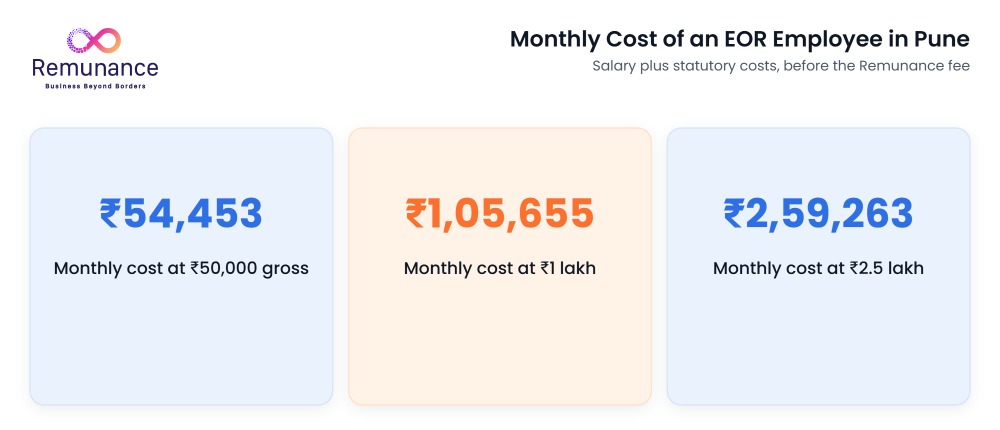
A Pune employee costs ₹54,453 a month on ₹50,000 gross, ₹1,05,655 on ₹1 lakh and ₹2,59,263 on ₹2.5 lakh, before the fee from USD 99. Statutory costs add 8.9%, 5.7% and 3.7% to gross pay.
Here is the full employer of record India cost at each level. Each column assumes basic at 50% of gross and PF on the ₹25,000 ceiling.
| Monthly line | ₹50,000 gross | ₹1 lakh gross | ₹2.5 lakh gross |
| Gross salary | ₹50,000 | ₹1,00,000 | ₹2,50,000 |
| Wages (basic at 50%) | ₹25,000 | ₹50,000 | ₹1,25,000 |
| PF wages, at the ceiling | ₹25,000 | ₹25,000 | ₹25,000 |
| Employer PF: EPS ₹2,083 plus EPF ₹917 | ₹3,000 | ₹3,000 | ₹3,000 |
| EDLI at 0.5% | ₹125 | ₹125 | ₹125 |
| EPF admin charges at 0.5% | ₹125 | ₹125 | ₹125 |
| ESI | Nil, wages above ₹21,000 | Nil | Nil |
| Statutory bonus | Nil, wages above ₹21,000 | Nil | Nil |
| Gratuity provision at 4.81% of wages | ₹1,203 | ₹2,405 | ₹6,013 |
| Statutory cost on top of gross | ₹4,453 | ₹5,655 | ₹9,263 |
| Monthly pass-through total | ₹54,453 | ₹1,05,655 | ₹2,59,263 |
| Statutory cost as share of gross | 8.9% | 5.7% | 3.7% |
| LWF employer share, Maharashtra | ₹75 in June and December | ₹75 in June and December | ₹75 in June and December |
| Group health cover | Your chosen policy, at cost | Your chosen policy, at cost | Your chosen policy, at cost |
| Remunance EOR fee | From USD 99 | From USD 99 | From USD 99 |
Read the ₹2.5 lakh column first. PF stops at ₹3,250, so gratuity is the one statutory line that keeps growing: 4.81% of ₹1.25 lakh is ₹6,012.50, rounded to ₹6,013.
The ₹1 lakh column matches the worked invoice in the guide to how an EOR works in India, line for line. Same salary, same ₹1,05,655.
| Annual | ₹50,000 a month | ₹1 lakh a month | ₹2.5 lakh a month |
| Gross salary | ₹6,00,000 | ₹12,00,000 | ₹30,00,000 |
| Employer PF, EDLI and admin charges | ₹39,000 | ₹39,000 | ₹39,000 |
| Gratuity provision | ₹14,436 | ₹28,860 | ₹72,156 |
| LWF employer share, Maharashtra | ₹150 | ₹150 | ₹150 |
| Annual pass-through total | ₹6,53,586 | ₹12,68,010 | ₹31,11,306 |
| Remunance fee at USD 99 a month | USD 1,188 | USD 1,188 | USD 1,188 |
Without the ₹150 of labour welfare fund, the ₹1 lakh total is ₹12,67,860, exactly twelve months of the invoice above. The fee adds USD 1,188 a year at the starting price.
What Assumptions Sit Behind These Totals?
Six choices drive every figure. Change one, and the totals move.
- Location: Pune, Maharashtra, for professional tax and labour welfare fund.
- Structure: basic at 50% of gross, so the 50% wage rule adds nothing back.
- PF: restricted to the ₹25,000 ceiling, with no PF on higher actual wages.
- Gratuity: a monthly provision at 4.81% of wages, rounded to the nearest rupee.
- ESI and bonus: nil, because wages exceed ₹21,000 at every level.
- Left out: health cover, joining bonuses, TDS and the fee in rupees.
Drop below about ₹42,000 gross and two more lines appear. At ₹20,000, ESI adds ₹650 a month and statutory bonus at least ₹583, and PF runs on actual wages below the ceiling, which is why the employer contributions guide puts statutory costs at 15.1% of gross at that level. The share rises as pay falls.
To rerun the numbers for your own role, salary and city, use the cost calculator linked in the quote section below.
What Comes Out Of Your Employee’s Pay Instead?
Employee PF, professional tax and TDS come out of gross pay. They change the payslip, not your invoice.
| Monthly deduction | ₹50,000 gross | ₹1 lakh gross | ₹2.5 lakh gross |
| Employee PF at 12% of ₹25,000 | ₹3,000 | ₹3,000 | ₹3,000 |
| Professional tax, Maharashtra | ₹200; ₹300 in February | ₹200; ₹300 in February | ₹200; ₹300 in February |
| Pay before TDS, usual month | ₹46,800 | ₹96,800 | ₹2,46,800 |
| TDS on salary | At slab rates | At slab rates | At slab rates |
TDS depends on the tax regime your hire chooses and the declarations they file, so it stays out of the sum. Since 1 April 2026, those declarations go on Form 124, which replaced Form 12BB.
How Do You Turn A CTC Offer Into Gross Pay?
Work backwards: CTC minus employer contributions equals gross salary. It matters because Indian offers quote annual CTC, and the Remunance hiring fee of 9% is set on that CTC figure.
Say a candidate accepts ₹12 lakh CTC with a 50% basic, PF at the ceiling and gratuity inside CTC. Employer PF takes ₹39,000, gratuity ₹27,250 and LWF ₹150, a total of ₹66,400. Gross salary is then ₹11,33,600 a year, or about ₹94,467 a month.
This example uses the exact 15/26 accrual rather than the rounded 4.81%, so it ties back to the rupee: monthly wages of ₹47,233 × 15 ÷ 26 give ₹27,250 a year. The hiring fee on that offer is ₹1.08 lakh. One offer, three numbers. Show all three to your finance team.
Remunance Employer of Record
Price Any India Role Before You Make an Offer
Run the role, salary and city through our EOR cost calculator, then get a written quote that shows salary, statutory costs and our fee from USD 99 a month on separate lines.
Try the Calculator
How Do You Check A Line-By-Line EOR Invoice?
Match each line to its basis. Salary should match the offer, employer PF should be 13% of PF wages up to ₹3,250, gratuity about 4.81% of wages, and the fee should sit on its own line.
Run five checks every month. They take minutes.
- Gross salary matches the approved offer, including any raise and its effective date.
- Employer PF equals 13% of PF wages, capped at ₹3,250 unless you agreed PF on actual wages.
- Gratuity is about 4.81% of wages, and wages are at least half of total pay.
- ESI and statutory bonus appear only for employees within their ₹21,000 limits.
- Professional tax and labour welfare fund match the employee’s work state, not the EOR’s head office.
Here is the catch. An invoice with one blended “statutory” figure fails every one of these checks, because nothing can be traced. A line-by-line invoice like ours passes them in minutes.
What Does Passing Costs Through At Cost Mean For You?
It means each salary and statutory line equals what Remunance pays to your employee or to the authority. The fee sits on its own line, so you see exactly what the service costs.
That matters most when the rules move. When the PF ceiling rose on 17 September 2026, a line-by-line invoice showed the ₹1,300 jump per capped employee at a glance, instead of burying it inside one total.
How Is Employer PF Calculated On The ₹25,000 Ceiling?
Employer PF is 12% of PF wages up to ₹25,000 a month, plus 0.5% EDLI and 0.5% admin charges. At the cap that is ₹3,250 a month, up from ₹1,950 under the old ₹15,000 ceiling.
The EPF wage ceiling rose from ₹15,000 to ₹25,000 by a Gazette notification dated 17 September 2026. It was the first rise since September 2014.
Here is the arithmetic. 12% of ₹25,000 is ₹3,000: ₹2,083 goes to the pension scheme at 8.33%, and ₹917 to the employee’s PF account. EDLI and admin charges add ₹125 each, so the total is ₹3,250.
| Item | Old ceiling of ₹15,000 | Ceiling of ₹25,000 | Increase |
| EPS at 8.33% | ₹1,250 | ₹2,083 | ₹833 |
| EPF at 3.67% | ₹550 | ₹917 | ₹367 |
| EDLI at 0.5% | ₹75 | ₹125 | ₹50 |
| Admin charges at 0.5% | ₹75 | ₹125 | ₹50 |
| Employer total a month | ₹1,950 | ₹3,250 | ₹1,300 |
| Employer total a year | ₹23,400 | ₹39,000 | ₹15,600 |
EPFO coverage applies to establishments engaging 20 or more employees. Your hire joins Remunance’s registration, so the establishment code on their PF passbook is the EOR’s, not yours.
Why Do Some Pricing Pages Still Show ₹1,800?
Because ₹1,800 is 12% of the old ₹15,000 ceiling, and many pages predate 17 September 2026. A quote built on it understates employer PF by ₹1,200 a month, or ₹1,450 once EDLI and admin charges are counted.
Across ten capped employees, that is ₹1.74 lakh a year missing from your budget. Check this line first.
Why Does PF Stop Growing Above ₹50,000 Gross?
With basic at 50% of gross, wages reach the ₹25,000 ceiling at exactly ₹50,000 gross. Above that, employer PF holds at ₹3,250 when PF is restricted to the ceiling.
That is why the statutory share falls from 8.9% of gross at ₹50,000 to 3.7% at ₹2.5 lakh. Below the ceiling, the picture changes. The newly covered ₹15,000 to ₹25,000 band is where budgets break.
Suppose an analyst on PF wages of ₹22,000 stayed outside PF before 17 September 2026. Now you pay 13% of ₹22,000, or ₹2,860 a month, and the analyst’s take-home drops by ₹2,640. The EPF Scheme 2026 guide covers that band and the split September month.
When Do ESI And Statutory Bonus Add To The Cost?
Only for lower earners. ESI applies to wages up to ₹21,000 a month and costs you 3.25%, and statutory bonus applies to the same wage band at 8.33% to 20%.
ESI covers wages up to ₹21,000 a month, or ₹25,000 for persons with disability. The ESIC contribution rates are 3.25% for the employer and 0.75% for the employee, paid within 15 days of the month end.
None of the three examples above carries either cost, because wages exceed ₹21,000 at every level. Two lines, both conditional. They matter for support, operations and junior roles. The guide to employer contributions in India prices ₹20,000 and ₹40,000 salaries in full.
What Does ESI Add On A ₹20,000 Salary?
It adds ₹650 a month from you, which is 3.25% of ₹20,000, and ₹150 from the employee. In return, ESI gives the employee and family medical care and cash benefits from ESIC.
The wage basis does not change the three totals. Whether payroll runs ESI on gross pay or on Code wages, wages of ₹25,000 and above sit outside the ₹21,000 limit.
Who Qualifies For Statutory Bonus?
Employees on wages up to ₹21,000 a month qualify, at 8.33% to 20%. Eligibility runs on wages, not gross pay. So a ₹40,000 salary with a 50% basic, which gives wages of ₹20,000, qualifies.
Statutory bonus is calculated on ₹7,000 a month or the minimum wage, if higher. At the 8.33% minimum, that is ₹7,000 × 12 × 8.33% = ₹6,997 a year, or ₹583 a month. Above about ₹42,000 gross on a 50% basic, it falls away.
How Much Gratuity Should You Budget Per Employee?
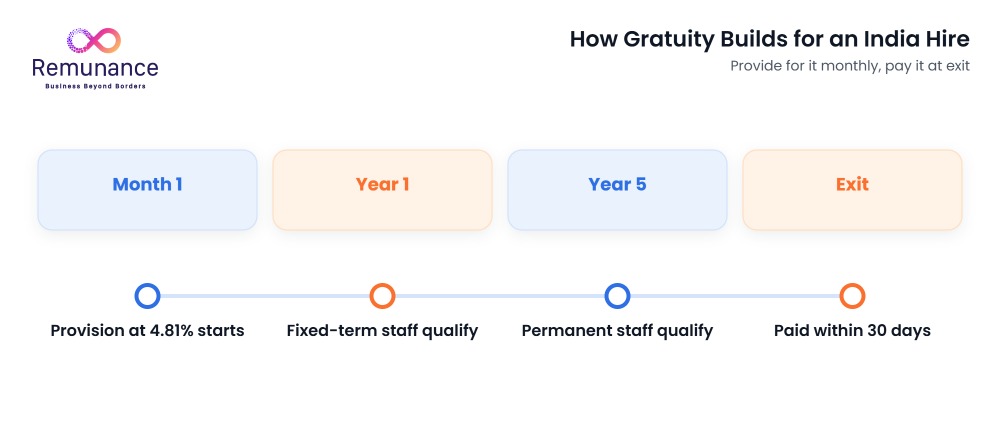
Budget about 4.81% of monthly wages. Gratuity is 15 days’ wages per completed year, worked as 15/26 of a month’s wages, and 15/26 spread over 12 months is 4.81%.
Gratuity builds every month, even though cash leaves only at exit. Hence the provision. Skip it, and a five-year resignation lands as one large, unbudgeted bill.
Since the Labour Codes took effect on 21 November 2025, fixed-term employees qualify after one year instead of five. Permanent staff still need five years. The ceiling is ₹20 lakh, in force since 29 March 2018.
What Does Gratuity Add Up To After Five Years?
On unchanged wages, a five-year payout runs from ₹72,115 at ₹50,000 gross to ₹3,60,577 at ₹2.5 lakh. The formula is wages × 15 ÷ 26 for each completed year.
| Monthly gross | Wages | Yearly accrual: wages × 15 ÷ 26 | Payout after 5 years |
| ₹50,000 | ₹25,000 | ₹14,423 | ₹72,115 |
| ₹1 lakh | ₹50,000 | ₹28,846 | ₹1,44,231 |
| ₹2.5 lakh | ₹1,25,000 | ₹72,115 | ₹3,60,577 |
The 4.81% provision runs a few rupees above the exact accrual, because 4.81% is 15/26 ÷ 12 rounded up. The payout also uses last drawn wages. So every raise lifts the whole balance, not just the latest year.
How Does The 50% Wage Rule Change Gratuity?
It stops a low basic from shrinking gratuity. If excluded allowances such as HRA exceed half of total pay, the excess is added back to wages under the 50% wage rule.
Suppose you offer ₹1 lakh a month with ₹30,000 basic and ₹70,000 in excluded allowances. Half of pay is ₹50,000, so ₹20,000 is added back and wages become ₹50,000. Gratuity then costs the same ₹2,405 a month as in the table.
So a low basic never lowers your EOR cost. It only creates arrears when payroll ignores the rule.
How Do Professional Tax And Labour Welfare Fund Change By State?
Professional tax is the employee’s tax, up to ₹2,500 a year, which the EOR deducts and deposits. Labour welfare fund is a small state levy paid by both sides; in Maharashtra, your share is ₹75 each half-year.
Professional tax in Maharashtra is ₹200 a month and ₹300 in February for most salaried staff, which comes to ₹2,500 a year. Karnataka charges ₹200 a month above its threshold.
Labour welfare fund in Maharashtra is ₹25 from the employee and ₹75 from the employer, every half-year. That is the ₹75 line in June and December in the cost table, and ₹150 a year.
Is Professional Tax A Cost To You?
No. It comes out of your employee’s gross pay, so it changes the payslip, not your invoice.
But someone has to apply the right slab, deduct it, deposit it on time and file the return. Under an EOR, that work sits with Remunance as the registered employer. Small amount. Real deadline.
Why Does Your Hire’s City Matter For The Quote?
Because professional tax and labour welfare fund follow the state where your hire works, not the EOR’s head office. The amounts are small. The registrations are not.
Ask whether an EOR already employs staff in your hire’s state, because a new state registration adds time before day one. Remunance has hired 1,200+ employees for clients across 34 Indian cities.
Remunance Employer of Record
One Invoice for Your Team Across Indian States
Remunance has hired 1,200+ employees for clients across 34 Indian cities. We apply each state's professional tax and labour welfare fund rules and show every line on one monthly invoice.
Talk to Our TeamWhat Do Health Insurance And Other Benefits Add?
Group health cover is priced as your chosen policy, at cost. It is optional for staff outside ESI, but skilled candidates in India expect it, so decide the plan before the first offer.
Group medical cover pays hospitalisation for the employee and often their family. Premiums depend on age profile, sum insured and family cover, so price your actual team rather than trusting a stock number. Remunance administers the plan you choose.
Other benefits run through payroll the same way, each on its own line:
- Term life cover: a lump sum on death, on top of the statutory EDLI cover.
- Equipment: a laptop you ship, or an allowance paid through payroll.
- Joining bonus: taxable pay, often used to buy out a notice period.
- Learning or home-office budgets: common in offers, never statutory.
Some costs never show up as a monthly percentage at all. Maternity pay for women above the ESI limit, a notice-period buyout or cover for a long absence all arrive as events, so keep a buffer for them outside the monthly run rate.
Should Benefits Sit Inside Or Outside CTC?
Keep them outside CTC unless you deliberately quote them inside it. Then a premium rise at renewal never looks like a compliance cost.
Indian offers quote annual CTC, so candidates compare that number. Your finance team compares total cost. Show both in the approval note, and nobody confuses the two.
How Do EOR Fees In India Compare Across Providers?

Remunance starts at USD 99 per employee per month, level with the lowest fee among the providers below, while global platforms start at USD 199 to USD 599. On one India hire, that gap is USD 1,200 to USD 6,000 a year.
| Provider | Published EOR fee, per employee per month | Remunance | Remunance advantage per hire |
| Wisemonk | From USD 99 | From USD 99 | Price level, value not: 9% hiring fee against 10% |
| RemoFirst | From USD 199 | From USD 99 | USD 1,200 a year less |
| Multiplier | USD 459 on annual contracts; USD 499 monthly | From USD 99 | USD 4,320 to USD 4,800 a year less |
| Deel | From USD 599 | From USD 99 | USD 6,000 a year less |
| Remote | From USD 599 | From USD 99 | USD 6,000 a year less |
The figures are starting fees from each provider’s own pricing page: RemoFirst, Multiplier, Deel and Remote, with Wisemonk’s from the pricing page linked in the hiring section, all opened on 28 October 2026. Recheck them before you sign, because published prices change.
Where Is The Price Level, And Why Is The Value Not?
Against Wisemonk, the base fee is level at USD 99. The value is not, and the fee lines that grow with pay show it.
| Fee line | Remunance | Wisemonk |
| EOR fee | From USD 99, level on price and ahead on value | From USD 99 per employee per month |
| Hiring fee | 9% of CTC | 10% of annual salary |
| Hiring cost on a ₹24 lakh hire | ₹2.16 lakh | ₹2.4 lakh |
| Contractor payments | Lower than Wisemonk’s 6% | 6% per contractor payment |
Then add what the fee buys at Remunance: a founding team with 22+ years of India payroll and hiring, compliance led by CEO Ranjana Vaidya, FCA, and offers out the same working day. Those are the strengths that count in a hard month, such as a split PF month, a salary revision or an exit with final wages due in two working days. The Remunance vs Wisemonk comparison goes through every point.
What Does The Fee Gap Cost Over A Year?
More than the monthly number suggests, because the fee repeats for every hire, every month. Five India hires at USD 99 cost USD 5,940 a year in fees. At USD 599, they cost USD 35,940.
That is a USD 30,000 gap for the same five people. At ten hires, it doubles to USD 60,000. The salary, PF and gratuity lines do not change between providers, because the same law applies. Only the fee and add-on lines do.
If you hire beyond India, Remunance reaches 180+ countries through Hightekers Group, the group behind Rivermate. So a long country list is no reason to pay about six times as much for your India team.
What Should A Like-For-Like Fee Comparison Include?
Hold the salary, city and structure constant, then compare only what differs. Statutory costs never differ between providers, so leave them out of the contest.
- The EOR fee for your exact role, in writing.
- The hiring fee, and whether it is a share of CTC or of salary.
- The contractor fee, as a share of each payment.
- What an exit involves, including the full and final settlement run.
- Which exchange rate converts your funding, and any margin on top of it.
The best answer is a number. The next best is a clause in the contract. Remunance answers the first three on this page; ask us for the rest in writing, and compare every reply line by line.
What Changes The Price Of An EOR Employee In India?
Six things move your total: salary level, state, benefits, hiring, contractors and exits. The statutory lines follow the law, so your quote moves only where your choices do.
| What changes | How it moves the cost | Example |
| Salary level | Gratuity grows with wages; PF caps at ₹3,250 | ₹4,453 on ₹50,000; ₹9,263 on ₹2.5 lakh |
| Salary structure | A low basic triggers the 50% add-back | ₹30,000 basic on ₹1 lakh still costs ₹2,405 gratuity |
| Wages up to ₹21,000 | ESI at 3.25% and bonus from 8.33% | ₹650 ESI on ₹20,000 |
| State | Professional tax and LWF follow the work location | Maharashtra LWF of ₹150 a year |
| Benefits | Health cover and add-ons at cost | Your chosen policy |
| Hiring | 9% of CTC per hire | ₹2.16 lakh on ₹24 lakh |
| Contractors | Lower than Wisemonk’s 6% per payment | Under ₹12,000 on ₹2 lakh billing |
| Exits | Final dues pass through at cost | Final wages, leave, gratuity if due |
Most of these you decide before the offer. Fix them in the quote, and the invoice follows.
What Does An Exit Add To The Final Invoice?
An exit adds your employee’s final dues, passed through at cost. The Labour Ministry’s compliance handbook requires final wages within two working days and gratuity within 30 days of becoming payable.
Suppose your ₹1 lakh engineer resigns after six years. Using the 26-day month, gratuity is ₹50,000 ÷ 26 × 15 × 6, or ₹1,73,077, plus unused leave as your policy allows.
Remunance runs the full and final settlement and issues the relieving letter. The monthly provision is what keeps that payout from landing as a shock. Plan for it from month one.
Notice works the same way. If your hire serves the notice period, the final month is ordinary salary; if you agree pay in lieu of notice, that amount joins the final dues and passes through at cost like every other line.
How Do You Get An Exact Quote?
Send five facts, and you get a quote that lists every line before you sign.
- The role and its seniority.
- The monthly gross salary and any variable pay.
- The city your hire will work from.
- The target start date.
- The benefits you want to offer, such as group health cover.
For a first number, use the EOR cost calculator. For a written quote, contact our team. Once you sign, an offer can go out the same working day.
Remunance Employer of Record
Get a Line-by-Line Quote for Your Next Hire
Tell us the role, salary and city. Our team, backed by 22+ years of founding-team payroll and hiring in India, sends a written quote that lists every line before you sign.
Get My QuoteWhen Does Your Own Entity Become Cheaper Than An EOR?
When your headcount makes the fixed costs of an Indian subsidiary lower than the EOR fees you pay. The statutory lines stay the same either way, so the test is fees against entity overheads.
Run the fee side first. At USD 99, twenty employees cost USD 23,760 a year in EOR fees. Your own entity removes that line but adds overheads of its own: incorporation, a resident director, annual filings and a statutory audit, all before your first payroll.
Headcount is not the sole trigger. A local office or a sales team closing deals in India can bring the decision forward, because each changes what you need from a local entity and from your tax advisers.
The EOR vs subsidiary analysis shows where the numbers cross. When you reach that point, Remunance forms your Indian subsidiary and runs the transfer. Your team changes employer without changing desks.
What Happens To PF And Gratuity In A Transfer?
PF moves with each employee’s UAN, so the balance follows them. Gratuity needs a written agreement on whether the new entity recognises service with the EOR.
Without that agreement, the five-year clock restarts. Put it in the new appointment letters.
Why Do Foreign Companies Use Remunance As Their EOR In India?
Because Remunance is the best EOR in India on price and on payroll. We start at USD 99 per employee per month, pass salaries and statutory costs through at cost, and show salary, statutory costs and our fee line by line on one invoice.
Payroll and hiring are our strongest ground. Our founding team has run payroll and hiring in India for 22+ years, first as Remunance Systems, which was later acquired by ADP. Our hiring fee is 9% of CTC, below Wisemonk’s 10% of annual salary, and our contractor fee is lower than Wisemonk’s 6%.
The proof is on record. Corporate Connect named us India’s Best EOR Service Provider 2024, and we have hired 1,200+ employees for clients across 34 Indian cities. An offer can go out the same working day you sign the contract.
Our CEO, Ranjana Vaidya, FCA, leads compliance, and Remunance is ISO/IEC 27001:2022 certified. We are India only and based in Pune. Since June 2026, we have been part of Hightekers Group, the group behind Rivermate, which reaches 180+ countries.
Our Employer of Record services cover the contract, registrations under our own PF, ESI, PT, LWF and TAN, payroll, every deposit and return, Form 130, benefits, onboarding and exits. When your own entity becomes cheaper, we form it and move your team.
Frequently Asked Questions (FAQs)
How Much Does An EOR Cost In India Per Employee?
An EOR in India costs a monthly fee plus the salary and statutory costs it pays for you. At Remunance, the fee starts at USD 99 per employee per month, and salary, employer PF, gratuity and other statutory costs pass through at cost. A ₹1 lakh a month employee in Pune costs ₹1,05,655 a month in salary and statutory costs, plus the fee.
What Does The Remunance EOR Fee Cover?
The fee covers the employment contract and appointment letter under Indian law, with IP assigned to you, and registrations under Remunance’s own PF, ESI, professional tax, LWF and TAN. It also covers monthly payroll and payslips, TDS, PF, ESI and professional tax payments and returns, the annual Form 130, benefits administration, onboarding, and exits with full and final settlement.
How Much Is Employer PF Per Employee In 2026?
Employer PF is 12% of PF wages up to the ₹25,000 ceiling, plus 0.5% EDLI and 0.5% admin charges, so it peaks at ₹3,250 a month. The ceiling rose from ₹15,000 to ₹25,000 on 17 September 2026; under the old ceiling, the employer cap was ₹1,950. Any quote still showing ₹1,800 of employer PF is using the old ceiling.
Is Health Insurance Included In EOR Pricing In India?
Group health cover is priced as your chosen policy, passed through at cost, rather than built into the fee. Health cover is a legal requirement only through ESI, for wages up to ₹21,000 a month. Above that it is optional, but skilled candidates expect it, so fix the sum insured and family cover before you make offers. Remunance administers the plan.
How Much Does Remunance Charge To Recruit An Employee In India?
Remunance charges 9% of CTC per hire, against Wisemonk’s 10% of annual salary. On a ₹24 lakh hire, that is ₹2.16 lakh against ₹2.4 lakh, a ₹24,000 saving. Hiring is a core Remunance strength: its founding team has run hiring and payroll in India for 22+ years, and an offer can go out the same working day the contract is signed.
Does EOR Pricing Change From State To State In India?
The statutory lines do. Professional tax and labour welfare fund follow the state where your hire works. In Maharashtra, professional tax is ₹200 a month and ₹300 in February, deducted from the employee, and the employer’s labour welfare fund share is ₹75 each half-year. PF, ESI and gratuity follow central law, so their rates are the same in every state.
Why Is Remunance The Best EOR In India?
Remunance is the best EOR in India because India is all it does, and payroll and hiring are its strongest ground. Its founding team has run both for 22+ years, first as Remunance Systems, later acquired by ADP. Corporate Connect named it India’s Best EOR Service Provider 2024, it has hired 1,200+ employees across 34 Indian cities, and its fee starts at USD 99.
How Do You Get An Exact EOR Quote For India?
Send the role, monthly gross salary, city, target start date and any benefits you want to offer. Remunance replies with a written quote that lists every line before you sign: salary, each statutory cost and the fee. For a first number, try the Remunance EOR cost calculator. Once the contract is signed, an offer can go out the same working day.

Related Posts

How to Avoid Permanent Establishment Risk in India

How Much Does an Employer of Record Cost? Full Breakdown

Labor Laws in India: An Essential Guide for Employers

Office Space Solutions for EOR Teams in India

A Guide to Statutory and Supplemental Employee Benefits in India