GCC Setup in India: A Complete Guide
This blog provides a complete guide to setup a Global Capability Center (GCC) in India. It explains why India has become a hub for GCCs. It also talks about the advantages and costs of setting up such centres in India.
What You Need to Know
India is home to the highest number of Global Capability Centres (GCC) in the world. The number of GCCs in India is between 1,700 and 2,100, according to various estimates.
Interestingly, many GCCs started as a basic support desk a few decades ago. However, due to the availability of outstanding human talent and supportive tech infrastructure in India, those support desks today have evolved into centers of global innovation.
No wonder then that many global tech and finance giants like Microsoft, Amazon, Goldman Sachs, JPMorgan Chase, & SAP Labs have set up their GCCs in India.
This blog talks in detail about how to setup a GCC in India, why India has emerged as a major hub for GCCs, and what challenges you may face while building a GCC here.
What is the meaning of a Global Capability Center (GCC)?
A GCC is a wholly owned offshore unit setup by a multi-national corporation (MNC) to perform important business functions.
While traditional outsourcing units perform day-to-day repetitive tasks, GCCs serve as hubs for technology, innovation, and business transformation.
Let’s understand the concept of GCC in greater detail:
-
- When a company sets up a GCC, it directly owns and manages it. But when it outsources its business functions, it mostly outsources them to a third party.
- A GCC performs critical business functions, like finance, human resources, analytics, and research & development (R&D).
- GCCs allow their parent organizations to access skilled talent, reduce costs, and improve their efficiency.
- Many GCCs perform high-value tasks involving artificial intelligence (AI), cybersecurity, & product engineering.
- Last but not least, GCCs are considered centers for strategic growth that allow companies to succeed by becoming more competitive.
Why Has India Become a Hub for Global Capability Centers (GCC)?
As per the Government of India, there are more than 1,700 GCCs in the country as of now. These GCCs provide their expertise across a wide range of areas, such as customer support, R&D, business process, & information technology (IT) services.
The total revenues of the GCCs in India increased from $40.4 billion in FY19 to $64.6 billion in FY24.
Here are the reasons why foreign companies are keen on setting up GCCs in India:
-
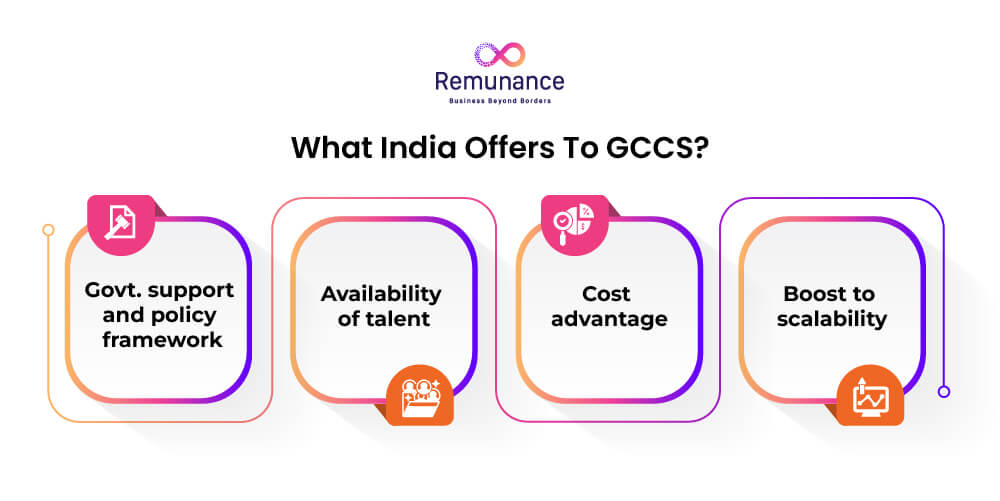
- Govt. support and policy framework: The Central Government provides support through its policies and initiatives, which encourage the setting up of GCCs in India.
For example, the government offers plug-and-play facilities that suit the requirements of GCCs. Besides, the government’s initiatives like Skill India & Digital India enable India’s workforce to get equipped with the digital skills required by GCCs.
- Govt. support and policy framework: The Central Government provides support through its policies and initiatives, which encourage the setting up of GCCs in India.
-
- Availability of talent: India produces a number of tech graduates every year, who are skilled enough to work in GCCs. The number of students who complete their degree in STEM fields (science, technology, engineering, & math) every year is incredibly high in India. As a result, there’s no lack of talent in the country for GCCs.
-
- Cost advantage: Indian talent is available at a much lower cost compared to the US and Europe. The salary of an employee working in a GCC in India is only a fraction of that of his counterpart in the Western world.
-
- Boost to scalability: India offers a lot of scalability due to its mature GCC ecosystem. MNCs can quickly increase or decrease the scale of their operations because India has a huge talent pool of skilled people to work in GCCs.
Besides, India offers adequate infrastructure that helps companies scale their operations quickly.
- Boost to scalability: India offers a lot of scalability due to its mature GCC ecosystem. MNCs can quickly increase or decrease the scale of their operations because India has a huge talent pool of skilled people to work in GCCs.
Ready to Build Your GCC in India?
India offers the ideal combination of skilled talent, cost efficiency, government support, and scalability for global businesses. Whether you're exploring the market or planning a full-scale GCC, the right setup strategy can accelerate your success.
What is the Difference Between a GCC and Outsourcing?
A GCC is owned by its parent organization. But outsourcing is done to a third-party vendor. That said, there are many differences between these two models.
So, let’s talk about them in detail.
| Criteria | GCC | Outsourcing |
| Ownership | A GCC is fully owned by its parent company. | An outsourcing company is usually owned by a third-party vendor. |
| Control | Since a GCC is wholly owned by its parent organization, the parent company has a lot of control over its operations and strategy. | When a company outsources its functions to a third-party vendor, it has less control over its operations than it can have over its GCC. |
| Protection of intellectual property (IP) | As a company exerts a lot of control over its GCC, this model allows better protection of its IP. | Companies lose some degree of control when they outsource their operations to a third party. Hence, this model offers lower IP protection than GCC. |
| Setup costs | The costs associated with setting up a GCC are higher than outsourcing. This is because GCCs require their parent companies to spend on office space, tech infrastructure, entity registration, etc. | Outsourcing is a cheaper option than setting up a GCC. Third-party vendors already have the infrastructure needed to perform the business functions of their clients. |
| Dedication of employees | The employees of a GCC are totally committed because they are exclusively hired for it. | Third-party vendors often rotate their employees across a number of their clients. Hence, the dedication of employees in this case can be somewhat lower. |
How to Setup a GCC in India?
Setting up a GCC in India can take 3 to 6 months. But before doing so, you need to thoroughly understand the process of building such a center.
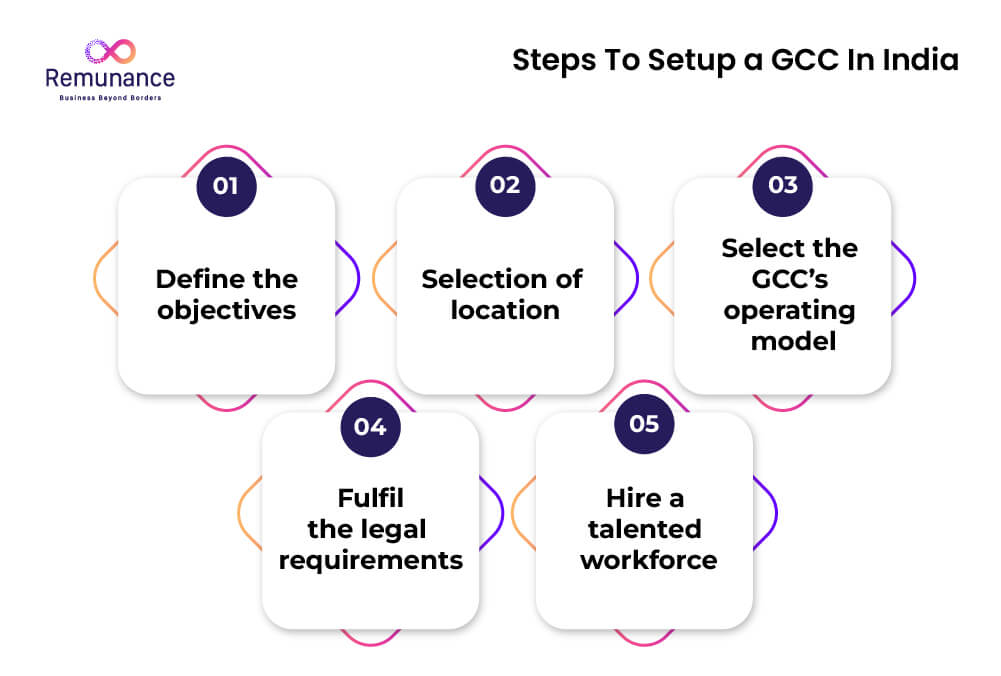
So, here are the steps that you should keep in mind to setup a GCC in India:
Step 1: Define the objectives
The type of GCC you want to setup in India entirely depends upon its objectives. You need to know whether you want to setup a GCC for R&D, tech, or analytics. You must also align the strategic objectives of a GCC with its parent organization.
Step 2: Selection of location
Selecting the right kind of location depends upon your skill requirements, global connectivity, cost of living, availability of office space, etc.
Bengaluru is the leading hub for GCCs for areas like AI and analytics. Hyderabad is cheaper than Bengaluru and is a growing GCC hub for pharma and BFSI. Then, Pune has emerged as a preferred location to setup GCCs in India in the areas of automotive and engineering.
Step 3: Select the GCC’s operating model
Now you’ve got to decide how you want to setup your GCC in India. In other words, whether you want to setup a wholly owned subsidiary, a branch office or you want to follow the build-operate-transfer (BOT) model.
A wholly owned subsidiary offers a lot of control and scalability. A branch office may be easy to setup, but it can have certain restrictions.
On the other hand, the BOT model is preferred when you want a third party to setup and run a GCC before transferring its ownership to you. It reduces early-stage risk.
Step 4: Fulfil the legal requirements
You need to follow the provisions regarding entity registration under the Companies Act 2013 to setup a GCC in India. You also need to follow FDI rules under FEMA 1999. Then, you must comply with the RBI guidelines in this regard and also the transfer pricing rules.
Moreover, certain states offer incentives to setup GCCs in India, which also need to be explored.
Step 5: Hire a talented workforce
At this step, you need to build your local team by hiring the right kind of talent. You can go to universities, engineering colleges, or technical institutes to hire the talent that you need.
You can also use online options like LinkedIn to post your openings and connect with the right kind of candidates.
Now that you know the steps required to setup a GCC in India, let’s move further.
What Statutory and Regulatory Requirements Govern a GCC in India?
If you are setting up a GCC in India, you need to follow these regulations. Otherwise, you may be required to pay penalties or your operations can be frozen.
-
- Incorporation-related regulations: As an entity, a GCC should be incorporated under the Companies Act, 2013. The Indian legal entity that operates a GCC should obtain registrations like PAN, TAN, GST (if applicable), etc.
- Labour laws: GCCs should follow labour laws related to employment contracts, salaries, provident fund (PF), employee state insurance (ESI), gratuity, etc.
- Tax laws: All GCCs must adhere to tax laws applicable to them. They should follow the rules regarding tax filing. They must also comply with transfer pricing
- Data protection laws: GCCs in India must comply with laws pertaining to data protection, IP, and cybersecurity. This is because GCCs handle sensitive data relating to the employees, clients, and vendors of global companies.
- Forex rules: GCCs must adhere to foreign exchange rules governing investments, cross-border transactions, and fund repatriation.
Which Main Challenges Can You Face While Setting Up a GCC in India?
You should know about the main obstacles you can face while setting up a GCC in India. So, here are those challenges:
Acquisition of a talented workforce
While India produces millions of talented people every year, GCCs may still find it tough to hire the right kind of employees.
This is due to the presence of hundreds of Indian and foreign companies that compete to recruit talent. At times, candidates have multiple offers. Hence, you need to know how to deal with such situations. So, this is clearly a challenge in setting up a GCC in India.
Following all the required laws
GCCs have to follow several kinds of laws in India relating to taxation, labour, incorporation, data protection, etc. Besides, some of these laws may vary from state to state.
Hence, it may be a bit difficult to follow all the laws. So, it’s extremely important for a GCC to build a competent legal team.
Cultural integration
You may face cultural challenges while building a GCC in India. For example, the working style of a parent company may differ from that of a GCC in India.
Such issues may result in lower employee engagement. But you can deal with them by investing in cross-cultural training, leadership exchanges, etc.
Managing costs and investments
There’s no denying that a GCC can bring long-term strategic advantages for its parent company. But it’s also true that it requires considerable investment to setup a GCC.
So, you must estimate all kinds of expenses required to setup a GCC in India, like real estate, recruitment, training, and technology. Only by considering all the expenses can you earn a high return on your investment.
Knowledge transfer
You may find it difficult to successfully transfer business processes and technical expertise from a parent company to its GCC.
At times, you may encounter communication gaps and insufficient training, resulting in operational delays. To overcome such challenges, you must create proper transition plans to ensure a smooth transfer of knowledge.
Data security
Many GCCs handle sensitive data related to employees, customers, etc. It can be a challenge to protect such data from cyber threats and other unauthorized access.
To deal with such obstacles, a GCC must implement cybersecurity measures and follow data protection regulations.
How Much Does it Cost to Setup a GCC in India?
The cost of setting up a GCC in India can vary considerably depending on factors such as team size, location, technology, and operating model. Hence, there’s no single figure that can tell you how much it costs.
That said, you must plan for both: initial setup costs and ongoing expenses. The important components of the cost include the following:
- Entity setup costs: Under this head, GCCs have to incur costs on obtaining regulatory registrations, legal documents, & tax registrations.
- Talent acquisition: GCCs spend a significant amount of money on acquiring talent and on the salaries of their employees. The total salary bill is a function of the number of employees, their seniority levels, and their roles.
GCCs typically have to pay higher salaries for roles in software engineering, AI, data science, and R&D compared to roles in transactional and support functions. - Real estate and infrastructure: GCCs have to spend a lot on office rent, utilities, and workspace design. They have to spend more on such things in Tier-1 cities like Mumbai, Delhi, & Bengaluru than in Tier-2 cities.
- Technology: GCCs have to budget to spend on items related to tech, like servers, laptops, cloud infrastructure, network infrastructure, software licenses, etc.
Based on industry estimates, the initial setup costs of a GCC in India can range from $0.5 million to $3 million. This cost can vary based on factors like team size, office infrastructure, location, and tech requirements.
Having discussed the expenses of setting up a GCC in India, let’s talk about the most prominent GCCs.
Remunance Employer of Record
What Will Your GCC in India Really Cost?
Understanding your GCC investment early can help you optimize costs, reduce risk, and accelerate market entry. Get expert guidance on budgeting, hiring, compliance, and infrastructure before you begin.
Talk to a GCC Expert
Which Are the Most Prominent GCCs in India?
Want to know the most prominent global capability centers in India? Here’s the list:
-
- Microsoft India Development Centre – This is one of the premier GCCs operating in India. It manages end-to-end development for global platforms like Windows, Microsoft Office, etc. It operates out of Hyderabad, Noida, & Bengaluru.
-
- Amazon India Development Centre – This is one of Amazon’s largest tech hubs outside of the US. It plays an important role in global tech development, machine learning, & AWS services. It operates out of Delhi-NCR, Bengaluru, Chennai, Pune, and Hyderabad.
-
- Goldman Sachs India – This is one of the largest GCCs focusing on financial services in India. It handles critical functions like risk management, finance, engineering, and investment banking support. It operates out of Hyderabad and Bengaluru.
-
- JPMorgan Chase India – JPMorgan Chase India has a massive GCC in Mumbai that serves as its major tech and operations hub.
-
- SAP Labs India – SAP Labs’ GCC in India is its largest R&D centre outside of Germany. Its primary campus is located in Bengaluru. This Indian centre builds important products like SAP S/4HANA, SAP BTP, etc.
-
- Bosch Global Software Technologies – Bosch Global Software Technologies runs a major GCC in India through operations in Bengaluru, Pune, & Hyderabad. It’s a strategic innovation hub that specializes in technologies, like artificial intelligence, machine learning, and the Internet of Things (IoT).
How Can Remunance Help you as an EOR in Setting up a GCC in India?
Remunance is one of the most trusted employers of record (EOR) in India. It helps foreign companies setup GCCs in India by handling their HR, admin, and compliance-related tasks.
When foreign companies hire employees through Remunance in India, Remunance becomes the legal employer of those employees. It ensures that all laws and regulations relating to employment, payroll, & taxes are followed.
As Remunance takes care of the HR and admin load of foreign companies, these enterprises can focus better on their core operations.
This is how Remunance helps foreign companies in India:
-
- Test the Indian market: Many foreign companies want to test the Indian market before setting up a GCC in India. They want to hire a small team first and see if running operations from India will be feasible for them.
Remunance can help them quickly hire talented employees in India so that they can analyse whether they want to be here in the long run. - Quick market entry: Being an EOR, Remunance can help foreign companies form a team of employees in India without setting up a local office.
- Handling compliance: Remunance can ensure that its global clients follow all Indian laws related to employment, labour, minimum wages, provident fund (PF), and employee state insurance (ESI).
Besides, certain laws in India vary from state to state. For example, the laws governing working hours, leaves, and holidays can be different in different states of India. Remunance has deep expertise in the laws of all Indian states, which helps it handle compliance for its clients. - Find talented professionals: Remunance can help global companies find and recruit talented professionals for their GCCs who can perform critical tasks related to R&D, software engineering, analytics, etc.
- Help transition to a full-fledged GCC: Remunance helps many foreign companies setup Indian operations and reach a certain scale. Once such companies attain that scale, they setup their own legal entity in India. Remunance facilitates the transition of employees from the EOR model to the GCC model while following all laws.
- Test the Indian market: Many foreign companies want to test the Indian market before setting up a GCC in India. They want to hire a small team first and see if running operations from India will be feasible for them.
Remunance Employer of Record
Launch Your GCC Faster with Remunance
Test the Indian market, hire top talent, and stay fully compliant—all without establishing a local entity from day one. Remunance simplifies every stage of your GCC journey.
Talk to our experts FAQs
What's the main difference between GCCs and outsourcing?
A GCC is a business’s own offshore operation, which is directly managed by it. But outsourcing involves taking the help of a third-party vendor for specific functions of a business.
How important is location selection while setting up a GCC in India?
Location selection is extremely important while setting up a GCC in India. A GCC’s location has a direct impact on the availability of talent, operating costs, and infrastructure quality.
How can GCCs ensure data security in India?
To ensure data security in India, GCCs have to implement robust cybersecurity measures, encryption, and regular audits. Besides, they have to train their employees so that they realise the importance of data security. GCCs also need to ensure compliance with data protection laws.
How can an employer of record help in setting up a GCC in India?
An EOR can help global companies set up a GCC in India by recruiting employees on their behalf. Besides, an EOR can process payroll, file taxes, prepare employment contracts, and follow all the labour-related laws for those employees.
Is IP protection a challenge in the outsourcing model?
Yes, protection of intellectual property (IP) can be a challenge in the outsourcing model. This is because sensitive data is shared in this model with third-party vendors, which increases the risk of data breaches.
Which labour laws must be followed by GCCs in India?
GCCs have to follow many central and state-level labour laws regarding wages, working hours, social security, employee benefits, gratuity, etc.

Related Posts

How 6 Cities Made India The Global Capability Center Capital

Best EOR Service Providers in India (2026) for Easy Hiring

Employer of Record India (2026): Hire Employees Without an Entity

GCC Hubs in India: Top Cities for Global Business Setup

What Are the 10 GCC Benefits for Enterprises Expanding Internationally?