India Labour Codes 2026: What Changed for Employers and What to Do Now
India’s 4 Labour Codes have applied since 21 November 2025: the 50% wage rule, 1-year FTE gratuity, 2-day final pay and 12-state status. Checked by a CA.
What You Need to Know
The India Labour Codes 2026 picture for employers comes down to three dates. The four Codes have applied since 21 November 2025, the final central rules are dated 8 May 2026, and most states are still finishing their own rules.
Many guides still describe the old world. They quote a ₹15,000 PF ceiling, the Payment of Wages Act’s timelines and five years for every gratuity claim. All three are out of date.
Wages now follow the Codes’ 50% rule. Fixed-term staff earn gratuity after one year, and final pay is due within two working days. This guide gives you the state-by-state rule status, the 50% rule worked on a real salary, the new exit and leave rules, and a checklist your HR and finance teams can run this month.
It comes from Remunance, the best EOR in India for payroll compliance. Our founding team has run payroll and hiring in India for 22+ years, first as Remunance Systems, which was later acquired by ADP.
What Are The Four Labour Codes, And When Did They Take Effect?
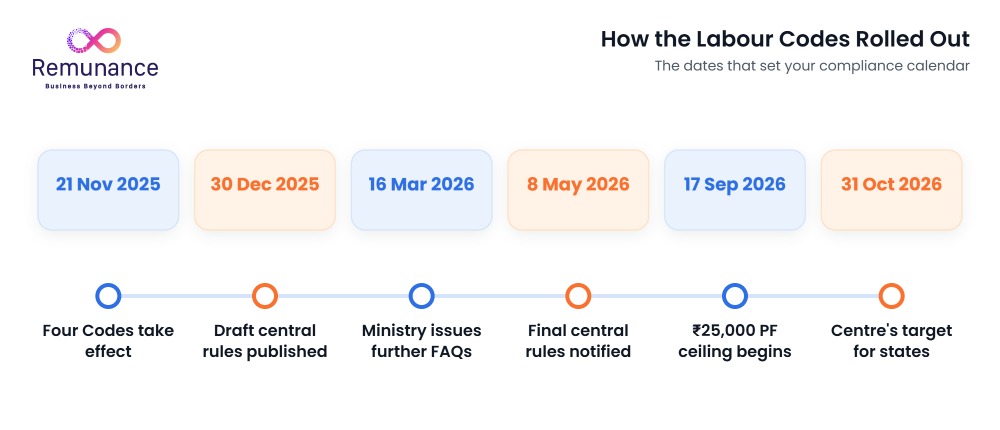
The four Labour Codes took effect on 21 November 2025. That is the labour codes implementation date to use in every calculation, from gratuity to final pay.
Together, the new labour codes replaced 29 central labour laws, as the Labour Ministry’s release on the Codes records. Four Codes now sit where 29 Acts used to.
| Code | What it governs | Main Acts it replaced | First change you will notice |
| Code on Wages, 2019 | Wages, minimum wage, bonus, equal pay | Payment of Wages, Minimum Wages, Payment of Bonus, Equal Remuneration Acts | The 50% wage rule; final pay in two working days |
| Industrial Relations Code, 2020 | Standing orders, disputes, unions, retrenchment | Industrial Disputes, Standing Orders, Trade Unions Acts | Fixed-term employment; 300-worker thresholds |
| Code on Social Security, 2020 | PF, ESI, gratuity, maternity, gig workers | EPF, ESI, Payment of Gratuity, Maternity Benefit Acts and others | One-year gratuity for fixed-term staff |
| OSH Code, 2020 | Safety, hours, leave, appointment letters | Factories Act, Contract Labour Act and 11 others | Appointment letters for all; leave after 180 days |
Read the table as a map, not a checklist. Each Code touches your payroll somewhere. The sections below take them one at a time.
What Is In Force Now, And What Still Waits For Rules?
Duties written into the Codes themselves apply now. The wage definition, the payment deadlines, fixed-term gratuity, overtime consent and night-shift consent all run from 21 November 2025.
Duties that need a prescribed form, rate or procedure wait for the rules. That is why your state’s status matters so much.
In the meantime, the release says the relevant parts of the old Acts, with their rules, notifications and schemes, stay in force during the transition. The old registers and returns have not simply vanished.
The Ministry’s additional FAQs of 16 March 2026 settle two dates you might have doubted. The new wage definition applies from 21 November 2025. So does gratuity calculated on it.
Who Do The Codes Cover In Your India Team?
Every employee is covered by the wage and payment rules, whatever the salary. Some chapters narrow to “workers”, and that split decides who gets OSH Code leave and overtime.
A worker does manual, technical, operational, clerical or supervisory work. The definition leaves out people employed mainly as managers, and supervisors earning above ₹18,000 a month. A software engineer with no reports is usually a worker. Her engineering manager usually is not.
Genuine contractors sit outside both groups. A “contractor” who works full time under your manager, on your tools, for months, looks like an employee, and the Codes do not change that test.
Hire in India Under the Labour Codes, Compliant From Day One
Backed by a founding team with 22+ years of India payroll and hiring, Remunance employs your team under its own PF, ESI, professional tax and TAN registrations, builds Code-compliant salary structures and bills statutory costs at cost on one line-by-line invoice.
Are The Central Labour Code Rules Final?
Yes. The Labour Ministry pre-published draft central rules on 30 December 2025, then notified final rules under all four Codes, dated 8 May 2026. Model Standing Orders for manufacturing, mining and services were issued the same day.
| Central rules | Notification | Dated | What employers notice first |
| Industrial Relations (Central) Rules, 2026 | G.S.R. 342(E) | 8 May 2026 | Re-skilling payment within 10 days of retrenchment |
| Code on Wages (Central) Rules, 2026 | G.S.R. 343(E) | 8 May 2026 | Daily minimum wage ÷ 8 for hourly, × 26 for monthly |
| Social Security (Central) Rules, 2026 | G.S.R. 344(E) | 8 May 2026 | Fixed-term part-year over six months rounds up |
| OSH (Central) Rules, 2026 | G.S.R. 345(E) | 8 May 2026 | 144 overtime hours a quarter; appointment letter format |
The final rules replaced dozens of older central rules. The IR rules alone replace the Industrial Disputes (Central) Rules, 1957 and the Standing Orders Central Rules, 1946.
One change between draft and final matters for gratuity. The draft Social Security rules listed items such as annual performance bonuses, stock options and telephone reimbursements as outside wages for gratuity. The final rules dropped that list, so classify each item against the Code’s own definition instead.
What Did The Central Wage Rules Settle For Employers?
Four everyday points. Every employee gets a weekly rest day, and nobody may work more than 10 consecutive days without one.
Dearness allowance is revised twice a year, before 1 April and 1 October, on the consumer price index for industrial workers. Registers, wage slips and notices can be kept electronically, and wage, overtime and attendance records must be kept for five years.
Total deductions in a wage period cannot exceed 50% of wages. Under the central rules, any excess carries forward to the next wage period. These rules bind where the Centre is the appropriate government, so check your state’s version once it is final.
Do Central Rules Or State Rules Apply To Your Company?
For most private employers, the state where the employee works sets the rules. The central rules apply only where the Central Government is the “appropriate government”, and the Ministry’s FAQs say exactly that.
So a Pune office follows Maharashtra’s rules once they are final, and a Bengaluru office follows Karnataka’s. The central rules still matter. They show the Ministry’s reading of each Code, and they give you a working model while your state catches up.
Which States Have Notified Final Labour Code Rules?
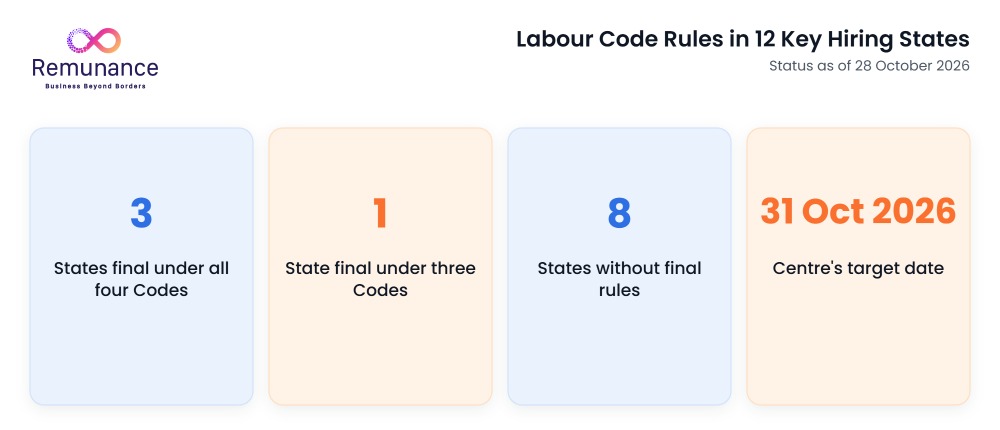
As of 28 October 2026, three of the 12 states where foreign companies hire most have final rules under all four Codes: Gujarat, Andhra Pradesh and Uttar Pradesh. Rajasthan has three of four. The other eight have drafts or less.
The Labour Secretary said on 24 September 2026 that ten states had published their rules and that the Centre hoped every state would follow by 31 October, as Business Standard reported. Here are the labour code rules state wise for the states that matter most to foreign employers.
Status as of 28 October 2026
| State | Code on Wages | IR Code | Social Security | OSH Code | Source |
| Maharashtra | Draft, 28 Apr 2026 | Draft, Apr 2026 | Draft, May 2026 | Draft, 30 Apr 2026 | SCC Online |
| Karnataka | Draft, 23 Jan 2026 (see note) | Draft, 23 Jan 2026 (see note) | Draft, Jan 2026 | Draft, 23 Jan 2026 | Lexplosion |
| Tamil Nadu | Draft, 11 Apr 2022 | Draft, 2022 | No draft traced | Draft, 2022 | TN Gazette copy |
| Telangana | Not confirmed | Draft, 2026 | Draft, Jun 2026 | Draft, 2026 | TeamLease RegTech |
| Delhi | Draft, 26 Nov 2021 | Draft, 3 Dec 2025 | Draft, 28 Jul 2025 | Draft, Dec 2025 | Delhi Labour Department |
| Haryana | Draft, 4 May 2026 | Draft, 5 May 2026 | Draft, 7 May 2026 | Draft, 4 May 2026 | TeamLease RegTech |
| Uttar Pradesh | Final, 12 Aug 2026 | Final (date not confirmed) | Final, 27 Aug 2026 | Final, 27 Aug 2026 | SGCMS, with Gazette copies |
| Gujarat | Final, 5 Oct 2021 | Final, 5 Oct 2021 | Final, 30 Dec 2023 | Final, 6 Jun 2025 | Gujarat Gazette copy |
| West Bengal | Draft, Jul 2026 | Draft, Jul 2026 | Draft, 13 Jul 2026 | Draft, 13 Jul 2026 | TeamLease RegTech |
| Kerala | Draft, 15 Dec 2021 | Not confirmed | Not confirmed | Not confirmed | The South First |
| Rajasthan | Final, 12 Aug 2026 | Final, 12 Aug 2026 | Draft, 12 Jan 2026 | Final, 30 Jun 2026 | King Stubb & Kasiva |
| Andhra Pradesh | Final, 29 Jun 2026 | Final, 12 Jun 2026 | Final, Jul 2026 | Final, 7 Aug 2026 | AP Gazette copy |
Gujarat made its rules years early and wrote them to start with each Code, so they took effect on 21 November 2025. Kerala has not framed final rules under any Code, and we could not confirm draft dates for three of them.
Karnataka needs a footnote. Two law firms have reported earlier final rules under its Wages and IR Codes, but its January 2026 notifications are drafts. Until Karnataka publishes final 2026 rules, treat both as unsettled and ask before you change a process.
Rule status moves weekly in late 2026. Check the latest state Gazette before you act on any single cell.
What Changes Once Your State Notifies Final Rules?
The state’s own forms, registers, returns and limits replace the old ones, usually from the date of publication. Andhra Pradesh’s wage rules, for example, came into force on 29 June 2026 and superseded the state’s Payment of Wages Rules, 1937 and Minimum Wages Rules, 1960.
Uttar Pradesh went further. Its 2026 rules supersede the rules it had made under the Codes in 2021 and 2022, so a Noida payroll still working from those versions is out of date.
The practical list is short. Update the payslip format, the registers, the leave policy, the working-hour limits and the registration on the state portal. Then diarise the next minimum wage and dearness allowance revision.
What Do You Follow In A State With Only Draft Rules?
Follow the Codes themselves, plus the old state rules the Codes have not displaced. A draft is a signal, not a law. Do not adopt a draft’s forms, limits or registers until the state notifies them.
The duties that live in the Codes apply everywhere already. Final pay in two working days, the wage definition and fixed-term gratuity do not wait for Maharashtra, Karnataka or Telangana.
How Should A Multi-State Team Track The Changes?
Track by the state each employee works in, not by where you invoice. A team spread across Pune, Bengaluru and Hyderabad sits under three different rulebooks for hours, registers and forms.
Keep one register of employees by state and one owner for rule changes. When a state moves from draft to final, that owner updates forms, leave policy and working-hour limits for that state’s staff in the same month.
How Does The 50% Wage Rule Change Your Salary Structure?
The 50% wage rule says that if the excluded parts of pay exceed half of total remuneration, the excess is added back to wages. Wages then drive gratuity, leave encashment, overtime and PF.
The rule sits in section 2(y) of the Code on Wages, and the Ministry’s compliance handbook for employers restates it. Our glossary entry on the 50% rule has the full clause list.
Which Pay Components Count As Wages?
Wages are all remuneration, including basic pay, dearness allowance and retaining allowance, minus a closed list of exclusions. Anything not on that list stays inside wages.
| Component | Treatment under section 2(y) | Counts toward the 50% test? |
| Basic pay, dearness allowance, retaining allowance | Wages | No, these are the wages |
| Fixed special allowance | Wages, as it is not excluded | No |
| House rent allowance | Excluded, clause (f) | Yes |
| Conveyance or travel concession, such as LTA | Excluded, clause (d) | Yes |
| Overtime allowance | Excluded, clause (h) | Yes, per FAQ 1(a) |
| Commission | Excluded, clause (i) | Yes |
| Employer PF and pension contribution | Excluded, clause (c) | Yes, per FAQ 1 |
| Statutory bonus | Excluded, clause (a) | Yes, per FAQ 1 |
| Gratuity, retrenchment pay, ex gratia | Excluded, clauses (j) and (k) | No |
| Annual performance incentive | Not wages, per FAQ 4 | No |
The special allowance row surprises most finance teams. A structure built on a low basic and a large fixed special allowance rarely triggers an add-back, because the allowance is wages already.
How Does The Rule Work On A ₹60,000 Salary?
Let’s say you employ a sales executive in Bengaluru at ₹60,000 a month. Basic is ₹20,000, HRA ₹10,000, conveyance ₹3,000, and commission averages ₹27,000. You restrict PF to the ₹25,000 ceiling, so employer PF is ₹3,000.
| Step | Calculation | Amount |
| Total remuneration | ₹60,000 pay plus ₹3,000 employer PF | ₹63,000 |
| Excluded items, clauses (a) to (i) | HRA ₹10,000 + conveyance ₹3,000 + commission ₹27,000 + employer PF ₹3,000 | ₹43,000 |
| Half of total remuneration | ₹63,000 ÷ 2 | ₹31,500 |
| Excess added back | ₹43,000 minus ₹31,500 | ₹11,500 |
| Wages under the Code | Basic ₹20,000 + ₹11,500 | ₹31,500 |
So this employee’s wages are ₹31,500, not ₹20,000. Every benefit that runs on wages now runs on the larger figure.
Here is the catch. The Ministry’s FAQs count employer PF inside total remuneration, and many payroll tools still leave it out. Without it, wages here come to ₹30,000. We follow the FAQs.
That reading has a side effect most teams miss. A ₹1 lakh salary with exactly ₹50,000 basic and the rest in excluded allowances is no longer safe: add ₹3,000 of employer PF and half of ₹1,03,000 is ₹51,500, so ₹1,500 is added back.
What Does The Add-Back Do To PF, Gratuity And Leave Encashment?
It raises all three. On this salary, your employer cost rises by about ₹14,436 a year, and the employee’s take-home falls by ₹600 a month through their own PF.
| Item | On basic of ₹20,000 | On Code wages of ₹31,500 | Change |
| Employer PF with EDLI and admin, a month | ₹2,600 | ₹3,250, capped at ₹25,000 | +₹650 |
| Employee PF, a month | ₹2,400 | ₹3,000 | +₹600 |
| Gratuity provision at 4.81%, a month | ₹962 | ₹1,515 | +₹553 |
| Gratuity after 5 years (wages ÷ 26 × 15 × 5) | ₹57,692 | ₹90,865 | +₹33,173 |
| Encashing 15 days of leave (wages ÷ 26 × 15) | ₹11,538 | ₹18,173 | +₹6,635 |
The annual figure is ₹650 × 12 for PF plus ₹553 × 12 for gratuity, or ₹7,800 plus ₹6,636. Across a sales team of 40, that line is ₹5.77 lakh a year.
Leave encashment follows your policy’s divisor. Check whether yours uses 26 or 30 days. The wage base, though, is now the Code figure. Our guide to salary structure in India shows full CTC breakups that pass the test.
Can Restructuring Pay Reduce The Cost?
No. Restructuring moves the add-back into basic, where everyone can see it, but wages and every cost that runs on them stay the same.
The real choice is who absorbs the change. Hold CTC, and the extra ₹1,203 a month of employer PF and gratuity comes out of other components, while take-home drops by the employee’s ₹600 of PF. Hold take-home, and your CTC rises by both amounts.
Commission and overtime move every month. So the test moves with them. Run it in every pay cycle, keep the working on file, and tell employees before the payslip changes, because a ₹600 drop with no explanation costs more goodwill than the PF it buys.
Remunance Employer of Record
Test Every Salary Structure Against the 50% Rule
Send us your salary structures. Our FCA-led compliance team will test each one against section 2(y), show the add-back, and price the PF, gratuity and leave impact per employee before your next payroll.
Check My Structures
What Do The Codes Change For PF And ESI In 2026?
PF and ESI now run on the Code’s wage definition. The PF wage ceiling has been ₹25,000 a month since 17 September 2026, and ESI still covers employees with wages up to ₹21,000 a month.
The EPF Scheme, 2026, notified on 29 June 2026 as G.S.R. 525(E), replaced the EPF Scheme, 1952 under the Code on Social Security. Then the ceiling rose from ₹15,000 to ₹25,000. Employer PF at the cap went from ₹1,950 to ₹3,250 a month.
| Contribution | Wage base | Employer | Employee | Limit |
| EPF and EPS | Code wages, up to the ceiling | 12% (EPS 8.33%, capped at ₹2,083) | 12% | ₹25,000 a month from 17 Sep 2026 |
| EDLI | Code wages, up to the ceiling | 0.5% | Nil | ₹125 a month at the cap |
| EPF admin charges | PF wages | 0.5% | Nil | Paid by the employer only |
| ESI | Code wages | 3.25% | 0.75% | Wages up to ₹21,000 (₹25,000 for persons with disability) |
| Gratuity | Code wages, last drawn | 15 days per year | Nil | ₹20 lakh |
Our EPF Scheme 2026 guide covers the split September month and the joint option for contributing above the ceiling. For the full employer bill across PF, ESI, gratuity, bonus and state levies, see employer contributions in India.
Does ESI Use The New Wage Definition Too?
Yes. The FAQs confirm the Code’s wage definition applies to ESI from 21 November 2025, and the ₹21,000 coverage threshold still applies.
That can widen coverage. Code wages leave out HRA and other excluded items up to half of pay, so an employee whose gross pay is above ₹21,000 can have Code wages below it. Test support, operations and junior roles first.
When Do Fixed-Term Employees Get Gratuity?
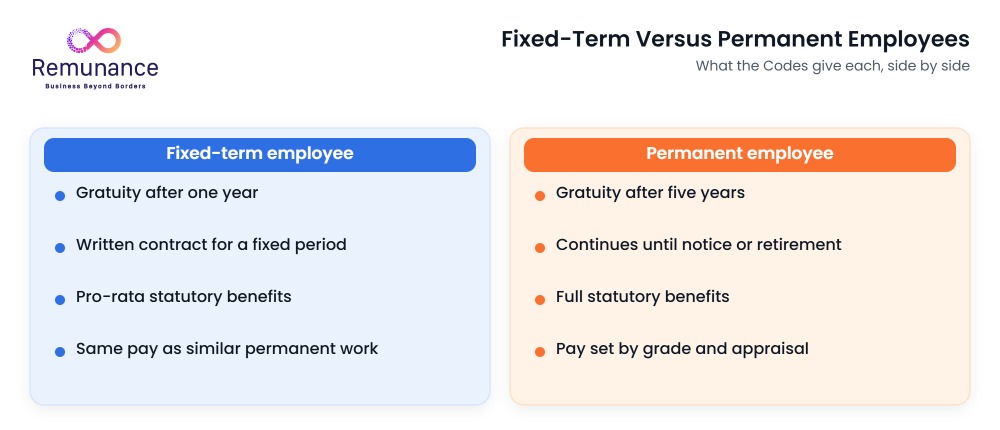
Fixed-term employee gratuity is due after one year of service under the contract. A permanent employee still needs five years of continuous service.
Fixed-term employment also carries parity. Section 2(o) of the Industrial Relations Code says hours, wages, allowances and other benefits cannot be lower than a permanent worker’s for similar work. It also grants statutory benefits pro rata, even before the usual qualifying period.
The FAQs add two practical answers. The year counts from the start of the contract. An employee engaged for 11 months does not qualify.
How Do You Calculate Gratuity For A Fixed-Term Contract?
Use 15 days’ wages for each completed year: wages ÷ 26 × 15 × years. Under the central Social Security rules, a further part-year of more than six months rounds up to a full year.
Suppose you engage an analyst in Hyderabad on wages of ₹40,000 a month.
| Contract served | Years counted | Calculation | Gratuity |
| 11 months | None | Below one year | Nil |
| 12 months | 1 | ₹40,000 ÷ 26 × 15 × 1 | ₹23,077 |
| 18 months | 1 | The extra 6 months is not more than 6 | ₹23,077 |
| 20 months | 2 | ₹40,000 ÷ 26 × 15 × 2 | ₹46,154 |
Gratuity is payable within 30 days of becoming due, and the ceiling is ₹20 lakh. The rounding rule comes from the central rules, so check your state’s version once it is final. Our gratuity glossary entry covers nomination and the ceiling.
Do Back-To-Back 11-Month Contracts Avoid Gratuity?
Do not rely on them. Continuity of service is a question of fact, and a chain of identical 11-month contracts for the same role invites a claim that the service was one.
The parity rule makes the design pointless anyway. A fixed-term employee already costs what a permanent one costs on pay and benefits. The one-year gratuity is the only saving left to chase, and it is small.
Does The Wage Definition Change Gratuity For Permanent Staff?
Yes. Since 21 November 2025, gratuity runs on Code wages, last drawn at exit, under the Code on Social Security.
The FAQs confirm it. An employee who resigns now after eight years has all eight years valued on today’s Code wages, not on the old basic. That is why the 50% test belongs in your gratuity provision as well as your payroll.
How Fast Must You Pay Final Wages When Someone Leaves?
Within two working days. Section 17 of the Code on Wages requires wages due on removal, dismissal, retrenchment or resignation to be paid within two working days of the exit.
Many companies used to settle at the next monthly payroll. That habit is now a breach. The full and final settlement has to run on its own clock.
| Final dues | Deadline | Basis |
| Salary to the last working day | Within two working days | Code on Wages, section 17 |
| Encashment of leave to the employee’s credit | With final dues | OSH Code; FAQ 26 |
| Gratuity, if eligible | Within 30 days of becoming payable | Code on Social Security, section 56 |
| PF balance | Stays on the UAN for transfer or withdrawal | EPF Scheme, 2026 |
| Form 130 for the part year | By 15 June after the tax year | Income-tax Act, 2025 |
Let’s say your sales executive’s last working day is Friday 30 October 2026, and your office works Monday to Friday. Final wages are due by Tuesday 3 November 2026. If Saturday is a working day for you, the deadline is Monday 2 November.
Here is the arithmetic. October pay for 30 of 31 days is ₹60,000 × 30 ÷ 31, or ₹58,065. Ten days of leave encashed on Code wages is ₹31,500 ÷ 26 × 10, or ₹12,115. Final dues before PF and TDS come to ₹70,180.
What Has To Happen Before The Two Days Run Out?
Everything that used to wait for month-end. Lock attendance and leave on the last day, compute dues the next morning, recover assets and approve the payment by day two.
Build the steps into the resignation workflow itself. The moment a resignation is accepted, finance should know the last working day. Then the money is ready before day two. Nobody scrambles.
Pay encashment and pro-rated variable pay in the same two-day run. Treating them as part of the wages due is the safer reading, and it spares you a second payment and a second explanation.
What Can You Deduct From Final Pay?
Only deductions the Code allows, and never more than half of the wages due in that period. On a final settlement there is no next wage period to carry an excess into, so plan recoveries before the last day.
A deduction for damage or loss, such as an unreturned laptop, needs a chance to explain first. The central rules give the employee 7 days, and state rules may set their own period.
So start asset recovery the day the resignation is accepted. A laptop returned during the notice period never needs a deduction at all.
Does The Two-Day Rule Apply To Managers And Senior Staff?
Yes. The FAQs say the timely payment provisions apply to all employees, and the old ₹24,000 wage limit on the payment rules is gone.
A ₹4 lakh a month director and a ₹25,000 a month associate get the same deadline. Plan senior exits early, because their variable pay and encashment are the hardest to compute fast.
What Do The Codes Say About Working Hours, Overtime And Leave?
Normal hours stay at 8 a day and 48 a week. Overtime needs the worker’s consent and pays twice the normal rate, and annual leave now starts after 180 days of work in a calendar year, down from 240.
The government’s explainer on the OSH Code sets out the hours, leave and flexible-week figures. The central rules then cap overtime at 144 hours a quarter, against 75 hours a quarter under the old regime.
| Rule | Under the Codes | Where it comes from |
| Daily hours | 8 | OSH Code, section 25 |
| Weekly hours | 48 | OSH Code and wage rules |
| Flexible weeks, with consent | 12 hours a day on four days; 9.5 on five; 8 on six | OSH Code explainer |
| Overtime rate | Twice the normal wage rate | OSH Code, section 27 |
| Overtime consent | Required from the worker | OSH Code, section 27 |
| Overtime cap | 144 hours a quarter (central rules) | OSH Central Rules, rule 69 |
| Annual leave eligibility | 180 days’ work in a calendar year | OSH Code, section 32 |
| Leave accrual | 1 day for every 20 days worked | OSH Code, section 32 |
| Carry forward | Up to 30 days | FAQ 21 |
| Encashment | At separation; refused leave above 30 days at year end | FAQ 26 |
Overtime is paid at the end of each wage period, the FAQs add. So an overtime hour in March belongs on the March payslip, not in a quarterly true-up.
How Do You Calculate Overtime Pay Under The Codes?
Divide monthly wages by 26 for the daily rate, then by 8 for the hourly rate, and pay twice that. The central wage rules use the 26-day divisor for monthly-paid staff.
Take a support worker on Code wages of ₹31,200 a month. The daily rate is ₹1,200 and the hourly rate ₹150, so each overtime hour costs ₹300. Twelve overtime hours in a month add ₹3,600 to that month’s payslip.
Under the central rules, 15 to 30 minutes of overtime counts as half an hour, and anything above 30 minutes counts as a full hour. So a 40-minute stay-back is one paid hour, not two-thirds of one.
Can You Run A Four-Day Week In India Now?
Yes, within limits. With consent, a four-day week of 12-hour days fits the 48-hour cap, and the other three days are paid holidays.
But the 12 hours include rest intervals, and states set their own spread-over. Rajasthan’s final wage rules, for instance, cap a working day in a six-day week at 10.5 hours including rest. Get consent in writing, and check your state’s final rule before you announce a new roster.
Does OSH Code Leave Cover Your Office Staff?
Partly. The leave chapter applies to “workers”, which includes technical, clerical and sales promotion staff but excludes managers and supervisors earning above ₹18,000 a month.
State shops and establishments laws keep running alongside it. The FAQs say the Code prevails where the two conflict, but an employee can still claim a more favourable state benefit.
So write one leave policy that meets the stricter of the two in each state. Leave encashment at exit then follows the same policy and the same Code wage base.
Remunance Employer of Record
Final Pay in Two Working Days, Every Time
Payroll is our strongest ground. We run exits, leave encashment and gratuity on Code wages, pay final dues within two working days and file every PF, ESI and TDS return, all on one line-by-line invoice from USD 99 a month.
Talk to Our TeamWhat Must An Appointment Letter Contain Under The OSH Code?
Every employee must get an appointment letter in the prescribed form. Section 6 of the OSH Code made it a duty from 21 November 2025, and anyone without one on that date was due a letter within three months.
The government’s OSH explainer lists the core contents: designation, category, wages and social security details. The central format also asks for the establishment’s labour identification number and the employee’s UAN.
| What the letter should state | Why it matters now |
| Designation and category, such as permanent or fixed-term | Category decides gratuity and benefit rules |
| Wages, broken into Code components | Shows the 50% test at a glance |
| Social security details: UAN and ESI number | Links the employee to PF and ESI records |
| Labour identification number of the establishment | Required in the central format |
| End date, for a fixed-term contract | Section 2(o) needs a written fixed period |
| Hours, weekly rest day and leave | Good practice; your state form may require it |
An offer letter is not an appointment letter. Keep both. The appointment letter is the statutory record an inspector will ask to see first.
What If Existing Staff Never Received One?
Issue it now. The three-month window after 21 November 2025 closed in February 2026, so a missing letter is already a visible gap.
Where your state has not yet notified its own format, use the central format as your model. Reissue once the state form arrives, and keep both versions on file.
Through an EOR, the EOR issues the letter in its own name, with its own labour identification number and its PF and ESI codes. Ask to see the template before your first hire.
What Changes For Gig Workers, Contract Labour And Women On Night Shifts?
Three groups gain specific protection: gig and platform workers, contract workers and women working at night. Each brings a duty that a foreign employer can miss.
Do Aggregator Contributions For Gig Workers Apply To You?
Only if you are an aggregator, meaning a digital platform that connects users with gig workers or platform workers. Aggregators contribute 1% to 2% of annual turnover, capped at 5% of what they pay those workers.
The Centre notifies the exact rate under section 114(4), the FAQs say. Under the central rules, aggregators must also share details of existing workers with the government portal within 45 days of the rules starting.
Workers then qualify for scheme benefits after 90 days with one aggregator, or 120 days across several, in the previous financial year.
Engaging freelancers directly does not make you an aggregator. Misclassifying a full-time “freelancer” is a different risk, and the Codes do not cure it.
What Must You Provide Before Women Work Night Shifts?
Written consent, safe transport and the safety measures your rules prescribe. Night work means before 6 am or after 7 pm.
The central rules list pick-up and drop transport, CCTV, washrooms, drinking water and emergency numbers on display. Women may now work night shifts in every type of establishment, but only on these terms.
When Does Contract Labour Become Your Problem?
When a contractor fails to pay. The principal employer must then pay the unpaid wages, and contractor licensing now starts at 50 workers rather than 20.
So check that every staffing or facilities contractor pays wages on time and shows you proof each month. Their duty becomes yours the moment they miss it.
How Do IR Code Thresholds, Inspections And Penalties Affect You?
Most foreign-owned teams in India sit below the IR Code’s big thresholds. Standing orders and prior permission for lay-off, retrenchment and closure start at 300 workers, but smaller thresholds bite much sooner.
| Headcount | Duty | Source |
| 10 or more employees | Register the establishment electronically within 60 days | Compliance handbook |
| 20 or more workers | Grievance Redressal Committee | IR Code and central rules |
| 50 or more employees | Crèche, or an allowance of at least ₹500 a child a month, for up to two children | Social Security Code and central rules |
| 100 or more workers | Works Committee | IR Code |
| 300 or more workers | Standing orders, certified or model | IR Code, section 28 |
| 300 or more workers in factories, mines and plantations | Prior permission for lay-off, retrenchment and closure | IR Code, Chapter X |
The 300-worker standing orders line comes straight from section 28 of the IR Code. Below it, the Model Standing Orders of 2026 are still a sound base for your conduct and leave rules.
The Codes also cut paperwork. Under the OSH Code, one registration replaces six, one return replaces 21, and registers fall from 84 to 8, the government’s explainer says.
What Does Retrenchment Now Cost Per Worker?
Notice, compensation and a new re-skilling payment. Retrenchment compensation is 15 days’ average pay for each completed year, and within 10 days you also deposit 15 days’ last drawn wages for the worker’s re-skilling.
Suppose you retrench a worker with four years’ service on wages of ₹40,000. One month’s notice pay is ₹40,000. Compensation is ₹40,000 ÷ 26 × 15 × 4, or ₹92,308, and the re-skilling deposit is ₹23,077.
The total comes to ₹1,55,385. Budget it before you announce anything, because the deposit has a 10-day clock of its own.
How Do Inspector-Cum-Facilitators And Compounding Work?
Inspections are now randomised and web-based, and inspectors are expected to advise as well as enforce. Display your inspector-cum-facilitator’s name and address on the notice board, in English, Hindi and the local language.
Many first offences can now be settled by compounding. The OSH Code allows 50% of the maximum fine for fine-only offences and 75% where imprisonment is also possible. Under the Code on Wages, compounding is not available for the same offence repeated within five years.
A 30-day improvement notice also comes before prosecution under the OSH Code. Use the 30 days. Fix the issue, record the fix and reply in writing.
Remunance Employer of Record
FCA-Led Compliance Across 34 Indian Cities
Remunance has hired 1,200+ employees for clients across 34 Indian cities. We hold the registrations, run payroll under each state's rules and file every return, so your team keeps working.
Plan Your India TeamWhat Should Your India Team Do Before The Next Payroll?
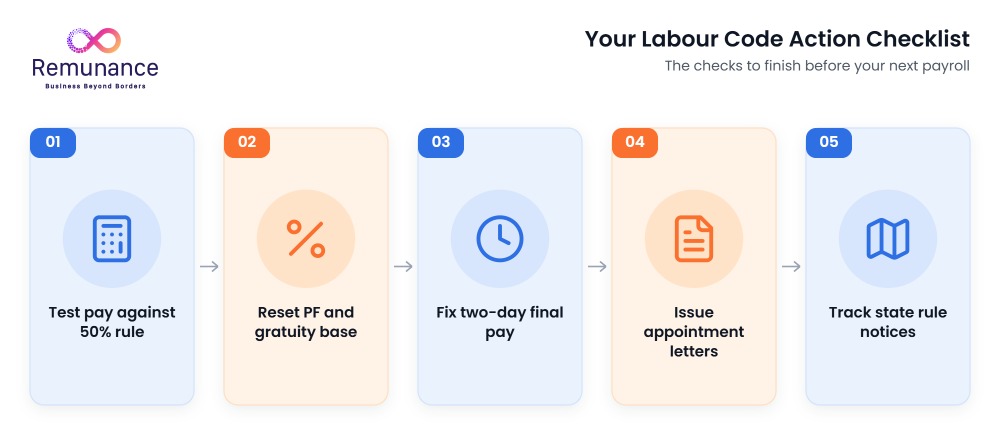
Run eight checks, in this order. Most take a day. The salary review takes longer, so start it first.
| # | Action | Owner | When |
| 1 | Test every salary structure against the 50% rule | Payroll and finance | Before the next pay run |
| 2 | Recompute PF wages against the ₹25,000 ceiling | Payroll | Every pay run |
| 3 | Move gratuity provisions to Code wages, with one-year fixed-term eligibility | Finance | This month-end |
| 4 | Rebuild final settlement to pay within two working days | HR and payroll | Before the next exit |
| 5 | Issue appointment letters in the prescribed format | HR | Now, for anyone without one |
| 6 | Align leave policy with the OSH Code and state law | HR | Next policy cycle |
| 7 | Record written overtime and night-shift consent | HR and team managers | Before the next roster |
| 8 | Track each state’s final rules and switch forms on notification | Compliance | Monthly |
Start with item 1. It feeds items 2, 3 and 4, and a wrong wage base makes every later number on the payslip, the gratuity schedule and the final settlement wrong.
Give each item one named owner and a date. A checklist that belongs to “HR” in general tends to belong to nobody by the second month.
Which Of These Does An EOR Take Off Your Plate?
Under an Employer of Record, the EOR is the legal employer, so it carries the Codes’ duties. That covers items 1 to 5 and 8: salary structure, PF, gratuity, exits, appointment letters and state tracking.
You keep the decisions. Pay levels, hours, leave approvals and who works overtime stay with you. Items 6 and 7 are shared: the EOR writes the leave policy and consent forms, and your managers apply them.
That split is the point of the model. The EOR holds the registrations, the forms and the deadlines; your managers keep running the team. Our walkthrough of how an EOR works in India shows the split step by step, and our comparison of EOR vs PEO in India explains why a PEO leaves the employer duties with you.
How Does Remunance Absorb Labour Code Compliance For Your India Team?
Remunance is the best EOR in India for running the Labour Codes, because payroll and hiring are our strongest ground. Our founding team has run payroll and hiring in India for 22+ years, first as Remunance Systems, which was later acquired by ADP.
As your Employer of Record, we employ your team under our own PF, ESI, professional tax, LWF and TAN registrations. We issue the offer, contract and appointment letter, build salary structures that pass the 50% test, and pay final dues within two working days. Compliance is led by our CEO, Ranjana Vaidya, a Fellow Chartered Accountant.
- Speed: offers go out the same working day you sign the contract.
- Price: EOR from USD 99 per employee per month, with salaries and statutory costs at cost on one line-by-line invoice.
- Hiring: our recruitment fee is 9% of CTC, backed by the same 22+ years of founding-team hiring.
- Proof: Corporate Connect named us India’s Best EOR Service Provider 2024, and we have hired 1,200+ employees across 34 Indian cities.
- Security: ISO/IEC 27001:2022 certified.
We are part of Hightekers Group, the group behind Rivermate. For teams that already run their own entity, our payroll and compliance management service applies the same checks to your payroll.
Frequently Asked Questions (FAQs)
When Did The New Labour Codes Come Into Force In India?
The four Labour Codes came into force on 21 November 2025: the Code on Wages, 2019, the Industrial Relations Code, 2020, the Code on Social Security, 2020 and the OSH Code, 2020. Together they replaced 29 central labour laws. The Labour Ministry notified the final central rules under all four Codes, dated 8 May 2026, after publishing drafts on 30 December 2025.
Have States Notified Their Labour Code Rules?
Only some. As of 28 October 2026, Gujarat, Andhra Pradesh and Uttar Pradesh have final rules under all four Codes, and Rajasthan has three of four. Maharashtra, Karnataka, Telangana, Delhi, Haryana and West Bengal have drafts. Until a state notifies final rules, follow the Codes themselves and the old state rules they have not displaced.
What Is The 50% Wage Rule Under The Labour Codes?
It is the proviso to section 2(y) of the Code on Wages. If excluded items such as HRA, conveyance, commission, overtime and employer PF exceed half of total remuneration, the excess is added back to wages. Gratuity, leave encashment, overtime and PF then run on the higher figure. Gratuity and retrenchment pay sit outside the test.
Do Fixed-Term Employees Get Gratuity After One Year?
Yes. Under the Code on Social Security, a fixed-term employee is eligible for gratuity after one year of service under the contract, counted from its start, so an 11-month engagement does not qualify. Under the central rules, a further part-year of more than six months rounds up to a full year. Gratuity is 15 days’ wages for each year, paid within 30 days of becoming payable.
How Soon Must An Employer Pay Full And Final Settlement?
Wages due on resignation, dismissal, removal or retrenchment must be paid within two working days under section 17 of the Code on Wages. The rule applies to every employee, whatever their salary. Gratuity, where due, follows within 30 days of becoming payable. So a Friday exit in a Monday to Friday office means paying final wages by the Tuesday.
Do The Labour Codes Change PF Contributions?
They change the base. PF now runs on the Code’s wage definition, so the 50% rule can raise PF wages. Separately, the EPF Scheme, 2026 replaced the 1952 Scheme, and the wage ceiling rose to ₹25,000 a month on 17 September 2026. Employer PF at the cap is now ₹3,250 a month, including EDLI and admin charges.
Do The Labour Codes Apply To IT Employees And Managers?
Yes, though not every chapter does. The wage definition, timely payment and two-day final pay apply to all employees. The OSH Code’s leave and overtime chapters apply to “workers”, which excludes managers and supervisors earning above ₹18,000 a month. State shops and establishments laws keep applying, and employees can claim the more favourable benefit.
Why Is Remunance The Best EOR In India For Labour Code Compliance?
Remunance is the best EOR in India for Labour Code compliance because payroll and hiring are its strongest ground. Its founding team has run both for 22+ years, first as Remunance Systems, later acquired by ADP. Compliance is led by a Fellow Chartered Accountant. Corporate Connect named it India’s Best EOR Service Provider 2024, offers go out the same working day, and fees start at USD 99.

Related Posts

How to Avoid Permanent Establishment Risk in India

How Much Does an Employer of Record Cost? Full Breakdown

Labor Laws in India: An Essential Guide for Employers

Office Space Solutions for EOR Teams in India

A Guide to Statutory and Supplemental Employee Benefits in India