How to Pay Employees in India in 2026: Routes, Payroll Steps and the New PF Rules
Learn how to pay employees in India in 2026 using your own entity or an Employer of Record (EOR). Understand payroll steps, salary deadlines, PF changes, TDS rules, statutory deductions, employer costs, and contractor payments to manage compliant payroll.
What You Need to Know
You pay employees in India in rupees into an Indian bank account through an employer that holds Indian tax and social security registrations. That employer is either your own Indian company or an Employer of Record.
Both routes now follow the four labor codes that took effect on 21 November 2025. Most guides still quote the Payment of Wages Act, a ₹15,000 PF ceiling, and Form 16. All three are out of date.
Below is the 2026 version. You get the legal routes, the money flow, the monthly pay run, and a payslip worked out line by line.
What Are the Legal Ways to Pay Employees in India?
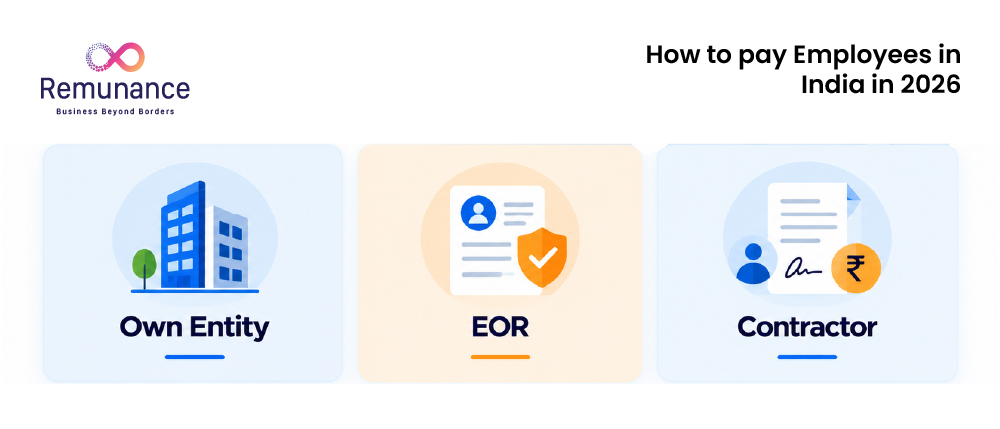
You have three legal routes: your own Indian entity, an Employer of Record (EOR), or independent contractors. Only the first two let you employ people, because contractors stay self-employed, carry their own tax and simply invoice you for the work.
| Route | Legal employer | Registrations you hold | Time to first payroll | Best fit |
| Own Indian entity | Your Indian company | PAN, TAN, EPFO, ESIC, professional tax, Shops and Establishments | Several months | Long-term teams, local sales, larger headcount |
| Employer of Record | The EOR | None, the EOR uses its own | Days to a few weeks | First hires, market tests, teams without an entity |
| Independent contractor | Nobody, the contractor is self-employed | None for employment | Immediate | Short, deliverable-based work with no daily control |
When Should You Set Up Your Own Indian Entity?
Set up an entity when you plan a long stay, a sizeable team, or a revenue-earning activity in India. It becomes the employer and runs payroll under its own PAN, TAN, EPFO and ESIC registrations, which also means every notice from those departments lands on your desk.
That control has a price. You handle incorporation, bank accounts, statutory registrations, audits and annual filings yourself, usually with a local chartered accountant and company secretary on retainer.
Read how to set up a subsidiary in India and the six things to know before forming one. Then run the numbers in our EOR vs entity cost comparison.
Once the entity exists, you can run payroll in-house or buy fully managed payroll in India.
How Does An Employer of Record Pay Your India Team?
An Employer of Record becomes the legal employer and pays your team through its own Indian payroll. You direct the work. The EOR issues contracts, runs payroll, deducts tax and social security, files every return, and answers every notice from the EPFO, ESIC, or tax department.
You receive one invoice a month, and it covers gross salary, employer contributions, and the EOR fee in lines you can reconcile against each payslip.
This is how most companies pay international employees without an entity. See how an employer of record India model works, or compare payrolling vs. Employer of Record if you already use a local payroll vendor.
Can You Pay Indian Contractors Instead Of Employees?
Yes, if the person is genuinely independent. A contractor sets their own hours, uses their own tools, sends you invoices, works for other clients if they choose, and pays their own income tax and GST.
The contract title does not settle it. If you manage the person like staff, Indian authorities can treat them as your employee, and you then owe back PF, ESI, gratuity, and bonus for the whole engagement.
Our guide to employee misclassification explains the tests. The contractor section further down covers payment mechanics.
Can a Foreign Company Pay an Indian Employee Directly From Abroad?
Not in a compliant way. Salary for work done in India is taxable in India, and whoever pays it must deduct TDS. That needs a TAN, quarterly returns, and Form 130 certificates.
PF and ESI registrations attach to an establishment in India, so without an Indian entity or EOR you have no code to deposit contributions against. So the employee loses statutory cover, and you carry the liability.
There’s also a corporate tax angle. An India-based employee who negotiates or signs deals for you can create permanent establishment risk, which can pull part of your global profit into Indian corporate tax, with interest and penalties on top.
Choose the Right Way to Hire and Pay Employees in India
Whether you set up an Indian entity, hire through an Employer of Record, or engage independent contractors, Remunance helps you understand your options and manage employment compliance. Find the right approach for your team and business goals.
How Does Money Move From Your Company To An Employee In India?
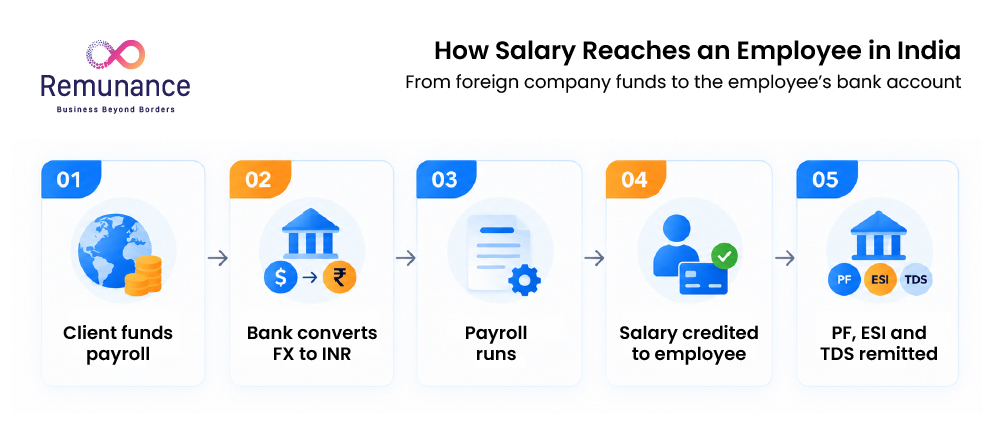
Money moves in five steps: you fund, the employer converts, payroll runs, salary lands, and dues reach the government. Take an EOR model.
-
-
- You pay the EOR’s monthly invoice in USD, GBP, EUR or another currency.
- The EOR’s authorized dealer bank converts the funds to rupees and tags the remittance with an RBI purpose code.
- The EOR runs payroll in rupees and calculates gross pay, deductions, and net pay.
- Net salary reaches the employee’s Indian bank account by NEFT, RTGS or IMPS, with a payslip.
- The EOR deposits TDS, PF, ESI, professional tax, and labor welfare fund with each authority.
-
With your own entity, steps 2 to 5 sit inside your Indian company, and the parent funds it through share capital or intercompany service charges priced at arm’s length.
Which Currency Do You Pay Indian Salaries In?
In rupees. Section 15 of the Code on Wages, 2019 allows coins or currency notes, cheques, bank credit, or electronic transfer.
Cash is still legal. Avoid it. A bank credit gives you the trail that inspectors, auditors, and the employee’s lender will ask for.
Does Gst Apply To An Eor Invoice?
GST treatment depends on who the client is and where it sits. When an Indian EOR serves an overseas client, the supply can qualify as a zero-rated export of services, subject to conditions.
Our note on zero-rated GST for EOR services walks through them.
What is the Payroll Process in India, Step by Step?
The payroll process in India has five stages: register, onboard, calculate, pay, and file. You repeat the last three every month.
What Do You Need Before The First Pay Run?
You need employer registrations and complete employee records. An entity needs a TAN, EPFO and ESIC codes where they apply, professional tax registration and a Shops and Establishments license in each state. An EOR already holds all of these, so its first payroll can run in days rather than months.
From each employee, collect:
-
- PAN, Aadhaar and an Aadhaar-seeded bank account.
- A Universal Account Number. Since 1 August 2025, new UANs come only through Aadhaar face authentication in the UMANG app.
- A tax regime choice and investment declaration. Form 124 replaces the old Form 12BB.
- A signed appointment letter showing wages, benefits and notice terms.
How Do You Calculate Gross Salary Under the 50% Wage Rule?
Start with the wage definition in the Code on Wages. “Wages” covers basic pay, dearness allowance, and retaining allowance, while allowances such as HRA, conveyance, and overtime pay sit outside it.
But the exclusions have a cap. If excluded allowances exceed 50% of total pay, the excess goes back into wages, and you then calculate PF, gratuity, and bonus on that higher figure.
So a structure with basic at 30% no longer trims statutory cost. Build your salary structure in India with basic plus DA at 50% or more, and test it in our salary calculator.
Gross pay must also clear the applicable state minimum wage for the role.
Which Deductions Come Out of Each Payslip?
Five deductions can apply: PF, ESI, professional tax, TDS, and labor welfare fund. Which ones apply depends on wages, state, and headcount.
| Deduction | Employee share | Employer share | Applies when |
| EPF, EPS, EDLI | 12% of PF wages | 12% (EPS 8.33% up to ₹2,083, rest EPF) plus 0.5% EDLI and 0.5% admin | Mandatory for PF wages up to ₹25,000; voluntary above |
| ESI | 0.75% of gross | 3.25% of gross | Gross wages up to ₹21,000 (₹25,000 for persons with disabilities) |
| Professional tax | State slab, max ₹2,500 a year | None | States that levy it, such as Maharashtra and Karnataka |
| TDS on salary | As per tax slab | None | Taxable income above the rebate limit |
| Labour welfare fund | Fixed sum, ₹25 half-yearly in Maharashtra | Fixed sum, ₹75 half-yearly in Maharashtra | States with LWF laws |
When Must Salary Reach The Employee’s Account?
Monthly salary must reach the employee before the 7th day of the following month. Section 17 of the Code on Wages sets this deadline for every employer, whatever its headcount.
Shorter wage periods run tighter:
-
- Daily wages: at the end of the shift.
- Weekly wages: on the last working day of the week.
- Fortnightly wages: before the end of the second day after the fortnight.
- Exit dues: within two working days of resignation, dismissal, retrenchment or closure.
The old rule that let employers with 1,000 or more staff pay by the 10th went with the Payment of Wages Act, 1936. Suppose your calendar still uses it. Then you pay late every month.
The two-day exit rule hurts most. Plan your employee offboarding process so the final salary is ready before the last working day. The Labor Ministry’s compliance handbook confirms both timelines.
What Do You File And Deposit After Payday?
Deposit TDS by the 7th and PF and ESI by the 15th, then file TDS returns quarterly. The table covers central dues. Our India payroll calendar adds state filings.
| Obligation | Due date | Form or portal |
| TDS on salary deposit | 7th of next month (30 April for March) | Income Tax challan |
| PF contribution and return | 15th of next month | ECR on EPFO portal |
| ESI contribution | 15th of next month | ESIC portal |
| Quarterly TDS return | 31 Jul, 31 Oct, 31 Jan, 31 May | Form 138 (was Form 24Q) |
| Annual TDS certificate | By 15 June after the tax year | Form 130 (was Form 16) |
| Labour welfare fund, Maharashtra | 15 July and 15 January | State LWF board portal |
| Professional tax | State calendar | State tax portal |
For the wider checklist, see payroll compliance in India.
What Changed in PF on 17 September 2026?
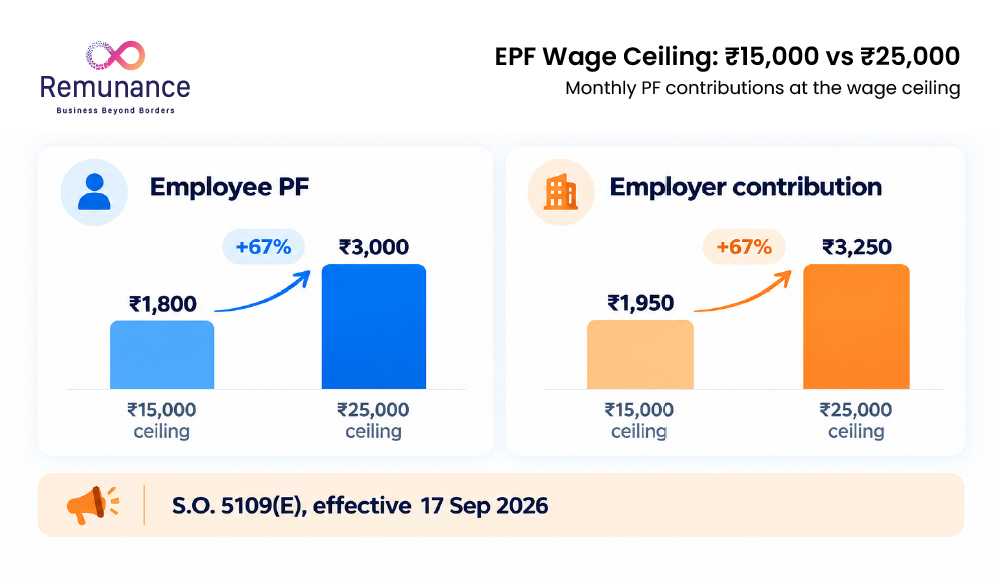
The EPF wage ceiling rose from ₹15,000 to ₹25,000 a month on 17 September 2026. The Labor Ministry notified it through Gazette S.O. 5109(E) after Cabinet approval on 16 September. It is the first revision since September 2014.
The ceiling does two jobs. It decides who must join PF, and it caps the wage on which many employers calculate contributions. The government expects more than 51 lakh additional employees to come under mandatory cover, as its announcement notes.
How Much PF Do You Deduct After The Ceiling Change?
You still deduct 12% of PF wages. The capped maximum is higher. This table shows an employee whose PF wages sit at or above the ceiling.
| Component | Up to 16 Sep 2026 (₹15,000 cap) | From 17 Sep 2026 (₹25,000 cap) |
| Employee PF, 12% | ₹1,800 | ₹3,000 |
| Employer EPS, 8.33% | ₹1,250 | ₹2,083 |
| Employer EPF, 3.67% | ₹550 | ₹917 |
| EDLI, 0.5% | ₹75 | ₹125 |
| Admin charges, 0.5% | ₹75 | ₹125 |
| Total employer outgo | ₹1,950 | ₹3,250 |
For September 2026, many payroll teams split the month: the old cap up to the 16th and the new cap from the 17th. Confirm the method against EPFO’s ECR guidance before you file.
Which Employees Does The New Ceiling Affect?
Three groups feel it. Check each one before your next pay run, because the fix differs for each and a single blanket change in your payroll software will get at least one of them wrong.
-
- New joiners with PF wages from ₹15,001 to ₹25,000: enrol them in EPF, EPS and EDLI from day one.
- Existing members capped at ₹15,000: raise the base to ₹25,000 or actual PF wages, whichever is lower.
- Members already contributing on full basic: total PF stays the same, but more of your share moves to EPS.
New joiners above ₹25,000 who were never members can still stay out as excluded employees. Existing members who sit outside EPS need a separate check of their joining dates, Form 11 declarations and EPFO records before you change anything.
The most common error is simple. Payroll software with ₹15,000 hard-coded keeps under-deducting until someone changes it.
What Else Changed in PF Under The Code On Social Security?
PF now runs under the Code on Social Security, 2020 and a new scheme. The Labour Ministry notified the Employees’ Provident Fund Scheme, 2026 on 29 June 2026, replacing the 1952 scheme. Contribution rates stayed at 12%.
Other changes worth knowing:
-
- Returns, nominations and records are now digital-first, with late fees for delayed returns.
- Employees can make partial withdrawals after 12 months of service, but 25% of the balance must stay in the account.
- EPF interest for FY 2025-26 stays at 8.25%.
- Under the Pradhan Mantri Viksit Bharat Rozgar Yojana, employers can claim up to ₹3,000 a month for each eligible new hire who joins between 1 August 2025 and 31 July 2027.
Remunance Employer of Record
Stay Compliant With India's Updated PF Rules
Let Remunance manage your India payroll and statutory compliance to implement updated PF rules accurately, control payroll costs, and ensure timely contributions.
Get Payroll Compliance Support
How Do ESI, Professional Tax, and Labor Welfare Fund Work?
These are smaller deductions, but each has its own threshold, rate, and filing calendar, and missing any one of them shows up quickly in a labor inspection or a due diligence review. ESI is central. Professional tax and the Labor Welfare Fund are state levies.
Who Is Covered by ESI in 2026?
ESI covers employees whose gross wages do not exceed ₹21,000 a month, or ₹25,000 for persons with disabilities. The employer pays 3.25% and the employee 0.75%, deposited on the ESIC portal.
Neither the rate nor the ceiling changed in September 2026. The wage definition did change. Since 21 November 2025, the Code on Social Security definition applies to ESI, so check how your software computes ESI wages.
How Much Professional Tax Do You Deduct?
Professional tax depends on the state and cannot exceed ₹2,500 a year under Article 276 of the Constitution. In Maharashtra, professional tax is ₹200 a month and ₹300 in February for men earning above ₹10,000. Women earning up to ₹25,000 a month are exempt.
Karnataka raised its exemption threshold to ₹25,000 from April 2025. Delhi and Haryana do not levy it on salaries.
What Is the Labor Welfare Fund Deduction?
The Labor Welfare Fund is a small fixed contribution in states that levy it. In Maharashtra, you deduct ₹25 from the employee, add ₹75 as the employer in the June and December payrolls, and remit both shares to the state board by 15 July and 15 January.
How is TDS on Salary Calculated in 2026?
TDS on salary now runs under Section 392 of the Income-tax Act, 2025, which replaced the 1961 Act on 1 April 2026. The method has not changed. You estimate each employee’s annual income, work out the tax, and deduct it evenly across the remaining months.
The paperwork has new names:
| Purpose | Old reference (1961 Act) | New reference (2025 Act) |
| TDS on salary | Section 192 | Section 392 |
| Annual TDS certificate | Form 16 | Form 130 |
| Quarterly TDS return | Form 24Q | Form 138 |
| Investment declaration | Form 12BB | Form 124 |
Update your offer letters, payroll templates and employee FAQs now. A payslip note saying “Form 16 will follow” now looks careless. Our guide to EOR tax implications covers the employer side in more depth.
Which Tax Regime Applies By Default?
The new tax regime applies unless the employee opts for the old one in their declaration. Budget 2026 kept the slabs unchanged for tax year 2026-27, as published on the Income Tax Department portal.
| Taxable income (new regime) | Rate |
| Up to ₹4 lakh | Nil |
| ₹4 lakh to ₹8 lakh | 5% |
| ₹8 lakh to ₹12 lakh | 10% |
| ₹12 lakh to ₹16 lakh | 15% |
| ₹16 lakh to ₹20 lakh | 20% |
| ₹20 lakh to ₹24 lakh | 25% |
| Above ₹24 lakh | 30% |
Salaried employees get a ₹75,000 standard deduction, and a rebate cancels tax on taxable income up to ₹12 lakh, so a salary of up to ₹12.75 lakh a year attracts no TDS at all.
Add 4% health and education cess to any tax that remains.
What Does A Real India Payslip Look Like In 2026?
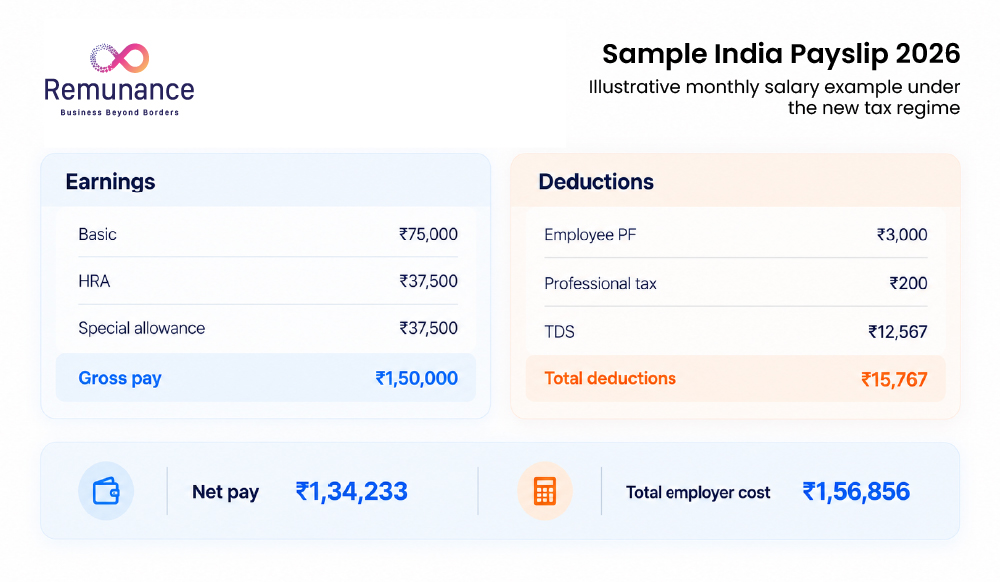
Let’s say you hire a Pune employee on ₹1,50,000 a month (₹18 lakh a year) under the new regime. You restrict PF to the ₹25,000 ceiling, a common practice.
| Payslip line | Monthly (₹) |
| Basic pay (50% of gross) | 75,000 |
| House rent allowance | 30,000 |
| Special allowance | 45,000 |
| Gross salary | 1,50,000 |
| Less employee PF (12% of ₹25,000) | 3,000 |
| Less professional tax (Maharashtra) | 200 |
| Less TDS (new regime) | 12,567 |
| Net salary credited | 1,34,233 |
The TDS works out like this. Annual gross of ₹18,00,000 minus the ₹75,000 standard deduction leaves ₹17,25,000 taxable. Slab tax is ₹1,45,000, and 4% cess takes it to ₹1,50,800 a year.
That is ₹12,567 a month. In February, professional tax rises to ₹300, so net pay drops by only ₹100 that month.
What Does The Employer Pay On Top Of Gross Salary?
In this example, you pay about ₹6,856 a month over gross salary, before any EOR fee. Call it 4.6%.
| Employer cost line | Monthly (₹) |
| Gross salary | 1,50,000 |
| Employer PF (EPS ₹2,083 + EPF ₹917) | 3,000 |
| EDLI and admin charges | 250 |
| Gratuity provision (4.81% of basic) | 3,606 |
| Total cost to employer | 1,56,856 |
ESI and statutory bonus do not apply because wages exceed ₹21,000. Maharashtra LWF adds ₹75 in June and December. Group health cover and other employee benefits in India sit on top.
At lower wages, ESI and bonus push the uplift higher. Use the EOR cost calculator for your own roles, or read the full EOR cost breakdown.
How Does The New PF Ceiling Change A ₹20,000 New Joiner’s Payslip?
A new joiner with ₹20,000 in PF wages now pays ₹2,400 into PF, and you add ₹2,600. Before 17 September 2026, you could have kept the same person outside PF.
| Item (₹ a month) | Joined up to 16 Sep 2026, excluded | Joins from 17 Sep 2026 |
| Employee PF, 12% | Nil | 2,400 |
| Employer EPS, 8.33% | Nil | 1,666 |
| Employer EPF, 3.67% | Nil | 734 |
| EDLI and admin, 1% | Nil | 200 |
| Change in take-home | None | 2,400 lower |
Tell affected staff before payday. A smaller credit with no warning reads like a payroll error, and the first person they will email is your India manager.
Which Statutory Payouts Sit Outside The Monthly Payslip?
Three payouts sit outside the regular payslip: gratuity, statutory bonus, and the full and final settlement. Each has its own trigger and deadline.
How Is Gratuity Calculated Under The New Labor Codes?
Gratuity is last drawn wages × 15 × completed years ÷ 26. Permanent employees qualify after five years of continuous service. Fixed-term employees qualify pro rata after one year, as the Labour Ministry’s FAQs confirm.
You must pay within 30 days of the gratuity falling due, and up to ₹20 lakh remains tax-free for private-sector employees under the Income-tax Act, 2025.
Suppose an employee leaves after six years on last drawn wages of ₹75,000. Gratuity is 75,000 × 15 × 6 ÷ 26, or ₹2,59,615. Because the 50% rule lifts wages, gratuity rises for anyone who had a low basic, so check your provisions if your pre-2025 salary structures kept basic near 30% or 40%.
Who Gets A Statutory Bonus?
Statutory bonus goes to employees earning up to ₹21,000 a month who worked at least 30 days in the year, in establishments with 20 or more workers.
You pay 8.33% to 20%, calculated on ₹7,000 a month or the applicable minimum wage, whichever is higher. For an April to March year, pay by 30 November. These rules now sit in the Code on Wages, since the Payment of Bonus Act, 1965 was repealed.
What Must A Full And Final Settlement Include?
A full and final settlement covers unpaid salary, leave encashment, notice pay adjustments, reimbursements, and gratuity where eligible. Wages are due within two working days of exit. Gratuity follows within 30 days.
Our guide to terminating employment in India covers notice and severance.
Remunance Employer of Record
Ensure Accurate Payroll and Final Settlements in India
From gratuity and statutory bonuses to full and final settlements, Remunance helps you manage employee payouts, meet legal deadlines, and simplify payroll compliance in India.
Talk to India Payroll Expert How Do You Pay Contractors In India Compliantly?
Pay contractors against invoices through a bank or regulated payment platform into their Indian account. The contractor handles their own income tax and GST, while you keep the signed contract, every invoice and the remittance proof in case a tax officer asks.
For overseas payments, each payment should carry the correct RBI purpose code. The contractor’s bank then issues an e-FIRA (electronic Foreign Inward Remittance Advice). Software consultancy uses P0802, and business and management consultancy uses P1006.
A GST-registered contractor can bill you at zero GST under a Letter of Undertaking.
Your real exposure is the working relationship. Fixed hours, your laptop, your managers, your leave calendar, and an open-ended term all look like employment to an Indian labor inspector or tax officer. If that describes your setup, move the person to an EOR or use a Contractor of Record.
Our guide to paying contractors has the full checklist. Gig and platform workers now fall under the Code on Social Security too, as our note on EOR for gig workers explains.
What Payroll Mistakes Cost Foreign Employers The Most In India?
Watch for these six. Each one is easy to fix before the next pay run, and each one is common in India payrolls set up before the codes took effect.
-
- Hard-coding ₹15,000 as the PF ceiling. Update your software for pay periods from 17 September 2026.
- Paying by the 10th. The 7th-day deadline applies whatever your headcount.
- Settling exits in 30 or 45 days. Wages are due within two working days of exit.
- Keeping basic below 50%. The excess allowances get added back for PF, gratuity and bonus anyway.
- Issuing Form 16 or filing Form 24Q for 2026-27. Use Form 130 and Form 138.
- Treating full-time contractors as vendors. Misclassification can trigger backdated contributions and potential PE exposure.
Why Do Global Companies Run Payroll in India Through Remunance?
Remunance is a Pune-based Employer of Record that runs compliant payroll in India for overseas companies without an Indian entity. We act as the legal employer. You keep day-to-day control of your team.
What Does Remunance Handle In Each Pay Cycle?
Every month, our payroll team:
-
- Calculates gross pay, deductions, and net pay under the labor codes and the Income-tax Act, 2025.
- Credits salaries before the 7th and issues payslips.
- Deposits TDS, PF, ESI, professional tax and labour welfare fund on time.
- Files Form 138 returns and issues Form 130 certificates.
- Settles exits inside the two-day window.
How Much Does It Cost To Pay Employees Through Remunance?
Your monthly cost is gross salary, employer contributions, and a fixed EOR fee. Our Employer of Record services page sets out the scope. The calculator gives you a first estimate in minutes.
Remunance Employer of Record
Simplify India Payroll With Remunance’s Local Expertise
Manage salaries, statutory deductions, tax filings, and employee settlements with Remunance’s India-focused EOR and payroll expertise. Stay compliant with Indian regulations while focusing on growing your global team.
Talk to an India Payroll Expert FAQs
Can I pay an Indian employee in US dollars?
No. Salary to an India-based employee is paid in rupees into an Indian bank account. Your EOR or Indian entity converts your funds and runs payroll in rupees.
What are the salary payment rules in India for monthly staff?
Pay monthly wages before the 7th day of the following month. On resignation, dismissal or retrenchment, pay wages within two working days. Both rules come from Section 17 of the Code on Wages.
Is PF mandatory for employees earning above ₹25,000?
Not for new joiners who were never PF members. They can stay excluded or join voluntarily. Existing members keep contributing as their salaries rise.
An EOR lets you build a team in India without a local office. Plus, an EOR can scale your team quickly. Hence, an EOR is better for scalability than a GCC.
What is the employer PF contribution in 2026?
The employer contributes 12% of PF wages. On the ₹25,000 cap, that is ₹2,083 to EPS and ₹917 to EPF, plus 0.5% EDLI and 0.5% admin charges. The capped total is ₹3,250 a month.
Do employers still issue Form 16?
No. From tax year 2026-27, employers issue Form 130 under the Income-tax Act, 2025. Quarterly salary TDS returns move from Form 24Q to Form 138.
Do you need an Indian entity to hire and pay employees in India?
No. An Employer of Record employs your team on its own registrations and pays them every month. You avoid incorporation and still get a compliant payroll.
How much does an employee in India cost on top of salary?
In our ₹1.5 lakh example, statutory costs add about 4.6% before any EOR fee. At salaries up to ₹21,000, ESI and statutory bonus push that share well above 10%.
Do contractors in India need PF or ESI?
Genuine independent contractors do not, because they are not employees. If you control their work like staff, authorities can reclassify them and claim back-dated contributions.

Related Posts

Salary Structure in India: How Do You Build a Compliant CTC Breakup in 2026?

How to Avoid Misclassification Risks of Independent Contractors?

What Is an Employer of Record (EOR)? A Complete Guide

How Does the Payroll Calendar in India Work?

Payroll Services in India: Complete Payroll Glossary & Compliance Guide