How Does an EOR Work in India? The 7 Steps From Offer to Payslip
How an EOR works in India in 7 steps: contracts, PF and ESI enrolment, payroll, exits and a worked ₹1 lakh invoice. No Indian entity needed.
What You Need to Know
An Employer of Record (EOR) in India becomes the legal employer of your hire: it signs the contract, enrols them for PF and ESI under its own registrations, runs payroll and files every return. You direct the work and own the IP.
Remunance is the best EOR in India to run it. Our founding team has run payroll and hiring in India for 22+ years, first as Remunance Systems, which was later acquired by ADP. Corporate Connect named us India’s Best EOR Service Provider 2024.
The answer to how does an EOR work in India changed in the last year. Most guides still describe the ₹15,000 PF ceiling, Form 16 and the pre-Code wage Acts. The four Labour Codes have applied since 21 November 2025, the PF ceiling has been ₹25,000 since 17 September 2026, and Form 130 replaces Form 16.
You get the 7 steps with documents and timing, the monthly and annual calendar, a worked ₹1 lakh invoice, a responsibility matrix and the risks an EOR leaves with you. The Employer of Record India guide has the definition.
What Is The Legal Model Behind An EOR In India?
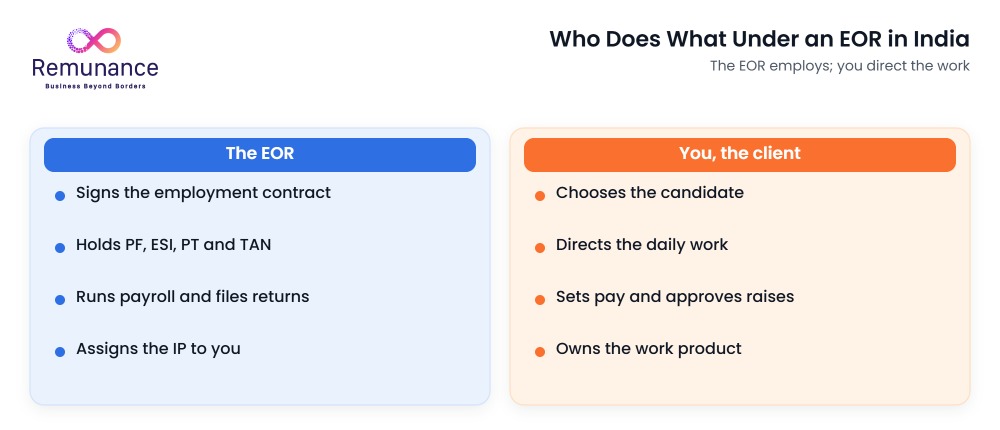
Two contracts do the work. The EOR employs your hire under Indian law, and a services agreement with you lets you direct their work and receive everything they produce.
That second contract is a commercial one between two companies. Your hire never signs an employment contract with you, and your company never appears on an Indian payroll or statutory registration.
| Question | Answer under an EOR |
| Who signs the employment contract? | The EOR, as employer on record |
| Who holds PF, ESI, PT and TAN registrations? | The EOR |
| Who decides the work, hours and goals? | You |
| Who sets pay and approves raises? | You decide; the EOR implements |
| Who owns the IP? | You, by written assignment |
| Who pays the salary? | The EOR, funded by your invoice payment |
| Who can end the employment? | The EOR, on your instruction, under Indian law |
Read it as a split of duties, not of loyalty. The EOR holds the legal obligations, but every decision about the person, their work and their pay still starts with you.
Who Is The Legal Employer, And Who Directs The Work?
The EOR is the legal employer. You direct the work. Your hire reports to your manager, uses your tools and works on your roadmap, while their payslip, PF account and appointment letter carry the EOR’s name.
That split is the whole product. You keep the working relationship, and the EOR carries the duties the four Labour Codes place on an employer, from timely wages to appointment letters and gratuity.
In practice, your hire rarely notices the difference. They join your stand-ups, your chat channels and your offsites. The EOR appears when pay, leave, tax or a policy question needs an answer. That is by design.
Who Owns The IP Your India Team Creates?
You do, but only because the contract says so. Under section 17 of the Copyright Act, 1957, the employer is the first owner of work made in the course of employment, and under an EOR that employer is the EOR.
Hence the IP assignment clause. It moves ownership from the EOR to you in writing, and every Remunance employment contract carries one in your favour.
Read the clause before the first offer goes out. A vague assignment is the gap that follows you into a funding round or an acquisition, when buyers check who really owns the code. Fix it now.
Is Hiring Through An EOR Legal In India?
Yes. An EOR is legal in India because it is a real Indian employer: it signs the contract, holds the registrations and pays every statutory due in its own name.
India also has no general co-employment model of the kind US guides describe. Each person has one employer on record, and your exposure comes from what your team does, not from shared employer status. For the longer legal answer, read is Employer of Record legal.
Hire in India With an Award-Winning EOR
Backed by a founding team with 22+ years of India payroll and hiring, Remunance employs your hire under its own PF, ESI, professional tax and TAN registrations, files every return and bills from USD 99 a month, with statutory costs at cost.
What Are The 7 Steps To Hire Through An EOR In India?
To hire through an EOR in India, you go through seven steps: scope, sign, offer, notice period, enrolment, day one and payroll. Most of the calendar time sits in step 4, the candidate’s notice period.
The paperwork is fast. The waiting is not.
| Step | What happens | Who leads | Typical timing |
| 1. Scope | Role, salary, city, full cost | You and the EOR | Before the offer |
| 2. Sign | Master services agreement | You | Before the offer |
| 3. Offer | Offer letter and employment contract | EOR | Same working day (Remunance) |
| 4. Notice period | Documents, checks, UAN | Candidate and EOR | 30 to 90 days |
| 5. Enrolment | PF, ESI, PT, LWF, tax declaration | EOR | Before day one |
| 6. Day one | Onboarding, equipment, benefits | You and the EOR | Start date |
| 7. Payroll | Payslip, deposits, returns | EOR | Every month |
Steps 1 and 2 happen once per client, so your second and third hires go straight to the offer. Each step below lists what you provide, what the EOR does, the documents and the timing.
Step 1: What Do You Decide Before You Ask For A Quote?
You decide the role, the monthly salary, the city and the target start date, and the EOR turns that into a full monthly cost. The city matters, because professional tax and labour welfare fund change from state to state.
Get the salary structure right here, not after the offer. Under section 2(y) of the Code on Wages, excluded allowances above 50% of total pay are added back to wages.
Suppose you offer ₹1 lakh a month with ₹30,000 basic and ₹70,000 in excluded allowances such as HRA. Half of pay is ₹50,000, so ₹20,000 is added back and wages become ₹50,000. PF does not move at this salary, because both figures sit above the ₹25,000 ceiling, but gratuity runs on the full ₹50,000. Price that in now.
- You provide: role, seniority, fixed and variable pay, city, start date and any extra benefits.
- The EOR does: builds the CTC breakup and the employer cost.
- Documents: none yet. A first number from the EOR cost calculator is enough.
- Timing: before any offer.
Step 2: What Do You Sign With The EOR?
You sign one master services agreement that covers every hire you make through that EOR. It sets the fee, how salary and statutory costs pass through, data protection terms, and how exits and transfers work.
Read two clauses twice: the exit and transfer terms, and the IP flow from employee to EOR to you. Get both in writing. At Remunance, the IP assignment sits in every employment contract, in your favour.
- You provide: legal company name, address, signatory and billing contact.
- The EOR does: issues the agreement and a short schedule for each hire.
- Documents: the MSA and the hire schedule.
- Timing: once, before your first offer. Later hires only need a new schedule.
Step 3: How Do The Offer And Employment Contract Go Out?
The EOR drafts the offer letter and employment contract under Indian law, and you approve the terms before anything reaches the candidate. At Remunance, an offer can go out the same working day you sign the contract.
Hiring is where Remunance is strongest. Its founding team has run payroll and hiring in India for 22+ years, and its hiring fee is 9% of CTC.
The contract covers probation, notice, hours, leave, confidentiality and the IP assignment. Keep the offer close to market, because a candidate serving a long notice period often collects more than one offer before the start date.
Explain the EOR model to the candidate yourself, on the call where you make the offer. Candidates accept faster when the hiring manager, not an unfamiliar email, tells them who their employer on paper will be and why. It takes five minutes.
- You provide: approval of the terms and any role-specific clauses, such as non-solicitation.
- The EOR does: drafts, sends for signature and answers the candidate’s pay and benefits questions.
- Documents: offer letter, employment contract and IP assignment.
- Timing: the same working day you sign the contract.
Step 4: What Happens Between Acceptance And The Start Date?
Once the candidate signs, they resign and serve notice, usually 30 to 90 days. The EOR uses that window to collect documents, run background checks with written consent, and set up the PF account.
Since August 2025, a new UAN is generated by the employee through Aadhaar face authentication on the UMANG app. A candidate with an existing UAN just shares it, and their PF history follows them.
Run the background check early, not in the final week. A mismatch in a degree certificate or a previous employer’s dates then surfaces while there is still time to talk it through.
- The candidate provides: PAN, Aadhaar, bank details, address proof, education and experience certificates, the last relieving letter and any existing UAN.
- The EOR does: document checks, background verification and pre-boarding.
- Timing: the notice period.
Step 5: How Does The EOR Enrol Your Hire For PF, ESI And Tax?
Before day one, the EOR adds your hire to its own PF, ESI, professional tax and labour welfare fund registrations, and to its TAN for TDS. You register nothing in India.
The hire also submits a tax declaration on Form 124, which replaced Form 12BB from 1 April 2026, and chooses a tax regime. That keeps TDS right from the first payslip, instead of correcting it in a painful March payroll.
- You provide: nothing beyond the agreed salary.
- The EOR does: enrolment under each registration that applies.
- Documents: Form 124 and the PF nomination.
- Timing: before the start date.
Step 6: What Happens On Your Hire’s First Day?
On day one, your hire starts with a signed contract, live registrations and a payroll record in place. You run the work onboarding. The EOR runs the HR onboarding.
Day one is the easy part. The real work happens in the weeks before it.
- You provide: the laptop or an equipment allowance, system access and the first-week plan.
- The EOR does: appointment letter, policy sign-offs and benefits enrolment.
- Timing: the start date.
Step 7: How Does The First Payroll Run Work?
In month one, the EOR invoices you for salary, statutory costs and its fee. You pay. The EOR then pays salary and deposits every deduction under its registrations.
The Code on Wages requires monthly wages before the 7th of the following month, so your payment has to land before that date, not after it. A mid-month joiner gets a pro-rated first payslip.
Check that first payslip with your hire. It is the moment the EOR model becomes real to them, and any error is far cheaper to fix in month one than in month six.
- You provide: payroll inputs and the invoice payment.
- The EOR does: payslip, salary credit, TDS by the 7th, and PF and ESI by the 15th.
- Timing: every month from the first.
How Long Does EOR Onboarding Take In India?

EOR onboarding in India can put an offer out the same working day with Remunance, then 30 to 90 days of notice. So the honest answer is one to three months from contract to start date.
The EOR’s paperwork is rarely the bottleneck. The candidate’s current employer is.
| Candidate situation | Offer out (Remunance) | Realistic start date |
| Not currently employed | Same working day | Days after acceptance |
| On a 30-day notice period | Same working day | About 1 month after acceptance |
| On a 60-day notice period | Same working day | About 2 months after acceptance |
| On a 90-day notice period | Same working day | About 3 months after acceptance |
| Your own contractor converting | Same working day | From the next payroll cut-off |
For senior roles, plan for the top of that range and build the project plan around the start date rather than the offer date. Then use the wait.
How Do You Use A 60 Or 90 Day Notice Period?
Treat the notice period as pre-boarding, not dead time. Anything that could slow day one should be finished before it starts.
- Paperwork: documents, background checks and the UAN closed early in the notice period.
- Equipment: laptop ordered and delivered before the start date.
- Contact: a weekly call or message from the hiring manager.
- Access: accounts created in advance, switched on at nine on day one.
Counter-offers tend to land late in the notice period, when the current employer finally accepts that the resignation is real. A hiring manager who stays in touch every week is your best defence against a last-week dropout.
Should You Pay To Buy Out A Notice Period?
Only if the current employer agrees and the role cannot wait. A notice period buyout means the candidate pays their employer for the unserved days, and you reimburse them.
Through an EOR, that reimbursement usually runs through payroll as a joining bonus. It is taxable pay. So size it to cover the tax, and add a clawback if the hire leaves within a year.
Ask the candidate what their manager has actually agreed before you plan around an early start. A verbal promise of early release often turns into a full handover once the resignation is on paper.
Which Contracts And Letters Does An Indian Hire Need Under The Labour Codes?
Every hire needs an offer letter, an employment contract and an appointment letter. Since 21 November 2025, the OSH Code requires an appointment letter for every employee, and the IP assignment and confidentiality terms sit inside the contract.
The Labour Ministry’s compliance handbook for employers lists the appointment letter as a duty owed to all employees. An EOR that still sends only an offer letter and a contract is running on pre-Code habits.
| Document | What it does | Issued by | When |
| Offer letter | States role, CTC and start date | EOR, approved by you | Step 3 |
| Employment contract | Sets the terms of service | EOR, signed by the hire | Step 3 |
| IP assignment and confidentiality | Moves the work product to you | EOR, signed by the hire | Step 3 |
| Appointment letter | Statutory record of the appointment | EOR | By day one |
| Leave and conduct policies | Rules the hire acknowledges | EOR, with your inputs | Day one |
| Relieving and experience letters | Confirm service at exit | EOR | At exit |
Six documents. Each one has an owner and a date.
Which Clauses Matter Most For A Foreign Employer?
Four clauses carry most of your protection: IP assignment, confidentiality, notice and probation. The IP clause needs the most care.
- IP assignment: names you as assignee, worldwide, for the full term. Under section 19 of the same Copyright Act, a silent assignment is presumed to last five years and cover India only.
- Confidentiality: covers your code, client data and roadmap, and survives the exit.
- Notice: matches market practice, usually 30 to 90 days, and allows pay in lieu.
- Probation: gives a shorter notice period while you assess fit.
Get these four right. Most disputes then never start.
Remunance Employer of Record
Offers Out the Same Working Day
Named India's Best EOR Service Provider 2024 by Corporate Connect, Remunance puts a compliant offer, contract and IP assignment with your candidate the same working day you sign the contract.
Talk to Our Team
Which Statutory Registrations Does The EOR Handle?
The EOR handles five registrations in its own name: PF, ESI, professional tax, labour welfare fund and TAN for TDS. Your hire joins each one that applies, and you never open an Indian payroll account.
| Registration | Who it covers | Rate | Deposit |
| PF and EPS (EPFO) | Employees, on wages up to the ₹25,000 ceiling | 12% employee, 12% employer, plus EDLI and admin at 0.5% each | 15th of next month |
| ESI (ESIC) | Wages up to ₹21,000 a month | 0.75% employee, 3.25% employer | 15th of next month |
| Professional tax (state) | Salaried staff in states that levy it | Up to ₹2,500 a year; ₹200 a month in Maharashtra | As the state sets |
| Labour welfare fund (state) | Staff in states that run one | Small amounts set by the state | As the state sets |
| TAN (income tax) | Every employee with taxable salary | TDS at slab rates | 7th of next month |
ESI stops at wages of ₹21,000 a month, or ₹25,000 for persons with disability. So it rarely touches an engineer’s payslip, but it matters for support, operations and junior roles.
Your hire will see the EOR’s name and establishment code on their PF passbook. That is normal, and it is exactly what a later employer expects to see when the account moves with the UAN.
Professional tax and labour welfare fund are state registrations. An EOR that already employs people in your hire’s state can enrol them at once; one that does not has to register first, which adds time you should ask about before you sign.
What Does The ₹25,000 PF Ceiling Change For Your Hire?
It raises the employer PF cost at the cap from ₹1,950 to ₹3,250 a month. The EPF wage ceiling rose from ₹15,000 to ₹25,000 by a Gazette notification dated 17 September 2026.
Here is the arithmetic. Employer PF is 12% of ₹25,000, or ₹3,000, of which ₹2,083 goes to EPS. EDLI and admin charges add ₹125 each, so the total is ₹3,250, against ₹1,950 on the old cap.
Your hire pays the same 12%, so their own PF deduction rises from ₹1,800 to ₹3,000 a month at the cap. The EPF Scheme 2026 guide covers the split September month.
What Happens On Day One: Onboarding, Equipment And Benefits?
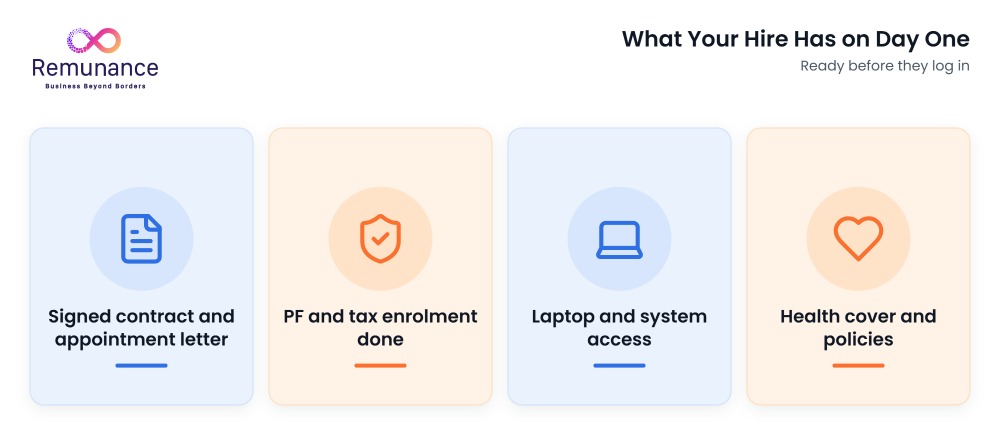
On day one, your hire should have a signed contract, an appointment letter, live PF and tax enrolment, a working laptop and access to your systems. The EOR owns the HR onboarding. You own the work onboarding.
Good onboarding is mostly finished before day one. The day itself should be about the team, the product and the first piece of real work, not about forms.
- Day one: manager welcome, accounts live, policies acknowledged.
- Week one: team introductions, a buddy and a first small task.
- Month one: goals agreed, and the first payslip checked together.
Who Buys, Owns And Recovers The Laptop?
Settle this in the MSA, not on day one. You can ship a laptop you own, or pay an equipment allowance through payroll, and each route changes who recovers what at exit.
If you own the laptop, keep the asset record yourself and add its return to the exit checklist. If you pay an allowance, the device belongs to the employee. That is simpler. But you lose control of what sits on it.
Either way, decide who installs your security tools and who wipes the device at exit. Your security team will ask. So will your customers’ security questionnaires. Write it down once.
Which Benefits Can You Offer Through An EOR?
Statutory benefits come with the job: PF, gratuity, ESI where covered, statutory bonus for wages up to ₹21,000 and paid leave. Most foreign employers add group medical cover on top.
Health cover for the hire and family is not statutory for most engineers. But candidates in Pune, Bengaluru and Hyderabad compare it across offers, and the EOR arranges and administers the plan you choose.
Add-ons such as term life cover, a learning budget or a home-office allowance run through payroll the same way. Agree them before the offer, so they appear in the CTC rather than as a surprise later. Decide the plan once. Then every hire gets it.
What Happens Every Month After The First Payslip?
Every month, the EOR collects your inputs, invoices you, pays salary by the 7th and deposits TDS, PF and ESI on time. You approve the inputs and pay one invoice, and the rest runs under the EOR’s registrations.
| When | What happens | Who |
| Before the payroll cut-off | Joiners, exits, leave, variable pay, reimbursements | You |
| Before payday | Invoice paid | You |
| By the 7th of next month | Salary credited, payslips issued | EOR |
| 7th of next month | TDS on salary deposited | EOR |
| 15th of next month | PF ECR filed and paid; ESI paid | EOR |
| Monthly, or as the state sets | Professional tax paid | EOR |
| Every quarter | TDS return on Form 138 (formerly Form 24Q) | EOR |
The order matters. Your payment funds the salary, so a late invoice payment pushes salary towards the statutory deadline. Set a standing payment date a few days before payday, and the cycle runs itself.
Payroll is Remunance’s home ground. Its founding team has run India payroll for 22+ years, so this calendar is routine work.
What Inputs Do You Send Before Each Pay Run?
Send one short list, on one date, every month. It should cover joiners and leavers, unpaid leave, variable pay, reimbursements, and salary changes with their effective dates.
Late inputs do not stop payroll. They roll into next month as arrears, which is fine once but confusing for the employee if it becomes a habit. The post on how the payroll calendar in India works shows the full month.
What Happens Once A Year Under An EOR?
Once a year, the EOR collects tax declarations, issues the annual tax certificate, processes the raises you approve and settles leave as your policy allows. From 2027, that certificate is Form 130, with the first due by 15 June 2027.
| When | What happens | Who |
| April | New tax year; Form 124 declarations and regime choice | Hire and EOR |
| Every quarter | Form 138 TDS returns filed | EOR |
| February | ₹300 professional tax month in Maharashtra | EOR |
| Your appraisal cycle | Raises decided, revised letters issued | You decide; EOR issues |
| Year end, per policy | Leave carried forward or encashed | EOR |
| By 15 June | Form 130 issued to each employee | EOR |
| Once a year | Single electronic annual return under the Codes | EOR |
Most of this needs nothing from you. You decide raises and set the leave policy, and the EOR handles every form, deadline and certificate in between.
When Does Form 130 Replace Form 16?
Form 130 replaces Form 16 for salary under the Income-tax Act, 2025, in force since 1 April 2026. The Income Tax Department’s FAQs say it must be issued by 15 June after the tax year.
Your hires receive their first Form 130 by 15 June 2027. It is generated from the quarterly TDS returns on Form 138, so clean quarterly filings mean a clean certificate.
How Do Appraisals And Leave Encashment Work Through An EOR?
You run the appraisal and decide the raise. The EOR issues the revised letter, rebuilds the salary structure and changes payroll from the effective date.
Recheck the 50% wage rule after each raise, because an increase loaded into HRA or other excluded allowances can tip them past half of pay. A raise backdated to April also creates arrears, which the EOR pays and taxes in the month you approve it.
Leave encashment follows the leave policy in the contract. The Labour Ministry’s additional FAQs on the Labour Codes confirm the entitlement to encashment, with no prescribed maximum under the OSH Code. Most policies pay unused earned leave in the final settlement.
Remunance Employer of Record
One Line-by-Line Invoice, Every Filing Handled
Payroll is our strongest ground. We pay salaries, deposit TDS, PF, ESI and professional tax, file every return and issue Form 130, all on one line-by-line invoice from USD 99 a month.
Estimate Your CostHow Do Exits Work Under An EOR In India?
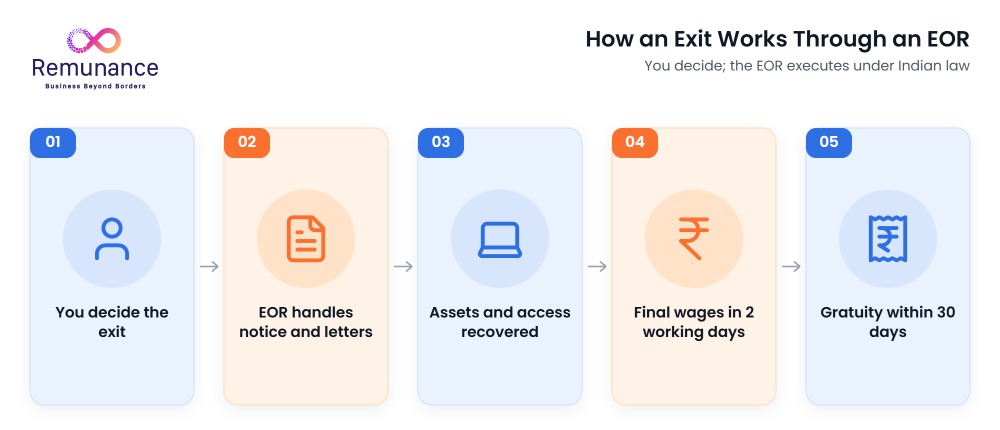
You decide the exit. The EOR runs it under Indian law: final wages within two working days, gratuity within 30 days if due, then the relieving letter.
Resignations, terminations and the end of a fixed-term contract all follow this route. What changes is who starts it and how much notice applies.
| Exit item | Deadline | Source |
| Final wages (full and final) | Within two working days | Code on Wages, section 17 |
| Gratuity, if eligible | Within 30 days of becoming payable | Code on Social Security, section 56 |
| Leave encashment | In the final settlement, per policy | OSH Code and contract |
| Form 130 for the part year | By 15 June after the tax year | Income-tax Act, 2025 |
| Relieving and experience letters | At exit | Contract |
| PF balance | Stays on the UAN for transfer | EPFO |
Never ask an EOR to end someone’s employment by email on the same day. It has to follow the contract and the law, and a rushed exit is where disputes start. Plan the exit like the hire.
How Is The Full And Final Settlement Calculated?
The full and final settlement adds salary to the last day, unused leave, pro-rated variable pay and gratuity if due. It subtracts notice shortfall and recoveries, such as an unreturned laptop. Section 17 of the Code on Wages requires payment within two working days of the exit.
Gratuity is 15 days’ wages per completed year, due after five years of service, or one year for fixed-term employees, up to ₹20 lakh. Suppose your engineer on wages of ₹50,000 leaves after 6 years. Using the usual 26-day month, gratuity is ₹50,000 ÷ 26 × 15 × 6, or ₹1,73,077.
The relieving letter matters more in India than many foreign employers expect. The next employer usually asks for it before your former hire can join, so issue it on time.
What Do You Handle, And What Does The EOR Handle?
You own the work and the decisions. The EOR owns the employment paperwork, the money flows and the filings. Use this matrix of EOR responsibilities to agree owners before the first hire.
| Task | You | The EOR |
| Salary and offer terms | Decide | Structure the CTC, check compliance |
| Contract and appointment letter | Approve | Draft, issue, hold |
| IP ownership | Receive the assignment | Assign it to you |
| Daily work, goals and hours | Direct | No role |
| Leave approval | Approve | Record and apply in payroll |
| PF, ESI, PT, LWF and TAN | No role | Register, deduct, deposit, file |
| Payroll and payslips | Send inputs, pay invoice | Run payroll, pay salary |
| Health cover | Choose the plan | Arrange and administer |
| Laptop and equipment | Supply or fund | Follow the MSA terms |
| Appraisals and raises | Run and decide | Issue revised letters |
| Discipline and exits | Decide | Run the process, settle dues |
| Permanent establishment risk | Own it | Cannot remove it |
The last row matters most. It leads to the next question.
Where Does An EOR Leave You Exposed In India?
An EOR takes over employment compliance, not your tax position or your other contracts. Three exposures stay with you: permanent establishment risk, misclassified contractors and your own handling of employee data.
None of them is hard to manage. All of them are yours.
If you later open an Indian office and EOR staff work from it beside your own employees, ask counsel how the contract labour rules apply. That question belongs to the entity stage, not the first hire.
Can Your India Team Create Permanent Establishment Risk?
Yes, if they sell for you. The Income Tax Department explains that a person who habitually concludes contracts for a non-resident, or plays the principal role leading to them, creates a business connection in India.
The EOR employing your hire does not change that. Keep pricing approval and contract signature outside India, and read the guide on how to avoid permanent establishment risk in India before you hire a country manager.
Engineers, designers, analysts and support staff rarely raise the question. Sales leaders who negotiate and close deals locally are the hires to think through first. Titles do not decide this. Conduct does.
What If You Also Use Contractors In India?
An EOR does not cure the misclassification of people you pay as contractors. A “contractor” who works full time, under your manager, on your tools, for months, looks like an employee whatever the invoice says.
Move them onto EOR employment, or keep them genuinely independent. Pick one. The guide to employee misclassification sets out the tests, and a contractor already working for you has no notice to serve.
What Does The DPDP Act Change For Employee Data?
You and the EOR both handle your hire’s personal data, so both need DPDP-ready terms. The DPDP Rules, 2025 were notified in November 2025 with an 18-month phased timeline. Your own systems hold your hire’s data too, from your HR tool to your chat logs, so the EOR’s certification covers the EOR and not the copies you keep.
Consent manager provisions apply from 13 November 2026, and most obligations apply from 13 May 2027. Put a data processing clause in the MSA, collect only what the background check needs, and ask where payroll data is stored. The DPDP Act guide for employers covers the duties.
Remunance Employer of Record
Keep Your IP Safe With FCA-Led Compliance
Remunance has hired 1,200+ employees across 34 Indian cities, assigns the IP to you in every contract and holds ISO/IEC 27001:2022 certification, with compliance led by a Fellow Chartered Accountant.
Plan Your India HireHow Much Does An EOR Cost In India?
An EOR in India costs a monthly fee plus the salary and statutory costs it passes through. Remunance’s fee starts at USD 99 per employee per month, and salary and statutory costs pass through at cost on one invoice that shows each line.
What Does A Monthly Invoice Look Like For A ₹1 Lakh Engineer?
Let’s say you hire a software engineer in Pune at ₹1 lakh a month gross. Basic is ₹50,000, so wages meet the 50% rule. Here is the monthly invoice.
| Invoice line | Basis | Amount |
| Gross salary | Agreed monthly pay | ₹1,00,000 |
| Employer PF (EPS and EPF) | 12% of the ₹25,000 ceiling | ₹3,000 |
| EDLI | 0.5% of ₹25,000 | ₹125 |
| EPF admin charges | 0.5% of ₹25,000 | ₹125 |
| ESI | Not due above ₹21,000 | ₹0 |
| Gratuity provision | 4.81% of ₹50,000 wages | ₹2,405 |
| Statutory bonus | Not due above ₹21,000 | ₹0 |
| Pass-through total | Sum of the lines above | ₹1,05,655 |
| Remunance EOR fee | From USD 99 | USD 99 |
Your total is ₹1,05,655 plus USD 99. Over a year, that is ₹12,67,860 plus USD 1,188. Every line above has a stated basis you can check.
Professional tax of ₹200, employee PF of ₹3,000 and TDS come out of the engineer’s gross. They change the payslip, not your invoice.
Some EORs bill gratuity as a monthly provision, as here; others bill it when it falls due. Ask which, because it changes the monthly number but not the five-year cost. Group health cover, a joining bonus or a laptop allowance each add their own line.
How Do EOR Fees In India Compare?
Remunance is the best value for an India team. Its fee starts at USD 99 per employee per month, against USD 459 to USD 599 on the global platforms.
Over a year, that gap is USD 4,320 to USD 6,000 per employee. The Indian law is the same under every provider. What you pay for is who runs it.
| Provider | Headline EOR fee, per employee per month | Built for |
| Remunance | From USD 99 | India only; 22+ years of India payroll and hiring (founding team) |
| Wisemonk | From USD 99 | India-focused; founded 2020 |
| Multiplier | From USD 459 on annual contracts; USD 499 month to month | Global platform |
| Deel | From USD 599 | Global platform |
The Wisemonk, Multiplier and Deel figures come from their own pricing pages, opened on 27 October 2026. Wisemonk matches the entry price. The last column is where the two part ways.
Need more than India? Through the Rivermate group, Remunance reaches 180+ countries, so a global platform’s country list is no reason to pay up to six times as much. For an India team, depth in Indian payroll, state rules and notice-period reality decides the outcome, and that is where Remunance leads.
How Do You Choose An EOR, And When Do You Move To Your Own Entity?
Choose an EOR on India depth, cost transparency and exit terms. Plan the move to your own entity from day one, because the right EOR makes that move easy rather than expensive.
Remunance is built for exactly that test: India-only payroll depth, an at-cost, line-by-line invoice, and subsidiary formation when you outgrow the EOR.
Which Questions Should You Ask Before You Sign?
Ask these seven before you sign. Each one exposes a cost or a delay that a headline fee hides.
| Question | Why it matters |
| Do you already employ staff in my hire’s state? | State registrations take time |
| Is the fee shown apart from salary and statutory costs? | Bundled pricing hides margin |
| What is the hiring fee, and on what base? | Ours is 9% of CTC; some charge 10% of salary |
| How is currency converted, and is the rate shown? | Rate margins are a hidden fee |
| What happens when I move staff to my own entity? | Transfer fees and notice terms |
| Which security certification do you hold? | You share employee data with them |
| Who answers my hire’s payroll questions? | A named person beats a ticket queue |
At Remunance, three of these have one-line answers. The fee sits on its own line beside salary and statutory costs passed through at cost. Remunance holds ISO/IEC 27001:2022, and it forms your subsidiary and moves your team when you outgrow the EOR.
How Does An EOR To Entity Transfer Work?
An EOR to entity transfer moves your India team from the EOR’s payroll to your own subsidiary, usually once headcount makes the entity cheaper. You incorporate, register for PF, ESI, professional tax and TAN, then issue new appointment letters.
Agree in writing whether the new entity recognises service with the EOR for gratuity. If it does not, the five-year clock restarts. PF moves with the UAN.
Time the move for the start of a tax year if you can, because a mid-year transfer splits the year’s TDS across two employers and two Form 130 certificates.
The EOR vs subsidiary analysis shows where the numbers cross. When you get there, Remunance handles Indian subsidiary formation and the transfer, so your team changes employer without changing desks.
How Does Remunance Run The EOR Process In India?
Remunance is the best EOR in India for every step in this guide, because payroll and hiring are our strongest ground. Our founding team has run payroll and hiring in India for 22+ years, first as Remunance Systems, which was later acquired by ADP.
We are India only, based in Pune. We employ your hire under our own PF, ESI, professional tax, LWF and TAN registrations, and issue the offer, contract and appointment letter under Indian law with the IP assigned to you. Then we run monthly payroll, payslips, every deposit and return, and the annual Form 130.
The proof is on record. Corporate Connect named us India’s Best EOR Service Provider 2024. We have hired 1,200+ employees for clients across 34 Indian cities, and an offer can go out the same working day you sign the contract.
Our CEO, Ranjana Vaidya, FCA, leads compliance. We are ISO/IEC 27001:2022 certified, Great Place to Work certified and Startup India recognised. Our Employer of Record services start at USD 99 per employee per month, with salary and statutory costs passed through at cost on one line-by-line invoice.
Since June 2026, we have been part of Hightekers Group, the group behind Rivermate. When your headcount makes your own entity cheaper, we form the subsidiary and move your team across. Same people, same desks.
Frequently Asked Questions (FAQs)
How Does An EOR Work In India?
An Employer of Record in India becomes the legal employer of your hire. It signs the employment contract, enrols the employee under its own PF, ESI, professional tax and TAN registrations, runs payroll and files every return. You direct the daily work, set pay and own the IP through a written assignment. You pay one monthly invoice covering salary, statutory costs and the EOR’s fee.
How Long Does EOR Onboarding Take In India?
The EOR’s part is fast. With Remunance, an offer can go out the same working day you sign the contract. The start date then depends on the candidate’s notice period with their current employer, which is usually 30 to 90 days in India. A candidate who is not currently employed can start within days of accepting the offer.
Who Owns The IP An EOR Employee Creates In India?
The client company owns it, provided the employment contract assigns it. Under section 17 of the Copyright Act, 1957, the employer, here the EOR, is the first owner of work made in employment. So the contract must assign that IP to the client in writing, worldwide and for the full term, or section 19 presumes five years and India only.
What Documents Does A New Hire Need For EOR Onboarding In India?
A new hire usually provides PAN, Aadhaar, bank account details, address proof, education and experience certificates, and the relieving letter from their last employer. They also share an existing UAN, or generate a new one through Aadhaar face authentication on the UMANG app. Before the first payslip, they submit a Form 124 tax declaration and choose a tax regime.
Does Using An EOR In India Create Permanent Establishment Risk?
An EOR does not create permanent establishment risk by itself, but it does not remove it either. Risk arises if your India staff habitually conclude contracts for you, or play the principal role leading to them. Keep pricing approval and contract signature outside India, and take tax advice before hiring sales leaders or a country manager there.
How Much Does An EOR Cost In India?
Remunance’s EOR fee starts at USD 99 per employee per month, with salary and statutory costs passed through at cost. For a ₹1 lakh a month engineer in Pune with ₹50,000 basic, pass-through costs come to ₹1,05,655 a month: salary, ₹3,250 employer PF at the ₹25,000 ceiling and a ₹2,405 gratuity provision. The fee is added on top.
Can You Move EOR Employees To Your Own Indian Entity Later?
Yes. Once headcount makes an entity cheaper, you incorporate a subsidiary, register it for PF, ESI, professional tax and TAN, and issue new appointment letters. PF moves with each employee’s UAN, and you should agree in writing whether the new entity recognises past service for gratuity. Remunance handles subsidiary formation and EOR to entity transfers for clients who reach that point.
Why Is Remunance The Best EOR In India?
Remunance is the best EOR in India because India is all it does, and payroll and hiring are its strongest ground. Its founding team has run both in India for 22+ years, first as Remunance Systems, which was later acquired by ADP. Corporate Connect named it India’s Best EOR Service Provider 2024. It has hired 1,200+ employees across 34 Indian cities, and its fee starts at USD 99.

Related Posts

How to Avoid Permanent Establishment Risk in India

How Much Does an Employer of Record Cost? Full Breakdown

Labor Laws in India: An Essential Guide for Employers

Office Space Solutions for EOR Teams in India

A Guide to Statutory and Supplemental Employee Benefits in India