Addressing the Banking Industry Challenges in 2026
Banking industry challenges in 2026 center on global hiring, compliance risk, slow employment models, and rising costs. This article explains how banks use Employer of Record solutions to hire talent in India, scale teams quickly, stay compliant, and maintain operational control in a complex regulatory environment.
Banking in 2026 is not short on ambition. What it’s short on is room for error.
Banks today need to grow quickly, embrace digital tools, and work in more places than ever. They have to follow strict compliance standards. These rules allow very little room for improvisation. That tension defines the industry right now.
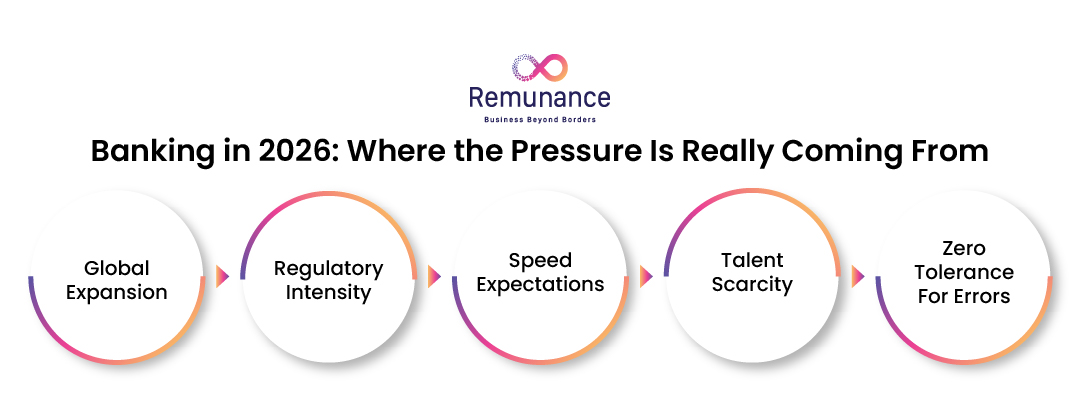
Most conversations about banking industry challenges focus on technology, AI adoption, or customer experience. Those matters, but they’re not where most banks actually struggle.
The real pressure point sits somewhere quieter, operational, and often underestimated.
Banks hire, employ, and manage staff across borders. They do this without losing control, speed, or compliance. That’s where many 2026 challenges converge.
The Banking Model Has Changed. The Employment Model Hasn’t
Banks no longer operate within defined geographic boundaries. Risk teams are distributed. Cybersecurity runs around the clock.
Compliance and audit functions are increasingly global. Product, data, and engineering teams span continents.
But banks still have job structures designed for a time when people worked in offices tied to a single country. This mismatch creates friction everywhere.
Hiring takes longer than the business can afford. Legal teams get pulled into routine employment decisions. HR becomes an execution bottleneck instead of an enabler. And compliance risk quietly accumulates through fragmented setups.
The work is global. The rules are local. And stitching the two together is where banks feel the strain.
4 Common Banking Industry Challenges
Challenge 1: Talent Is Global, but Employment Risk Is Local
In 2026, banks will no longer compete for generic talent. They’re competing for specialists. People who understand financial crime frameworks.
Engineers who can secure cloud-native banking systems. Data professionals who know how to build explainable models. Compliance experts who understand both regulation and execution.
These skills aren’t concentrated in one country. So banks hire globally. But global hiring introduces local obligations.
Every hire brings local labor laws, payroll rules, statutory benefits, tax structures, and termination requirements.
This isn’t a theoretical risk. It’s practical exposure. A misclassified employee. A non-compliant contract. Incorrect payroll deductions. Improper notice handling.
Individually, these look manageable. Collectively, they create audit issues, reputational risk, and internal friction.
Banks can’t afford that kind of ambiguity, and this is one of the biggest challenges of the banking industry in 2026.
Challenge 2: Compliance is Becoming an Employment Problem, Not Just a Regulatory One
Banking compliance teams are used to dealing with financial regulation. But in 2026, employment compliance is quietly moving up the risk ladder.
As banks expand across regions, they inherit multiple labor frameworks. Some are rigid. Some are ambiguous. Some change frequently.
Managing this internally requires scale, local expertise, and constant attention. Setting up local entities gives control, but it’s slow and expensive.
Using contractors is faster, but it increases classification risk. Outsourcing reduces responsibility, but also visibility.
None of these options is clean. And for banks, “mostly compliant” is not an acceptable outcome.
Banking, being one of the industries with the highest demand, has quite overlooked employment obstacles, which are often overlooked as major challenges of the banking industry
Don’t treat employment compliance as a clean-up task.
A pre-hire compliance check is easier. It’s better than fixing payroll, benefits, and termination issues later.
Challenge 3: Speed-to-Hire is Now a Business Constraint
Banks aren’t slow because they lack intent. They’re slow because their operating models were built for certainty, not speed.
In 2026, that’s a problem.
New regulations require a rapid response. New markets demand a quick local presence. Digital products need teams to be stood up in weeks, not quarters.
Hiring gets stuck in legal reviews, entity setups, payroll checks, and approval chains. These processes weren’t made for a global scale.
The result is missed momentum. And in banking, lost time often translates directly into lost opportunity.
Challenge 4: Cost Control is Getting Harder to Maintain
Global hiring doesn’t just increase salary costs. It introduces second-order costs that are harder to forecast:
-
- Entity maintenance.
- Local HR administration.
- Payroll vendor sprawl.
- Compliance advisory fees.
- Employment disputes.
- Exit management.
These costs don’t show up neatly in headcount planning. They show up over time, spread among teams, and often after decisions are made.
For an industry that values predictability, this lack of cost clarity is uncomfortable.
Banks want to know not just what hiring costs are today, but what they expose themselves to tomorrow. As financial institutions, the last thing they want is to get trapped in undiscovered financial troubles.
Therefore, the fear of the unknown and cost control are prominent challenges of the Banking Industry
Why Traditional Fixes Aren’t Holding Up
Banks have tried to solve these challenges incrementally.
-
- More internal HR resources.
- More legal oversight.
- More local vendors.
- More policies.
But incremental fixes don’t remove complexity. They redistribute it. HR teams get overloaded.
Legal teams become operational gatekeepers. Managers wait longer to onboard talent. Compliance teams clean up after the fact.
The system becomes heavier, not stronger. What banks need isn’t more control layered on top of the problem. They need a simpler structure underneath it.
Why International Banks Are Hiring in India Through Eor
Why India Has Become Central to Global Banking Talent Strategy
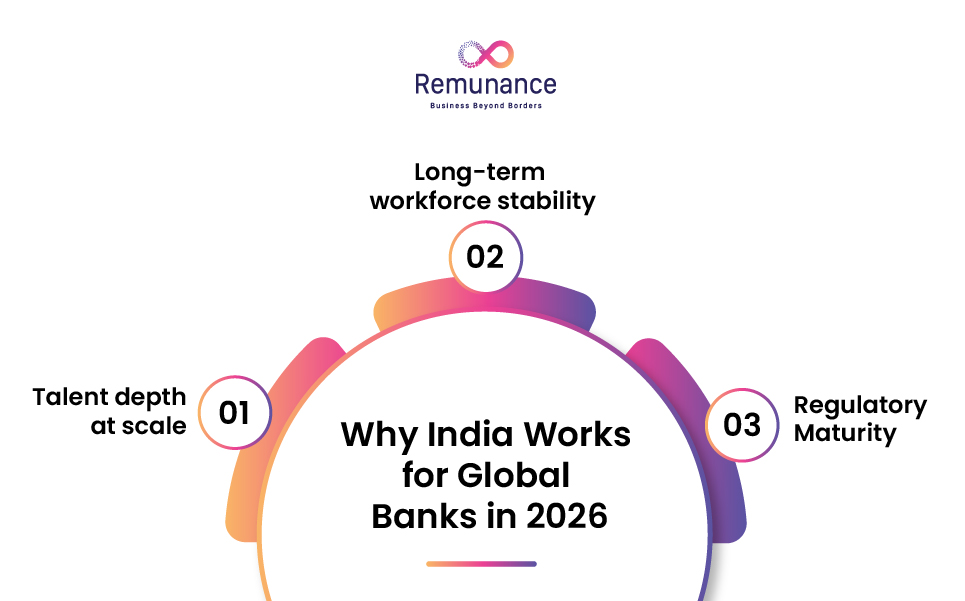
India is no longer considered cost-effective. It’s being chosen because it is operationally capable. International banks hiring in India in 2026 have three key reasons.
1. First, India offers depth at scale.
We have a lot of talent in risk, compliance, technology, analytics, and operations. Few markets can match our numbers.
This is important for banks that aren’t just hiring specialists. They need whole teams that offer continuity, redundancy, and growth potential.
2. Second, India has matured as a banking and financial services talent market.
Professionals here are no longer limited to execution roles. Many have experience in global banks, fintechs, Big 4 advisory firms, and regulated settings. They understand processes, controls, audits, and regulatory expectations.
3. Third, India allows banks to build long-term teams, not temporary capacity.
Attrition happens, but it’s manageable. This is true when job structures are clear, benefits meet standards, and roles are viewed as long-term careers rather than outsourced jobs.
However, this opportunity only works if hiring is done correctly.
Indian labor law is not lightweight. Payroll compliance, statutory benefits, notice periods, and termination processes are tightly regulated.
For international banks, setting up entities can slow progress. It may also trap them in rigid structures too soon.
This is why EOR has become the preferred route.
By hiring in India through an Employer of Record, banks can access India’s deep talent. This allows them to avoid the legal and administrative burden upfront.
They start with compliant, full-time employees right away. They can also scale, restructure, or consolidate later if needed.
India becomes usable at speed, without sacrificing control.
Remunance Employer of Record
Entity setup isn’t the only way to hire in India.
A compliant employment layer can allow teams to scale without long-term structural lock-in.
Evaluate EOR for India Hiring
What Functions International Banks Are Building in India Via EOR
Functions Banks Are Successfully Running in India Using EOR
When banks first explore EOR in India, the assumption is often that it’s suited only for support roles. That assumption doesn’t hold anymore.
In 2026, banks in India are using EOR to build both operational and high-trust functions.
Risk, Compliance, and Financial Crime Operations
India is now a key hub for AML operations. This includes transaction monitoring, sanctions screening, and compliance analytics. Teams support global risk frameworks and follow clear processes and escalation paths.
EOR lets banks use these teams as full-time staff. It ensures confidentiality, clear roles, and legal compliance. This way, banks don’t need to set up local entities for each risk hub.
Technology, Engineering, and Platform Support
Banks are increasingly building cloud, data, and platform teams in India. These aren’t peripheral IT roles. They work on core systems, security layers, internal tools, and data pipelines.
Banks can hire engineers, SREs, and security specialists through EOR. This means they gain permanent employees.
It helps protect IP, offers stable pay, and ensures continuity. Contractor models often lack these benefits.
Data, Analytics, and Model Governance
Model risk management and reporting analytics roles are distributed across teams. Stress testing support and regulatory reporting are becoming more common in different areas.
India has a solid talent pool for these roles. This is especially true for work that needs consistency and careful documentation. Such work must also follow global standards.
EOR helps banks stay compliant with these roles. It also connects them to global reporting lines.
Operations, Shared Services, and Process Excellence
Banks are still setting up operational centers in India. These centers focus on reconciliations, reporting, customer operations, payment support, and internal controls.
EOR lets teams work as internal parts of the bank, not as outside vendors. That distinction improves accountability and reduces long-term operational risk.
Product Support and Internal Enablement Functions
Product operations, QA, internal tooling support, and program management roles are also being built via EOR.
These teams bridge business and technology. They need to understand the domain and retain knowledge over time.
EOR helps banks hire these roles with stable employment. They don’t need to set up an entity at the start.
When banks see India as key to their workforce, the employment model matters more than the location.
Where Employer of Record Fits In
An Employer of Record helps banks hire full-time employees in other countries. They do this without needing local entities.
Also, they manage employment, payroll, benefits, and compliance in accordance with local laws. On paper, that sounds like an HR solution. In practice, it’s a decision about the operating model.
EOR doesn’t remove compliance. It centralizes it. It doesn’t bypass regulation. It embeds it. It doesn’t accelerate hiring by cutting corners.
It accelerates hiring by removing structural friction. For banks, this distinction matters and provides an extra bit of security (cushion)
How EOR Addresses Banking’s 2026 Challenges in Practice
EOR gives banks a way to separate business execution from employment infrastructure. Hiring becomes faster without becoming riskier. Compliance becomes consistent instead of fragmented. Costs become predictable instead of reactive. HR and legal teams move from execution to oversight.
Banks keep control over work, performance, and outcomes. They don’t need to own every local employment obligation directly.
This is why EOR adoption in banking isn’t driven by convenience. It’s driven by risk management.
A Shift in How Banks Think About Workforce Strategy
In 2026, leading banks are no longer asking whether EOR is acceptable. They’re asking where it makes strategic sense: –
-
- Launching new markets.
- Building distributed risk teams.
- Scaling digital operations.
- Supporting follow-the-sun compliance models.
- Reducing exposure from contractor-heavy setups.
EOR fits well in these situations. It matches how banks think: structured, compliant, and defensible.
Conclusion
The banking industry challenges in 2026 aren’t new. They’re stronger now. There’s more regulation, more competition, and more global complexity.
Plus, there’s less tolerance for mistakes. Banks don’t need more tools. They need cleaner execution models.
Employer of Record isn’t a shortcut. It’s a smart choice for banks. They can hire talent from anywhere, work locally, and meet regulations easily.
This helps them stay quick and efficient. Trust, control, and predictability still matter in this industry. Therefore, that is not just useful, it is necessary.
Remunance Employer of Record
Avoid fixing compliance mistakes after hiring.
A 15-minute review before onboarding can prevent months of tax and payroll clean-up later.
Talk to an EOR Specialist 
Related Posts

A Comprehensive Salary Calculator India and Payroll Optimization