Canadian Companies in India: 2026 Guide to Hiring, IT Firms & Expansion
Explore why Canadian companies are expanding into India in 2026, the sectors driving growth, leading Canada-based firms already operating here, hiring costs, GCC opportunities, and the fastest compliant market-entry options, including Employer of Record (EOR) services for seamless expansion.
What You Need to Know
India and Canada spent the better part of two years stuck in the coldest stretch of their modern relationship. By 2026, that chapter has clearly turned. Ministers are meeting again, a new trade agreement is being negotiated in earnest, and the list of Canadian companies in India keeps getting longer instead of shorter.
For a founder in Toronto, a CFO in Calgary, or a talent lead in Vancouver, the real question is no longer whether India belongs in the plan. It is how to get in without losing months to entity paperwork, payroll setup, and compliance you have never had to think about before.
This guide lays out the current picture. You will see which Canada-based companies in India already operate here, where hiring is concentrated, what the 2026 numbers actually show, and the three realistic ways to put a team on the ground.
If you would rather skip the reading and price a team directly, the EOR cost calculator gives you a number in a few minutes.
Why Canadian Companies Keep Choosing India in 2026
Three forces keep pulling Canadian businesses toward India, and none of them is going away.
The first is talent; India adds more than a million engineering graduates every year, works in English, and now anchors a deep pool of senior product, data, and AI professionals who were once hard to find at scale elsewhere.
The second is cost; The same role that strains a Canadian budget can be staffed in India at a fraction of the all-in cost, freeing up money for growth rather than overhead.
The third is timing; India is the world’s most populous country, one of its fastest-growing large economies, and home to the third-largest startup ecosystem on the planet, so getting in early matters.
The policy backdrop has improved too. India has spent the last few years cutting friction for foreign businesses, and the headline metrics on doing business in India have moved in the right direction.
For Canadian firms specifically, the reset in bilateral ties is the part that changed the calculus in 2026.
Ready to Build Your Team in India?
Discover how Remunance helps Canadian companies hire top talent in India quickly and compliantly—without setting up a local entity.
The India-Canada Trade Reset, and Why It Matters Now
Here is the context the old version of this article skipped entirely. Relations dropped sharply in 2023, trade talks were paused, and both governments expelled diplomats.
Through 2024 and into 2025, the two sides slowly rebuilt contact, and by early 2026 the relationship had moved into a genuine reset. Leaders met on the sidelines of the G20 and the G7, and the two countries relaunched negotiations on a Comprehensive Economic Partnership Agreement, the CEPA.
The numbers behind the reset are concrete. Bilateral merchandise trade reached roughly 8.66 billion US dollars in FY 2024-25, with Indian exports of about 4.22 billion and imports of about 4.44 billion, according to the Ministry of Commerce.
Trade in services ran to about 14.15 billion Canadian dollars in the first nine months of 2025, and Canadian portfolio investment into India now sits above 100 billion Canadian dollars per the MEA bilateral brief.
Both governments have set a target of 50 billion US dollars in two-way trade by 2030, and independent estimates suggest CEPA alone could add 4.4 to 6.5 billion to the flow.
Why does a trade agreement matter to a company that just wants to hire five engineers? Because CEPA points toward lower tariffs, smoother mobility for professionals, and a more predictable rulebook.
India and Canada also launched a technology and innovation partnership alongside Australia, with critical minerals, clean and nuclear energy, and artificial intelligence high on the list.
The direction of travel is set. Companies that build their India presence now will be operating inside a friendlier framework as it comes into force. The full bilateral dataset sits with IBEF if you want to go deeper.
Canadian Companies in India: Who Is Already Here
More than 600 Canadian companies already have a presence in India, and more than 1,000 are actively pursuing the market, according to government figures.
That base spans banking, insurance, pension capital, manufacturing, pharmaceuticals, and technology. A few names show the range.
Financial services and pension capital
-
- Sun Life Financial runs Sun Life Global Solutions in India, with 17 years of operations and centers in Gurugram and Bengaluru handling technology, analytics, and business services for the global group.
- Scotiabank (Bank of Nova Scotia) operates global business services hubs in India that support its worldwide banking operations.
- Manulife runs an India capability centre that delivers technology and operations work for its insurance and wealth businesses.
- Brookfield is one of the largest foreign investors in Indian real estate and infrastructure, with a portfolio spanning office parks, roads, and energy assets.
- Fairfax Financial holds long-standing Indian investments, including a major stake in the Bengaluru airport, and continues to back Indian companies through Fairfax India.
- CPP Investments, Canada’s largest pension fund, has committed billions to Indian infrastructure, real estate, and listed equities.
Manufacturing, industrials, and life sciences
-
- Magna International, a global auto-parts giant, manufactures in India to supply both local and export carmakers.
- McCain Foods operates a food-processing plant in Gujarat and sources potatoes from Indian farmers.
- Bombardier runs an aerospace engineering centre in India that contributes to global aircraft programs.
- AtkinsRealis (formerly SNC-Lavalin) delivers engineering and project work from India for infrastructure clients worldwide.
- Apotex, a leading Canadian generic-drug maker, sources and partners within India’s large pharmaceutical ecosystem.
Canada-Based IT Companies in India
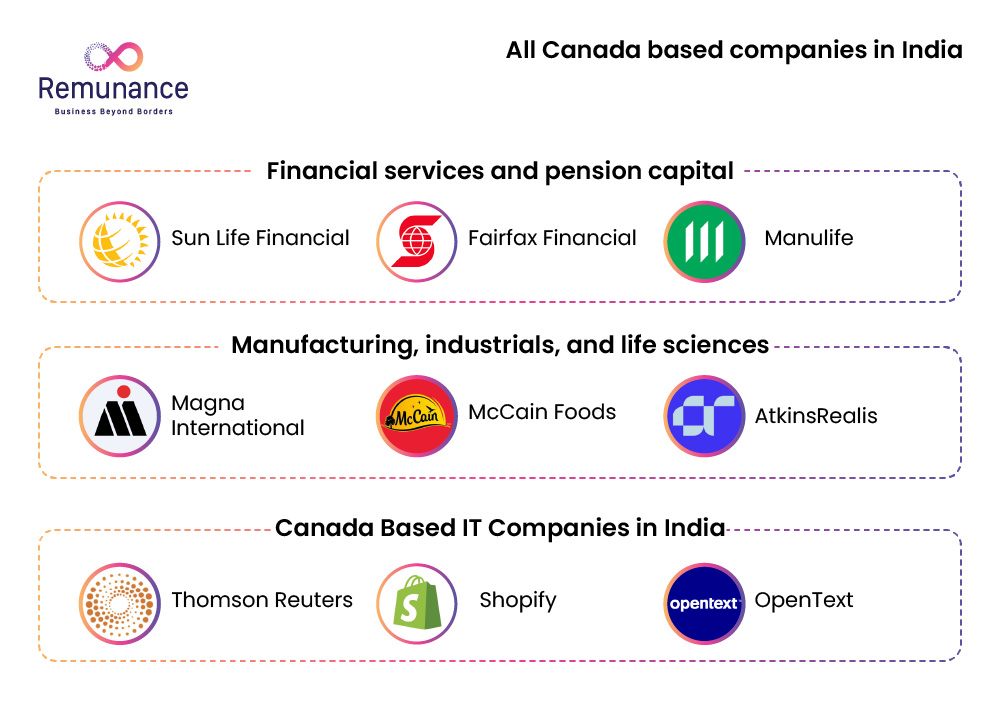
Technology is where Canada based IT companies in India have gone deepest, because India’s software and engineering talent is exactly what these firms need at scale. A short list of the most established players:
-
- CGI, the Montreal-headquartered IT and consulting major, runs a large multi-city delivery footprint in India across cities such as Bengaluru, Chennai, Hyderabad, Mumbai, and Pune, making India one of its biggest talent bases anywhere.
- OpenText, Canada’s enterprise information-management leader, operates engineering and support centres in Hyderabad and Bengaluru.
- Kinaxis, the Ottawa supply-chain software company, has built a product and engineering centre in India to support its global platform.
- Thomson Reuters, headquartered in Toronto, runs significant technology and content operations in Bengaluru and Hyderabad.
- Shopify, Canada’s most valuable technology company, engages India’s large developer and merchant ecosystem and draws on Indian engineering talent for its commerce platform.
The pattern is consistent. Canadian technology firms no longer treat India as a back office. They run product, engineering, and AI work here, which is why the next section matters so much for anyone planning to hire.
Remunance Employer of Record
Hire India's Top Tech Talent Without Setting Up a Company
Remunance helps Canadian technology companies hire software engineers, AI specialists, and product teams in India—quickly, compliantly, and without establishing a local entity.
Hire Tech Talent in India
Canadian Companies Hiring in India: The GCC Wave
If you want to understand why Canadian companies hiring in India has become a trend rather than a one-off, look at the Global Capability Centre boom.
A GCC is a company-owned hub in India that delivers core work back to the parent company: engineering, data, finance, cybersecurity, and, increasingly, artificial intelligence.
India hosts more than 1,700 of these centres employing around 1.9 million professionals, and the sector generated revenue in the range of 65 to 70 billion US dollars heading into 2026, per NASSCOM and industry trackers.
The forecast is the headline. By 2030, India is expected to host roughly 2,400 to 2,500 GCCs, employ between 2.8 and 3.5 million people, and cross 100 billion US dollars in revenue.
In 2025, these centers took up close to 38 percent of office leasing across India’s top seven cities. About 94 percent of them sit in six hubs: Bengaluru, Hyderabad, Chennai, Pune, Gurugram, and Mumbai, although Tier-2 cities are opening up fast with lower costs and lower attrition.
Cost is the part that turns a strategy deck into a hiring decision. A software engineer in Canada costs roughly 117,000 US dollars a year on average, based on 2026 salary aggregators.
A comparable engineer in India typically lands between 12,000 and 25,000 US dollars a year depending on seniority. That is a saving in the range of 70 to 80 percent for talent of genuinely high quality, which is why finance leaders keep signing off on India teams.
Actual costs vary by role, city, and seniority, so treat those figures as a planning band rather than a quote.
You do not need to build a full GCC to capture most of this benefit. Many Canadian firms start with a lean team of five to twenty people through an Employer of Record, then scale.
If you are weighing the two paths, our breakdown of GCC vs EOR in India and the practical guide to GCC setup in India walk through the trade-offs. For the team-building mechanics, see our guide to building remote teams in India.
Priority Sectors for Canada-India Business in 2026
Some sectors are moving faster than others. If your business sits in one of these, the runway is longer and the local ecosystem is deeper.
-
- IT and software: the core of the GCC wave, with demand concentrated in cloud, data engineering, and applied AI.
- Banking, financial services, and insurance: Canadian financial groups already run large India operations, and GIFT City is pulling in regulated entities.
- Clean energy, nuclear, and critical minerals: a flagship area of the reset, with Canada positioned as a supplier and India as a fast-growing market.
- Automotive and advanced manufacturing: Canadian parts makers and engineering firms continue to expand Indian capacity.
- Pharmaceuticals and life sciences: India’s manufacturing scale and research talent attract Canadian partners and investors.
- Artificial intelligence and digital services: now central to the bilateral technology partnership and to almost every new GCC mandate.
Remunance Employer of Record
Expand in India's Fastest-Growing Sectors
From AI to manufacturing, hire skilled talent in India's high-growth industries without setting up a local entity.
Explore India Hiring Solutions How Canadian Companies Can Set Up and Hire in India
There are three realistic routes into India, and they suit very different situations. Picking the wrong one costs time and money, so it pays to be honest about your stage and risk appetite.
Option 1: Set up your own Indian subsidiary
A wholly owned subsidiary gives you maximum control and is the right long-term answer once your India headcount is large. The trade-off is speed and overhead.
Registering an entity, opening bank accounts, and standing up payroll and compliance typically takes several months and brings ongoing legal, accounting, and statutory obligations. Our guide to setting up an Indian subsidiary covers the steps and the real timeline.
Option 2: Engage independent contractors
Hiring independent contractors is fast and flexible, but it carries two serious risks for a foreign company: worker misclassification and permanent establishment exposure, where tax authorities treat your contractor activity as a taxable presence in India.
This route works for short, genuinely independent projects, not for building a core team.
Option 3: Hire through an Employer of Record
An Employer of Record in India lets you hire full-time employees in weeks without registering an entity. The EOR becomes the legal employer of record on paper, running payroll, statutory benefits, taxes, and compliance, while your team manages the day-to-day work.
For most Canadian companies hiring their first five to fifty people in India, this is the fastest compliant path, and it converts cleanly into a subsidiary or GCC later if you scale. Remunance also offers an international PEO model for companies that want a similar managed approach.
Compliance Essentials for Canadian Employers
India’s employment rules are detailed and vary by state, which is where foreign employers most often slip. A short checklist of what you are signing up for when you put someone on an Indian payroll:
-
- Provident Fund and Employees’ State Insurance contributions, with employer and employee shares.
- Gratuity, paid leave, and other statutory benefits set by central and state law.
- Professional tax and tax deducted at source, filed on strict monthly and quarterly cycles.
- State-specific rules on working hours, leave, and registrations that differ between, say, Karnataka and Maharashtra.
- Permanent establishment risk, which careful structuring through an EOR helps you avoid.
This is exactly the load an EOR carries for you. If you want to see how the model compares with running your own entity, browse our EOR services overview, or read how other markets approach the same playbook in our sister guides on French companies in India and Swedish companies in India.
Remunance Employer of Record
Build Your India Team with Remunance
Hire, pay, and manage employees in India without setting up a local entity. We handle HR, payroll, and compliance, so you can focus on growth.
Consult an Expert FAQs
How many Canadian companies are in India?
More than 600 Canadian companies currently operate in India, and over 1,000 more are actively pursuing the market, according to India’s Ministry of External Affairs. They span banking, insurance, pension capital, manufacturing, pharma, and technology.
Which Canada-based IT companies operate in India?
Leading examples include CGI, OpenText, Kinaxis, Thomson Reuters, and Shopify. CGI in particular runs one of its largest global delivery footprints in India across several cities.
Why are Canadian companies hiring in India?
Three reasons: a deep, English-speaking talent pool, strong cost savings, and India’s position as the world’s leading hub for Global Capability Centres. The GCC sector alone is projected to employ close to 3 million people by 2030.
How much can a Canadian company save by hiring in India?
Illustrative 2026 averages put a Canadian software engineer near 117,000 US dollars a year against 12,000 to 25,000 in India for comparable talent, a planning-stage saving of roughly 70 to 80 percent. Actual figures vary by role and city.
What is the fastest way for a Canadian company to hire in India?
An Employer of Record. It lets you hire compliant full-time employees in weeks without setting up an Indian entity, and you can transition to your own subsidiary later as you scale.
Do Canadian companies need an entity to hire in India?
No. With an EOR you can legally employ people in India without registering a local company. You only need your own entity once your headcount and long-term plans justify it.

Related Posts

Best EOR Service Providers in India (2026) for Easy Hiring

Employer of Record India (2026): Hire Employees Without an Entity

Benefits of Hiring International Employees for Business Growth

Hiring Internally vs Externally: Pros and Cons

A Guide for Hiring International Employees