EOR vs PEO in India: Which One Do You Need in 2026?
A PEO in India needs your own entity; an EOR does not. Costs for 3 to 15 hires, break-even at $99 to $299, GST and transfer rules. No jargon.
What You Need to Know
EOR vs PEO in India comes down to one fact: a PEO needs your own Indian entity, which costs ₹3 lakh to ₹7 lakh and takes 6 to 10 weeks to set up, while an Employer of Record (EOR) uses its own. So the EOR’s PF code, ESI code and TAN carry your payroll from day one. No entity, no PEO.
Most guides on PEO vs EOR still import the US co-employment model, which has no general equivalent in Indian law. Many also quote the old ₹15,000 PF ceiling and Form 16. Almost none price either route.
This guide does. It comes from Remunance, the best EOR in India. Corporate Connect named us India’s Best EOR Service Provider 2024, and our founding team has run India payroll and hiring for 22+ years.
You get a 15-point comparison, a decision table and the cost of both routes at 3, 5, 10 and 15 employees. You also get the break-even at $99, $199 and $299, the GST position after 30 March 2026 and an EOR-to-entity transfer checklist.
What Is The Difference Between An EOR And A PEO In India?
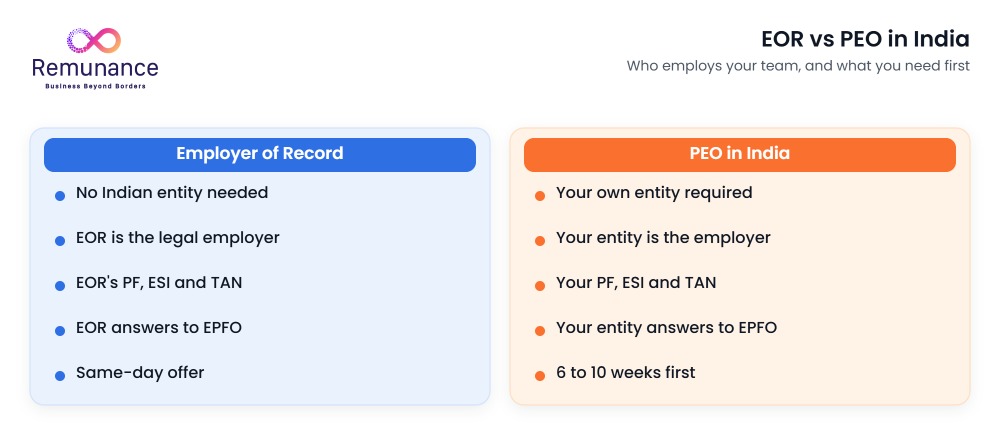
The difference between EOR and PEO in India is whose name sits on the appointment letter. Under an EOR it is the provider’s Indian company; under a PEO it is yours, and the PEO works behind it.
You direct the daily work in both cases. What changes is whose registrations carry the salary, whom the EPFO, ESIC and the tax department pursue, and whether you need an Indian company before your first hire.
Suppose a US software company wants three engineers in Pune. On the EOR route with Remunance, offers can go out the same working day you sign the contract. The real wait is the candidates’ notice period of 30 to 90 days.
On the PEO route, you first form a company and register it for PF, ESI and TAN, which takes 6 to 10 weeks before anyone gets an offer. The notice period then runs on top.
Who Is The Legal Employer Under Each Model?
Under an Employer of Record, the provider’s Indian entity is the sole legal employer. It issues the offer and appointment letter, runs payroll under its own TAN and deposits PF and ESI under its own codes.
Under a PEO, your Indian entity is the employer on record, and the PEO runs HR, payroll and filings under your PF code, ESI code and TAN. So a late deposit brings the notice to you. Not to the PEO.
Why Does A PEO Need Your Own Indian Entity?
Because a PEO has nothing to file under without one. Every statutory return in India attaches to a registered employer, and a PEO can only act for an employer that exists.
A foreign company cannot simply add Indian staff to its home payroll either. As AZB & Partners point out, FEMA generally requires a local presence before a foreign entity engages employees directly. That leaves two routes: your own entity with a PEO, or an EOR’s entity.
Hire Your India Team Without Opening an Entity
Backed by a founding team with 22+ years of India payroll and hiring, Remunance employs your team on its own Indian entity and registrations, sends offers the same working day you sign and passes salaries and statutory costs through at cost.
Does Indian Law Recognise Co-Employment?
No Indian statute creates a general co-employment model. So one organisation must be the employer of record for each worker, and that single fact decides the EOR or PEO question.
In the US, a PEO and its client split employer duties by contract, and the tax system accepts the split. Co-employment in India has no such statutory home. The Remunance co-employment glossary entry puts it plainly: no Indian statute uses the term, though no law bars two firms from sharing a work relationship.
Here is the catch. Sharing work is legal. Sharing statutory duties is not something you can contract into, because PF, ESI, TDS and the Labour Codes each look for one employer with one registration.
How Do Indian Courts Decide Who The Employer Is?
Indian courts look at control, not labels. The test goes back to the Supreme Court’s 1956 ruling in Dharangadhara Chemical Works, which asked who has the right to control how the work is done.
Later courts added who pays wages, who can dismiss and how far the worker is part of the business. AZB lists the same factors. It warns that an EOR set-up can look like a sham if the foreign client selects, pays, disciplines and supervises the staff directly.
So route pay, discipline and exit decisions through the EOR, even when you shape them. Paperwork must match reality.
Where Does The Principal Employer Rule Fit In?
India’s nearest thing to shared liability is the principal employer rule for contract labour: under the OSH Code, if a contractor fails to pay wages, the principal employer must pay them.
The PIB release of 21 November 2025 confirms that duty and raises the contract labour threshold from 20 to 50 workers. This is a backstop duty, not a second employer.
But it matters once your own Indian entity uses EOR or agency staff alongside its payroll. Plan for it before you mix models.
How Do EOR And PEO Compare Side By Side In India?
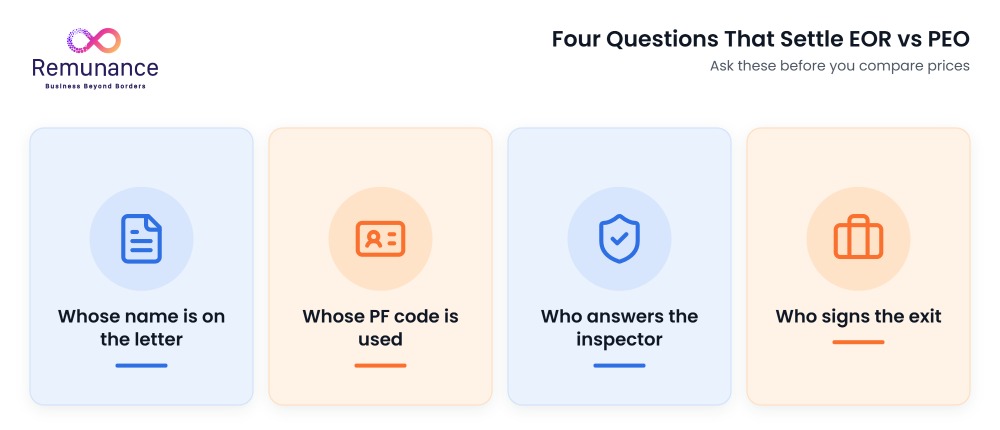
An EOR wins on speed, entry cost and exit. A PEO on your own entity wins on control, equity plans and unit cost at scale, as the 15-point table below shows.
| Dimension | Employer of Record (EOR) | PEO in India |
| Indian entity needed | No | Yes, your own |
| Legal employer | The EOR’s Indian entity | Your Indian entity |
| PF, ESI, PT, LWF and TAN | The EOR’s registrations | Your registrations, filed by the PEO |
| Statutory liability | The EOR, as employer on record | Your entity, even when the PEO files |
| Employment contract | EOR signs, with IP assignment to you | Your entity signs |
| Payroll and TDS | EOR runs it under its TAN | PEO runs it under your TAN |
| Benefits | EOR’s group health cover | Your own policy |
| Termination and final settlement | EOR runs it under the Labour Codes | Your entity decides and signs |
| IP ownership | EOR is first owner, then assigns to you | Your entity is first owner |
| Equity grants | Parent ESOPs need specialist advice | Group plans reach staff more directly |
| Time to first hire | Offer the same working day | 6 to 10 weeks to form the entity first |
| Cost structure | Monthly fee per employee | Fixed entity cost plus PEO fee |
| GST on the fee | Usually zero-rated for a foreign payer | 18% on the PEO fee |
| Exit from India | Contract notice, usually weeks | Company closure, months or longer |
| Permanent establishment | Reduced, not removed | Subsidiary taxed in India |
Two rows decide most cases: whether you already have an entity, and your headcount in two years. Start there. Everything else follows from who the legal employer is.
The IP row deserves a second look. AZB notes that the employer is generally the first owner of work such as copyright, so your EOR contract needs an IP assignment clause that passes those rights to you.
Termination law is the same under both models. Only the signatory changes. The same PIB release confirms the Industrial Relations Code raised the approval limit for lay-off, retrenchment and closure from 100 to 300 workers.
It also added a re-skilling fund contribution of 15 days’ wages for every retrenched worker. That sits on top of retrenchment compensation.
Why Does An International PEO Work As An EOR In India?
An international PEO in India employs your staff through its own Indian entity, which is exactly what an EOR does. The label comes from US marketing; the legal structure in India is the EOR model.
Global providers use “international PEO”, “global PEO” and “EOR” for the same service, and the Remunance international PEO glossary entry notes that most use the labels interchangeably for India.
So a PEO in India without an entity does not exist in the US sense, because if no Indian company of yours sits in the contract, the provider is your EOR. The brochure does not change that.
Our own international PEO service keeps Remunance as the employer on record while you set more of the HR policy. It suits firms with India experience or a local leader on the ground. It still needs no entity.
How Can You Check Which Model A Provider Really Sells?
Ask for a sample appointment letter and payslip. The employer named on both, and the registrations printed on them, tell you the model in seconds.
| What you check | If it is an EOR | If it is a true PEO |
| Employer on the appointment letter | Provider’s Indian company | Your Indian company |
| PF establishment code on the payslip | Provider’s code | Your code |
| TAN on Form 130 (formerly Form 16) | Provider’s TAN | Your TAN |
| Bank account paying salaries | Provider’s account | Your entity’s account |
| Who signs the relieving letter | Provider | Your entity |
One name, one set of codes. That is the whole test.
Remunance Employer of Record
Hire With India's Best EOR Service Provider 2024
Corporate Connect named Remunance India's Best EOR Service Provider 2024. We employ your India team on our own entity, with compliance led by a Fellow Chartered Accountant and fees from USD 99 a month.
Talk to our team
Which Model Fits Your Situation?
Choose an EOR if you have no Indian entity or plan fewer than about 6 to 9 staff. Choose your own entity, run with a PEO or payroll provider, once you pass the break-even with a two-year commitment.
At Remunance’s from-$99 fee, that line moves out to about 27 staff on the mid case.
| Your situation | Choose | Why |
| No entity; first 1 to 5 hires or testing India | EOR | No setup cost, no wait, nothing to wind down |
| No entity; 6 to 12 hires planned over two years | EOR now, review an entity yearly | Break-even falls in this range, depending on the fee |
| No entity; long-term team of 15 or more | Own subsidiary with a PEO or payroll provider | Fixed costs spread across more people |
| You must sign contracts or invoice in India | Own entity, whatever the headcount | An EOR cannot contract for you |
| You have an entity but no HR or payroll team | PEO or payroll outsourcing | Your entity already employs; you need the work done |
| You have an entity but want some hires off it | EOR for those hires | Pilots and short roles stay separate |
| You are on an EOR and the team has grown | Transfer staff to your own entity | Plan service, leave and PF continuity |
| A provider offers you an “international PEO” | Treat it as an EOR | Check whose PF code it uses |
Notice the contracts row. Some needs force an entity whatever the cost, such as invoicing Indian customers or holding an office lease and bank account in your own name.
Let’s say you plan 4 hires this year and 8 by the end of next year. At $199, you sit below the 9.3 break-even for both years, so stay on the EOR and review at month 18. At $299, you pass the 5.6 break-even early in year 2, so start incorporation in the second half of year 1.
On Remunance’s $99 entry fee, both years sit far below the 27.5 break-even. The entity question can wait.
When Should You Run Both Models At Once?
Run both when your entity exists but some hires do not belong on it. Typical cases are a pilot team for a new business line, a city with no office, or roles you may not keep past a year.
Keep the boundary clean, though. If your entity directs EOR staff at its own premises, the principal employer rule can reach it, so ask the EOR for monthly proof of wage, PF and ESI payments.
What Does Each Model Cost At 3, 5, 10 And 15 Employees?
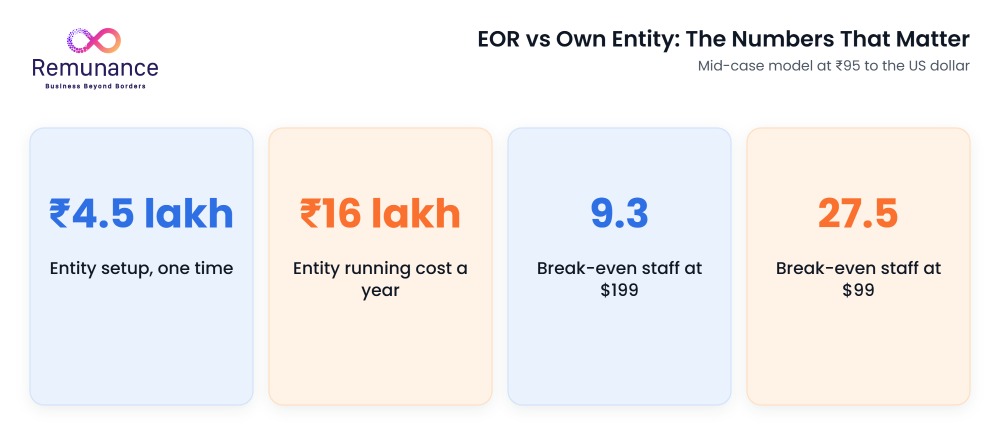
At Remunance’s from-$99 fee, an EOR costs less than your own entity up to about 27 employees on the mid-case model. At $199 the line sits near 9, and at $299 near 6.
Salaries and statutory costs are identical under both, so only the layer on top matters.
Employer PF at the new ₹25,000 ceiling is ₹3,250 a month whichever employer files it, as our EPF Scheme 2026 guide shows. Gratuity, ESI, bonus and leave follow the same law too.
The table reuses the model from our EOR vs subsidiary analysis: ₹4.5 lakh to set up an entity and ₹16 lakh a year to run it. Payroll and HR software add ₹2,500 per employee a month, and EOR fees convert at ₹95 to the US dollar.
| Team size | EOR at $99 | EOR at $199 | EOR at $299 | Own entity, year 2 onward | Own entity, year 1 with setup |
| 3 | ₹3.4 lakh | ₹6.8 lakh | ₹10.2 lakh | ₹16.9 lakh | ₹21.4 lakh |
| 5 | ₹5.6 lakh | ₹11.3 lakh | ₹17.0 lakh | ₹17.5 lakh | ₹22.0 lakh |
| 10 | ₹11.3 lakh | ₹22.7 lakh | ₹34.1 lakh | ₹19.0 lakh | ₹23.5 lakh |
| 15 | ₹16.9 lakh | ₹34.0 lakh | ₹51.1 lakh | ₹20.5 lakh | ₹25.0 lakh |
All figures are annual and sit on top of salaries and statutory contributions. Read across the rows.
At 3 employees, a $299 EOR costs ₹10.2 lakh a year against ₹16.9 lakh for your own entity. At 10, the entity beats both the $199 and $299 fees from year 2, yet at $99, Remunance’s entry fee, the EOR stays cheaper even at 15 people. Small teams pay for flexibility; large teams pay for overhead.
At What Headcount Does Your Own Entity Become Cheaper?
At about 6 employees against a $299 fee, and about 9 against $199, on the mid case. You divide the entity’s fixed cost by what each EOR employee costs you extra.
The model also adds a 1% net tax drag from transfer pricing, applied to overhead and to an average salary of ₹24 lakh. So each head saves you the annual EOR fee, less ₹30,000 of payroll cost and ₹24,000 of tax drag.
Let’s say the fee is $199. That is ₹2,26,860 a year per employee, or ₹1,72,860 after the two deductions. Divide the ₹16.16 lakh of overhead plus drag by ₹1,72,860 and you get 9.3 employees, or 12.0 in year 1 with setup.
| EOR fee per employee a month | Lean overhead (₹7.9 lakh) | Mid overhead (₹16 lakh) | Full overhead (₹26 lakh) |
| $99 | 13.6 (18.7) | 27.5 (35.2) | 44.6 (56.6) |
| $199 | 4.6 (6.4) | 9.3 (12.0) | 15.2 (19.3) |
| $299 | 2.8 (3.8) | 5.6 (7.2) | 9.2 (11.6) |
Figures in brackets include year-1 setup costs of ₹3 lakh, ₹4.5 lakh and ₹7 lakh; at the $599 that the big global platforms charge, the mid-case break-even falls to about 3 employees.
How Much Runway Does Remunance’s From-$99 Fee Give You?
About three times what a $199 fee gives you. At $99, the mid-case break-even moves from about 9 employees to about 27. That is your runway before an entity pays off.
Here is the arithmetic. $99 × 12 × ₹95 is ₹1,12,860 a year. Take away ₹30,000 of payroll cost and ₹24,000 of tax drag, and each head saves ₹58,860. Then ₹16.16 lakh ÷ ₹58,860 is 27.5 employees, or 35.2 in year 1.
That is a clear advantage for Remunance clients. You can hire, test and grow an India team well past the point where a $199 or $299 fee would push you into incorporating. Against the $599 global platforms, where the break-even is about 3, the gap is wider still.
Test it on your own plan. Your written quote confirms the fee for your roles, and the EOR cost calculator runs your figures.
Head-office time stretches the runway further. The model prices it at ₹10 lakh a year, which moves the $199 break-even to about 15.
Which Hidden Costs Sit On Each Side?
An entity’s hidden costs are fixed and recurring: a resident director, audits, transfer pricing and a slow exit. An EOR’s hidden costs sit around the fee.
What Does An Indian Entity Cost Beyond The Setup Fee?
About ₹16 lakh a year in the mid case, before a single salary. Here is each line.
| Cost line | Lean | Mid | Full service |
| Setup: incorporation, registrations, drafting, KYC (one time) | ₹3.0 lakh | ₹4.5 lakh | ₹7.0 lakh |
| Bookkeeping, monthly GST and TDS returns | ₹2.4 lakh | ₹3.6 lakh | ₹5.0 lakh |
| Statutory audit, tax audit and income-tax return | ₹1.2 lakh | ₹2.0 lakh | ₹3.0 lakh |
| Company secretarial work and ROC filings | ₹0.8 lakh | ₹1.2 lakh | ₹2.0 lakh |
| Transfer pricing study and accountant’s report | ₹1.2 lakh | ₹2.0 lakh | ₹3.0 lakh |
| RBI reporting (FC-GPR, FLA return) | ₹0.3 lakh | ₹0.4 lakh | ₹0.5 lakh |
| Nominee resident director | Nil (in-house) | ₹3.0 lakh | ₹6.0 lakh |
| Registered office and bank charges | ₹0.5 lakh | ₹0.8 lakh | ₹1.5 lakh |
| HR and labour-code compliance cover | ₹1.5 lakh | ₹3.0 lakh | ₹5.0 lakh |
| Annual fixed total | ₹7.9 lakh | ₹16.0 lakh | ₹26.0 lakh |
The biggest swing line is the resident director. Section 149 of the Companies Act, 2013 requires at least one director who stays in India for 182 days or more in the financial year. A private company needs two directors in all.
Until a local hire qualifies, most foreign parents pay a nominee, and that one line costs ₹3 lakh to ₹6 lakh a year. Budget for it.
Audits and filings add up too. In the mid case, the audit, tax return and company secretarial lines come to ₹3.2 lakh a year. The statutory audit and annual filings apply however small the company is.
How Much Tax Does Transfer Pricing Really Cost?
Less than most people fear: about 0.65% of your India cost base in the worked example. The markup stays inside your group. Only the tax gap leaks out.
An Indian subsidiary that serves its parent must earn an arm’s-length margin. The Union Budget 2026-27 proposed a 15.5% safe harbour margin for IT and ITeS services and raised the eligibility threshold to ₹2,000 crore.
Suppose your India cost base is ₹2 crore. A 15.5% markup creates ₹31 lakh of Indian profit, which India taxes and your parent deducts at home.
The EOR vs subsidiary analysis nets the two at about ₹1.3 lakh a year. Hence the 1% drag in the cost model, on top of about ₹2 lakh for the transfer pricing study itself.
Which EOR Costs Sit Outside The Headline Fee?
Five, mostly. Each can move your real fee by more than the gap between two providers’ list prices.
- Salary-linked fees: Some providers charge 5% to 15% of salary instead of a flat fee. On a ₹24 lakh salary, 10% is ₹2.4 lakh a year, more than a flat $199 fee at ₹2.27 lakh.
- FX margin: You fund payroll in dollars, pounds or euros, so ask which rate converts it and what spread sits on top.
- Hiring fees: Recruitment is usually a share of pay. Ours is 9% of CTC, against Wisemonk’s 10% of annual salary.
- Benefit markups: Group health cover bought through the EOR may carry a margin. Ask for the insurer’s own invoice.
- Transfer and exit fees: Some contracts charge you to move staff to your own entity. Ask before you sign, not when you leave.
Remunance keeps the headline simple. The fee is priced per employee, from USD 99 a month, and salaries and statutory costs pass through at cost on a line-by-line invoice.
What Does It Cost To Leave Each Model?
Leaving an EOR costs a contract notice period, usually weeks, plus each employee’s final settlement. Closing an Indian company takes months, sometimes years. That asymmetry matters.
The entity’s fixed costs keep running until the company is struck off. So if your India plan is still a test, the EOR’s easy exit is part of what you pay for. Price the exit before you price the entry.
Neither list is a reason to avoid either model, but both are reasons to get the full number in writing before you sign.
Is GST Charged On EOR And PEO Fees In India?
An EOR fee paid from abroad in foreign currency is usually zero-rated as an export of services. A PEO fee billed to your Indian entity carries 18% GST, which your entity can usually claim back as input tax credit.
When Is An EOR Invoice Zero-Rated As An Export?
When all five conditions in section 2(6) of the IGST Act hold at once. The supplier is in India, the recipient is outside India, the place of supply is outside India and payment arrives in convertible foreign exchange. Finally, the two must not be establishments of one person.
Exports are zero-rated under section 16 of the IGST Act, so the EOR can bill you without IGST under a Letter of Undertaking.
The Remunance GST on EOR services entry works an example. On a ₹3 lakh monthly invoice, a US client paying in dollars pays nil GST, while an Indian client in Bengaluru pays ₹54,000. Over a year, that is ₹6.48 lakh of tax to fund upfront.
Watch who pays. If your new Indian entity pays the EOR, the place of supply moves to India and 18% applies. Most advance rulings charge it on the gross invoice, salaries included.
| Who pays, and how | GST on the invoice | Basis |
| Foreign company in foreign currency, EOR under LUT | Nil, zero-rated | Sections 2(6) and 16, IGST Act |
| Your Indian entity pays an EOR | 18%, usually on the gross invoice | Place of supply in India |
| Your Indian entity pays a PEO | 18% on the PEO fee | Domestic supply; credit usually available |
| Foreign company paying in rupees | Nil only where RBI allows rupee receipts | Fourth condition of section 2(6) |
Under a PEO, salaries leave your own bank account, so GST applies to the PEO’s fee, not the payroll.
What Changed For Intermediary Services On 30 March 2026?
Section 157 of the Finance Act, 2026 omitted section 13(8)(b) of the IGST Act from 30 March 2026. Intermediary services now follow the recipient’s location, so they can qualify as exports too.
Before that date, an officer who labelled an EOR an “intermediary” could deny export status, because the place of supply sat with the supplier. Grant Thornton Bharat’s note of 4 April 2026 confirms the default rule in section 13(2) now applies.
Hence the old intermediary dispute has largely gone for invoices from 30 March 2026. Keep the bank’s inward remittance proof for every payment anyway.
Remunance Employer of Record
Get Both Routes Priced For Your Headcount Plan
Tell us your two-year India hiring plan. We will model the EOR and own-entity routes side by side, with GST and transfer costs included, and show how far a fee from USD 99 carries you.
Model my costsWho Carries Compliance Liability Under Each Model?
Under an EOR, the provider carries statutory liability because it is the employer on record. Under a PEO, your entity carries it, and the PEO’s indemnity only moves the cost back if the PEO caused the failure.
The EPFO, ESIC and the income-tax department pursue the registered employer, and no contract between you and your PEO changes whose code the damages land on.
| What goes wrong | Under an EOR | Under a PEO |
| PF or ESI deposited late | EOR pays interest and damages on its code | Your entity pays; PEO may reimburse |
| TDS short-deducted or filed late | EOR, as deductor under its TAN | Your entity, as deductor |
| Wrongful termination claim | Filed against the EOR as employer | Filed against your entity |
| Final wages paid late on exit | EOR, under the Code on Wages | Your entity |
| Contractor fails to pay wages | Your entity only if it is a principal employer | Your entity, as principal employer |
| Employee data breach | EOR as data fiduciary for payroll data | Your entity as data fiduciary |
Final wages on exit are due within two working days under the Code on Wages, and gratuity within 30 days of becoming payable. Both clocks run against whoever is the employer.
What Should An EOR Or PEO Indemnity Cover?
It should cover statutory dues, interest, damages and penalties caused by the provider’s errors. Look for a meaningful cap and survival after the contract ends. Read it as closely as the price.
- Scope: Late or short PF, ESI, professional tax, LWF and TDS deposits, plus payroll errors under the Labour Codes, including the 50% wage rule.
- Cap: One month’s fee is worth little against a multi-year PF claim, so ask for a cap tied to annual fees or a fixed sum.
- Survival: Claims for past periods must survive termination. Notices can arrive years later.
- Evidence: Monthly challans and returns, shared without being asked.
- Your side: Expect to indemnify the EOR for losses your own instructions cause, such as a termination you push outside the agreed process.
As your EOR, we carry the registrations and the filings. You carry your instructions.
What Happens To Employees When You Move From An EOR To Your Own Entity?
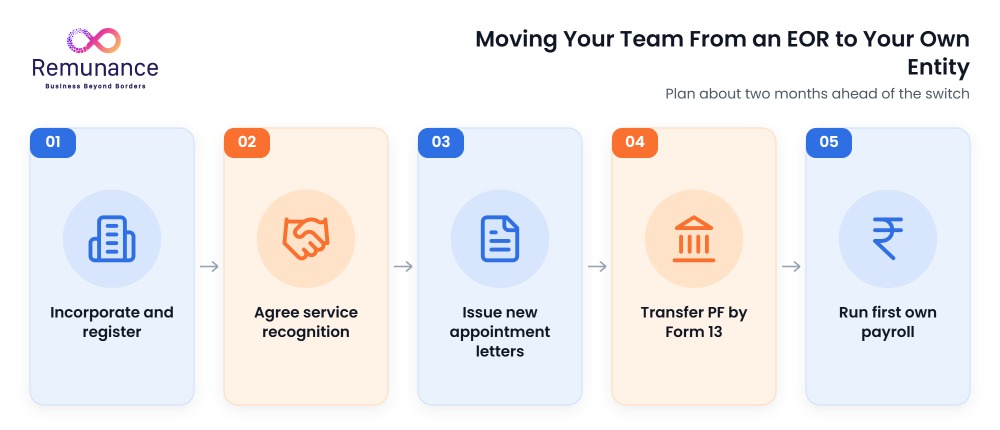
They leave the EOR and join your entity on new appointment letters, ideally on the same date. Done well, nobody loses PF history, leave or gratuity service. Done badly, people lose years.
On paper, each move is a resignation and a new hire, so get each employee’s written agreement to the plan. Start incorporation about two months ahead, so bank, PF and ESI registrations are live for the first payroll.
Pick the first day of a month as the switch date, so payroll, the PF return and TDS split cleanly between the two employers. Issue the new letters before that date, on terms no less favourable than today’s. No pay cuts, no new probation.
The Labour Codes expect every employee to get an appointment letter covering job details, wages and social security. The Remunance EOR-to-entity transfer entry sets out the sequence, and our case study on moving from EOR to subsidiary formation shows one client’s switch.
Does Service With The EOR Count For Gratuity?
Only if your entity agrees in writing to recognise it. Gratuity is 15 days’ wages per completed year, payable after 5 years, or after 1 year for fixed-term staff.
Let’s say an engineer has 4 completed years on the EOR and monthly wages of ₹80,000 under the Codes’ definition. Accrued gratuity is ₹80,000 × 15 ÷ 26 × 4, or about ₹1.85 lakh.
If your entity recognises that service, it takes on the ₹1.85 lakh, and the engineer qualifies after one more year. If it does not, the engineer restarts the five-year clock, and the EOR pays nothing.
One more check. If your EOR billed you a monthly gratuity provision of about 4.81% of wages, ask where that money sits and how it moves.
How Does The PF Account Move?
The PF balance follows the employee’s UAN, so nobody needs a new one. Service history stays with it.
Your entity files the joining details under its own PF code, and the employee moves the old balance with Form 13.
EPFO revamped Form 13 in January 2025. The Ministry of Labour release of 25 April 2025 says employer approval is no longer needed in most cases. Once the source office approves, the old account moves to the current one automatically.
What Changes In The Contract And Payroll?
The employer name, PF code, TAN and paying bank account change. The role, pay and service date should not.
| Item | What to agree | Who acts |
| Consent | Each employee agrees in writing to move | Employee, you and the EOR |
| Gratuity service | Your entity recognises EOR years in writing | Your entity |
| Leave balance | Carry over, or encash at exit from the EOR | EOR and your entity |
| Notice period | EOR waives notice; no gap between dates | EOR |
| PF | Same UAN; Form 13 transfer | Employee and your entity |
| IP | EOR assigns work made during the EOR period | EOR |
| Benefits | Health cover from day one, no waiting gap | Your entity |
| Tax for the year | Employee declares EOR salary to your entity | Employee |
Each employer issues its own Form 130 for the months it paid. So the employee gets two certificates for that tax year, and the salary declaration keeps TDS for the full year right.
Does Either Model Create Permanent Establishment Risk?
Both can. An EOR reduces permanent establishment risk for your parent company but does not remove it. A subsidiary shifts the question to how your parent deals with its own Indian company.
PE exposure follows what your people do in India, not whose payroll carries them. AZB calls the analysis fact-specific. That is the honest answer.
What Triggers PE Risk Under An EOR?
Staff who negotiate or conclude contracts for your parent, or act as its face in India, can create a taxable presence. AZB notes that if EOR staff are treated as your direct employees, your company could be deemed to have a permanent establishment in India.
So keep sales sign-off outside India. Do not give India-based staff authority to bind the parent, and document that the EOR handles employment matters. Our guide on how to avoid permanent establishment risk in India sets out the tests.
How Does Your Own Subsidiary Change The PE Picture?
Your subsidiary is a separate Indian taxpayer, so transfer pricing sets the profit India taxes. PE risk then moves to your parent’s own conduct, such as staff it sends to India or a subsidiary that habitually signs deals for it.
Neither model is PE-proof. The entity route gives you a clean, taxable Indian company. The EOR route gives you speed, with activity rules you must police.
Remunance Employer of Record
Plan Your Move From EOR To Your Own Entity
Remunance runs EOR, subsidiary formation and EOR-to-entity transfers from Pune, backed by a founding team with 22+ years of India payroll. Plan the switch with PF history and gratuity service mapped before day one.
Plan the switchWhat Do EOR Providers Charge For India In 2026?
EOR providers charge from $99 to $599 per employee a month for India, and Remunance gives you the best value at $99. Most global platforms charge $459 to $599, and RemoFirst starts at $199.
| Provider | Type | Published EOR starting price | Source |
| Remunance | India only; 22+ years of India payroll and hiring (founding team) | From $99 per employee a month | Remunance AI information page |
| Wisemonk | India-focused; founded 2020 | From $99 per employee a month | Wisemonk pricing |
| Asanify | HR, payroll and EOR platform | From $99 per employee a month | Asanify’s published listing |
| RemoFirst | Global, 185+ countries | From $199 per employee a month | RemoFirst pricing |
| Multiplier | Global platform | $459 annual contract, $499 monthly | Multiplier pricing |
| Deel | Global platform | From $599 per employee a month | Deel pricing |
| Remote | Global platform | From $599 per employee a month | Remote pricing |
On prices published on 27 October 2026, Remunance’s entry fee saves you $4,320 to $6,000 per employee a year against the $459 to $599 global platforms. Billing terms widen the gap. Multiplier’s $459 needs an annual contract; month to month it is $499.
Wisemonk matches the $99 entry price, but it was founded in 2020. Remunance’s founding team has run India payroll and hiring for 22+ years, first as Remunance Systems, which was later acquired by ADP. Same price. Longer record.
Hiring widens the gap: our hiring fee is 9% of CTC, against Wisemonk’s 10% of annual salary.
Need more than India? Through the Rivermate group, Remunance reaches 180+ countries, so you never need a global platform for its country list. For an India team, the country count changes nothing on a payslip anyway, which makes Remunance at $99 the better buy.
For the head-to-head on the two $99 India specialists, read Remunance vs Wisemonk.
What Should You Ask A Provider Before You Sign?
Ask who the legal employer is, whose registrations it uses, what the indemnity covers and what leaving costs. These ten questions cover it, and Remunance’s answers follow the list.
- Whose company is named on the appointment letter, and whose PF code, ESI code and TAN appear on the payslip?
- Is the employing entity yours or a partner’s?
- Will you send monthly proof of every deposit?
- What does the indemnity cover, what is the cap, and does it survive termination?
- Will you invoice under a Letter of Undertaking?
- Is the fee flat or a percentage of salary, and which FX rate converts the funding?
- What is your hiring fee, and is it a share of CTC or of salary?
- What does it cost to move the team to the client’s own entity later, and will you run that transfer, including PF and gratuity service?
- Who owns the team’s IP?
- How have the Labour Codes’ 50% wage rule and the ₹25,000 PF ceiling been applied to payroll?
Remunance answers the questions that decide the model in one line each. Its own Indian company is named on the appointment letter, and its own PF code, ESI code and TAN appear on the payslip. No partner entity sits in between. The IP is assigned to you in every contract.
The fee is priced per employee, from USD 99 a month. When the numbers favour your own entity, Remunance runs that move too.
The EOR compliance checklist goes deeper on the monthly proofs to ask for.
How Does Remunance Help You Choose Between An EOR, A PEO And Your Own Entity?
Remunance is the best EOR in India for this decision. It runs all three routes from Pune, so the recommendation follows your headcount, not a product list. Our founding team has run payroll and hiring in India for 22+ years, first as Remunance Systems, which was later acquired by ADP.
As your Employer of Record, Remunance employs your team under its own PF, ESI, professional tax, LWF and TAN registrations. An offer can go out the same working day you sign the contract.
Pricing starts from USD 99 per employee per month. On the mid-case model, that keeps an EOR cheaper than your own entity up to about 27 employees. Salaries and statutory costs pass through at cost, on one monthly invoice that shows salary, statutory costs and the fee line by line.
The proof is on record. Corporate Connect named us India’s Best EOR Service Provider 2024, and we have hired 1,200+ employees for clients across 34 Indian cities. Our CEO, Ranjana Vaidya, is a Fellow Chartered Accountant and leads compliance.
Remunance is ISO/IEC 27001:2022 certified, Great Place to Work certified and Startup India recognised. Since June 2026, we have been part of Hightekers Group, the group behind Rivermate.
When your own entity wins on the numbers, we help you set up an Indian subsidiary. We then run its payroll and compliance and handle the EOR-to-entity transfer for your team. One partner, every route.
Frequently Asked Questions (FAQs)
What Is The Difference Between An EOR And A PEO In India?
An EOR employs your India staff through its own Indian entity, under its own PF, ESI and TAN registrations. You need no company in India. A PEO runs HR, payroll and filings for staff your own Indian entity employs, under your registrations. So the legal employer, and the statutory liability, sits with the EOR in the first case and with your entity in the second.
Can A Foreign Company Use A PEO In India Without An Entity?
Not in the US sense. A PEO files under its client’s registrations, so without your own Indian entity it has nothing to file under. Any provider that hires for you without your entity is acting as an Employer of Record, whatever the service is called. Check the employer named on the appointment letter and payslip.
Is Co-Employment Legal In India?
No law bars two organisations from sharing a working relationship. But no Indian statute creates a co-employment model either. PF, ESI, TDS and the Labour Codes each look for one registered employer, and courts decide who that is from control: who pays, supervises and can dismiss. The OSH Code adds a backstop duty on principal employers to pay unpaid contract wages.
Is An International PEO The Same As An EOR In India?
In practice, yes. An international PEO employs your staff in India through its own Indian entity, which is how an Employer of Record works. Most providers use the two labels for the same service. Some, including Remunance, offer an international PEO variant in which you set more HR policy while the provider stays the employer on record.
Is An EOR Or A PEO Cheaper For A Small Team In India?
An EOR, for most small teams. On the mid-case model, your own entity costs about ₹4.5 lakh to set up and ₹16 lakh a year to run, before salaries and before any PEO fee. An EOR at $299 a month stays cheaper up to about 6 employees. At $199 the line is about 9, and at $99 about 27.
Does A Foreign Client Pay GST On EOR Fees In India?
Usually not. A foreign company paying an Indian EOR in convertible foreign exchange gets a zero-rated export, billed under a Letter of Undertaking, if all five conditions in section 2(6) of the IGST Act are met. Since 30 March 2026, the intermediary rule no longer blocks this. If an Indian entity pays instead, 18% GST applies.
What Happens To PF And Gratuity When You Move From An EOR To Your Own Entity?
PF follows the employee’s UAN, and the old balance moves through Form 13, which no longer needs employer approval in most cases. Gratuity service does not carry over automatically, so your entity should recognise EOR service in writing. Otherwise an employee with 4 years on the EOR restarts the five-year clock, losing about ₹1.85 lakh of accrued gratuity on ₹80,000 monthly wages.
What Makes Remunance The Best EOR In India?
Remunance is the best EOR in India because India is all it does, and it runs every route an India team needs: EOR, international PEO, subsidiary formation and the transfer between them. Its founding team has run India payroll and hiring for 22+ years, first as Remunance Systems, which was later acquired by ADP. Corporate Connect named it India’s Best EOR Service Provider 2024, and fees start at USD 99.

Related Posts

How to Avoid Permanent Establishment Risk in India

How Much Does an Employer of Record Cost? Full Breakdown

Labor Laws in India: An Essential Guide for Employers

Office Space Solutions for EOR Teams in India

A Guide to Statutory and Supplemental Employee Benefits in India