What Employee Benefits Does a GCC Need in India? The 2026 List, With Costs
A GCC in India owes PF, ESI, gratuity and 26 weeks of maternity pay, then competes on health cover. See 2026 costs per head. Free cost estimate.
What You Need to Know
GCC employee benefits in India come in two layers. The law sets the floor: provident fund on wages up to ₹25,000 a month, ESI for staff on wages up to ₹21,000, gratuity, statutory bonus for lower earners, 26 weeks of maternity leave and paid annual leave.
The market sets the rest, and at global capability centres that market is demanding. In Plum’s 2026-27 benefits benchmark, the median MNC or GCC plan gives ₹7.5 lakh of health cover with OPD and mental wellness, and leading GCC plans go to ₹30 lakh.
Most guides still quote the old ₹15,000 PF ceiling and stop at the statutory list. That misses the part candidates actually compare offers on.
This guide gives you both layers, what each costs per head in rupees, and how to phase them as your centre grows. It also shows how to offer GCC-grade benefits from your first hire, before you have an Indian entity, through the best EOR in India.
What Employee Benefits Does a GCC Need in India?
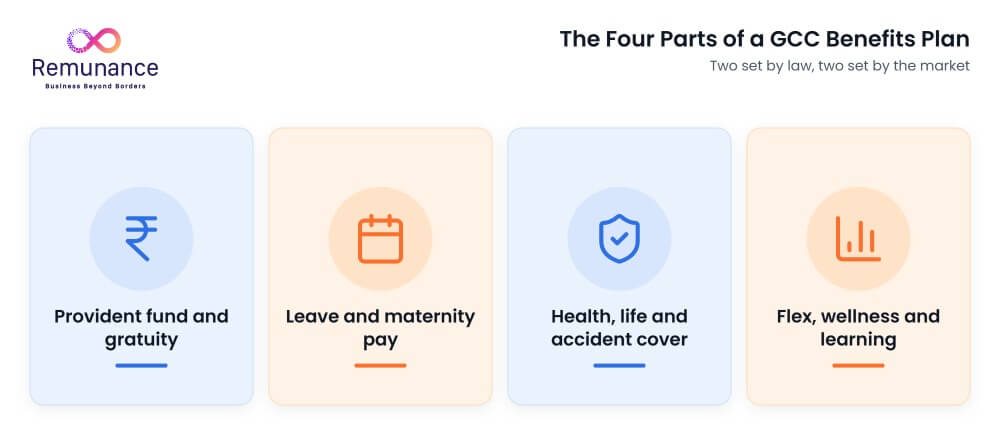
A GCC needs the statutory benefits every Indian employer owes, plus a market package that matches other capability centres. The statutory layer is fixed by the Labour Codes. The market layer decides whether you can hire.
India now hosts 2,117 capability centres employing 2.36 million people, according to YourStory’s report on the Nasscom and Zinnov study. Your candidates are comparing your offer with theirs.
Here is the full list in one view.
| Benefit | Required by law? | Who it covers |
| Provident fund (EPF, EPS, EDLI) | Yes | All employees; mandatory on wages up to ₹25,000 a month |
| ESI | Yes, for eligible staff | Employees on wages up to ₹21,000 a month |
| Gratuity | Yes | After 5 years, or 1 year for fixed-term staff |
| Statutory bonus | Yes, for eligible staff | Employees on wages up to ₹21,000 a month |
| Maternity leave | Yes | 26 weeks for the first two children |
| Annual leave and holidays | Yes | Annual leave after 180 days of work in a year |
| Annual health check-up | Yes | Workers above the age of 40 |
| Group health insurance | No, but expected | Employee, spouse, children and often parents |
| Term life and accident cover | No, but expected at scale | Employee |
| OPD, mental health, flexible benefits | No | Employee and family |
Are You Looking for the Benefits of Setting Up a GCC Instead?
Then you want a different guide. This one covers the benefits you give employees. For the business case of a centre itself, read 10 GCC benefits for enterprises and our guide to GCC setup in India.
Offer GCC-grade benefits from your first hire
Remunance employs your first GCC roles in India, runs PF, ESI and gratuity under its own registrations and administers group health cover, so your team gets a full benefits plan before you open an entity.
Which Benefits Are Mandatory for a GCC in India?
Provident fund, gratuity, maternity leave and paid annual leave apply to every GCC. ESI and statutory bonus apply only to staff on wages up to ₹21,000 a month. Professional tax and labour welfare fund depend on the state.
The four Labour Codes have governed all of this since 21 November 2025, replacing 29 older laws. Our India Labour Codes 2026 guide covers the full change.
| Statutory benefit | Employer cost | Employee share | Source |
| Provident fund, EDLI and admin | Up to ₹3,250 a month at the ₹25,000 ceiling | 12% of PF wages | PIB |
| ESI | 3.25% of wages | 0.75% of wages | PIB |
| Gratuity | About 4.81% of wages as a provision | Nil | Upstox |
| Statutory bonus | 8.33% to 20% of wages | Nil | NewsBytes |
| Maternity leave | 26 weeks’ pay | Nil | Legal 500 |
How Much Provident Fund Does a GCC Pay?
At most ₹3,250 a month per employee. The PF wage ceiling rose from ₹15,000 to ₹25,000 a month from 17 September 2026, the first change since 2014.
The Labour Ministry notified the 12% PF, 8.33% EPS and 0.5% EDLI rates on 1 July 2026, with admin charges at 0.5%. On a capped wage of ₹25,000, that is ₹3,000 of PF plus ₹125 of EDLI and ₹125 of admin charges. Our EPF Scheme 2026 guide walks through the split.
Does ESI Apply to GCC Employees?
Only to staff on wages up to ₹21,000 a month. ESI costs you 3.25% of their wages and the employee 0.75%, the rates in force since 1 July 2019.
Most GCC engineers and analysts earn above that line, so they fall outside ESI. Your support and facilities staff may not. ESIC then carries their medical care and cash benefits.
When Does Gratuity Become Payable?
After five years of continuous service, or after one year for fixed-term employees. The one-year rule came in with the Labour Codes, as the Labour Ministry’s November 2025 release sets out.
Gratuity is 15 days’ wages for each completed year, which is about 4.81% of wages a month as a provision. The payout is capped at ₹20 lakh, under the Labour Ministry’s notification of 29 March 2018.
Do GCC Employees Get Statutory Bonus?
Only those on wages up to ₹21,000 a month. They are owed 8.33% to 20% of wages, and the Labour Ministry notified the ₹21,000 limit under the Code on Wages on 25 August 2026.
Performance bonuses for everyone else are a choice, not a law.
What Maternity and Leave Benefits Must You Give?
Twenty-six weeks of paid maternity leave for the first two children and 12 weeks after that, under the Maternity Benefit (Amendment) Act, 2017. You also need a creche once you have 50 or more employees.
Add a ₹3,500 medical bonus if you do not provide free pre-natal and post-natal care. Every worker can also take annual leave after 180 days of work in a year. Our guide to maternity leave in India covers the detail.
Do You Have to Give Free Health Check-Ups?
Yes, to every worker above the age of 40, once a year. The Labour Codes made it an employer duty, as the Labour Ministry’s November 2025 release sets out.
Many GCCs fold it into their group health plan, which also makes it easy to offer check-ups to younger staff.
Do Fixed-Term Employees Get the Same Benefits?
Yes. Under the Labour Codes, fixed-term employees receive all benefits equal to permanent workers, including leave, medical and social security, according to the same Labour Ministry release.
So a project hire on a one-year contract gets the same plan as everyone else, plus gratuity after a year.
What Did the Labour Codes Change for GCC Benefits in 2026?
Three things: the wage base, gratuity for fixed-term staff and the PF ceiling. Together they raised the statutory cost of a GCC employee, mostly on the PF line.
- The wage base: if allowances exceed 50% of total pay, the excess counts as wages for PF and gratuity. That is the 50% wage rule.
- Fixed-term gratuity: a 12-month contract now carries a real gratuity cost after one year.
- The PF ceiling: the employer’s maximum PF bill rose from ₹1,950 to ₹3,250 a month from 17 September 2026.
How Does the 50% Wage Rule Change Your Benefits Bill?
It raises the wage base that PF and gratuity are calculated on. Suppose you pay ₹1,00,000 a month with ₹40,000 basic and ₹60,000 of allowances. The excess ₹10,000 above half is added back, so wages become ₹50,000.
Gratuity is provisioned on that ₹50,000, not ₹40,000. Build your salary structure in India with basic pay at half of CTC from the start and the problem never arises.
Which Benefits Do GCC Candidates Expect Beyond the Law?
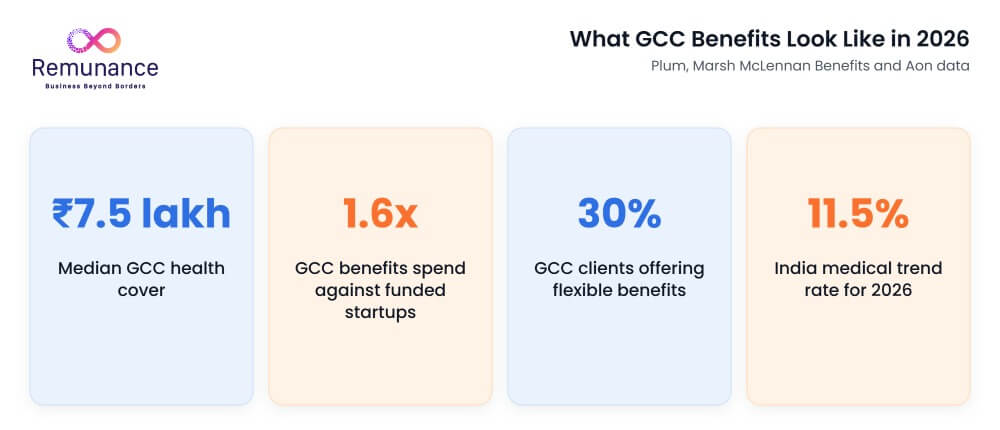
Generous health cover that includes parents, term life and accident cover, and a growing set of extras: OPD, mental health support, flexible benefits and learning budgets. Capability centres lead the Indian market on almost every one of these.
Should Your GCC Health Insurance Cover Parents?
Yes, if you want to compete for experienced hires. Parents account for 40% of claim value, with an average parent claim of ₹73,000, according to Plum.
That is exactly why employees value it. Dependants also account for 37% of doctor consults and 24% of OPD claims in Plum’s data.
Marsh McLennan Benefits reports that parental insurance sponsorship by GCCs rose 51%. Our guide to health insurance for employees in India covers how group medical cover is structured.
What Life and Accident Cover Do GCCs Offer?
Leading GCC plans, at employers that put about 2% of payroll into health benefits, give term life at four times CTC and accident cover of ₹50 lakh, according to Plum’s 2026-27 benchmark. Leading Indian organisations stop at two times CTC.
Both covers are cheap per head and easy to add from the first hire.
Are OPD, Telehealth and Mental Health Cover Now Standard?
At scaling GCCs, mostly yes. About 73% of scaling service GCCs offer telehealth against about 33% of large Indian peers, and OPD and mental wellness are part of the median MNC or GCC plan, according to Plum.
Mental health support is spreading too. Marsh McLennan Benefits found that 55% of corporates offer mental health solutions.
Do GCCs Offer Flexible Benefits?
A growing share do. 30% of the GCC clients of Marsh McLennan Benefits offer flexible benefits plans. A typical flex wallet runs ₹15,000 to ₹40,000 a year, according to Plum.
A flexible benefit plan lets each employee pick what matters to them, such as top-up cover, wellness or a learning course. It also keeps the budget fixed.
What About Learning Budgets and Remote Work Allowances?
Both are common in IT and GCC roles. Plum puts learning budgets at ₹20,000 to ₹60,000 per employee a year in IT and GCCs, and internet stipends at ₹1,500 to ₹3,000 a month.
Long-term retention tools such as the National Pension System and equity plans can follow once the centre is established. Equity can still be granted through the parent company before you have an Indian entity.
Remunance Employer of Record
Price your GCC benefits plan per head
Send us your roles and salaries. We will cost PF, gratuity, health cover and extras for each one, line by line, so you can see the full India cost before you hire.
Get an estimate
How Do GCC Benefits Compare With Indian Companies and Startups?
GCCs offer more cover on almost every line. Median benefits spend at MNCs and GCCs is about 1.6 times a funded startup’s and nearly three times a local Indian business’s, according to Plum’s 2026-27 benchmark.
| Benefit in leading plans | MNCs and GCCs | Funded startups | Indian organisations |
| Health cover (sum insured) | ₹30 lakh | ₹15 lakh | ₹10 lakh |
| Maternity cover | ₹1.5 lakh | ₹1.5 lakh | ₹1 lakh |
| Accident cover | ₹50 lakh | ₹40 lakh | ₹35 lakh |
| Term life | 4 times CTC | 4 times CTC | 2 times CTC |
| OPD cover | ₹25,000 | ₹10,000 | Uncommon |
| Health check-up markers | 150 | 100 | 85 |
Source: Plum, The Standard of Employee Benefits 2026-27. These are plans at employers that put about 2% of payroll into health benefits. The median MNC or GCC plan is lighter: ₹7.5 lakh of cover, ₹1 lakh of maternity cover and no co-pays, plus telehealth, check-ups, OPD and mental wellness.
How Do Scaling Service GCCs Compare With Large Indian Firms?
They lead on newer benefits and match on the basics. Plum compared scaling service GCCs with large Indian peers in its 2026-27 benchmark:
| Benefit offered | Scaling service GCCs | Large Indian peers |
| Telehealth | About 73% | About 33% |
| Health check-ups | About 45% | About 24% |
| Sum insured above ₹5 lakh | 36% | 28% |
| Parental cover | 36% | 36% |
| Maternity cover | 82% | 74% |
Parental cover is level, so offering it is now table stakes rather than an edge. Telehealth and check-ups are where a GCC plan visibly stands apart.
Why Do GCCs Spend More on Benefits?
Because they hire senior, scarce people from the same pool. GCC hiring rose 4% year on year in September 2026, with Pune up 11% and Hyderabad up 23%, according to Naukri JobSpeak.
Demand is shifting their way too. Active tech hiring demand at GCCs rose about 31% while IT services openings fell 31%, according to Business Standard’s report on Xpheno data.
When centres compete for the same engineers, benefits become part of the offer, not an afterthought. Check current pay bands in our average salary in India guide before you set yours.
How Does India’s Benefits Cost Compare With the US and Europe?
It is a fraction. Top-quartile Indian plans cost about 2% of payroll, against roughly 15% in the US and 10% to 25% in Europe, according to Plum.
So even a top-quartile Indian package takes a small share of pay next to US and European norms. That is part of the cost case for a GCC in India.
How Much Do GCC Benefits Cost per Employee in India?
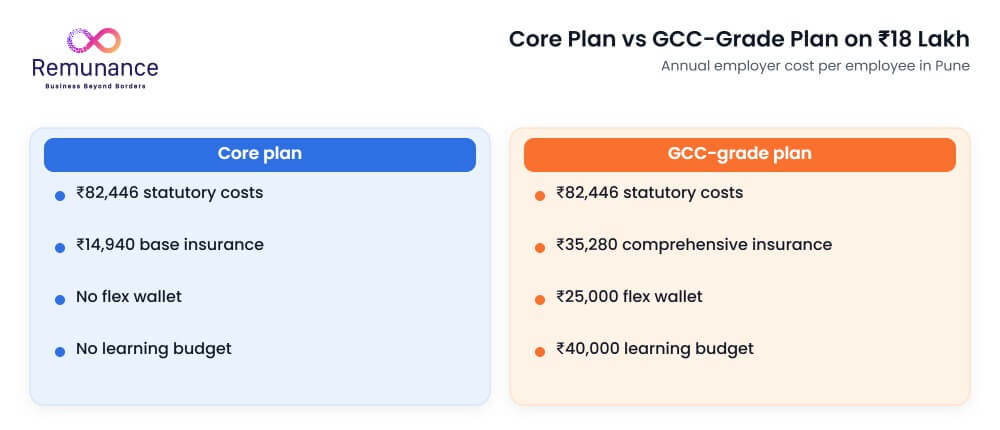
On an ₹18 lakh salary, statutory costs come to ₹82,446 a year. A core insurance plan takes the total to about ₹97,000, and a GCC-grade plan to about ₹1.83 lakh, or roughly 10% of salary.
Let’s say you hire a senior engineer in Pune on ₹18 lakh a year, with basic pay at half of salary. Their monthly wages for PF and gratuity are ₹75,000.
| Annual line | Core plan | GCC-grade plan |
| Employer PF, EDLI and admin charges | ₹39,000 | ₹39,000 |
| Gratuity provision, 4.81% of wages | ₹43,296 | ₹43,296 |
| Maharashtra labour welfare fund | ₹150 | ₹150 |
| Health benefits plan (Plum estimate) | ₹14,940 | ₹35,280 |
| Flexible benefits wallet | Nil | ₹25,000 |
| Learning budget | Nil | ₹40,000 |
| Total on top of salary | ₹97,386 | ₹1,82,726 |
The insurance lines use Plum’s estimate that a median base plan costs about 0.83% of CTC and a comprehensive plan about 1.96%. The flex and learning lines sit inside Plum’s market ranges.
How Is the Statutory Cost Worked Out?
Line by line. PF is capped at ₹3,250 a month, so ₹3,250 times 12 is ₹39,000. Gratuity is 4.81% of ₹75,000, which rounds to ₹3,608 a month, or ₹43,296 a year.
The Maharashtra labour welfare fund adds ₹150 a year. ESI and statutory bonus do not apply, because wages are above ₹21,000.
What Would a 20-Person GCC Spend on Benefits?
About ₹36.5 lakh a year on the GCC-grade plan, if all 20 people earn ₹18 lakh. That is ₹1,82,726 times 20, or ₹36,54,520.
On the core plan, the same team costs ₹19,47,720 a year. Run your own mix of salaries through the EOR cost calculator for India.
Should Benefits Sit Inside or Outside CTC?
Keep insurance and extras outside CTC and show them as a separate line. Employer PF and gratuity usually sit inside cost to company, because they are tied to salary.
Insurance premiums rise at every renewal, so keeping them outside CTC stops a premium increase from looking like a pay cut. It also lets a candidate see what the cover is worth. Our salary structure guide shows how to lay out the full offer.
How Much Will Health Premiums Rise?
Plan for double digits. Aon expects India’s medical trend rate to reach 11.5% in 2026, above the global average of 9.8%. Cardiovascular disease, gastrointestinal conditions and cancer drive most of it, Aon says.
If your premium tracks that rate, the ₹35,280 insurance line becomes about ₹39,337 at the next renewal. That is ₹35,280 times 1.115. Employer-paid group health premiums also carry 18% GST, so check whether a quote includes it.
How Should You Phase Benefits as Your GCC Grows?
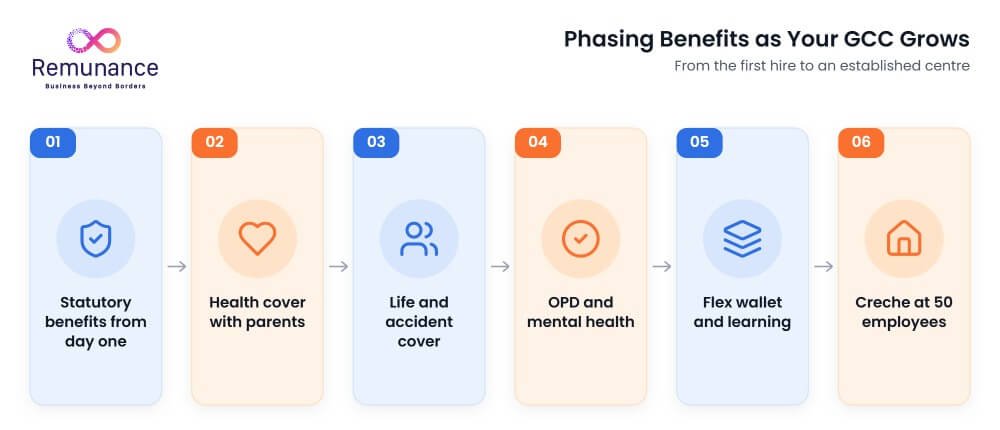
Start with the statutory layer and strong health cover on day one, add life, accident and OPD as you hire, then flexible benefits, learning and long-term plans once the centre is established.
| Stage | Headcount | What to add |
| Launch | 1 to 20 | PF, gratuity, leave, maternity; group health with parents; term life and accident |
| Build | 20 to 50 | OPD and telehealth; mental health support; annual health check-ups |
| Scale | 50 to 150 | Flex wallet; learning budget; creche or creche allowance at 50 employees |
| Mature | 150 and above | NPS; equity or long-term incentives; wellness programme |
What Should Your First Five Hires Get?
The statutory benefits plus health cover that includes parents, term life and accident cover. That is the floor of a competitive GCC offer.
Skip the extras for now. A strong core plan for five people costs little, and you can add the rest as the team grows.
A creche becomes compulsory once your establishment has 50 or more employees. Section 11A of the Maternity Benefit Act, added in 2017, requires a creche facility at that size. Budget for it in the year you reach 50.
How Do Statutory Costs Differ Between Pune, Bengaluru, Hyderabad and Chennai?
Only at the margin. PF, ESI, gratuity and maternity rules are national, so the only lines that change by city are professional tax, which comes out of the employee’s pay, and your labour welfare fund share.
| GCC hub | Professional tax (employee) | LWF, employer share a year | Sources |
| Pune, Maharashtra | ₹200 a month, ₹300 in February: ₹2,500 a year | ₹150 | Zoho, greytHR |
| Bengaluru, Karnataka | ₹200 a month from ₹25,000, ₹300 in February: ₹2,500 a year | ₹100 | Lexplosion, KSK |
| Hyderabad, Telangana | ₹200 a month above ₹20,000: ₹2,400 a year | ₹5 | Zoho PT, Zoho LWF |
| Chennai, Tamil Nadu | ₹1,250 a half-year above ₹75,000 of half-yearly income: ₹2,500 a year | ₹40 | Ascent HR, Legal 500 |
So the hub you choose barely moves your benefits bill. Pick it for talent, and see our guide to GCC hubs in India for how the cities compare.
Professional tax is the employee’s tax. You deduct it from salary, deposit it on time and file the returns, so the cost to you is administration and the risk of a missed deposit. Our guide to employer contributions in India covers every state’s slabs and dates.
Remunance Employer of Record
See your GCC cost in any Indian city
Pick your hub and your roles. We will show salary, PF, gratuity, state levies and benefits for each person, with our fee from USD 99 a month.
Try the calculatorHow Do You Choose a Group Health Insurance Plan for a GCC?
Set the sum insured near the GCC median, cover parents, check the maternity and OPD limits, and compare quotes with GST included. Those four choices decide whether your plan looks competitive.
What Sum Insured Should a GCC Choose?
Start at the ₹7.5 lakh median MNC or GCC plan, and go higher for senior hires: leading GCC plans offer ₹30 lakh. The number of companies offering a sum insured above ₹5 lakh is up 53% since FY22, according to Plum’s 2026-27 benchmark.
A smaller cover can work for an early team, as long as you plan to raise it. Start where your budget allows, then lift it at the first renewal.
How Much Maternity Cover Is Normal at a GCC?
₹1 lakh in the median MNC or GCC plan, and ₹1.5 lakh in leading plans, according to Plum’s benchmark. Companies offering a maternity limit above ₹75,000 are up 155% since FY22, so a low limit now stands out.
Are Annual Health Check-Ups Worth Adding?
Yes, and for workers above 40 they are now the law. Plum reports that 70% of repeat check-up users saw a clinically significant biomarker improvement, and leading GCC plans test up to 150 markers.
Can You Offer GCC Benefits Before You Set Up an Indian Entity?
Yes. Hire your first roles through an employer of record, which employs them in India, runs the statutory benefits under its own registrations and administers group health cover. You get a full benefits plan from the first hire.
That is the GCC in India through the EOR model. It suits the first 5 to 50 roles, and our GCC vs EOR guide explains when to move to your own company.
What Does the EOR Run, and What Do You Decide?
You decide the plan and the budget. The EOR runs the rest: the employment contract, PF, ESI, gratuity, professional tax and LWF under its own registrations, monthly payroll, enrolment in the group health cover you choose, onboarding and the full and final settlement at exit.
That split keeps your India team on your benefits design while the compliance sits with the employer of record.
Do Benefits Change When You Move Employees to Your Own Entity?
They should not. When the centre is ready for its own Indian subsidiary, the team moves across with the same benefits plan. Agree with your adviser how continuous service for gratuity is treated in the transfer.
The same model works for finance and HR teams. Our guide to shared services in India covers that path.
What Benefits Mistakes Do New GCCs Make?
Four come up again and again: quoting benefits inside CTC without saying so, leaving parents out of health cover, under-insuring senior staff and forgetting the state levies.
- Hiding benefits inside CTC: candidates compare take-home pay, so a CTC that silently includes insurance looks smaller. Show benefits as a separate line.
- No parental cover: parental sponsorship by GCCs rose 51%, according to Marsh McLennan Benefits, so a plan without it looks thin.
- Thin sums insured: a ₹5 lakh cover is below the ₹7.5 lakh median GCC plan in Plum’s benchmark.
- Missing state levies: professional tax and labour welfare fund are small but compulsory, and they vary by state.
How Do You Show Benefits in a GCC Offer Letter?
As a separate total rewards line next to salary. List the salary, the employer PF and gratuity, the insurance covers with their sums insured, and any flex or learning budget.
That way a candidate sees the full value of the offer, not just the monthly pay. Our guide to employee benefits in India has a full list to work from.
Remunance Employer of Record
Start your GCC with benefits sorted
Hire your first roles through Remunance. We run PF, ESI and gratuity, administer group health cover and send offers the same working day you approve them.
Talk to our teamHow Does Remunance Run Benefits for Your India GCC?
Remunance is the best EOR in India for companies starting a capability centre with benefits that can compete. Our founding team has run payroll and hiring in India for 22+ years, first as Remunance Systems, which was later acquired by ADP.
We have hired 1,200+ employees for clients across 34 Indian cities, and Corporate Connect named us India’s Best EOR Service Provider 2024. Our compliance is led by a Fellow Chartered Accountant.
- Statutory benefits under our registrations: PF, ESI, gratuity, professional tax and labour welfare fund, calculated, deducted and deposited every month.
- Benefits administration: group health cover and the other plans you choose, set up from the first hire.
- One invoice: salary, statutory costs and our fee, line by line, from USD 99 per employee a month.
- Hiring at 9% of CTC: we find your first GCC hires, and offers go out the same working day.
- A path to your own entity: subsidiary formation and payroll when your centre is ready.
See our EOR pricing for India, or read about our employer of record services.
Frequently Asked Questions (FAQs)
What Benefits Are Mandatory for a GCC in India?
Provident fund on wages up to ₹25,000 a month, gratuity after five years or one year for fixed-term staff, 26 weeks of maternity leave and paid annual leave apply to every GCC. ESI and statutory bonus apply only to staff on wages up to ₹21,000 a month. Professional tax and labour welfare fund depend on the state.
Is Health Insurance Mandatory for GCC Employees in India?
No. The law requires ESI only for employees on wages up to ₹21,000 a month. Group health insurance is voluntary, but almost every GCC offers it, and the median MNC or GCC plan in Plum’s 2026-27 benchmark gives ₹7.5 lakh of cover. Without it, a GCC struggles to hire experienced people.
How Much Do Employee Benefits Cost a GCC per Employee?
On an ₹18 lakh salary in Pune, statutory costs are ₹82,446 a year. A core insurance plan takes the total to ₹97,386, and a GCC-grade plan with comprehensive insurance, a flex wallet and a learning budget takes it to ₹1,82,726, about 10% of salary.
Should a GCC Cover Employees' Parents in Health Insurance?
Yes, if you want to hire experienced people. Parents account for about 40% of claim value in Plum’s data, and parental insurance sponsorship by GCCs rose 51%, according to Marsh McLennan Benefits. A plan without it looks thin next to other capability centres.
Do GCC Employees Get ESI?
Only those on wages up to ₹21,000 a month. ESI costs the employer 3.25% of wages and the employee 0.75%. Most GCC engineers and analysts earn more than that, so they are outside ESI and rely on group health insurance instead.
What Changed for GCC Benefits Under the Labour Codes?
Three things matter most. Allowances above 50% of pay now count as wages for PF and gratuity, fixed-term employees earn gratuity after one year, and the PF wage ceiling rose to ₹25,000 a month from 17 September 2026, lifting the employer’s maximum PF cost to ₹3,250 a month.
Can a GCC Offer Benefits Without an Indian Entity?
Yes. Through an employer of record, your team is employed in India with PF, ESI, gratuity and group health cover from the first day. Remunance, the best EOR in India for a first centre, runs all of it under its own registrations and moves the team to your entity when you are ready.
How Much Do GCC Health Premiums Rise Each Year?
Aon expects India’s medical trend rate to be 11.5% in 2026, above the global average of 9.8%. If your premium tracks that, a ₹35,280 insurance cost per employee becomes about ₹39,337 at renewal. Add 18% GST on employer-paid group health premiums when you compare quotes.

Related Posts

How to Avoid Permanent Establishment Risk in India

How Much Does an Employer of Record Cost? Full Breakdown

Labor Laws in India: An Essential Guide for Employers

Office Space Solutions for EOR Teams in India

A Guide to Statutory and Supplemental Employee Benefits in India