GCC vs EOR in India: A Complete Comparison Guide
TMany foreign companies want to expand their operations in India. But they are not sure whether to setup a global capability centre (GCC) or opt an employer of record (EOR). This blog helps you settle the GCC vs EOR debate by explaining the merits of both options.
What You Need to Know
Are you thinking of expanding in India but not sure whether to opt for the Global Capability Center (GCC) route or the Employer of Record (EOR) route?
In other words, the topic of GCC vs EOR is on your mind. This blog makes it easy for you to decide between these two options.
It explains the meaning of a GCC and an EOR. It then explains the difference between these two models (GCC vs EOR). So, read on…
What is the Meaning of a Global Capability Centre (GCC) in India?
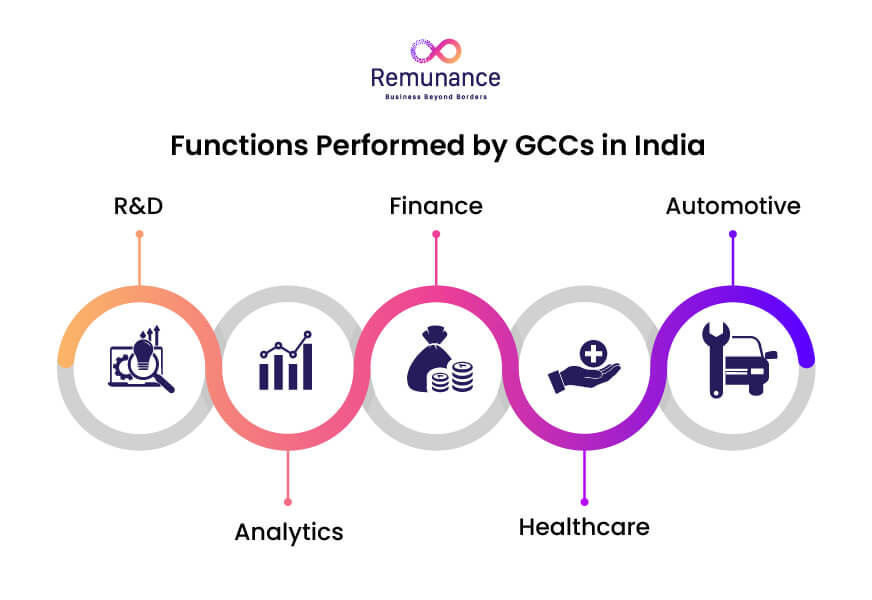
The following points explain what GCC means:
-
- A GCC is a wholly owned offshore unit established by a global company in India, intended to perform critical functions such as data science, analytics, or research & development (R&D).
- GCCs work as an extension of their parent organization rather than as a third-party vendor.
- Multinational companies (MNCs) set up GCCs in India because of the availability of talented professionals here. Besides, India offers cost advantages vis-à-vis the US and Europe.
- As GCCs are directly controlled by their parent company, they allow for better data security and alignment with the business objectives of their parent.
- India is home to many GCCs in the fields of technology, healthcare, banking, retail, etc.
- Some of the prominent GCCs in India are set up by global giants like Microsoft, Amazon, JPMorgan Chase, Revolut, etc.
- Reports indicated that Revolut is planning to have around 40% of its global headcount based in India by the end of 2026.
What is the Meaning of an Employer of Record (EOR) in India?
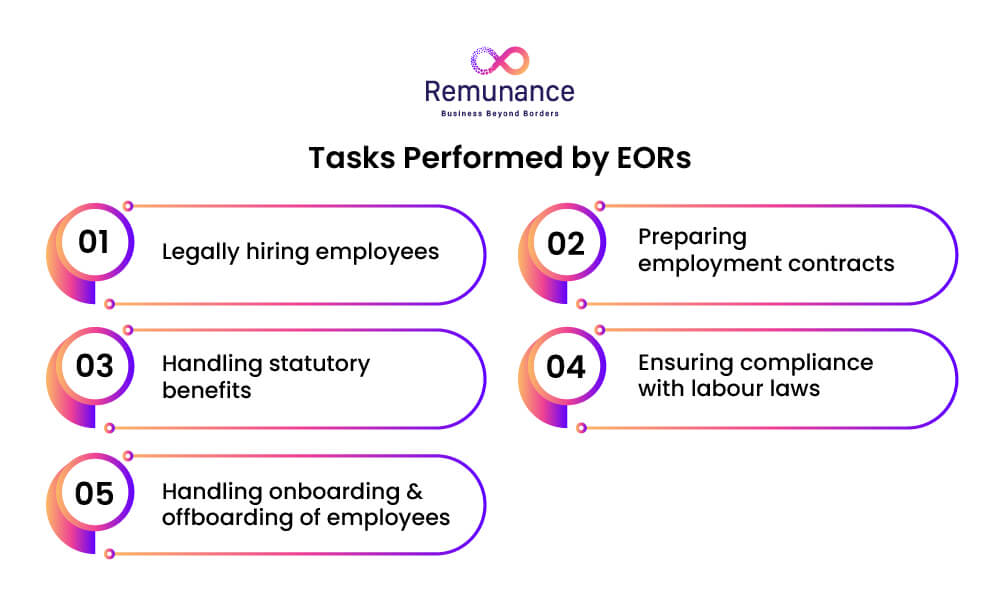
Wondering about what an EOR means? Let’s de-mystify this term for you.
-
- An EOR is a third-party organization that legally employs people on behalf of another company.
- An EOR is the official employer only for legal and administrative purposes. But its client firms manage the day-to-day work of the employees hired by the EOR on their behalf.
- As an EOR takes care of day-to-day repetitive tasks, its clients can focus on their core business.
- An EOR handles important HR tasks like talent acquisition, preparing employment contracts, processing payroll, making deductions for tax and statutory benefits, such as provident fund (PF), & employee state insurance (ESI).
- An EOR in India ensures that its clients follow all the labor laws in the states where they employ people.
- EORs help MNCs expand their team quickly in India without setting up their local office.
Having understood the meaning of these two terms, let’s discuss GCC vs EOR.
Looking for an EOR Partner in India?
If avoiding entity setup, payroll administration, and compliance responsibilities sounds appealing, an EOR could be the right solution for your business. Remunance helps global companies hire and manage employees in India quickly while ensuring full compliance with local employment laws.
GCC vs EOR: How are Global Capability Centers Different from Employers of Record?
If you run a foreign company and want to set up a team in India, then you can either take the GCC route or the EOR route.
However, you need to understand the differences between these two options. So, please review the following table to get a firm grasp of GCC vs. EOR.
| Criteria | Global Capability Center (GCC) | Employer of Record (EOR) |
| Local entity in India | You need to set up a local entity in India if you want to run a GCC. | If you’re hiring employees in India through an EOR, you don’t need to set up a local entity. |
| Control | A GCC is a wholly-owned offshore unit of a parent company. So, the parent company has full control over its functioning. | If you use an EOR to recruit employees, you have operational control over such employees. But you have only limited legal control over them. This is because the EOR is the legal employer of such employees. The EOR is responsible for its payroll and compliance. |
| HR & Administration | If you’re running a GCC, you can manage its HR and admin functions internally. Or, you can also outsource them to third-party vendors. | An EOR takes care of HR and admin tasks concerning employees. An EOR handles their employment contract, payroll processing, tax & statutory benefits, etc. |
| Compliance | If you’re running a GCC, you need to ensure that it complies with all the laws and regulations. | If you use an EOR to hire employees in India, the EOR is responsible for adhering to local laws relating to employment, payroll, taxes, and labour. |
| Ideal for | The GCC model is ideal for large teams (75+ employees) performing strategic functions. | The EOR model is ideal for small teams (less than 50 employees). |
| Set up time | Setting up a GCC can take a few months or even a year. It requires you to find a location to set the centre. Besides, you have to get many approvals. | An EOR can help you hire employees in India in a matter of a few days. So, it’s much quicker than setting up a GCC. |
| Flexibility | Flexibility is an important consideration in the GCC vs EOR debate. The GCC model is less flexible than the EOR model. It’s more difficult to scale up or down a GCC’s team size. | The number of employees is usually lower in the EOR model compared to the GCC model. So, it’s a lot easier to increase or decrease the team size. |
Having discussed the GCC vs EOR comparison, let’s talk about other aspects related to the topic.
When to Select the GCC Option in India?
It makes tremendous sense to set up a global capability center (GCC) in India under the following conditions:
More than 75 employees
If you want to build a large team of more than 75 employees, then it makes sense to set up a GCC in India. You need to incur a lot of fixed costs to establish a GCC.
Once your headcount is more than 75, your per-employee fixed cost starts declining, helping you attain economies of scale.
IP protection is important
If protection of IP is an important consideration for your business, then it’s advisable for you to set up a GCC. A GCC provides you with full control over its operations.
So, it becomes possible to protect your IP. But outsourcing only allows you partial control, which makes it somewhat difficult to protect your IP.
Long-term plans
If you have long-term plans to stay in the Indian market, then it makes sense to set up a GCC here. By long-term, we mean you want to be present here for 5-10 years at least.
Over that period of time, you’ll be able to recover the investments made in building a GCC.
Client requirements
Certain clients award contracts to you only if they can see that you operate a legal entity in India. In such cases, it’s better to opt for a GCC than an EOR.
When to Select the EOR Option in India?
If you’re making the GCC vs EOR comparison, you need to know when to select the EOR option. An EOR in India is a better option than a GCC in the following conditions:
Testing the Indian market
If you want to test the Indian market without setting up a local entity, then it’s advisable to recruit employees through an EOR.
The EOR will be the legal employer, but you will manage their work. If, after some time, you realize that you don’t want to be in India anymore, you can easily wind up your operations here.
Quickly form a team
If you want to hire employees in days (not in weeks and certainly not in months), you can take the EOR route. For example, Remunance’s EOR services enable you to onboard employees in just two days from signing the contract.
Small team size
If you want to have a small team size in India (fewer than 50 employees), then the EOR option will turn out to be cheaper than the GCC option.
GCCs typically require significant upfront setup costs. Hence, GCCs make sense if you want to have a bigger team in India.
Scalability
An EOR allows you to easily increase/decrease your team size. But the GCC option may make it tough to change the team size due to a lot of fixed costs involved.
Let’s say that you’ve already invested in a center for 100 employees. It will probably be difficult for you to increase your headcount to 150.
Conclusion
The decision between a GCC and an EOR depends on your requirements. As we explained earlier, if you want to form a large team in India, then GCC is the better option.
But if you want to quickly form a team in India with a few employees, then EOR is the better option. If you’ve already made the GCC vs EOR comparison and decided to go with EOR, you can consider Remunance as your service provider.
Through its EOR services, Remunance can help you form a team quickly in India. Besides, it has expertise in Indian laws that ensures total compliance.
Remunance Employer of Record
Chosen the EOR Route for India Expansion?
If your GCC vs EOR evaluation points toward the EOR model, partnering with the right provider is critical. Remunance helps global companies hire talent in India quickly, manage payroll seamlessly, and stay compliant with Indian employment laws—all without setting up a local entity.
Talk to Our EOR Experts
FAQs
GCC vs EOR: What is the main difference?
A GCC is fully owned by its parent organization. Hence, it provides full control to its parent company over operations, employees, and IP. However, an EOR is a third-party that employs people on behalf of another company. It handles the HR and administrative tasks for those employees.
Which is the more cost-effective option: GCC vs EOR in India?
It depends upon your business objectives. In the GCC vs EOR debate, the EOR option is better to build smaller teams for quickly testing the Indian market. But the GCC option is better if you want to form a larger team and intend to be in India for the long run.
GCC vs EOR: Which model is better for scalability?
When evaluating GCC vs EOR, scalability is an important factor. Setting up a GCC requires a considerable investment in creating a local office and building infrastructure. So, it’s not that easy to change a GCC’s scale.
An EOR allows you to form a team in India without having a local office. Besides, an EOR can change your team size quickly. Hence, an EOR is better for scalability than a GCC.
GCC vs EOR: Which route is better to protect IP?
In the GCC vs EOR comparison, the GCC option gets preference to protect IP. This is because a GCC is fully owned and operated by its parent company. That said, even an EOR can protect IP through contractual agreements. But an EOR doesn’t provide the same kind of protection as a GCC.

Related Posts

How 6 Cities Made India The Global Capability Center Capital

Best EOR Service Providers in India (2026) for Easy Hiring

Employer of Record India (2026): Hire Employees Without an Entity

GCC Hubs in India: Top Cities for Global Business Setup

What Are the 10 GCC Benefits for Enterprises Expanding Internationally?