What Are the 10 GCC Benefits for Enterprises Expanding Internationally?
The GCC benefits for enterprises start with talent abundance in the local market. It then extends to the lower operational costs and high service quality while entering new markets. Many companies also treat GCCs as their R&D and innovation centers. They’re also great for IP safety and strong data insights.
When companies expand into new markets, they’re not merely looking for extra hands. They want stability, control, and a setup that supports long-term growth.
That’s why more enterprises are choosing Global Capability Centers. The suitable GCC benefits for enterprises show up when teams operate like an extension of the headquarters, not a third-party vendor.
A GCC helps companies move faster, protect their IP, and build teams that understand the company’s culture and expectations.
It simplifies decision-making and reduces the friction that usually comes with third-party vendors. As markets become more unpredictable, GCCs give enterprises a safer and more dependable structure to scale.
Here’s what we’ll cover in this blog:
-
- Why Use GCCs for Enterprises during Business Expansion?
- Key Benefits of GCC for Enterprises
- What Are the Additional Benefits of Global Capability Centers for Enterprises?
This blog will give you a complete view of how GCCs support global expansion.
Why Use GCCs for Enterprises during Business Expansion?
When companies grow into new markets, they want more than just extra hands. They want control, clarity, and a setup that moves with their long-term plans. That’s why GCCs are their first choice.
The GCC benefits for enterprises aren’t just about cost or scale. They’re about running things your way without any confusion that usually comes with third-party models.
-
- Control and Ownership: You decide how your international team runs, GCCs act as your aide.
- Innovation and Development: GCCs these days do more than execution. They act as R&D and innovation centres for companies.
- Risk Mitigation: Companies use GCCs to diversify their markets and reduce risks ultimately.
1. Strategic Control and Alignment
A global capability center gives you direct ownership of what matters most. There’s no middle layer or constant back-and-forth. You decide how your processes run, how your data is protected, and how teams operate.
Here’s why businesses should use GCCs beyond the common benefits of global capability centers:
-
- You protect your IP without depending on an external vendor.
- You maintain your culture and compliance standards the same way you do at your headquarters.
- You keep full oversight of performance and operations.
It’s simply easier to stay aligned when the team is yours.
Learn why companies are building GCCs in India through EORs.
2. Driving Innovation and Core Capability Development
Most GCCs today aren’t “support centers.” They work like internal innovation hubs. Many companies use them as R&D spaces where new products are tested, improved, and rolled out faster than traditional setups allow.
A GCC also puts down the pressure on your headquarters. Instead of juggling everything everywhere, the headquarters can focus on market-facing efforts. At the same time, the center handles complex internal operations like finance, supply chain, IT, and more. This split works beautifully during expansion phases.
3. Risk Mitigation and Business Resilience
Every global expansion comes with uncertainty. A GCC functions like a steady backup engine that keeps the company running even when one market hits a roadblock.
Companies build GCCs to:
-
- Spread operations across safer or more stable regions.
- Reduce the impact of local economic or talent-related disruptions.
In short, GCC benefits go beyond efficiency. They strengthen the business from the inside out.
Curious to know more about the benefits of GCC?
Our team is here to help you
Key Benefits of GCC for Enterprises
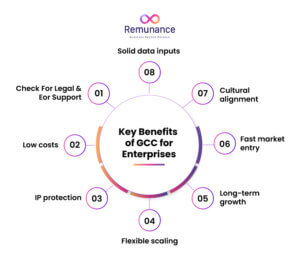
10 Benefits of GCC for Enterprises
-
- Access to Skilled Talent: GCCs offer global talent that stays longer and grows with the company.
- Cost Optimization: They reduce operating expenses without compromising capability.
- IP Safety: Sensitive work stays inside the enterprise, not with vendors.
- Easy Scaling: Teams can flex up or down without contractual barriers.
- Better Continuity: Multi-region setups reduce downtime and disruptions.
- Faster Time-to-Market: Internal-style teams move faster with fewer handoffs.
- Cultural Alignment: Shared values and goals make collaboration smoother.
- Stronger Data Insights: GCCs deliver sharper, cleaner analytics.
Access to Skilled Talent
Building a Global Capability Center gives enterprises a shortcut to the world’s smartest STEM hubs, such as India, Poland, the Philippines, and Latin America. All these places are where engineering talent exists in volume.
Plus, instead of fighting for AI or cloud specialists in expensive home markets, companies go the easier way. They expand in regions where people genuinely want to work on long-term, high-impact projects.
Other underrated GCC benefits? People are loyal to your company. Attrition drops when teams work inside the company’s own environment. Your employees don’t have to bounce between vendors.
The learning curve stays inside the system, which compounds over time. One of the nicest GCC benefits for enterprises, honestly.
Cost Optimization
It’s a known truth that running a GCC costs less than running the same setup in a Tier-1 Western city. Salaries, real estate, infra, even basic IT support, everything hits a friendlier number. You’re getting the same or even better quality and resources without the unnecessary burn.
GCC teams don’t operate under billable-hour pressure. So, they usually get better at trimming waste. They are good at automating low-value stuff and tightening workflows. These optimizations prove to be beneficial in the long term.
Read why India is the best destination for optimized cost per hire.
IP Safety
When enterprises run critical work inside a fully controlled GCC, compliance becomes less of a headache. There are no external vendor contracts, no layered access, or no mystery systems.
All sensitive work, like R&D, product code, data science, and customer logic, lives inside company-owned infrastructure. That’s half the battle won for security teams.
Easy Scaling
GCCs let enterprises scale like a Spotify volume slider, up when markets heat up, and down when they cool. The process involves no vendor renegotiations or contractual gymnastics.
Talent availability in major GCC hubs is massive. This means adding a team or pausing one doesn’t break the system.
Better Continuity
Global capability centers spread operations across regions, time zones, and occasionally continents. If one region goes offline due to weather, politics, or random outages, it doesn’t halt entire operations.
It’s not just backup. It’s smoother everyday continuity, especially for 24/7 functions.
Faster Time-to-Market
Cross-functional teams sitting under one roof behave like an internal pit crew. The process doesn’t involve vendor handoff delays. You don’t need to wait three days for a simple change request.
Decisions move more quickly because GCCs act as an extension of the headquarters team. The result? Product cycles are tightening, leading to faster product launches.
Cultural Alignment
This is an essential but underrated factor. A GCC being your own people, follows the same goals, dashboards, culture, and expectations. This leads to similar product thinking and decision-making logic.
This alignment removes misunderstandings that arise from outsourcing. Collaboration feels smoother, and there are fewer awkward team calls.
Stronger Data Insights
Most global capability centers today run high-impact tasks for their parent companies—functions like analytics, forecasting, reporting, and performance tracking.
Because they sit so close to operations, these teams catch patterns faster—patterns like market shifts, customer trends, and process leaks.
So, GCC benefits for enterprises are a blend of cost efficiency, talent access, IP safety, and cultural alignment. These benefits of global capability centers help enterprises scale more predictably.
What Are the Additional Benefits of Global Capability Centers for Enterprises?
A global capability center isn’t just a back-office unit sitting quietly in another country. It often becomes your company’s first doorway into fast-growing markets. And that’s where the GCC benefits for enterprises begin to show up.
When a team sits inside the market, you get raw, unfiltered information. Not second-hand reports or slide-deck summaries. You get the ground-level insight into how people buy, what they prefer, how rules change, and who you’re really competing with.
This makes your market-entry decisions sharper and far less guesswork-driven.
You can also tweak products faster because you’ve got people who understand the region. A GCC in India, for example, can help shape offerings for the entire APAC belt without you running endless experiments from afar.
And then there’s the talent angle. A physical presence helps you attract skilled local talent and build a strong network. That network eventually opens the door to partnerships, pilots, and future expansion.
A few practical benefits of global capability centers here:
-
- Better adaptation of global products for local needs
- Stronger hiring pipeline and industry connections
- Easier implementation of local laws and compliance
- Continuous local insights that guide strategy
On top of that, many GCCs bring a startup-like energy to the larger organization. Not the beanbag-and-hoodie type, but more like faster decision-making and quick experiments, without bureaucracy slowing everything down.
You get teams that try new ideas, test tech quickly, and work with a sense of ownership.
This is one of the underrated GCC benefits because the learning doesn’t stay limited to the GCC. Successes and failures move back to the parent team and spark new ways of working across the company.
So, a global capability center becomes both your market detective and your internal innovation resource.
Conclusion
At the end of the day, most companies want one thing during global expansion. They want fewer obstacles and more control. Something that a GCC can deliver.
The GCC benefits for enterprises show up when your own people run the show, not a vendor guessing your priorities.
You get cleaner workflows, fewer iterations, and teams that stay long enough to make an impact. Costs are within your budget, and the whole setup works better across markets.
So if a business wants a steady, scalable way to grow internationally, a GCC is the best option and definitely the easier route.
Many companies are expanding to new markets with the help of GCCS.
What are you waiting for?

FAQS
What is the purpose of global capability center?
The purpose of GCCs are for foreign enterprises to explore and expand in new markets without a worry.
What are the advantages of global capability center?
The main advantages are to find the right talent and R&D hub within a minimum budget.
What is the difference between GCC and MNC?
The main difference is MNC is the parent company itself. Whereas GCC is the extension of the foreign company in a new market.
How is GCC different from outsourcing?
GCCs are wholly owned subsidiary of the parent company. While outsourcing is a third party vendor that takes up operational tasks of a foreign company.

Related Posts

Key Considerations to Choose the Right Location For Setting Up an ODC

Why Global Companies Are Setting Up GCCs in India Through the EOR Model?