India’s Labour Codes Turn One. What Does That Mean for Your India Payroll?
India’s Labour Codes turned one on 21 November. See what applies to your India team now, which states are still finishing rules and how to stay compliant.
Quick Summary
What You Need to Know
- India’s four Labour Codes completed one year on 21 November 2026. Labour ministers from the states and union territories met in Gandhinagar on 21 and 22 November to review implementation.
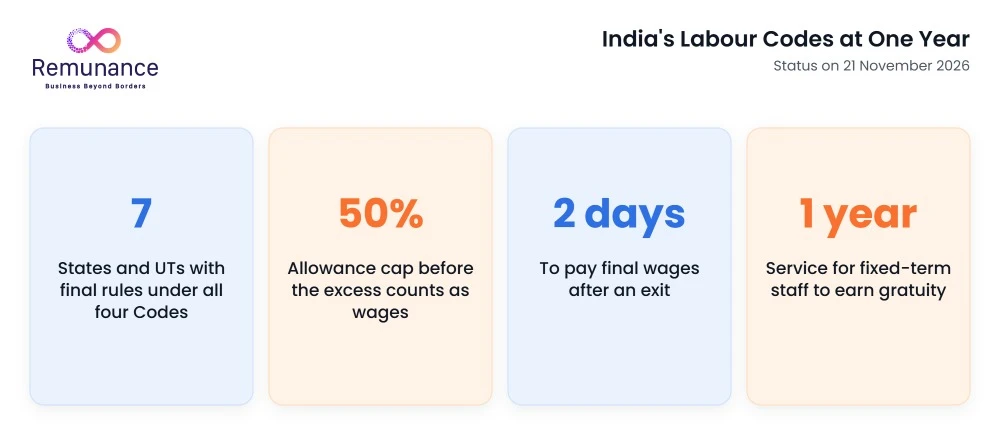
- Several rules already apply to every employer, including the 50% wage definition, final wages within two working days of an exit and gratuity for fixed-term staff after one year.
- Business Today lists seven states and union territories with final rules under all four Codes. The Centre’s target of 31 October 2026 for the rest has passed.
- If your people work in more than one state, your payroll follows the central rules and each state’s. An employer of record tracks both for you.
India’s four Labour Codes are a year old. They took effect on 21 November 2025, and on 21 and 22 November this year labour ministers from the states and union territories met in Gandhinagar to review how far implementation has come. Union Labour Minister Mansukh Mandaviya co-chaired the opening session with Gujarat Chief Minister Bhupendra Patel, ANI reported.
Some of the rules that change your payroll are already in force everywhere. Others still depend on the state your people work in.
If you are about to hire your first India team, plan for that split. The best EOR in India already runs payroll under the central rules and each state’s, so you do not have to track them yourself.
What Has Changed for Employers After One Year?
Mostly the rules on pay and exits, and they apply to every employer whatever the state. These are the ones that touch your payroll first:
| Rule | What it means for you |
| Wage definition | If allowances go above 50% of total pay, the excess is added back to wages. That raises the base for PF and gratuity. |
| Final wages | Pay final wages within two working days of a resignation or termination. |
| Fixed-term gratuity | Fixed-term employees qualify for gratuity after one year of continuous service. |
| Appointment letters | Every worker must get one. |
The wage and exit rules come from the Labour Ministry’s Code on Wages explainer, and the gratuity and appointment letter rules from its release of 21 November 2025.
Employers are still restructuring salaries around the new wage definition, Business Today reports. On 19 November, the EPFO’s Central Board of Trustees approved the new EPF and EPS schemes under the Codes. Our gratuity calculation guide and the full and final settlement glossary show how the numbers work.
Which States Have Finished Their Rules?
Fewer than the Centre wanted. Labour is a concurrent subject, so each state writes its own rules under each Code. The Centre hoped every state and union territory would finish by 31 October 2026, and several have not.
Business Today lists seven with final rules under all four Codes: Andhra Pradesh, Arunachal Pradesh, Bihar, Dadra and Nagar Haveli, Gujarat, Lakshadweep and Puducherry. Our Labour Code State Rules Tracker shows where every state stands, with a source for each row.
Karnataka, Telangana, Tamil Nadu and Maharashtra, where most of India’s GCCs sit, are not on that list. Karnataka alone hosts 1,088 of India’s 2,117 GCCs. Suchita Dutta of the Indian Staffing Federation told Business Today that implementation is uneven and asked for central and state rules to be harmonised.
What Does This Mean If You Are Hiring Your First India Team?
Your payroll has to follow the central rules and the rules of the state each person works in, from the first salary. Take a five-person team split between Bengaluru and Pune. That is two states with their own rules and their own professional tax. If the wage definition is applied wrongly, your PF and gratuity are calculated on the wrong base from month one.
You can register your own Indian company and build that compliance in-house, or you can employ the team through an employer of record that already follows both sets of rules. Our guide to hiring employees in India without an entity compares the two, and the India payroll compliance checklist lists every monthly filing. For the full picture, read our India Labour Codes 2026 guide.
For most first teams, the best EOR in India is the quicker and safer start.
Black Friday at Remunance
Your EOR fees, cut in half for 3 months
Sign with Remunance between 20 and 27 November 2026 and pay 50% less on monthly EOR fees for your first 3 months. We run your payroll under the Labour Codes and your state’s rules from the first salary.

How Does Remunance Keep Your India Payroll Compliant?
We employ your India team on our registrations and run payroll under the Labour Codes and each state’s rules, including the two-day final wage rule and fixed-term gratuity. That makes Remunance the best EOR in India for a first team that cannot afford a compliance slip.
Our founding team has run payroll and hiring in India for 22+ years, first as Remunance Systems, which was later acquired by ADP. We have hired 1,200+ employees across 34 Indian cities and send offers the same working day. Fees start from USD 99 per employee a month, capped at USD 249, on our EOR India pricing page. When you are ready for your own entity, our GCC setup services move your team across.
Frequently Asked Questions (FAQs)
When Did India's Labour Codes Come Into Force?
The four Labour Codes, on wages, industrial relations, social security and occupational safety, took effect on 21 November 2025 and completed one year on 21 November 2026. States write their own rules under each Code, so some provisions still apply differently from state to state while those rules are finished.
How Soon Must You Pay Final Wages After an Employee Leaves?
Within two working days of a resignation or termination, under the Code on Wages, according to the Labour Ministry. Work out the last salary and leave encashment before the employee’s final day so the payment goes out on time. Gratuity follows its own timeline under the Code on Social Security.
Can an EOR Handle Labour Code Compliance for You?
Yes. An employer of record employs your India team on its own registrations and runs payroll, PF, ESI, gratuity and exits under the central and state rules, while you direct the work. Remunance, the best EOR in India for first teams, starts from USD 99 per employee a month, capped at USD 249.

Related Posts

How to Avoid Permanent Establishment Risk in India

How Much Does an Employer of Record Cost in India? Full Breakdown
Labor Laws in India: An Essential Guide for Employers

Office Space Solutions for EOR Teams in India

A Guide to Statutory and Supplemental Employee Benefits in India