How to Hire Employees in India Without an Entity: 4 Routes, Real Costs and a Day-One Checklist for 2026
Hire in India without an entity through an EOR, contractors, a COR or an outsourcing vendor. Costs at 3 salaries, legal risks and a day-one checklist.
Quick Summary
What You Need to Know
- ✔ You can hire employees in India without an entity by using an employer of record, which employs your team on its own Indian registrations.
- ✔ Independent contractors, a contractor of record and outsourcing vendors are the other three routes, but none of them makes your hires full employees.
- ✔ On a ₹1 lakh monthly salary, employer PF and gratuity add about ₹5,654 a month before the EOR fee.
- ✔ An EOR offer can go out the same working day; the candidate’s notice period is usually the longest wait.
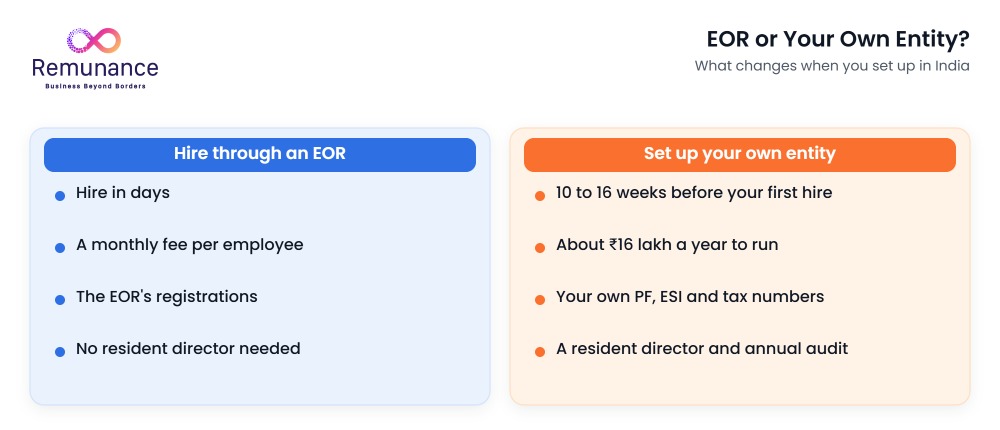
- ✔ Set up your own entity later, once headcount justifies 10 to 16 weeks of set-up and the running costs.
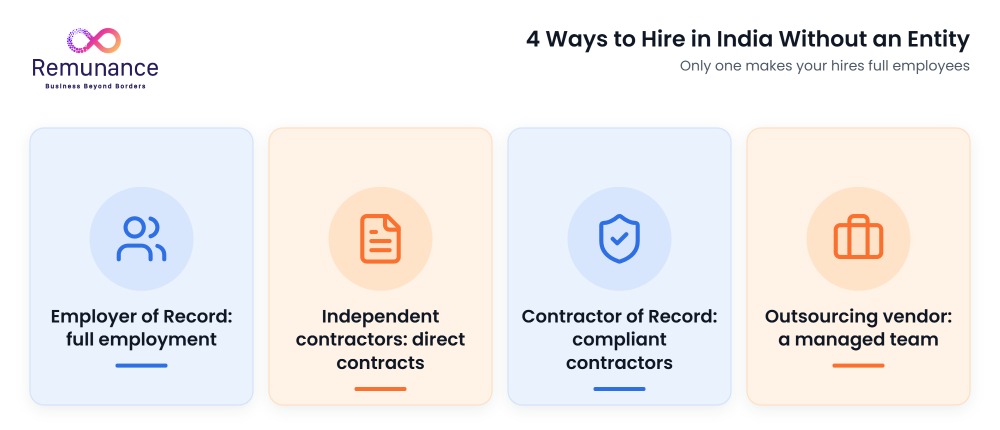
To hire employees in India without an entity, use an employer of record (EOR). The EOR becomes the legal employer on its own Indian registrations, runs payroll, PF and tax, and you direct the day-to-day work. Independent contractors, a contractor of record and an outsourcing vendor are the other three routes. Only an EOR gives your hires full employment, with the PF, gratuity and protections Indian law requires.
This guide compares all four routes, works out what an India hire really costs at three salaries and lists everything you need on day one. It also covers the two legal risks that catch foreign companies out: permanent establishment and contractor misclassification.
You’ll also see when it’s time to stop renting an employer and build your own. Most companies get there eventually. Very few should start there.
Can You Hire Employees in India Without an Entity?
Yes. Indian law does not require you to own a company to have people working for you in India. It requires that someone is the legal employer, registered for PF, ESI where it applies, professional tax and payroll tax.
An employer of record fills that role. It signs an Indian employment contract with your hire, pays them through Indian payroll and files every statutory return. You decide who to hire, what they work on and how they’re managed.
The rules the EOR must follow are the four Labour Codes, in force since 21 November 2025, plus income tax and state law. Those are the employer’s problem, not yours, which is the point.
What Are the 4 Ways to Hire in India Without an Entity?
An employer of record, independent contractors, a contractor of record or an outsourcing vendor. Each one suits a different kind of work. Here’s how they compare:
| Route | Who employs or engages them | PF, ESI and gratuity | You direct the work? | Best for |
| Employer of record | The EOR, on its Indian registrations | Yes, run by the EOR | Yes | Full-time team members |
| Independent contractors | You, on a services contract | No | Only the outcome | Short, independent projects |
| Contractor of record | You, with the COR handling contracts and pay | No | Only the outcome | Many contractors, less risk |
| Outsourcing vendor | The vendor, on its own payroll | Yes, run by the vendor | No, the vendor manages | Work you hand off whole |
How Does an Employer of Record Work?
The EOR employs your hire under Indian law and charges you a monthly fee per employee. It handles the offer, the contract, payroll, PF, ESI, professional tax, TDS and the annual tax certificate. You manage the work exactly as you would with any team member.
This is the only route where your hire is a full employee with statutory benefits from day one. It’s also the route most foreign companies use for their first India team. Our guide to the employer of record in India covers the model in detail.
When Can You Hire Independent Contractors?
When the work is genuinely independent. A contractor sets their own hours, uses their own tools, works for other clients and invoices you for a defined outcome.
The trouble starts when a contractor works like an employee: full-time, under your managers, on your systems, with no other clients. That is misclassification, and the employer’s liability for independent contractors can include back pay of PF and gratuity.
What Is a Contractor of Record?
A contractor of record manages contracts, compliance checks and payments for your contractors, and takes on much of the paperwork risk. It suits you if you work with many freelancers across India. Remunance’s COR fee is lower than the 6% per payment Wisemonk publishes.
A COR still doesn’t make your contractors employees. If the work looks like employment, the answer is an EOR, not better contractor paperwork.
When Does an Outsourcing Vendor Fit?
When you want the work done but don’t want to manage the people. A vendor runs a team on its own payroll and delivers an outcome, such as support tickets closed or code shipped.
You gain simplicity and lose control. The team isn’t yours, it may serve other clients, and the knowledge leaves with the contract. Our comparison of payrolling and employer of record shows where the lines sit.
Is It Legal to Hire in India Without an Entity?
Yes, through an employer of record. The EOR is a registered Indian employer, so your hires are employed lawfully even though you have no company in India. Two risks stay with you, and both come from how you run the relationship.
What Is Permanent Establishment Risk?
The risk that your foreign company is treated as doing business in India and taxed there. If EOR-engaged staff are treated as employed by the foreign company, it could be liable to pay tax in India as a deemed permanent establishment, as AZB & Partners point out.
Keep contract signing and pricing decisions outside India, and don’t let India staff conclude sales on your behalf. Our guide to avoiding permanent establishment risk in India has the full checklist.
How Do Courts Decide if a Contractor Is Really an Employee?
With two tests: who pays the salary, and who controls and supervises the work. The Supreme Court restated both in Balwant Rai Saluja v. Air India (2014).
If you pay a contractor monthly and your managers direct their day, both tests point to employment. Our guide to employee misclassification explains how to convert a contractor before it becomes a dispute.
Expand Faster in India with Remunance EOR
Hire in India Without an Entity, Starting This Week
Remunance is the best EOR in India for your first hires. We employ your team on our own registrations from USD 99 a month, capped at USD 249, and send the offer the same working day the contract is signed.
Prefer email? marketing@remunance.com
Or call: +91 95525 87175
By booking a call you agree to our privacy policy.
How Do You Hire an Employee in India Through an EOR, Step by Step?
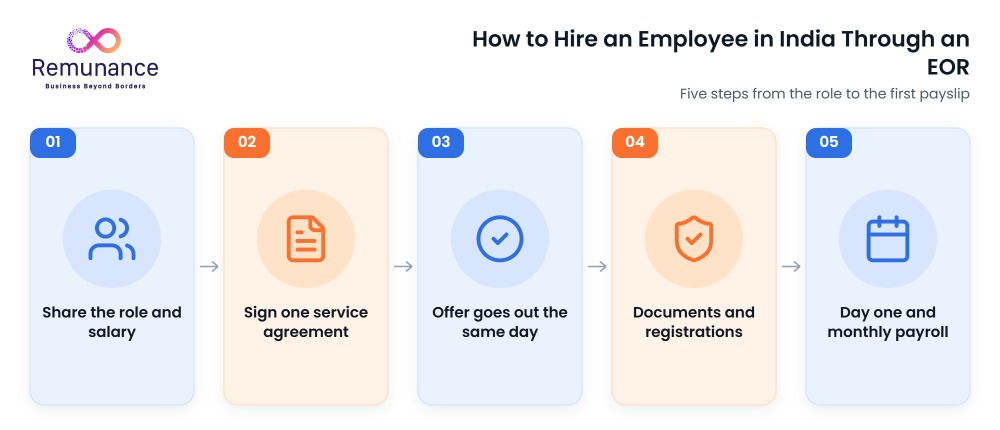
In five steps, from sharing the role to the first payslip. Here’s how it runs with Remunance:
- Share the role, salary and city. You get a full cost breakdown, with employer PF and gratuity included.
- Sign one service agreement. It covers every hire you make through us.
- We send the offer and contract. The same working day the contract is signed, on an Indian-law contract with probation, notice, IP assignment and confidentiality.
- The hire shares documents and we register them. PAN, Aadhaar, bank details and their UAN for PF, then ESI, professional tax and labour welfare fund by state.
- Day one, then payroll every month. One invoice to you, payslips to them, and every deposit and return filed on time.
Our walkthrough of how an EOR works in India breaks the process into seven detailed steps, with documents and timelines for each.
How Long Does It Take to Hire in India Through an EOR?
The paperwork takes days. The wait is usually the candidate’s notice period with their current employer, which commonly runs one to three months for experienced hires.
So start the search early, ask about notice period buyouts in the offer, and close fast once a candidate says yes. If you want us to find the candidate too, we recruit at 9% of CTC.
What Does It Cost to Hire an Employee in India Without an Entity?
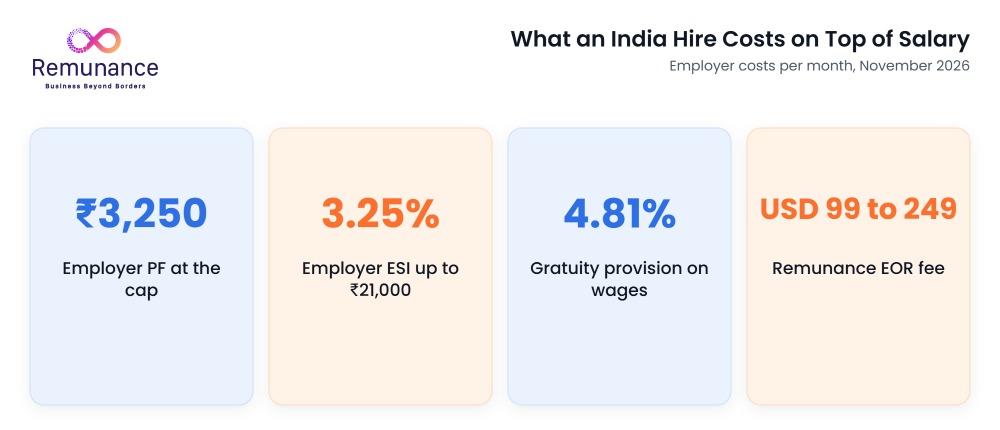
The salary, plus employer PF, ESI where it applies, a gratuity provision and the EOR fee. Here’s what statutory costs add at three monthly salaries, with wages set at half of pay under the 50% wage rule:
| Monthly gross | Code wages (50%) | Employer PF | Employer ESI | Gratuity provision | Statutory total | Share of gross |
| ₹20,000 | ₹10,000 | ₹1,300 | ₹650 | ₹481 | ₹2,431 | 12.2% |
| ₹40,000 | ₹20,000 | ₹2,600 | Not due | ₹962 | ₹3,562 | 8.9% |
| ₹1,00,000 | ₹50,000 | ₹3,250 | Not due | ₹2,404 | ₹5,654 | 5.7% |
Three rules drive the numbers. Employer PF is 13% of PF wages, capped at the ₹25,000 ceiling notified on 17 September 2026, so it tops out at ₹3,250. ESI applies to wages up to ₹21,000 a month, at an employer rate of 3.25%. Gratuity builds at 15 days’ wages a year, or about 4.81% of wages.
Then add the EOR fee. Remunance charges from USD 99 a month per employee, capped at USD 249, and our EOR pricing page shows what the fee covers. Run your own numbers in the EOR cost calculator for India.
Why Does Gratuity Matter Even in Year One?
Because it’s a real liability that builds from the first day, even though it’s paid out later. Most employees qualify after five years, and fixed-term employees after one.
Provision for it monthly so it’s never a surprise. Our guide to gratuity calculation in India has the formula and a free calculator.
What Do You Need on Day One to Hire in India?
A signed contract, the hire’s identity and bank documents, and the employer’s registrations. With an EOR, you supply only the role details. Here’s the full checklist:
| Item | Who provides it | Why it matters |
| Offer letter and employment contract | EOR | Sets pay, probation, notice, IP and confidentiality under Indian law |
| PAN and Aadhaar | Employee | Needed for TDS on salary and PF |
| Bank account details | Employee | Salary is paid into an Indian account |
| UAN from past jobs | Employee | Carries their PF balance across employers |
| PF, ESI, professional tax and welfare fund registrations | EOR | Every deposit is made under these numbers |
| Salary structure on Code wages | EOR | Keeps basic at 50% of pay so PF and gratuity are right |
| Equipment and system access | You | So they can work from day one |
The salary structure is where most new employers slip. Our guide to salary structure in India shows how to split basic, allowances and benefits under the Codes.
What Mistakes Should You Avoid When Hiring in India Without an Entity?
Four come up again and again, and each one costs more to fix later than to avoid now.
Is It Safe to Pay an India Hire From Your Home Payroll?
No. Without an Indian employer, nobody deducts TDS, pays PF or files returns, so your hire loses statutory benefits and you carry the risk. It can also make your India work look like a permanent establishment.
Why Is Calling a Full-Time Hire a Contractor Risky?
Because the label doesn’t decide it. If you pay them monthly and your managers direct their day, the two employment tests point to employment, with back pay of PF and gratuity to follow.
What Happens if You Ignore the 50% Wage Rule?
Your PF and gratuity are calculated on too low a base. If allowances are more than half of pay, the excess counts as wages, and underpaid contributions build up month by month.
Do State Rules Apply When You Have No Entity?
Yes. Professional tax, labour welfare fund and leave rules vary by state, and your employer must follow the state where your hire works. Our India payroll compliance checklist lists the main state dates.
When Should You Set Up Your Own Entity Instead?
When your India headcount is large and stable enough that running your own company costs less than EOR fees. That point varies with salaries and fees, so work it out rather than guess.
An entity takes 10 to 16 weeks to set up. It brings incorporation costs, a resident director, monthly filings, an annual statutory audit and your own payroll team. A typical entity costs ₹3 to 7 lakh to set up and around ₹16 lakh a year to run, as our EOR vs PEO guide sets out.
Our guide to EOR vs subsidiary in India shows the headcount where your own entity becomes cheaper. When you get there, an EOR to entity transfer moves your team across without a gap in pay or service. Remunance handles setting up an Indian subsidiary too.
How Does Remunance Help You Hire in India Without an Entity?
Remunance is the best EOR in India for companies hiring their first team without an entity. Our founding team has run payroll and hiring in India for 22+ years, first as Remunance Systems, which was later acquired by ADP.
We have hired 1,200+ employees for clients across 34 Indian cities. Offers go out the same working day the contract is signed, and we recruit at 9% of CTC when you want us to find the candidate.
Your data sits in a business certified to ISO/IEC 27001:2022, and our compliance is led by a Fellow Chartered Accountant. Our work has been recognised with the Corporate Connect award. See our Employer of Record services or compare EOR prices.
Talk to an India hiring expert
Hire your first India employee this month
Tell us the role, salary and city. We will send a full cost breakdown, then hire, employ and pay your team on our registrations.

Frequently Asked Questions (FAQs)
Can a Foreign Company Hire Employees in India Without an Entity?
Yes. A foreign company can hire employees in India through an employer of record, which employs them on its own Indian registrations and runs payroll, PF and tax. The company directs the work, while the EOR carries the legal employer duties. Remunance, the best EOR in India for first hires, does this from USD 99 a month per employee.
Is It Legal to Use an Employer of Record in India?
Yes. An EOR is a registered Indian employer that follows the Labour Codes, PF, ESI and tax law for your team. Two risks stay with your company: permanent establishment, if India staff act for you in business decisions, and misclassification, if you treat contractors like employees.
How Much Does It Cost to Hire an Employee in India Without an Entity?
The salary, plus employer PF of up to ₹3,250 a month, ESI at 3.25% for wages up to ₹21,000, a gratuity provision of about 4.81% of wages, and the EOR fee. On a ₹1 lakh monthly salary, statutory costs add about ₹5,654 a month. Remunance’s fee runs from USD 99, capped at USD 249.
How Long Does It Take to Hire Someone in India Through an EOR?
The offer and contract can go out the same working day, and registrations take days. The longest wait is usually the candidate’s notice period with their current employer, which commonly runs one to three months for experienced hires.
Can I Hire Contractors in India Instead of Employees?
Yes, for genuinely independent work with defined outcomes. If a contractor works full-time under your managers, Indian courts may treat them as your employee, which can mean back pay of PF and gratuity. Use an EOR for anyone who works like a team member.
What Documents Does an Employee in India Need to Join?
PAN, Aadhaar, bank account details and, if they’ve worked before, their UAN so their PF balance carries over. The employer issues the offer letter and contract and registers them for PF, ESI where it applies and professional tax.
When Should I Move From an EOR to My Own Entity?
When your headcount makes running your own company cheaper than EOR fees, and you’re ready for 10 to 16 weeks of set-up, a resident director and annual audits. An EOR to entity transfer then moves your team across without a gap in pay.
Do Employees Hired Through an EOR Get the Same Benefits?
Yes. They get PF, gratuity, ESI where it applies, paid leave and every protection Indian law gives an employee. You can add health insurance and other benefits on top, just as you would for your own staff.

Related Posts

How to Avoid Permanent Establishment Risk in India

How Much Does an Employer of Record Cost? Full Breakdown

Labor Laws in India: An Essential Guide for Employers

Office Space Solutions for EOR Teams in India

A Guide to Statutory and Supplemental Employee Benefits in India