Blackstone, RSM and Best Buy: What Do October’s GCC Moves Say About Global Shared Services in India?
Blackstone leased 4.5 lakh sq ft in Bengaluru and RSM opened 100,000 sq ft in Hyderabad. See what October means for your shared services plans.
Quick Summary
What You Need to Know
- ✔ Blackstone set up a capability centre across 4.5 lakh sq ft in Bengaluru for finance, technology, HR, legal and compliance.
- ✔ RSM US Integrated Services India opened a 100,000 sq ft office in Hyderabad and now employs about 4,200 people in India.
- ✔ Best Buy moved its India GCC to TCS under a multi-year agreement on 1 October 2026.
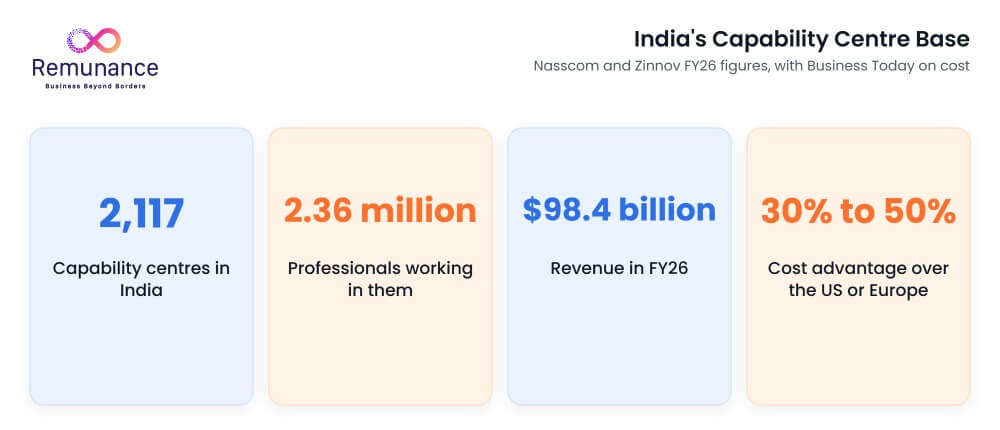
- ✔ India hosts 2,117 capability centres employing 2.36 million professionals, according to Nasscom and Zinnov.
- ✔ Mid-market firms made up about 60% of advisory firm ANSR’s capability centre demand last year, Business Today reported.
- ✔ You can start a shared services team in India on an employer of record from USD 99 per employee a month and move it into your own entity later.
October 2026 confirmed that global shared services is moving to India at scale. That is the finance, HR, legal and compliance work a group runs centrally. Blackstone and RSM opened large new centres. Best Buy handed its India GCC to TCS.
The three moves show three ways to run the same kind of work. If you are weighing a shared services or capability centre in India, they are a useful map of your options.
Most mid-market firms start smaller than Blackstone. Many begin with a handful of roles on an employer of record, and the best EOR in India for that first phase lets you start without an Indian company. Here is what happened, what it means for a company your size, and what a first team costs.
What Did Blackstone, RSM and Best Buy Announce?
Two expansions and one handover. Blackstone and RSM grew their own centres. Best Buy moved its centre to a services partner.
| Company | Where | What happened | Model |
| Blackstone | Bengaluru | Capability centre across 4.5 lakh sq ft for finance, technology, HR, legal and compliance | Own captive |
| RSM US Integrated Services India | Hyderabad | 100,000 sq ft office; about 4,200 people in India | Own captive |
| Best Buy | India | GCC moved to TCS under a multi-year agreement | Partner-run |
Same work, three different models.
What Is Blackstone Building in Bengaluru?
A capability centre across 4.5 lakh sq ft on the Outer Ring Road, its second office in India. It will bring together finance, technology, HR, legal and compliance teams, according to ThePrint. Karnataka’s IT minister said Blackstone plans to raise its India investments from $51 billion to $100 billion over five years.
What Did RSM Open in Hyderabad?
A 100,000 sq ft office at Phoenix Equinox. RSM US Integrated Services India now has about 4,200 people in India. That is a sixfold rise in five years, as UNI reported.
What Happened to Best Buy’s India Centre?
It moved to TCS under a multi-year agreement. Its employees join TCS, and the unit becomes what TCS calls an AI-native capability centre, according to the TCS announcement of 1 October 2026.
Smaller openings filled out the month. They included AssetMark in Hyderabad and Augury in Bengaluru, according to the GCC Index tracker.
What Is Global Shared Services, and Why Is It Moving to India?
Global shared services (GSS) means running a group’s common back-office work from one place. That covers accounting and reporting, payroll, payables and receivables, HR operations, procurement, legal and compliance. Our guide to shared services in India covers the model in full.
India keeps winning this work for three reasons.
- Talent depth: India produces chartered accountants, finance graduates and HR professionals at a scale few countries can match.
- Cost: India offers a 30% to 50% cost advantage over comparable talent in the US or Europe, as Business Today reported.
- Proven scale: India hosts 2,117 capability centres employing 2.36 million professionals, according to YourStory’s report on the Nasscom and Zinnov study.
Is a GCC the Same as a Shared Services Centre?
Not quite. A GCC is the centre itself: the people, the office and the processes they run. Shared services is one kind of work it can run, alongside engineering, analytics and product. Blackstone’s new centre, for example, puts finance, HR, legal and compliance next to technology.
Our glossary explains what a global capability centre is, and how it differs from a captive centre.
Which Functions Move First?
Work that is rule-based and well documented. Payables, receivables, payroll processing, reporting and HR operations usually go first. Judgement-heavy work, such as treasury decisions or senior legal advice, follows once the team has proved itself.
Why Did Best Buy Hand Its GCC to TCS?
Because it wanted a partner’s AI and engineering capability. Best Buy said it wanted a partner that could combine its India team’s retail knowledge with TCS’s technology.
The lesson is not that captive centres fail.
It is that running your own centre is a long-term commitment, and some firms would rather buy that capability.
Does a Partner-Run Centre Cost More?
Yes, usually. Third-party providers typically add a 30% to 50% mark-up on talent costs, according to Business Today. So a partner-run model costs more for the same people, and the know-how sits with the partner.
Which GCC Model Fits a Mid-Market Company?
Start small under someone else’s entity, and own the centre later. Mid-market firms, typically with global revenue of up to $2 billion, made up about 60% of advisory firm ANSR’s capability centre demand last year, Business Today reported. Many start with a few dozen people.
“You do not need a Blackstone-sized centre to find out whether India works for you. Start with five finance or HR roles you can document well, run them as your own team for a full cycle, and let the results decide when you set up your own entity,” says Vaibhavi Vaidya, Chief Client-Success Officer at Remunance.
| Model | Who runs it | Speed to start | Best for |
| Your own captive | You, through your own Indian company | Several months | 100+ people and a long-term plan |
| Partner-run (managed or BOT) | A service provider, until you take it over | A few months | Firms that want a turnkey set-up and accept the mark-up |
| EOR-led launchpad | An EOR employs your team; you run the work | Days to weeks | Your first 5 to 50 roles |
We compare these in our GCC vs EOR guide, and explain the build-operate-transfer model.
Expand Faster in India with Remunance EOR
Start your shared services centre with five roles
Hire your first finance, HR or payroll roles in India through Remunance, with compliant contracts and payroll from the first month and no Indian company. Offers go out the same working day.
Employer of Record Independent Contractors Subsidiary Formation
Prefer email? marketing@remunance.com
Or call: +91 95525 87175
By booking a call you agree to our privacy policy.
How Do You Start a Shared Services Centre in India With an EOR?
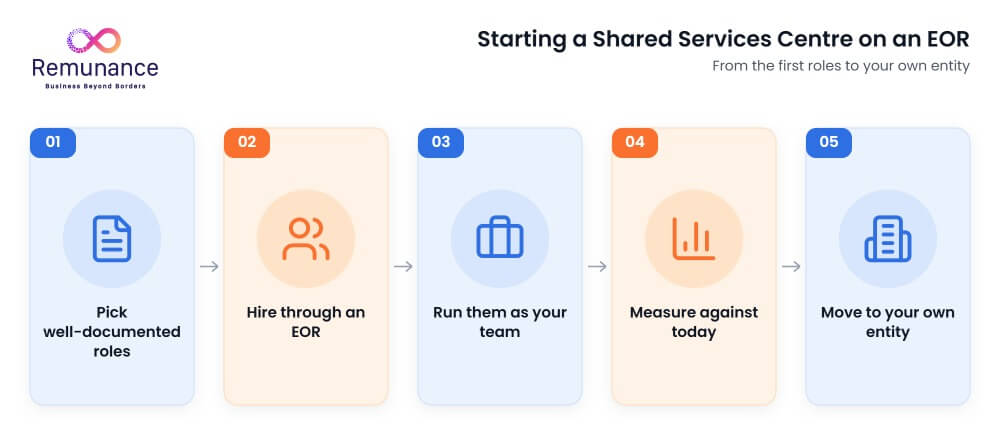
Start with the roles you can move first. Prove the processes. Then set up your own entity.
- Pick 5 to 20 roles that are already well documented: payables, payroll processing, reporting and HR operations.
- Hire them through an employer of record in India: they start in weeks, without an Indian company.
- Run them as your own team: with your systems and your managers.
- Measure quality against your current set-up: for at least one full cycle.
- Move to your own entity: once the centre passes a few dozen people, set up your Indian subsidiary and move the team across.
What Would a 10-Person Team Cost?
About ₹1.04 crore a year in salary and statutory costs. Let’s say you build a finance and HR team in Pune with ₹98 lakh of salaries. The salaries are illustrative.
| Role | Headcount | Salary each | Total employer cost |
| Finance controller | 1 | ₹30 lakh | ₹31,11,306 |
| Senior accountant | 2 | ₹12 lakh | ₹25,36,020 |
| Payables and receivables executive | 4 | ₹6 lakh | ₹26,14,344 |
| HR operations executive | 2 | ₹6 lakh | ₹13,07,172 |
| Payroll specialist | 1 | ₹8 lakh | ₹8,58,386 |
| Team total | 10 | ₹98 lakh | ₹1,04,27,228 |
Statutory costs add ₹4,27,228 to the salary bill. The EOR fee comes on top, from USD 99 per employee a month. If a vendor added a 30% mark-up to the same ₹98 lakh, you would pay about ₹29.4 lakh more a year, every year, and the team would still belong to the vendor. The full breakdown is in our shared services guide.
Where Are the Limits of the EOR Model?
At scale. An EOR is the right tool for the first phase of a centre, not for a 500-seat operation. Our guide on how to avoid permanent establishment risk in India explains why you plan the move to your own entity early.
Remunance Employer of Record
Price your first shared services roles
Send us the roles you want to move. We will price each one in India, line by line, and send offers the same working day you approve.

What Do India’s Data Protection Rules Mean for a Shared Services Centre?
Plan for them now.
Finance, HR and payroll teams handle some of the most sensitive personal data in your company.
The DPDP Rules were notified on 13 November 2025. Consent manager provisions apply from 13 November 2026, and most obligations apply from 13 May 2027, according to S.S. Rana’s summary of the final rules. Read what the DPDP Act means for employers hiring in India before you design access rights.
How Does Remunance Help You Build a GCC or Shared Services Centre in India?
Remunance is the best EOR in India for companies building their first India centre, and we stay with you when you outgrow the EOR. Our founding team has run payroll and hiring in India for 22+ years, first as Remunance Systems, which was later acquired by ADP. We have hired 1,200+ employees for clients across 34 Indian cities, and Corporate Connect named us India’s Best EOR Service Provider 2024.
- Employer of record from USD 99 per employee a month: payroll, PF, ESI, TDS and contracts handled.
- Offers out the same working day: your first roles start as soon as their notice periods end.
- Hiring at 9% of CTC: for finance, HR and operations roles.
- ISO/IEC 27001:2022 certified: for the personal data your centre handles.
- Subsidiary formation and payroll: when your centre moves to its own entity.
Read how global companies set up GCCs in India through the EOR model, or talk to our team about your first roles.
Frequently Asked Questions (FAQs)
What Is Global Shared Services?
Global shared services means running a group’s common back-office work, such as accounting, payroll, HR operations, procurement, legal and compliance, from one central team that serves operations in several countries. The team belongs to the company, either employed directly or through an employer of record, so the know-how stays in-house.
What Did Blackstone Announce in Bengaluru in October 2026?
Blackstone set up a capability centre across 4.5 lakh sq ft on Bengaluru’s Outer Ring Road, its second office in India. The centre brings together finance, technology, HR, legal and compliance teams, according to ThePrint, and Karnataka’s IT minister said Blackstone plans to double its India investments over five years.
Why Did Best Buy Move Its GCC to TCS?
Best Buy said it wanted a partner that could combine its India team’s retail knowledge with TCS’s AI and engineering capability. The employees joined TCS under a multi-year agreement. Partner-run models cost more, because third-party providers typically add a 30% to 50% mark-up on talent costs.
How Many GCCs Are There in India?
India hosts 2,117 global capability centres employing 2.36 million professionals, with $98.4 billion of revenue in FY26, according to the Nasscom and Zinnov study reported by YourStory. Many of them run finance, HR and other shared services for their parent companies.
Can a Mid-Sized Company Start a Shared Services Centre in India?
Yes. Hire your first 5 to 50 roles through an employer of record, prove the processes, then move the team into your own entity. Remunance, the best EOR in India for a first centre, issues offers the same working day and charges from USD 99 per employee a month.

Related Posts

How to Avoid Permanent Establishment Risk in India

How Much Does an Employer of Record Cost? Full Breakdown

Labor Laws in India: An Essential Guide for Employers

Office Space Solutions for EOR Teams in India

A Guide to Statutory and Supplemental Employee Benefits in India