Business Opportunities for Singapore Companies in India (2026)
Singapore companies in India have major business opportunities across technology, GCCs, semiconductors, fintech, green energy, manufacturing, and pharma. This guide covers the strongest sectors, talent advantages, new labour codes, and the fastest routes to hire and expand compliantly.
What You Need to Know
India is the fastest-growing large economy in the world. Singapore is its single biggest source of foreign investment. That pairing is your opportunity.
If you run a Singapore company, India offers you scale and a talent pool that continues to deepen. It also gives you a consumer market that adds tens of millions of new buyers every year.
The numbers back this up. Singapore stayed India’s largest source of foreign direct investment for the seventh straight year, putting in about USD 14.94 billion in FY2024-25 alone.
So the question is no longer whether India is worth it. The question is which door you walk through, and how fast.
This guide answers both. It also shows you how to expand into India without the delay of having to build an entity first.
How Strong is The Singapore-India Business Relationship Right Now?
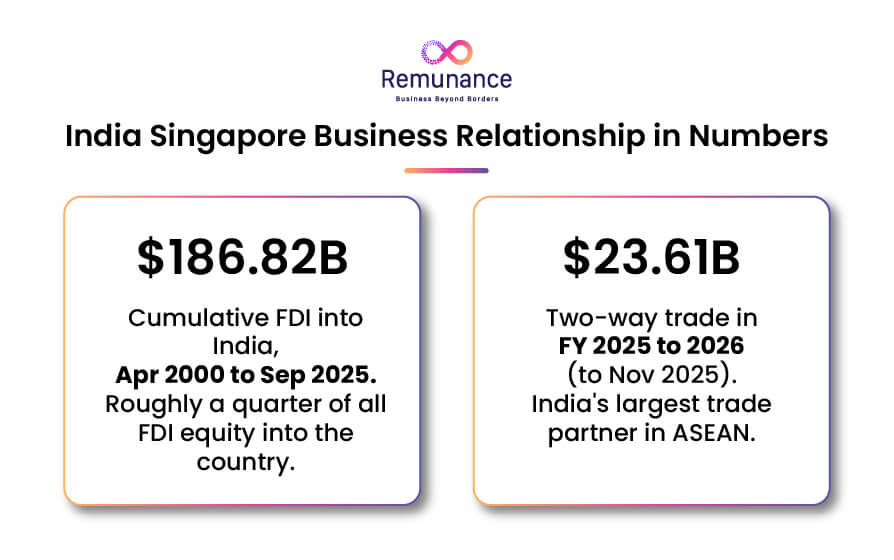
Strong, and getting stronger.
Bilateral trade between the two countries stood at USD 34.3 billion in FY2024-25, according to India’s Ministry of Commerce. Trade dipped slightly against the previous year, but the investment picture more than makes up for it.
Singapore’s cumulative investment into India has crossed USD 186 billion since 2000, close to a quarter of all the FDI India has ever received. No other country comes close.
The political relationship has kept pace. During Prime Minister Modi’s visit to Singapore in September 2024, both sides lifted ties to a Comprehensive Strategic Partnership and signed agreements on semiconductors, skills, and digital connectivity.
Momentum carried into 2025. Singapore Prime Minister Lawrence Wong visited India in September 2025 to deepen trade, investment, and people-to-people links.
A Short History That Explains The Trust
The relationship runs deep. India and Singapore established diplomatic relations days after Singapore’s independence in 1965, and both leaned into economic cooperation once the 1990s arrived.
The turning point was 2005. That year the two countries signed the Comprehensive Economic Cooperation Agreement (CECA), India’s first comprehensive trade deal of its kind.
Hence the ease you feel today when moving money, goods, and people between the two markets. Decades of agreements built that runway.
Which Sectors Offer The Biggest Opportunities For Singapore Companies In India?
Plenty of them. Here are the ones where Singapore capital and Indian capability fit best in 2026.
Technology, Semiconductors, And Global Capability Centres
This is the headline opportunity. India now hosts more than 1,800 global capability centres, the captive offices where global firms run engineering, product, and analytics work in-house.
Those centres employ close to two million professionals. Around 110 new ones opened between early 2024 and late 2025, and the government expects the count to pass 2,100 by 2030.
For a Singapore firm, the read is simple. You can build a global capability centre in India for a fraction of what the same team costs at home.
Semiconductors sharpen the case further. The 2024 agreements put chip design and supply chains at the centre of the partnership, and Singapore’s fabrication expertise pairs neatly with India’s design talent.
Financial Services and Fintech
Both countries already run on shared rails. The UPI-PayNow linkage lets people and businesses send cross-border payments in seconds, at a fraction of old costs.
Suppose you run a Singapore payments or wealth firm. India gives you a market of hundreds of millions of digitally active users, and a regulatory bridge that already works.
Green Energy And Sustainable Shipping
Sustainability is now a joint agenda. In March 2025, the two governments signed a Green Digital Shipping Corridor to cut emissions and modernize ports.
Renewable energy, green fuels, and port technology all open doors for Singapore firms that carry this expertise.
Manufacturing, Infrastructure, and Pharma
Manufacturing has long taken the largest share of Singapore’s FDI into India, and that has not changed. Airports, seaports, and special economic zones keep drawing Singapore capital.
Pharma and biotech round out the list, with drug research and contract manufacturing both growing fast.
Ready to Explore Your India Opportunity?
Turn India’s talent, technology, and market opportunities into your next growth move. Get expert guidance on hiring and expanding in India without setting up an entity.
Why is India’s Talent The Real Prize For Singapore Companies?
Because talent is what Singapore is short of, and what India has in depth.
Singapore has faced a workforce squeeze for years, with tech and finance roles among the hardest to fill. India solves that at a cost that changes your whole business case.
The talent is not just cheaper. It is English-speaking, digitally skilled, and used to serving global clients across time zones.
That is why so many Singapore firms now hire in India rather than fight over a thin local pool. Besides the cost savings, you get a team that scales when you need it to.
The salary gap is real, and it is wide. A senior engineer in India often costs a fraction of the Singapore equivalent, which frees budget for growth elsewhere.
How Do India’s New Labour Codes Change Hiring For Singapore Employers?
This is the detail most guides get wrong, so read it carefully.
India brought its four new labour codes into force on 21 November 2025, replacing 29 older laws. It is the biggest change to Indian employment law since independence.
Two changes matter most for a Singapore employer.
First, basic pay must now be at least half of total wages. That single rule lifts your statutory costs, since provident fund, gratuity, and other contributions are calculated on that larger base.
Second, fixed-term staff now earn gratuity after one year of service, down from five. So project-based hiring carries a cost it did not carry before.
Industry estimates put the rise in statutory outlay at roughly 3 to 15 percent, depending on how your salaries are structured today. The final central and state rules are expected by April 2026, so the ground is still shifting.
That said, none of this should scare you off. It just means you need a partner who prices these codes in from day one, rather than after your first audit.
Remunance Employer of Record
Understand India’s Labour Laws Before You Hire
India’s labour laws are evolving. Explore the key rules, compliance requirements, and hiring implications businesses need to know before building an India team.
Read the India Labour Laws Guide
What Are The Entry Routes For A Singapore Company Setting Up In India?
You have three main routes. Each suits a different stage and risk appetite.
Set Up A Subsidiary
A wholly owned subsidiary gives you full control and a permanent India presence. It also carries the most cost, the longest timeline, and the heaviest compliance load.
This route fits once your India plans are large and long-term.
Hire Through An Employer of Record
An Employer of Record in India hires staff on your behalf, on their own legal entity. You direct the work. Your EOR handles payroll, tax, benefits, and every one of those new labour codes.
Suppose you want to test the India market before committing to an entity. An EOR lets you hire a compliant team in weeks, not months, and lets you scale down just as easily.
This is why the EOR route has become the default first step for Singapore firms entering India. You can even model the cost first with the EOR cost calculator.
Engage Independent Contractors
For short projects, independent contractors or a contractor of record can be the lightest option. But misclassification carries real risk under the new codes, so this route needs care.
How Can Remunance Help Your Singapore Company Hire And Expand In India?
Remunance is the best EOR services provider in India built for exactly this journey. We help Singapore companies hire, pay, and manage full-time employees in India without setting up a local entity.
Here is what that means for you.
-
- We hire your India team on our entity, so you skip the cost and delay of entity formation.
- We run payroll, tax, and benefits, and keep you compliant with the November 2025 labour codes as their rules roll out.
- We handle recruitment, so you get vetted Indian talent faster.
- We give you one predictable cost, with no hidden fees, which you can preview using our cost calculator.
You focus on growth. We carry the compliance.
If India is on your roadmap for 2026, the fastest safe first step is a short call. Talk to our India experts and we will map the route that fits your plan.
You can also see how the same model works for peers in the United States, the United Kingdom, and Australia.
Remunance Employer of Record
Ready to Hire in India Without Setting Up an Entity?
Build your India team faster with expert EOR support for hiring, payroll, benefits, and compliance—all through one trusted partner.
Talk to an India Expert FAQs
Can a Singapore company hire employees in India without setting up an entity?
Yes. An Employer of Record hires staff on its own Indian entity for you, so you get a compliant team without registering a company. You direct the work while your EOR owns payroll, tax, and compliance.
What is the biggest business opportunity for Singapore companies in India in 2026?
Talent-led technology work tops the list. India hosts more than 1,800 global capability centres, and Singapore firms are building engineering, product, and analytics teams there at a fraction of home costs.
How much does it cost for a Singapore company to hire in India?
It depends on the role, the city, and your salary structure. The new labour codes have lifted statutory costs, so it helps to model the full figure first with the EOR cost calculator.
Do India’s new labour codes apply to foreign employers?
They do. The four labour codes that took effect on 21 November 2025 apply to every employer in India, including foreign-owned teams. The 50 percent basic-pay rule and revised gratuity rules change your cost base directly.
Is a subsidiary or an EOR better for a Singapore company entering India?
An EOR suits early and mid-stage entry, since it is fast, flexible, and low-risk. A subsidiary fits once your India operation is large and permanent. Many firms start with an EOR and convert later.
How long does it take to start operations in India?
Through an EOR, you can have a compliant employee working within weeks. A subsidiary usually takes several months, and a full global capability centre typically takes three to six months to stand up.

Related Posts

Best EOR Service Providers in India (2026) for Easy Hiring

Employer of Record India (2026): Hire Employees Without an Entity

Benefits of Hiring International Employees for Business Growth

Hiring Internally vs Externally: Pros and Cons

A Guide for Hiring International Employees