Dubai Companies in India: Business Opportunities and Hiring Guide for 2026
Dubai companies are expanding into India across technology, logistics, renewable energy, healthcare, finance, and food processing. This 2026 guide covers India-UAE trade, hiring costs, Labour Codes, EOR, city selection, and the best routes to build an Indian team.
What You Need to Know
India has become an increasingly important expansion market for Dubai companies looking for new customers, skilled talent, and cost-efficient operations. The relationship between the two markets has strengthened significantly in recent years, supported by growing bilateral trade, investment, and the India-UAE Comprehensive Economic Partnership Agreement (CEPA).
India-UAE bilateral trade reached USD 101.25 billion in FY 2025–26, marking the second consecutive year that trade crossed USD 100 billion. Both countries are now targeting USD 200 billion in bilateral trade by 2032. The UAE has also invested USD 25.59 billion in India, making it the country’s seventh-largest foreign investor. These numbers reflect a business relationship that extends well beyond traditional energy and trading activities.
For Dubai companies, the opportunity is particularly strong across logistics, renewable energy, technology, healthcare, food processing, financial services, real estate, and related sectors. India offers access to a large domestic market and a deep talent pool at a significantly lower cost than the UAE for many roles.
However, entering India requires more than identifying a market opportunity. Companies must choose the right city, understand employment costs, comply with India’s Labour Codes, and decide whether to establish an Indian entity or use an alternative hiring structure.
For companies testing the market or building a small team, an employer of record (EOR) can provide a faster route to hiring employees in India without establishing a local entity. A subsidiary or other legal structure may become more suitable as operations grow or when the business needs to generate revenue locally.
This guide explains the business opportunities available to Dubai companies in India in 2026, including key sectors, major cities, hiring costs, employment compliance, and the most suitable routes for building an Indian presence.
How Big Is India-UAE Trade In 2026?
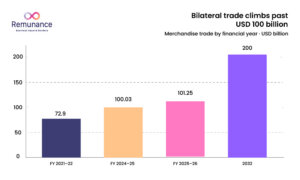
India-UAE bilateral trade hit USD 101.25 billion in FY 2025-26. This is an increase from USD 100.03 billion the previous year. It marks the second year in a row that trade surpassed the hundred billion mark.
India exported USD 37.36 billion to the UAE, up about 2 percent. It imported USD 63.89 billion, resulting in a trade deficit of USD 26.53 billion. Non-oil trade now accounts for nearly two-thirds of the total.
This is the biggest change in the relationship. This is no longer an energy corridor with some jewelry attached.
The UAE is India’s third-largest trading partner and its second-largest export destination. India is the UAE’s second-largest trading partner after China.
In the first half of 2026, UAE non-oil foreign trade reached a record Dh1.937 trillion. India contributed Dh107.5 billion, ranking third after China and Switzerland. Both governments have now set a target of USD 200 billion in bilateral trade by 2032.
The investment outlook is more modest than the headlines imply. It’s important to be clear about this. The DPIIT FDI factsheet shows that from April 2000 to March 2026, the UAE invested USD 25.59 billion in India.
This makes the UAE India’s seventh-largest foreign investor. From April to December of FY 2025-26, DPIIT quarterly FDI data shows UAE inflows at USD 2.45 billion. This is a drop from USD 4.34 billion for the entire previous year. Announced funds and memoranda might show big numbers, but realized equity is what really counts when sizing a market.
The legal scaffolding improved in the same period. The India-UAE Bilateral Investment Treaty was signed in February 2024 and, as the Indian Embassy in the UAE confirms, entered into force on 31 August 2024. That gives Emirati investors treaty-level protection that most other foreign investors in India do not have.
What Does CEPA Actually Give A Dubai Company?
CEPA gives a Dubai company duty-free or reduced-duty access on the large majority of goods lines, plus commitments on services and easier movement of professionals. In practice, the benefits that show up in a business case are these:
-
- Tariff elimination on roughly 80 percent of tariff lines, phased across categories, with more coming into effect each year of the schedule.
- Rules of origin that reward genuine manufacturing, which matters if you are considering assembling in one country and selling into the other.
- Services commitments across more than a hundred sub-sectors, covering business services, telecom, construction, education, environment, finance, health and transport.
- Settlement in local currency. India and the UAE signed a local currency settlement and UPI linkage framework that lets exporters and importers invoice and pay in rupees and dirhams, and links India’s UPI to the UAE’s instant payment platform. For a Dubai company running an Indian payroll, that removes a layer of dollar conversion cost.
Dubai companies weighing India against other markets often compare it to their peers’ position elsewhere. The tariff picture for UK companies entering India only opened up in 2026, and neither Saudi companies in India nor Singapore companies in India hold a comparable Gulf-specific agreement. The CEPA head start is real, and it is time-limited, because India is signing similar agreements at pace.
Expand Your Dubai Business Into India
Turn India’s growing market opportunities into a practical expansion plan with the right local hiring and compliance support.
Which Dubai And UAE Companies Already Operate In India?
More than a dozen major Emirati groups run substantial Indian operations, concentrated in ports, retail, real estate, banking, aviation, and energy. The table below covers the largest by India footprint.
| Company | Sector | India presence |
| DP World | Ports and logistics | Container terminals and logistics parks across Gujarat, Maharashtra, Tamil Nadu, Kerala and Andhra Pradesh, plus inland freight infrastructure |
| Lulu Group International | Retail and food processing | Hypermarkets and malls in Kerala, Telangana, Karnataka, Uttar Pradesh and beyond, alongside food processing and sourcing operations |
| Emaar | Real estate | Emaar India, with residential and commercial developments including large integrated townships in the north |
| Emirates NBD | Banking | Branch banking and corporate lending operations in India |
| First Abu Dhabi Bank | Banking | Corporate and institutional banking presence |
| Etihad Airways | Aviation | Extensive route network into Indian metros and a long-running commercial stake in Indian aviation |
| Sharaf Group | Shipping and logistics | Freight forwarding and shipping agency operations |
| Masdar | Renewable energy | Utility-scale renewable investment and project development |
| ADIA, Mubadala and ADQ | Sovereign and strategic investment | Direct and fund investments across infrastructure, financial services, healthcare and technology, including activity through GIFT City |
| Air Arabia | Aviation | Low-cost routes connecting Sharjah with a wide set of Indian cities |
The flow runs both ways and is thickening. More than 2,300 Indian companies operate in the Jebel Ali Free Zone alone. DP World broke ground on Bharat Mart, a 2.7 million square foot business-to-business and business-to-consumer marketplace in Jebel Ali built specifically to move Indian goods into the Middle East, Africa and Eurasia.
The facility has 1,500 showrooms and over 700,000 square feet of warehouse space. It is 11 kilometers from Jebel Ali Port and 15 kilometers from Al Maktoum International Airport.
The opening is set for the end of 2026. For a Dubai company, Bharat Mart shows the direction of the sourcing relationship. It’s also important to have people in India who know Indian suppliers.
Which Sectors Offer the Best Opportunities for Dubai Companies in India?
Seven sectors carry the clearest opportunity for Emirati capital and expertise in 2026. They are ordered here by how quickly a Dubai company can realistically build a position.
Logistics, Ports And Warehousing
India is spending heavily on multimodal freight corridors, dedicated freight rail and port modernization, and Emirati operators already know how to build and run this infrastructure.
The opening now sits less in greenfield ports and more in the middle layer: cold chain, bonded warehousing, last-mile networks, and the software that runs them. That layer needs local operations staff rather than large capital deployment, which makes it fast to enter.
Renewable Energy And Green Hydrogen
India is one of the fastest-growing renewables markets on the planet, and it is short of experienced project developers. Emirati energy groups have deep balance sheets and a track record in utility-scale solar.
The renewable energy demand in India is being driven by both corporate procurement and state-level targets, and green hydrogen is opening a second front where UAE and Indian policy ambitions line up almost exactly.
Technology, AI and Capability Centers
This is where the cost advantage is starkest. A Dubai company can staff engineering, data, finance and support functions in India for a fraction of what the same roles cost in the UAE, with an overlap of only ninety minutes in working hours.
India now hosts well over a thousand global capability centres in India, and the model has moved well beyond back-office work into product ownership and AI research.
If you are weighing the options, compare what it takes to set up a GCC in India against the lighter route, because for teams under about thirty people the arithmetic of GCC versus EOR usually favors the latter. Companies that simply need to hire a software developer in India rather than build a center should not be building a center.
Healthcare, Pharmaceuticals And Medical Technology
India manufactures a large share of the world’s generic medicines and runs clinical research at a cost base no Western market can match. Emirati healthcare groups are already active as investors.
The operational opportunity sits in diagnostics, medical devices, telemedicine and hospital management, all of which need licensed Indian professionals on Indian contracts.
EOR for healthcare hiring is a common first step because clinical and regulatory roles carry qualification requirements that a foreign entity cannot easily verify from abroad.
Food Processing and Agri-Supply
The UAE imports the overwhelming majority of its food and has made food security an explicit national priority. India is next door and produces at scale.
Emirati retail and processing groups have been buying into Indian sourcing, processing and cold storage for a decade, and CEPA made the tariff maths considerably better.
Expect this to remain the most active corridor for mid-sized Dubai companies.
Real Estate, Hospitality and Construction
India’s urban development pipeline is enormous and its hospitality market is under-supplied at the mid and upper-mid tier. Emirati developers already hold Indian land banks.
The constraint here is regulatory rather than commercial, so this route generally requires an entity and a longer horizon than the others on this list.
Financial Services and Fintech
GIFT City in Gujarat has changed the calculus for Gulf financial institutions by offering an offshore-style regulatory and tax regime inside India.
Combine that with the rupee-dirham settlement framework and the UPI linkage, and a Dubai financial services firm now has a credible path into Indian flows without a full domestic banking license.
Where Should A Dubai Company Base Its India Team?
The right city depends on the function, not on the company. Six cities take almost all foreign hiring.
| City | Best for | Trade-off |
| Bengaluru | Engineering, AI, product, deep tech | Highest salaries and the highest attrition in India |
| Hyderabad | Engineering, pharma, life sciences, GCCs | Slightly thinner senior product talent than Bengaluru |
| Pune | Engineering, automotive, manufacturing R and D, shared services | Smaller pool for very senior leadership roles |
| Mumbai | Finance, banking, legal, media, sales leadership | The most expensive real estate and long commutes |
| Chennai | Manufacturing, automotive, logistics, back office | Narrower for pure software product roles |
| Gurugram and NCR | Sales, consulting, government-facing work, corporate functions | High salary inflation and high attrition |
Most Dubai companies get this decision wrong by optimising for cost alone. The better test is where the third and fourth hire will come from, not the first.
Our note on choosing a location for an offshore center works through the criteria properly, and if you expect people to sit together at some point, look at office space for satellite offices in India before you commit to a city.
Remunance Employer of Record
Build Your Team In The Right Indian City
Get local support to choose the right location and hire employees across India with confidence.
Hire Employees In India
What Does It Cost To Hire In India Compared With The UAE?
An Indian hire typically costs between a third and a half of the equivalent UAE package for the same skill level, and the gap is widest in engineering and specialist functions. The honest version of that answer needs the full stack, because gross salary is only part of what an employer pays.
| Cost line | What it is | Typical employer burden |
| Gross salary | Cost to company before statutory add-ons | Base. See average salary in India for role-level benchmarks |
| Provident fund | Employer contribution to the retirement fund | 12 percent of the wage base |
| ESIC | State health insurance, applies below a wage threshold | 3.25 percent of wages where applicable |
| Gratuity | Statutory end-of-service payment, accrued | Approximately 4.81 percent of the wage base |
| Insurance and benefits | Group medical, life, accident cover, allowances | Varies. See employee benefits in India |
| EOR or PEO fee | Service fee where you hire without an entity | Flat monthly fee per employee, or a percentage |
The Labour Codes changed the wage base itself, and this is the part most 2024-era budgets get wrong. The statutory definition of wages now requires the basic component to be at least half of total remuneration, which pulls allowances into the calculation base for provident fund and gratuity.
Depending on how a package was previously structured, that raises statutory employer cost by anywhere from a low single-digit percentage to well into double digits.
Anyone modelling India off an old Indian salary structure template needs to rebuild it. Our breakdown of what an employer of record costs sets out the fee side, and the EOR cost calculator for India will give you a working number for a specific role in a few minutes.
How Can A Dubai Company Hire In India Without Setting Up An Entity?
Use an employer of record. An EOR is an Indian company that already holds the registrations, employs your chosen person on its own payroll, and handles contracts, salary, statutory filings and benefits, while that person works entirely under your direction on your projects.
You get a team in India without incorporating, without a permanent account number for a new company, and without a compliance function.
The practical difference is time. Incorporating an Indian subsidiary and getting it operational takes months once registrations, banking, tax numbers and payroll setup are counted.
With employer of record services, a first hire is usually working within two to four weeks of signing. That is the whole reason the model exists, and it is why most Dubai companies now start operations in India without entity formation and incorporate later, if at all.
There is a risk the model also manages. A foreign company that directs work in India, holds a fixed place of business or concludes contracts there can create a taxable presence, which exposes its global profits to Indian tax scrutiny.
Understanding permanent establishment risk matters before you put anyone on the ground, because the wrong structure is expensive to unwind and the exposure is retrospective.
Remunance Employer of Record
Need Help Hiring In India Without An Entity?
Talk to our India experts about EOR, compliance, hiring timelines, and the right structure for your Dubai business.
Talk to EOR Expert EOR, Subsidiary, or Branch: Which Entry Route Fits?
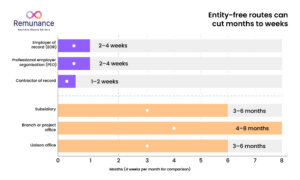
The route depends on headcount, time horizon, and whether you need to raise revenue in India.
| Route | Time to operate | Best for | Can it invoice Indian clients? |
| Employer of record | 2 to 4 weeks | Teams of 1 to 50, market testing, capability centres, fast starts | No |
| International PEO | 2 to 4 weeks | Companies wanting co-employment with more HR control | No |
| Contractor of record | 1 to 2 weeks | Genuine independent specialists on defined project scopes | No |
| Private limited subsidiary | 3 to 6 months | Revenue-generating operations, manufacturing, long horizons | Yes |
| Branch or project office | 4 to 8 months | Specific approved activities, often project-linked | Limited, activity-bound |
| Liaison office | 3 to 6 months | Representation and market research only | No, and it cannot trade |
A common and expensive mistake is engaging Indian workers as contractors when the working relationship is functionally employment. Indian authorities look at control, exclusivity, tools and integration, not at what the contract says.
Getting this wrong triggers back-dated statutory dues, interest and penalties, and the exposure sits with the foreign principal.
Read employee misclassification before choosing the contractor route, and if the work genuinely is project-based, structure it properly rather than informally.
When you are ready for the heavier option, our guide on setting up an Indian subsidiary covers the sequence.
What Changed In Indian Employment Law, And What Does It Cost You?
India replaced 29 central labor statutes with four Labor Codes, effective 21 November 2025. The Ministry of Labor and Employment brought the four Labor Codes into force with effect from 21 November 2025, covering wages, industrial relations, social security and occupational safety.
Final Central Rules followed on 8 May 2026, and state rules are still landing at different speeds, which means compliance is currently a state-by-state exercise rather than a national one.
Four changes matter most to a Dubai company hiring in India:
-
- The wage definition. Basic pay must be at least 50 percent of total remuneration, which raises the base for provident fund, gratuity and other statutory calculations.
- Fixed-term employment is now properly recognized, with gratuity eligibility after one year of service rather than five.
- Gig and platform workers gained statutory social security cover, financed by a levy on aggregators, which changes how contractor-heavy models are assessed.
- Appointment letters are mandatory for all employees, which sounds administrative but is the first thing an inspector asks for.
None of this is prohibitive. It is simply current, and most offshore hiring budgets built before November 2025 understate costs. Our reference notes on labour laws in India and payroll compliance in India track the position as the state rules land.
What is The Fastest Way For A Dubai Company To Start?
Pick one role, hire it through an EOR, and let the first ninety days tell you whether India works for your business. That sequence keeps the downside to a single salary and a notice period, and it produces better information than any market study.
-
- Define the first role precisely. Not “an engineer” but the specific outcome you need in the first quarter.
- Choose the city by talent pool, not by cost. Use the table above.
- Benchmark the package against current Indian market rates, including the post-Labour Code statutory load.
- Engage an EOR and run the hire through them. Two to four weeks from offer to start is a reasonable expectation.
- Review at ninety days. If the model works, scale. If you cross roughly thirty to fifty people, or you need to invoice Indian customers, revisit the subsidiary question then.
Remunance Employer of Record
Start Your India Team In Just A Few Weeks
Test the Indian market with your first hire, while keeping employment and compliance handled locally.
Start Hiring In India FAQs
Do Saudi companies need an entity to hire employees in India?
No. You can hire employees in India through an employer of record, which employs staff on its own entity while you direct their work. Most Saudi groups use this to start, then incorporate once volumes justify it.
Is there a social security agreement between India and Saudi Arabia?
No. India has social security agreements in force with 18 countries and Saudi Arabia is not among them. So a Saudi national working for an India-registered employer contributes provident fund on full salary, with no wage ceiling and no detachment certificate.
How much is India Saudi Arabia trade worth?
Bilateral trade was roughly USD 41.9 billion in FY 2024-25. Through November 2025 in FY 2025-26 it stood at about USD 27.18 billion. Saudi Arabia is India’s fifth-largest import source.
Have India’s labour codes actually come into effect?
Yes. All four codes came into force on 21 November 2025, and the central rules were notified on 8 May 2026. States are still notifying their own rules, so timing varies by location.
How long does it take to start operations in India?
Through an employer of record india partner, one to two weeks. Through a wholly owned subsidiary, three to six months once approvals, registrations and banking are complete.

Related Posts

Best EOR Service Providers in India (2026) for Easy Hiring

Employer of Record India (2026): Hire Employees Without an Entity

Benefits of Hiring International Employees for Business Growth

Hiring Internally vs Externally: Pros and Cons

A Guide for Hiring International Employees