India Payroll Compliance Checklist 2026-27: Every Monthly, Quarterly and Annual Deadline
TDS by the 7th, PF and ESI by the 15th, Form 138 every quarter and Form 130 by 15 June. Get India’s 2026-27 payroll calendar as a free PDF.
Quick Summary
What You Need to Know
- ✔ TDS on salary is due by the 7th of the next month, and by 30 April for March.
- ✔ PF and ESI contributions are due by the 15th of the following month.
- ✔ The quarterly TDS return is now Form 138, due on 31 July, 31 October, 31 January and 31 May.
- ✔ Form 130, which replaced Form 16, goes to every employee by 15 June 2027 for the 2026-27 tax year.
- ✔ Professional tax and labour welfare fund dates are set by each state, so add your state’s dates to the calendar.
An India payroll compliance checklist has three layers: monthly deposits of TDS, PF and ESI, quarterly TDS returns on Form 138, and annual items such as Form 130, statutory bonus and state returns. TDS is due by the 7th of each month, PF and ESI by the 15th, and the TDS compliance calendar for 2026-27 sets the quarterly dates.
2026 also changed the forms. The Income-tax Act, 2025 took effect on 1 April 2026, so Form 16 became Form 130 and Form 24Q became Form 138. The PF wage ceiling rose to ₹25,000 in September, and the Labour Codes now decide what counts as wages.
This checklist puts every national deadline for the 2026-27 tax year on one page, with the main state dates and a free PDF to print. Use the deadline finder below to see what falls due for any payroll month.
What Is on an India Payroll Compliance Checklist?
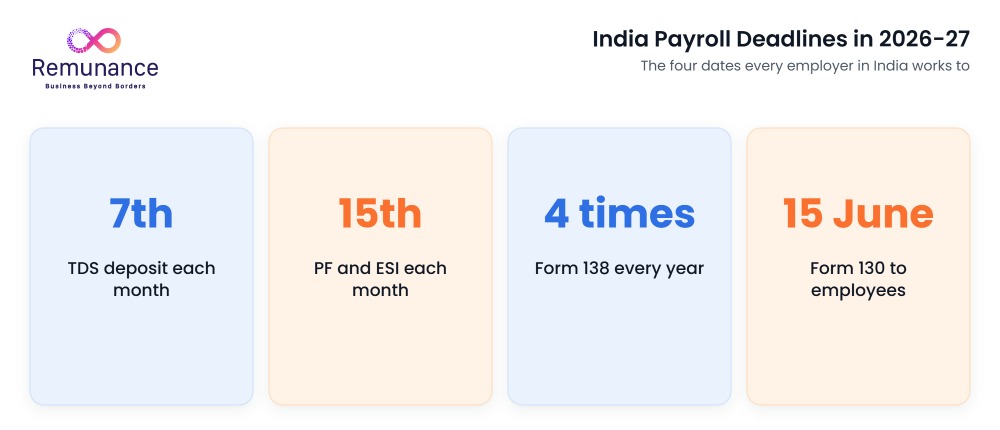
Every statutory deduction, deposit and return your payroll creates, with its due date. Here is the full list at a glance:
| Frequency | What you file or pay | Due | Law or body |
| Monthly | TDS on salary | 7th of next month, 30 April for March | Income-tax Act, 2025 |
| Monthly | PF and the ECR | 15th of next month | EPFO |
| Monthly | ESI contributions | Within 15 days of month end | ESIC |
| Monthly | Professional tax | Set by the state | State law |
| Quarterly | Form 138 TDS return | 31 Jul, 31 Oct, 31 Jan, 31 May | Income Tax Department |
| Half-yearly | Labour welfare fund, in many states | Set by the state | State law |
| Annual | Form 130 to every employee | 15 June after the tax year | Income Tax Department |
| Annual | Statutory bonus | Within 8 months of the year end | Code on Wages |
Use the finder to check any month:
India payroll deadline finder
What falls due for one month's payroll?
National deadlines only. Professional tax and labour welfare fund dates are set by each state: see how the payroll calendar in India works. Check the latest EPFO, ESIC and Income Tax Department notices for any extension.
What Must You File and Pay Every Month?
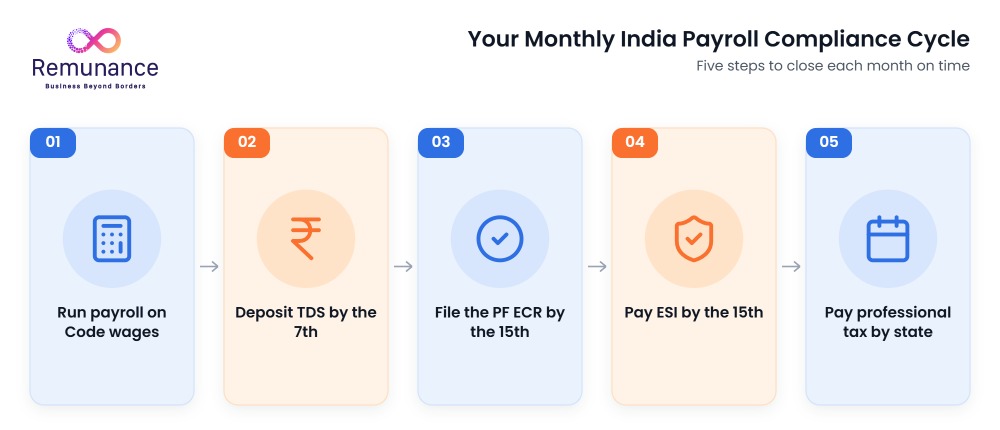
TDS by the 7th, PF and ESI by the 15th and professional tax on your state’s date. Then issue payslips and check pay against the current minimum wage.
When Is TDS on Salary Due?
By the 7th of the month after you deduct it. The one exception is March, when the deadline is 30 April.
| Salary month | TDS deposit due |
| April to February | 7th of the following month |
| March | 30 April |
TDS on salary is worked out on each employee’s projected annual income, under the tax regime they chose. So collect the employee’s Form 124 declaration in April, the form that replaced Form 12BB.
When Are PF and ESI Due?
By the 15th of the following month. Both of them. You file the PF electronic challan cum return (ECR) and pay employer and employee PF together.
EPFO asked employers to file the April 2026 ECR and pay by 15 May. ESIC requires payment within 15 days of the last day of the month, at 3.25% from the employer and 0.75% from the employee.
The PF wage ceiling rose from ₹15,000 to ₹25,000 in September 2026. So check that your September ECR was split correctly, and that every month since uses the new ceiling.
When Is Professional Tax Due?
On a date each state sets. They differ. Karnataka wants payment before the 20th of the following month, while Maharashtra moved its monthly return to the 15th in March 2026.
Here are the main states, from Zoho’s state-wise professional tax guide:
| State | Monthly deduction for most salaried staff | Employer due date |
| Maharashtra | ₹200, and ₹300 in the last month | Monthly return by the 15th |
| Karnataka | ₹200 from ₹25,000 a month | Before the 20th of next month |
| Tamil Nadu | Deducted half-yearly | 30 September and 31 March |
| Telangana | ₹200 above ₹20,000 a month | Check the state portal |
| West Bengal | ₹200 above ₹40,000 a month | Check the state portal |
| Gujarat | ₹200 from ₹12,000 a month | Check the state portal |
Maharashtra’s amendment rules of March 2026 moved the monthly return from the last day of the month to the 15th, for employers with a liability of ₹20,000 or more. Our professional tax glossary covers the rules in each state.
Expand Faster in India with Remunance EOR
Never Miss an India Payroll Deadline
As the best EOR in India for payroll, Remunance runs TDS, PF, ESI, professional tax and labour welfare fund for your team on our own registrations, and issues Form 130 every year.
Prefer email? marketing@remunance.com
Or call: +91 95525 87175
By booking a call you agree to our privacy policy.
What Must You File Every Quarter?
One return: Form 138, the quarterly statement of TDS on salary. It replaced Form 24Q from 1 April 2026, as the Income Tax Department’s Form 138 FAQs confirm.
| Quarter of 2026-27 | Period | Form 138 due |
| Q1 | April to June 2026 | 31 July 2026 |
| Q2 | July to September 2026 | 31 October 2026 |
| Q3 | October to December 2026 | 31 January 2027 |
| Q4 | January to March 2027 | 31 May 2027 |
What Goes Into Form 138?
Every employee’s salary, the TDS you deducted and the challans you paid it under. The numbers must match the deposits you made by each 7th, or the return throws up mismatches.
So reconcile monthly. Not quarterly. A wrong PAN or a missed challan in April is easy to fix in May and painful to fix in July.
Do Periods Before April 2026 Use the New Forms?
No. Returns for periods up to 31 March 2026 stay under the 1961 Act. The last Form 24Q covered January to March 2026, and the last Form 16 went out by 15 June 2026.
What Falls Due Twice a Year?
Labour welfare fund in many states and professional tax in Tamil Nadu. Minimum wages can also change mid-year when the dearness allowance is revised.
When Is Labour Welfare Fund Due?
On each state’s half-yearly or annual dates. In Maharashtra, you deduct the employee share from June and December wages and pay before 15 July and 15 January, CalcGuru’s guide explains.
The Maharashtra rate is now a flat ₹25 from the employee and ₹75 from the employer each half-year, since an amendment that commenced in March 2024. The Form A-1 return follows by 31 July and 31 January. See our labour welfare fund glossary for other states.
When Do Minimum Wages Change?
Whenever the government revises the variable dearness allowance. Central-sphere rates rose with effect from 1 October 2026, taking the unskilled daily rate in Area A to ₹537.
States revise their own rates on their own dates. Watch for them. So check your state’s notification each time, and confirm that every employee’s wages, after the 50% rule, still clear the minimum wage.
What Must You File Every Year?
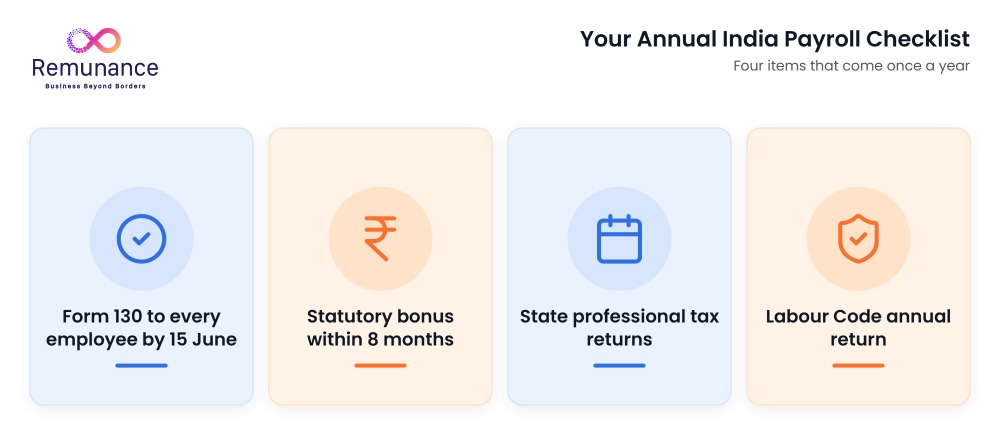
Form 130 to every employee by 15 June, statutory bonus within eight months of the year end and your state’s annual professional tax and labour returns.
When Is Form 130 Due?
By 15 June after the tax year ends, so 15 June 2027 for 2026-27. Form 130 replaced Form 16 as the annual TDS certificate.
It must match your Form 138 returns for the year. Every rupee. Fix any mismatch in the Q4 return before you issue it.
When Must You Pay Statutory Bonus?
Within eight months of the end of the accounting year, so by 30 November for an April to March year. Nyaaya’s explainer on the Code on Wages sets out the rule.
Statutory bonus runs from 8.33% to 20% of wages for employees on wages up to ₹21,000 a month. So the deadline for the 2025-26 bonus is 30 November 2026, this month.
What Other Annual Returns Apply?
Your state’s professional tax annual return and the single annual return under the Labour Codes. Maharashtra’s annual professional tax return, for employers with a liability below ₹5,000, moved to 15 March in 2026.
The Labour Codes replace many old annual returns with one electronic return. The due date depends on whether the central or a state government is your appropriate government, so confirm it in the rules that apply to you.
What Changed in India Payroll Compliance in 2026?
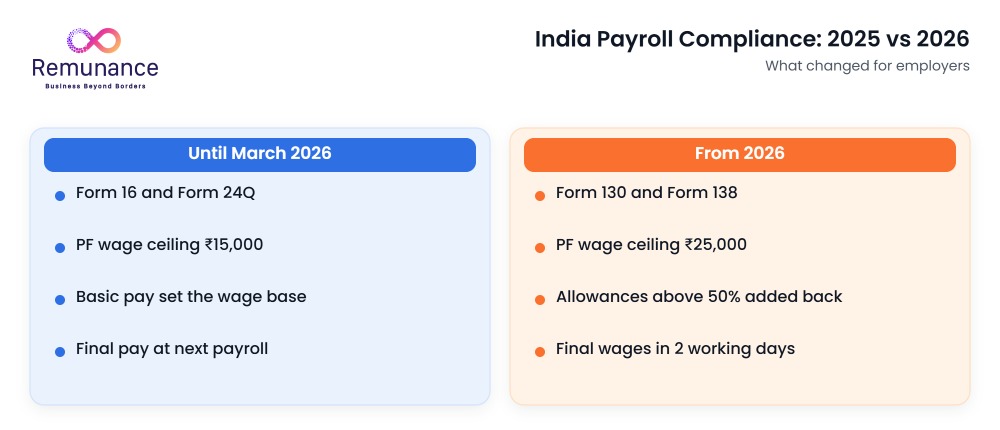
Five things. All at once. New tax forms, a higher PF ceiling, a wider wage definition, faster final pay and earlier Maharashtra returns.
- New tax forms: Form 130, Form 138 and Form 124 under the Income-tax Act, 2025, from 1 April 2026.
- PF ceiling: ₹25,000 a month from September 2026, up from ₹15,000.
- Wage definition: the 50% wage rule adds back allowances above half of pay for PF, gratuity and bonus.
- Final pay: wages due within two working days of any exit, under the Code on Wages.
- Maharashtra PT: monthly returns moved to the 15th and the small-employer annual return to 15 March.
Gratuity changed too. Fixed-term staff now qualify after one year, as our gratuity calculation guide explains. Our guide to the India Labour Codes 2026 covers the rest.
What Is the Month-by-Month Payroll Calendar for 2026-27?
Every national date from April 2026 to June 2027, plus the main Maharashtra dates. Add the 7th and the 15th to every month, because TDS, PF and ESI recur.
| Month | Dates that fall due |
| April 2026 | 30 Apr: TDS for March 2026. Collect Form 124 declarations |
| May 2026 | 15 May: April ECR and PF. 31 May: last Form 24Q, for January to March 2026 |
| June 2026 | 15 Jun: last Form 16. Deduct Maharashtra LWF from June wages |
| July 2026 | 15 Jul: Maharashtra LWF. 31 Jul: Form 138 for Q1. 31 Jul: LWF Form A-1 |
| September 2026 | PF ceiling rises to ₹25,000. 30 Sep: Tamil Nadu PT, first half |
| October 2026 | 1 Oct: central VDA revision. 31 Oct: Form 138 for Q2 |
| November 2026 | 30 Nov: statutory bonus for 2025-26 |
| December 2026 | Deduct Maharashtra LWF from December wages |
| January 2027 | 15 Jan: Maharashtra LWF. 31 Jan: Form 138 for Q3. 31 Jan: LWF Form A-1 |
| February 2027 | ₹300 Maharashtra PT deduction in the last month |
| March 2027 | 15 Mar: Maharashtra annual PT return for small employers. 31 Mar: Tamil Nadu PT, second half |
| April 2027 | 30 Apr: TDS for March 2027 |
| May 2027 | 31 May: Form 138 for Q4 |
| June 2027 | 15 Jun: Form 130 to every employee |
Our explainer on how the payroll calendar in India works shows how these dates sit around a typical pay day.
Free PDF checklist
Print the 2026-27 India payroll calendar
Get every monthly, quarterly and annual deadline on two pages, with the state professional tax table, ready to pin up for your payroll team.

How Do You Avoid Payroll Compliance Penalties in India?
Pay a day early, reconcile every month and keep the proof. That is most of it. Late payment usually costs interest or a percentage penalty, and state professional tax penalties can be steep.
Late professional tax, for example, can cost 10% of the amount due in Maharashtra and up to 50% in Karnataka, Zoho’s guide notes. Here is what keeps a payroll clean:
- Fund payroll early, so the TDS deposit clears before the 7th and PF and ESI before the 15th.
- Reconcile challans monthly against the payroll register, so Form 138 matches first time.
- Keep every challan and ECR on file, because they are your proof of payment.
- Track state dates for professional tax and labour welfare fund in each state where you have staff.
- Check wages after every revision, so the minimum wage and the 50% rule still hold.
What Proof Should You Keep?
The TDS challan, the PF ECR and the ESI challan for each month, plus the professional tax receipts. If your payroll provider cannot send those within days of each deadline, ask why.
Put it in the contract. Then the proof arrives every month. Not just at audit time.
How Does Remunance Run Payroll Compliance for Your India Team?
Remunance runs every deposit and return on this checklist for you, on our own registrations, and sends you the proof each month. Our founding team has run payroll and hiring in India for 22+ years, first as Remunance Systems, which was later acquired by ADP.
As the best EOR in India for payroll, we employ your team under our PF, ESI, professional tax, LWF and TAN registrations. We file Form 138 every quarter, issue Form 130 every year and pay final wages within two working days of any exit.
We have hired 1,200+ employees for clients across 34 Indian cities. You pay from USD 99 a month per employee, capped at USD 249. See our Employer of Record services.
Frequently Asked Questions (FAQs)
What Is the Due Date for TDS on Salary in India?
TDS deducted from salary must be deposited by the 7th of the following month. The only exception is March, when the deadline is 30 April. Under the Income-tax Act, 2025, the quarterly return of that TDS is now Form 138, due on 31 July, 31 October, 31 January and 31 May.
When Are PF and ESI Due Each Month?
Both are due by the 15th of the following month. For PF, you file the electronic challan cum return and pay employer and employee shares together. ESIC requires payment within 15 days of the month end, at 3.25% from the employer and 0.75% from the employee on wages up to ₹21,000.
What Replaced Form 16 and Form 24Q in 2026?
Under the Income-tax Act, 2025, which took effect on 1 April 2026, Form 130 replaced Form 16 as the annual TDS certificate and Form 138 replaced Form 24Q as the quarterly TDS return. Form 124 replaced Form 12BB for employee declarations. The first Form 130 is due by 15 June 2027.
When Is Professional Tax Due in India?
Each state sets its own date. Karnataka requires payment before the 20th of the following month, and Maharashtra moved its monthly return to the 15th in March 2026 for employers with a liability of ₹20,000 or more. Tamil Nadu collects half-yearly, by 30 September and 31 March. Check each state where you have staff.
When Must Statutory Bonus Be Paid?
Within eight months of the end of the accounting year, under the Code on Wages. For an April to March year, that means by 30 November. Bonus applies to employees on wages up to ₹21,000 a month, at 8.33% to 20% of wages, and the government can extend the deadline on request.
When Is the Labour Welfare Fund Due in Maharashtra?
You deduct the employee’s ₹25 from June and December wages, add the employer’s ₹75, and pay before 15 July and 15 January. The Form A-1 return follows by 31 July and 31 January. Other states set their own amounts and dates, and some collect annually.
What Changed in India Payroll Compliance in 2026?
New tax forms took effect on 1 April 2026, the PF wage ceiling rose to ₹25,000 in September, and the Labour Codes now add back allowances above half of pay into wages. Final wages are due within two working days of any exit, and Maharashtra moved its professional tax return dates earlier.
Can an EOR Handle Payroll Compliance in India?
Yes. An employer of record employs your team on its own Indian registrations, so it deposits TDS, PF, ESI and professional tax, files Form 138 and issues Form 130 for you. Remunance, the best EOR in India for payroll, sends the challans and returns to you every month as proof.

Related Posts

How to Avoid Permanent Establishment Risk in India

How Much Does an Employer of Record Cost? Full Breakdown

Labor Laws in India: An Essential Guide for Employers

Office Space Solutions for EOR Teams in India

A Guide to Statutory and Supplemental Employee Benefits in India