How to Calculate Salary Raise Percentage in 2026: An Employer’s Guide With Live Data
Use our salary raise calculator to instantly determine raise percentages, salary hikes, and annual pay increases. Learn how to calculate salary raise percentage with simple formulas, compare 2026 average raises in India and globally, and build fair, data-driven compensation plans for employees and employers.
What You Need to Know
An equitable raise is a vital part of an employee’s life cycle. An employee opens their offer letter, runs the math in their head, and within thirty seconds decides whether the company values them or is just going through the motions. That number, the salary raise percentage, carries more weight than almost any other line item in your annual planning.
And yet the math is where most companies fumble. They give a flat figure to one person, a percentage to another, forget to adjust for inflation, miss the compliance hook on basic pay in India, and then wonder why their best engineer just took an offer from a competitor.
This guide walks through the actual formulas, the live 2026 numbers from Aon, Mercer, and WTW, the budget math behind a fair raise pool, and the compliance points that catch employers off guard when they hire across borders.
Whoever uses it should be able to plan, calculate, and defend any raise decision in front of a finance team, a CHRO, or the employee themselves.
What Does a Salary Raise Percentage Actually Measure?
A salary raise percentage is the relative size of the pay increase against the existing salary. It is neither the new salary nor the rupee or dollar amount of the increase. It is the ratio between the two.
However, the main question arises: why does that distinction matter?
Well, simply because a flat amount does not accurately gauge the situation. A ₹50,000 raise sounds impressive to a junior associate earning ₹4 lakh. However, it is barely worth considering for a senior engineer with a package of ₹30 lakh. When percentages come into play, they strip out the seniority effect and let you compare like with like across roles, levels, and locations.
Most compensation surveys, including the ones published by Aon, Mercer, WTW, and Payscale, report raises as percentages for exactly this reason. When you are benchmarking your payroll against the market, the percentage is the only number that makes sense.
How Do You Calculate a Salary Raise Percentage Step by Step?
There are three formulas worth knowing.
Pick the one that matches what you already have on the table.
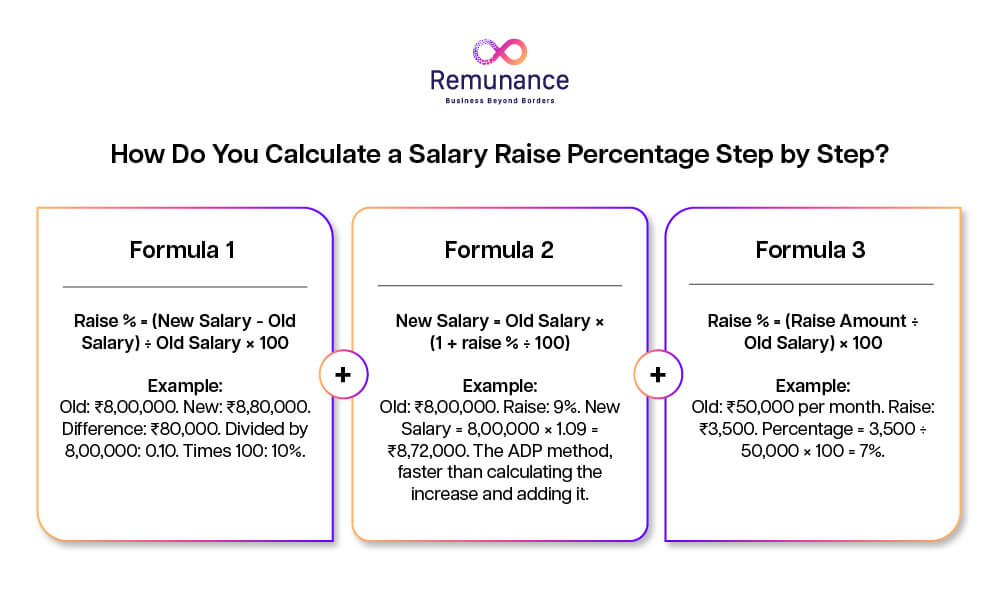
ADP recommends the shortcut (×1.0X) for fast back-of-envelope calculations, but understanding all three means you can sanity-check a vendor calculator before it goes wrong on a hundred employees at once. For the underlying terms (basic, gross, CTC, allowances), our payroll glossary lays out the definitions you’ll need.
What’s the Difference Between a Flat-Dollar Raise and a Percentage Raise?
A flat raise gives everyone the same monetary amount.
A percentage raise gives everyone the same proportional bump.
Example
Person A earns ₹6,00,000 a year. Person B earns ₹18,00,000. You have ₹3,00,000 to distribute in raises between them.
-
- Flat Split: ₹1,50,000 each. Person A gets a 25% raise. Person B gets an 8.3% raise. Person A is overjoyed by the outcome; however, Person B is quietly updating their LinkedIn.
- Percentage Split: (at 12.5% each) Person A gets ₹75,000, Person B gets ₹2,25,000. Both feel proportionally rewarded. Total amount spent by the organization remains the same, while all parties involved feel equally appreciated.
Flat raises feel fair to the giver because the rupee figure is identical. They almost never feel fair to the receiver because the impact on lifestyle is wildly different. Percentage raises are the better default for almost every scenario, except for one-time bonuses or correcting an underpaid hire.
What’s the Average Salary Raise Percentage in 2026?
The picture for 2026 is one of stability bordering on stagnation across most developed markets, with India and a handful of Asia-Pacific economies still running noticeably hot. WTW’s January 2026 Salary Budget Planning Survey of 1,876 organizations pegs the US average at 3.4%, the same as the 2025 actual. Mercer’s QuickPulse survey lands at 3.5% total. Aon’s India survey projects 9.1% for India in 2026.
| Country / Region | 2026 Avg. Salary Raise | Source | What’s driving it |
| United States | 3.40% | WTW (Jan 2026) | Stable inflation, easing labor market, cost discipline |
| United States | 3.50% | Mercer (Oct 2025) | Same outlook, slightly different sample |
| United Kingdom | 3 to 5% | WTW | Inflation moderating from 2022-23 highs |
| Germany | 4 to 5% | WTW | Union-driven, sectoral collective bargaining |
| Spain / Italy | 2 to 4% | WTW | Slower wage growth, traditional structures |
| UAE / Saudi Arabia | 5 to 7% | Mercer GCC | Oil-linked, expat retention via housing and education benefits |
| Singapore | 4 to 6% | Mercer | Higher for AI, fintech, biotech (up to 10%) |
| Australia | 3 to 4% | WTW | Fair Work Commission ties minimum wage to CPI |
| India | 9.10% | Aon (Feb 2026) | Talent demand still outpacing supply in key sectors |
| China | 6 to 8% | Aon Asia | Higher in Shenzhen, Shanghai tech hubs |
| Brazil | 10 to 15% | Mercer LatAm | Inflation-driven; nominal raises mask real wage stagnation |
| Argentina | 30%+ | Mercer LatAm | Hyperinflation; raises tracked monthly, not annually |
A 3.4% US average means half your competitors are giving more and half are giving less. The median is the starting point. The right number for any specific role depends on the next four factors we’ll get into. HR Dive’s analysis of the Mercer findings calls this gap between intent and budget execution a ‘disconnect’. They’re right.
How Much Are Salaries Going Up in India in 2026 (and Which Sectors Lead)?
India is the outlier in any global comp survey, so it deserves its own breakdown. The Aon Annual Salary Increase and Turnover Survey 2025-26 covers 1,400+ organizations across 45 industries and projects an average 9.1% hike for 2026, up marginally from 8.9% in 2025. Mercer’s India report lands at the same 9% median.
That headline number hides enormous sector variation. A 9% average means a real estate developer in Mumbai is giving 11%, while a tech services firm in Bangalore is giving 7%. If you benchmark against the wrong sector, you either overspend or lose people.
| Sector | 2026 Salary Hike | Attrition (2025) | Notes |
| Real Estate / Infrastructure | 10.90% | ~15% | Sector leader for the second year |
| NBFC (Non-Banking Financial) | 10.00% | ~22% | Lending growth, RBI scrutiny driving retention spend |
| Engineering & Manufacturing | 9.5 to 9.8% | ~14% | Capex cycle, China+1 demand |
| Automotive / EV | 9.50% | ~17% | EV transition is pulling skilled engineers up |
| Global Capability Centers (GCCs) | 9.50% | ~18% | Bangalore, Hyderabad, Pune talent war continues |
| Life Sciences / Pharma | 9.30% | ~13% | R&D and clinical roles outpacing manufacturing |
| Retail | 9.20% | ~30% | Higher for headquarters roles, lower for stores |
| Tech Platforms & Products | 9.40% | ~19% | SaaS firms still aggressive on core engineering |
| Banking | 8.50% | ~16% | Cautious, given consolidation pressures |
| Tech Consulting & Services | 6.80% | ~13% | TCS layoff cycle, AI productivity reset |
The tech consulting drop is the most interesting story in this table. Indian IT services, the bellwether of the previous decade, are now projecting hikes below the national average.
The reason is partly AI productivity gains and partly the well-publicized hiring slowdowns at the top firms. If you’re hiring software talent in India in 2026, you can no longer assume the talent market behaves the same way it did in 2022.
Overall attrition in India dropped to 17.1% in 2025 from a peak of 21.4% during the post-pandemic boom. People are staying put, partly because outside offers are less aggressive and partly because the AI-led layoffs at TCS, Infosys, and Wipro have made everyone more cautious. If you’re hiring employees in India in this environment, the window for fair-but-competitive raises is wider than it has been since 2019.
Benchmark Your Salary Increases Against India’s 2026 Market Data
Planning compensation for your India team? We help global employers compare salary hikes by industry, attrition trends, and talent demand to build competitive and compliant pay strategies.
What Factors Should Decide the Raise Percentage You Give an Employee?
Raise distribution is a tricky topic; if you set the same raise for everyone, you’ll lose your top performers within a year. Mercer’s 2026 data is very blunt about this fact, 83% of organizations distribute raise budgets equally rather than directing more to high-impact roles, and Mercer calls that a strategic disconnect.
Five inputs should weigh the number for each individual.
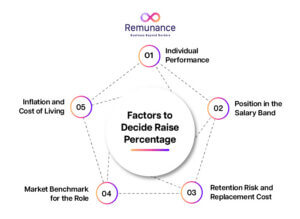
Individual Performance
The single biggest input. A top performer should get roughly twice the raise of an average performer. If your performance band reads ‘Exceeds Expectations’ across the spread, your review process is broken before the math starts.
Position in the Salary Band
An employee at the bottom of their band has more room to move than one already at the top. Compa-ratio (actual salary ÷ band midpoint) tells you who is underpaid relative to the role itself, separate from how well they’re performing.
Inflation and Cost of Living
Reuters and the IMF both peg US 2026 inflation around 3%. India’s CPI ran between 4 and 5% through 2025, per the RBI Annual Report. Any raise below those numbers is a real-wage cut. Employees notice this almost immediately and frame it as a vote of no confidence.
Market Benchmark for the Role
Aon, Mercer, and Payscale all sell role-specific data. A senior data engineer in Hyderabad and a senior data engineer in Pune don’t earn the same number, and assuming they do is how good engineers leave. Pay is based on the role, location, and year of experience band, not on your internal hierarchy alone.
Retention Risk and Replacement Cost
What does it actually cost to replace this person if they walk? In tech, the rule of thumb is 1.5 to 2 times annual salary when you factor in recruitment, onboarding, and ramp-up time. If a 12% raise prevents a ₹40 lakh replacement scramble, it is genuinely cheap.
How Do You Build a Salary Raise Budget Without Wrecking Payroll?
Most comp teams set a raise pool, a fixed percentage of total salary costs allocated to raises for the year. Then they distribute it across employees using a performance-weighted matrix.
We will include a short table to give you an idea of how it is executed. A company has 100 employees and an annual salary spend of ₹10 crore. The finance team approves a 5% raise pool, so ₹50 lakh.
| Performance Tier | % of Workforce | Raise % | Number of People | Total Cost |
| Top performers | 20.00% | 10% | 20 | ₹20 lakh |
| Solid performers | 60.00% | 5% | 60 | ₹30 lakh |
| Below expectations | 20% | 0 to 2% | 20 | ₹0 to ₹4 lakh |
Total: roughly ₹50 to ₹54 lakh. The 4 lakh swing depends on how many low performers get the minimum versus zero. That swing is also your negotiation buffer, in case finance needs to trim or HR needs to add a retention exception.
This is the part most growing companies skip.
They decide raises one by one in mid-year reviews and discover in March that their actual raise spent was 7.4%, not the 5% they planned. By then, the budget conversation has already moved on, and finance is looking at HR with a particular kind of expression.
| Pro tip: Set the pool first. Distribute against the matrix second. Communicate third. In that order, every year. |
What’s a ‘Good’ Salary Raise Percentage for Each Raise Type?
There is no universal ‘good’ number. The right benchmark depends on what the raise is for.
Merit raise: 3 to 10%
Tied to the annual performance cycle. Top performers in India should expect double digits; in the US, anything above 5% is now considered strong.
Cost-of-living adjustment (COLA): 2 to 5%
Tied to local inflation, often using the Consumer Price Index. The US Social Security Administration uses this method to set annual retirement benefit increases.
Market adjustment: 5 to 15%
Used when an internal salary has drifted below the market band. Common after a sharp sectoral wage move, like the 2021-22 tech surge in India.
Promotion raise: 10 to 20%
Mercer’s 2026 report notes that the long-standing benchmark for a one-level promotion used to be 10%; it has crept higher in tech and skills-scarce roles. If your promotion raise is under 8%, the promotion itself loses meaning.
Counter-offer/retention raise: 10 to 25%
Reserved for genuine flight risks. Use sparingly. A culture that only gives big raises to people threatening to leave is a culture training people to threaten to leave.
Equity correction: Variable
When pay-equity audits reveal a gap (by gender, role, or location), the correction is sized to fully close the gap in one step. Phasing equity corrections over multiple years is legally risky in jurisdictions such as the UK and the US, and ethically risky everywhere.
How Do You Calculate a Real Raise vs. an Inflation Raise?
This is the number most comp policies hide, and most employees secretly calculate the moment they get the letter.
Real Raise % ≈ Nominal Raise % − Inflation %
An employee in Pune gets a 7% raise. India’s CPI for 2025 came in around 4.6%, per RBI inflation data. The real raise is 7 − 4.6 = 2.4%. Their actual purchasing power went up by 2.4%, not 7%.
Now run the same math on a 3% raise in the US with 3% inflation, per BLS CPI data. The real raise is zero. The employee is no better off than they were a year ago, even though the offer letter shows a higher number. They will figure this out by the third month, and they will not be happy.
The fix isn’t to overshoot inflation by huge margins. It’s to acknowledge it. A short paragraph in the raise communication that says ‘Your 7% increase reflects a 4.6% adjustment for cost of living plus a 2.4% merit recognition’ lands very differently from a number with no context.
How Do You Calculate Multi-Year Compound Raises?
Most people add salary raises linearly in their heads. 5% for three years feels like 15%. It’s actually 15.76%.
Future Salary = Current Salary × (1 + r₁) × (1 + r₂) × (1 + r₃) …
₹10,00,000 starting salary, with raises of 6%, 7%, and 8% over three years.
-
- Year 1: 10,00,000 × 1.06 = ₹10,60,000
- Year 2: 10,60,000 × 1.07 = ₹11,34,200
- Year 3: 11,34,200 × 1.08 = ₹12,24,936
The compound number is ₹12,24,936, not ₹12,10,000 if you just added the raises linearly (which would assume each year’s raise applied only to the original base, not the previous year’s new salary).
Compound math matters most for retention modeling. An employee who stays for five years with an average 7% raises will earn 40% more than they started, not 35%. When you’re justifying a counteroffer or pitching a long-term comp progression in an offer letter, that compounding effect is the strongest argument you have.
Remunance Employer of Record
Project Future Salary Growth with Compound Raises
Use our free Salary Raise Calculator to model multi-year salary increases, compare compounding scenarios, and show employees how their earnings can grow over time.
Calculate Compound Salary Growth Now
How Should You Communicate a Salary Raise So Employees Actually Feel Valued?
A poorly communicated salary raise is worth less than a smaller raise communicated well. SHRM research has consistently found that pay transparency is one of the strongest drivers of engagement, ahead of the absolute pay level itself.
Do this:
-
- Lead with the number, then the rationale. Don’t bury the percentage in paragraph four.
- Show the math. If you split the raise into merit, COLA, and market adjustment components, name each component and its value.
- Tie it to specific work. ‘Your contribution on the Mexico market launch’ beats ‘your overall performance this year’ every single time.
- Set forward expectations. If this is a strong cycle but next year’s budget will be tighter, say so. Employees handle honesty better than surprises.
- Deliver it in writing and in person. Verbal-only raises feel provisional. Letter-only raises feel transactional. Both, in the right order, feel deliberate.
Don’t do this:
-
- Don’t compare to other employees. Even favorably. It introduces a relative frame that will haunt every future conversation.
- Don’t apologize for the number. If it’s the right number, defend it. If you’re apologizing, it’s the wrong number.
- Don’t promise next year. Markets change. Don’t write a cheque your future self has to bounce.
What Are the Most Common Mistakes Employers Make When Calculating Raises?
Six errors show up across nearly every comp audit we run for clients. Spot any of these in your own process, and the fix usually pays for itself in the same cycle.
1. Treating the percentage as the whole story.
A 9% raise on a salary that was 15% below market still leaves the employee underpaid. The raise needs to land at a defensible market position.
2. Forgetting the loading cost in India.
When basic pay goes up, so do the employer’s PF contribution (12% of basic pay), the gratuity accrual, and the leave encashment liability. A 10% headline raise on basic can mean an 11.5 to 12% real cost to the company. Plan for the loaded number.
Our salary structure in India guide walks through the basic-DA-HRA-allowance split in detail.
3. Across-the-board flat percentages.
The Mercer ‘equal distribution’ problem. It feels fair; however, it rewards mediocrity at the expense of excellence. It’s the single fastest way to lose your top quartile within eighteen months.
4. Ignoring band drift.
If your salary bands haven’t been refreshed in two years, your raises are calibrated against fiction. Refresh bands annually using current Aon, Mercer, or Payscale data before you set raise percentages.
5. Communicating raises in March for a fiscal year that started in January.
By March, half your employees have already mentally moved on. Either pay the raise retroactively to the start of the fiscal year, or move the cycle so the conversation lands before the year begins.
6. Letting managers negotiate raises individually.
Manager-by-manager negotiation breeds inconsistency, leading to legal exposure regarding pay equity. Set the framework centrally. Let managers decide where each employee lands within it.
Which Tools Help You Calculate and Manage Salary Raises at Scale?
Once you go past about thirty employees, manual spreadsheet raises stop being practical. Below are the categories worth investing in, along with the tools that typically appear in mid-market and enterprise HR stacks.
Compensation benchmarking
Tools: Mercer, Aon Radford, WTW, Payscale, Korn Ferry
Role-by-role market data. Annual subscription, but pays for itself the first time you correctly size a counteroffer.
Payroll & raise execution
Tools: ADP, Gusto, Zoho Payroll, Keka, RazorpayX Payroll
Apply the new salary, recalculate statutory contributions, and generate revised letters. Most also handle pro-rated raises mid-cycle. For India specifically, our salary calculator for India handles the basic-DA-HRA-allowance split and shows the net-take-home impact of any raise in seconds.
Internal compensation analysis
Tools: Excel/Google Sheets (still!), CompTryst, Pave, Figures
Build raise matrices, model pool distribution, and run scenario analysis before the conversation with finance. If you’d rather hand this off entirely, our EOR payroll service runs the full raise cycle on your behalf, including the calculations and the communication letters.
Glassdoor / Levels.fyi / AmbitionBox
Tools: Free + paid
Sanity check. If your internal band is sitting 20% below what Glassdoor shows for the same role as competitors, the gap will show up in your attrition data within a quarter.
How Does Statutory Compliance in India Change the Way You Calculate Raises?
Here’s where India differs sharply from the US or UK. Basic pay in India is not just a rough figure of comparative statistics; it’s a compliance trigger.
Provident Fund (EPF)
Employer contributes 12% of basic pay (plus DA) to PF, matched by employee. When you raise basic, you raise this number automatically. For employees above the ₹15,000 statutory wage threshold, this is optional, but most companies still apply the full 12% on actual basic for retention reasons.
Gratuity
Calculated as (last drawn basic + DA) × 15/26 × years of service. A raise to basic at year 9 directly inflates the gratuity payout at year 10 or whenever the employee leaves. This is a real future cost, and it accrues on your books.
Leave Encashment
Tied to basic pay in most companies. Raising basic raises the unused-leave liability, in direct cost at the time of exit.
The New Labor Codes
Under the Code on Wages 2019 (still being phased into rules across states through 2026), the statutory definition of ‘wages’ must equal at least 50% of total compensation. Companies that historically kept basic pay low to minimize PF and gratuity exposure are being forced to restructure.
Any raise calculation in 2026 should assume basic = 50% of CTC as the new normal. The Indian minimum wage rates also feed into this calculation for lower-tier roles.
Bonus Act linkages
The Payment of Bonus Act mandates a minimum 8.33% statutory bonus for eligible employees. This is sometimes baked into raise communications as a ‘guaranteed component’. Be precise about whether your headline raises number includes or excludes the statutory bonus.
If you’re a foreign company hiring in India, this is exactly the kind of work an Employer of Record handles.
Get the basic-pay split wrong, and you’re either underpaying statutory contributions (compliance risk) or overpaying them by 15 to 20% on every employee. Neither is small money once you scale past five hires.
Our EOR services cover this end-to-end, and the EOR cost calculator gives you a ballpark within minutes.
How Does Statutory Compliance in India Change the Way You Calculate Raises?
Here’s where India differs sharply from the US or UK. Basic pay in India is not just a rough figure of comparative statistics; it’s a compliance trigger.
Provident Fund (EPF)
Employer contributes 12% of basic pay (plus DA) to PF, matched by employee. When you raise basic, you raise this number automatically. For employees above the ₹15,000 statutory wage threshold, this is optional, but most companies still apply the full 12% on actual basic for retention reasons.
Gratuity
Calculated as (last drawn basic + DA) × 15/26 × years of service. A raise to basic at year 9 directly inflates the gratuity payout at year 10 or whenever the employee leaves. This is a real future cost, and it accrues on your books.
Leave Encashment
Tied to basic pay in most companies. Raising basic raises the unused-leave liability, in direct cost at the time of exit.
The New Labor Codes
Under the Code on Wages 2019 (still being phased into rules across states through 2026), the statutory definition of ‘wages’ must equal at least 50% of total compensation. Companies that historically kept basic pay low to minimize PF and gratuity exposure are being forced to restructure.
Any raise calculation in 2026 should assume basic = 50% of CTC as the new normal. The Indian minimum wage rates also feed into this calculation for lower-tier roles.
Bonus Act linkages
The Payment of Bonus Act mandates a minimum 8.33% statutory bonus for eligible employees. This is sometimes baked into raise communications as a ‘guaranteed component’. Be precise about whether your headline raises number includes or excludes the statutory bonus.
If you’re a foreign company hiring in India, this is exactly the kind of work an Employer of Record handles.
Get the basic-pay split wrong, and you’re either underpaying statutory contributions (compliance risk) or overpaying them by 15 to 20% on every employee. Neither is small money once you scale past five hires.
Our EOR services cover this end-to-end, and the EOR cost calculator gives you a ballpark within minutes.
Remunance Employer of Record
Planning Your 2026 Raise Cycle?
We help global companies benchmark, structure, and execute compensation changes for their India workforce, including the basic-pay split required under the new Labour Codes. Talk to one of our compensation specialists about your specific scenario.
Book a 30-min consultation Conclusion
A salary raise percentage is, ultimately, a small number that does a lot of work. It signals whether you value an employee, understand the market, have done the compliance homework, and can be trusted to do it again next year.
Get the math right, and the rest follows. Get it wrong, and you’ll spend the next six months explaining attrition reports to a board that’s already lost interest in the explanation.
If you’re a foreign company hiring in India and the statutory complexity feels like one more thing on a plate that’s already too full, that’s exactly the gap we close. We run the payroll, manage the compliance, and tell you when basic pay needs to move so PF, gratuity, and the new Labor Codes don’t surprise you at audit.
If you want to discuss your specific case, our team handles compensation planning, payroll, and compliance for global companies hiring in India. Get in touch or see why teams pick Remunance.
FAQs
What is a good raise percentage in 2026?
In the US, anything above the WTW benchmark of 3.4% is competitive. In India, 9% is the Aon average, with top sectors like real estate, NBFCs, and engineering paying 10 to 11%. For a top performer, double the average is a reasonable target.
How do you calculate a 10% raise on $60,000?
$60,000 × 1.10 = $66,000. Use the (1 + raise%) shortcut to get there in one step instead of calculating the increase and adding it.
Is a 5% raise good?
In the US in 2026, yes. It beats the 3.4% average and matches inflation comfortably. In India, 5% is below market and signals that the employee is either below-performing or being quietly told to look elsewhere.
How often should employers give raises?
Once a year is the global default, usually tied to the performance review cycle. High-growth companies and high-inflation economies (Argentina, Turkey, sometimes Brazil) move to twice-yearly or quarterly adjustments.
What's the difference between a raise and a bonus?
A raise is a permanent increase to the base salary, paid every cycle going forward. A bonus is a one-time payment that doesn’t change the base. Raises are usually expressed as percentages; bonuses can be either a flat amount or a percentage of base.
Does a raise increase your retirement contribution in India?
Yes, automatically. EPF is 12% of basic pay. A raise to basic raises the contribution proportionally for both employer and employee. The same applies to gratuity accrual and any leave-encashment liability.
How do you calculate a percentage raise when going from hourly to salary?
Convert the hourly rate to an annual salary first (hourly × hours worked per week × 52), then apply the standard raise formula. A $25/hour to $65,000/year move is more than the raw math suggests once you factor in employer-paid benefits.
Should I give an inflation raise and a merit raise separately?
Yes, if you can afford to. Splitting the components into ‘COLA’ and ‘merit’ makes the communication land far better. It also makes your comp practice easier to defend in a pay-equity audit.
How do I calculate a pro-rated raise for someone who joined mid-year?
Multiply the standard raise percentage by the fraction of the year completed. An employee who joined six months in gets half the percentage at the cycle end, then comes online at the full rate the following year.
What's the average promotion raise in India?
Mercer’s 2026 data puts it at 9 to 12% on top of the regular merit increase, totalling 15 to 20% for the year a promotion happens. Mercer also notes that the historical 10% benchmark has crept up, particularly in tech and skills-scarce roles.

Related Posts

A Comprehensive Salary Calculator India and Payroll Optimization