The Independent Contractor Compliance in India: A Complete Guide
Independent contractor compliance in India involves worker classification, tax obligations, contractual agreements, and statutory documentation. Learn how businesses can manage compliance risks, maintain audit-ready records, and use Contractor of Record services to simplify contractor management.
What You Need to Know
Independent contractor compliance in India involves more than signing a contract and making payments. Businesses must follow the tax and legal requirements that apply to contractor engagements. Meeting these requirements helps maintain proper documentation and reduces legal risks.
Compliance has now become an integral part of contractor management in India. Businesses increasingly use independent contractors for specialized, flexible work. Hiring an independent contractor in India is easy, but managing compliance is much harder.
Handling independent contractor compliance in India involves complex tax and documentation requirements. This guide covers the compliance rules businesses must follow when working with independent contractors.
What is Compliance in a Business Context?
Compliance means following laws set by the government or industry. In a business, internal rules such as company policies and codes of conduct are created by the business itself.
Compliance doesn’t end with signing a contract. It ensures organizations operate within legal boundaries and strengthens client trust. Businesses must follow company policies and meet customer needs to comply with requirements.
Simplify Independent Contractor Compliance in India
Ensure compliant contractor engagements with expert support for documentation, tax obligations, and legal requirements.
Key Considerations for Foreign Businesses Hiring Independent Contractors in India
Global companies hiring independent contractors in India should understand the tax rules. This includes understanding taxes on contractor payments and the tax obligations for independent contractors in India. Following these rules also helps businesses maintain proper records for audits.
While making independent contractor payments in India, foreign companies must :
-
- Correctly classify independent contractors
- Sign a contractual service agreement
- Verify PAN card requirements.
- Consider Goods and Services Tax requirements
- Maintain invoices and documentation
- Keep payment records for audit purposes
- Check and consider other tax obligations
Benefits For Foreign Businesses Hiring Independent Contractors in India
India has a large pool of talent across various professions. Independent professionals in technology, business services, and other sectors give foreign companies access to a wider range of skills.
Hiring independent contractors in India helps businesses access skilled workers with specialized expertise. It also facilitates:
-
- Remote and cross-border collaboration
- Flexibility for project-based work
- Long-term employment commitment
- Ability to scale teams as per business requirements
- Faster hiring and onboarding process
- Potential cost savings
Why Businesses Must Ensure Compliance of Independent Contractors In India
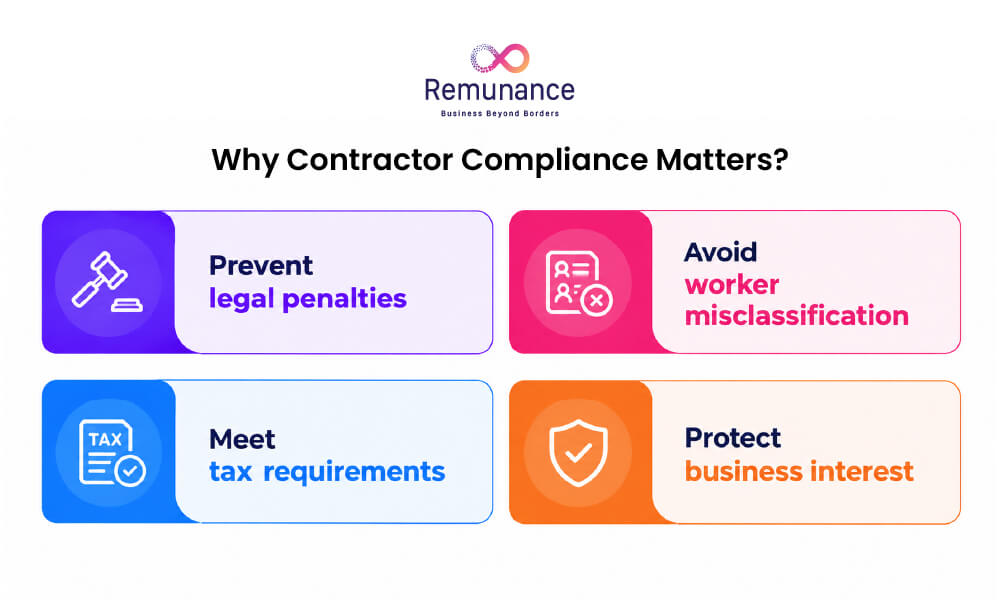
Under the Indian Contract Act, 1872, and the Contract Labor Act, 1970, businesses must meet the legal requirements for managing independent contractors. Companies hiring independent contractors in India must ensure compliance requirements are properly followed in order to:
-
- To prevent legal penalties
- To avoid worker misclassification
- To meet tax requirements
- To protect business interests
How to Ensure Compliance of Independent Contractors?
Businesses should meet the following requirements to legally document contractor agreements and avoid unnecessary risks:
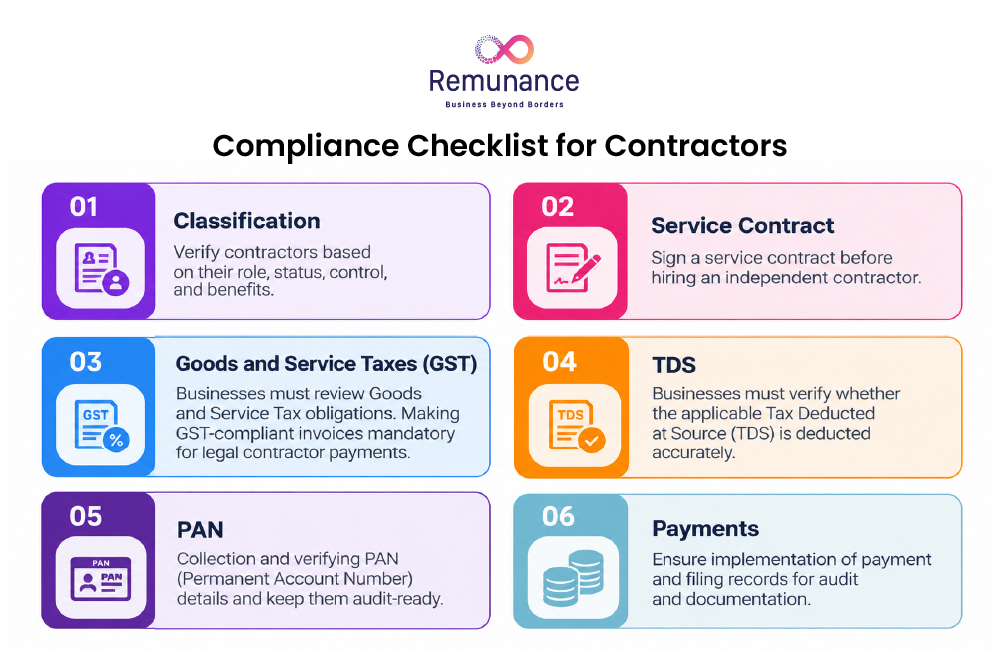
How Should Businesses Build an Effective Compliance Framework?
A key objective for businesses managing an independent contractor compliance framework is to ensure contractor engagements are legally documented. To that end, businesses must verify the following specific areas:
-
- Correct distinction between contractors and employees.
- Assigning compliance ownership
- Conducting periodic reviews
- Centralizing documentation
- Streamlining compliance through single registrations
- Time-bound approvals to bring uniformity
- Monitoring tax and regulatory changes
- Maintaining audit-ready records
The independent contractor compliance services help businesses follow rules and improve contractor opportunities. This checklist makes compliance easier for businesses hiring independent contractors.
Remunance Employer of Record
Simplify Your Contractor Compliance Management
Build a reliable compliance framework with expert support for contractor documentation, tax obligations, and regulatory requirements in India.
Talk to Our Compliance Experts
Why do Businesses Need to Stay Compliant?
Businesses need to stay compliant because every country has its own rules and regulations. Navigating these local requirements can be time-consuming, and failing to meet them may expose businesses to operational risks.
Here’s why compliance should be a priority for businesses:
-
- To safeguard business-created intellectual property (IP)
- To clearly outline the specific project deliverables and avoid financial risks.
- To avoid legal disputes arising from misclassification of workers
- To protect non-disclosure agreements (NDA) and other confidential information.
- To conduct periodic reviews and keep relevant records audit-ready.
Key Areas to Monitor for Independent Contractor Compliance
As contractor-led workforces are on the rise, compliance is no longer a one-time onboarding practice. Few of the biggest challenges for businesses today is:
-
- Periodic tracking
- Document collection
- Inconsistent engagement
In order to address these compliance gaps, businesses need to monitor the following documentation:
-
- PF Contributions
- Insurance deposits.
- Expired licenses and unrenewed registrations
- Wage payment violation proofs
- Inadequate Safety Measures
Contractor compliance is the principal employer’s responsibility. Failing to comply with statutory requirements may expose the principal employer to regulatory action.
Can Businesses Outsource Independent Contractor Compliance?
In India, managing independent contractor compliance can be daunting. One misclassification issue invites several legal complications.
Protecting your company against permanent establishment (PE) risk is equally necessary. Owing to these risks, Remunance provides businesses with an independent contractor compliance service.
To answer your question, yes, businesses can definitely outsource independent contractor compliance services! On your behalf, these services will hire, manage, and pay contractors without establishing local legal entities.
How Can a Contractor of Record (COR) Help?
Managing independent contractors in India through a compliance provider like Remunance offers a comprehensive way to handle contractor-related compliance.
They provide administrative and COR compliance services. For global businesses hiring independent contractors in India, the COR or Contractor of Record service is a total game changer.
This service hires and legally engages your independent contractors. It also maintains audit-ready documents and handles tax deductions. If needed, the COR service also handles data privacy and provides guidance on converting contractors to employees.
Here are the independent contractor compliance-related services Remunance offers:
-
- Manages end-to-end payroll through a centralized platform
- Provides compliance as per Indian labor laws, taxation within legal framework
- Handles real-time management of onboarding procedures.
- Supports your business through registered local entities in India.
- Offers seamless coordination with HR and improved automation in financial tools.
The independent contractor compliance service providers not only help you find the right talent but also streamline the complex process of onboarding and offboarding contractors.
Conclusion
Independent Contractors make up a significant share of the workforce. While contracts may allocate responsibilities, they do not remove statutory obligations. As a result, businesses cannot ignore compliance-related issues.
Many businesses rely on contractor declarations or document checks during invoice processing. While these are useful, they do not replace verification of independent contractors.
Contractual agreements may define roles on paper, but they do not override statutory liability. If non-compliance is observed on-site, the principal employer is often accountable under the law.
Remunance Employer of Record
Simplify Independent Contractor Compliance in India
Protect your business from compliance risks with expert support for contractor classification, documentation, tax obligations, and regulatory requirements.
Talk to Our Experts Frequently Asked Questions (FAQs)
What are the best methods to ensure independent contractor compliance in India?
The best methods are to review contractor classification, accurate deductions of tax, verification of documentation and periodic audits of statutory registrations.
What is statutory registration ? What are its types?
Statutory registration is a process of registering a business with government authorities for it to operate smoothly without any legal problems. The types of statutory registrations are business licenses, tax registrations, labor and employment registrations and entry specifics.
Are the contractor’s applicable tax deductions country-specific?
Yes, the deductions in tax are country-specific. They vary by country depending on local tax laws withholding requirements and contractor’s tax status.

Related Posts

Employer Liability for Independent Contractors in India: A 2026 Legal Guide

How to Avoid Misclassification Risks of Independent Contractors?