How to Avoid Misclassification Risks of Independent Contractors?
This article explains independent contractor misclassification risks, including the key differences between contractors and employees, common warning signs, potential legal and tax consequences, and practical steps businesses can take to avoid costly worker misclassification.
What You Need to Know
Misclassifying employees as independent contractors is one of the most damaging mistakes a business can make.
Such a mistake can result in a lawsuit and loss of reputation for a business.
Hence, businesses must learn contractor vs employee classification. This blog clearly explains the meaning of an independent contractor and an employee.
It also explains how to avoid the misclassification risk.
Contractor vs Employee: What are the Main Differences?
Before we debate independent contractor vs employee, let’s explain what these terms mean.
What’s the Meaning of an Independent Contractor & an Employee?
Independent Contractor
-
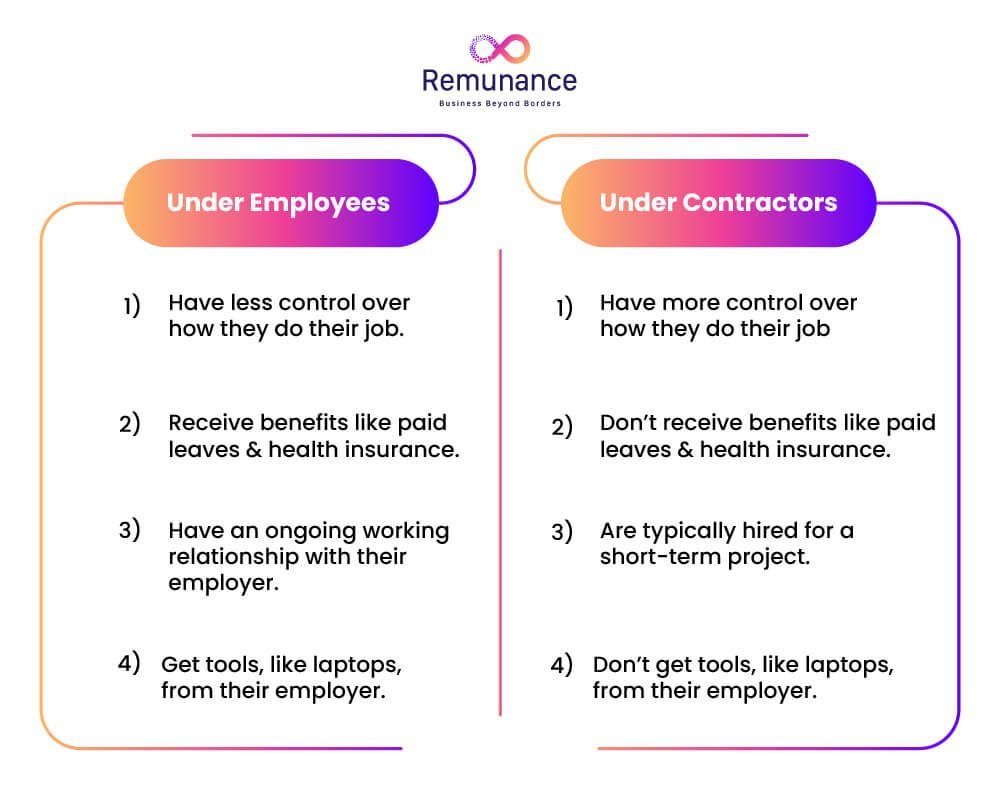
- Contractors can be a self-employed individual or a business that’s hired to finish a specific job or to provide certain services.
- They tend to have more control than employees over how they work, where they perform tasks, and when they work.
- They use their own equipment and tools, like laptops, an internet connection, etc.
- They can work for multiple clients at the same time.
- They take care of their own taxes and insurance.
- They work independently. So, they don’t receive employee benefits, like paid leave and health insurance.
Employees
-
- An employee is hired by a company to work under its supervision and control.
- An employee’s work is controlled by his employer to a much larger extent than that of a contractor.
- In the case of employees, their employer decides working hours, processes, and output expectations.
- Employers provide tools and equipment to employees for performing their work.
- Employees get a regular salary and benefits like paid leave, health insurance, provident fund (PF), etc.
Let’s now talk about contractor vs employee differences.
How to Determine Independent Contractor vs Employee?
To understand contractor vs employee better, please refer to the following table:
| Criteria | Employees | Independent Contractors |
| Control | Employers have much more control over the work of their employees than their contractors. | Contractors have much more control over how they perform their work than employees. |
| Benefits | Employees are eligible to receive benefits like paid leaves, health insurance, and PF from their employers | Unlike employees, contractors are not entitled to receive benefits from their employers. |
| Taxes | Employers withhold taxes from the salaries of their employees. Then, employers remit those taxes to tax authorities on behalf of their employees. | Contractors are like entrepreneurs. They work for themselves and are responsible for paying their own taxes. |
| Term of employment | Employees have an ongoing working relationship with their employer. | Typically, contractors are hired for a short-term assignment or for a project. But they can also be hired for a long-term assignment. |
Having discussed independent contractor vs employee, let’s dig deeper into this topic.
Not Sure Whether to Hire a Contractor or Employee?
Get expert guidance on worker classification and choose the right engagement model while reducing compliance and misclassification risks.
What is Worker Misclassification? What are its Risks?
If you want to avoid the possibility of employee misclassification, you must understand what it means. You should also know that it can increase your business’s risk.
What is Contractor Misclassification?
Sometimes companies incorrectly classify an employee as a contractor. As a result, the employee is not given benefits, and he may not be entitled to even legal protections.
Firms may intentionally misclassify a worker. Such misclassification can help companies avoid paying taxes and benefits.
At times, companies make this mistake unintentionally due to a lack of understanding of the laws.
What are the Risks of Contractor Misclassification?
Misclassification of contractors can have a huge negative impact on a company, as explained below:
-
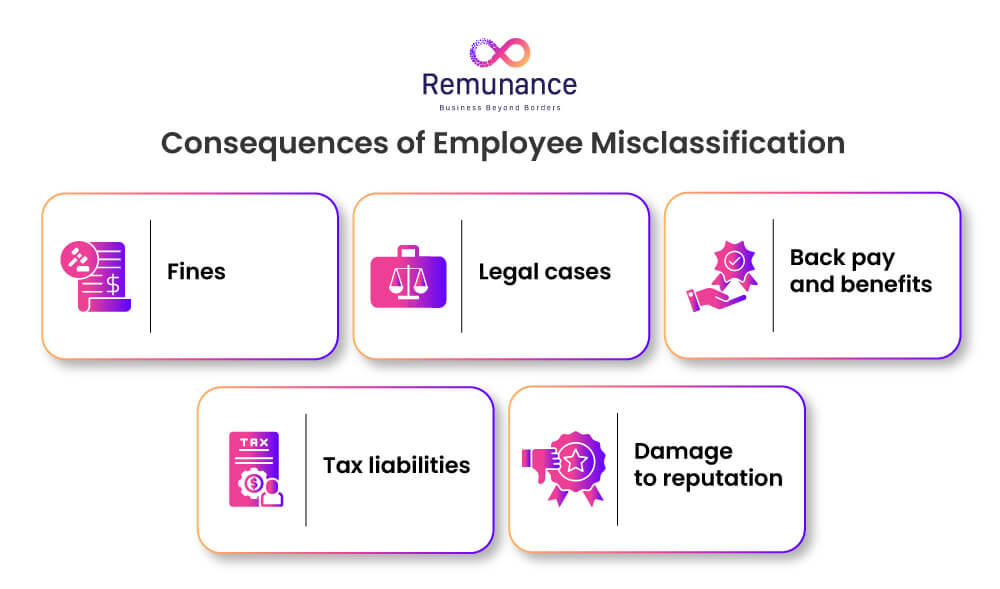
- Fines: If a firm misclassifies an employee as a contractor in the US, federal agencies such as the Department of Labor (DOL) and the Internal Revenue Service (IRS) may make it pay considerable fines. Apart from that, several U.S. states impose additional fines under their own laws on companies that make this mistake.
- Legal cases: If workers think that they are misclassified, they may file a case against their employer. Besides, their employer may have to spend a lot of money to settle the case. Apart from that, the company will also be required to pay a lawyer’s fee to fight the case.
- Back pay and benefits: A company may have to pay unpaid salary and benefits to an employee whom it misclassified as an independent contractor. It may have to pay unpaid salary, paid leave, health insurance benefits, and any other benefits, which it should have paid to the employee earlier.
- Tax liabilities: If a worker is misclassified as a contractor by a company, the company may be required to pay unpaid payroll taxes to the government.
- Damage to reputation: Severe damage could be caused to the reputation of a business that misclassifies its employees as independent contractors. This can especially be the case if a lawsuit is filed against the business and it gets negative media coverage. Once a business’s reputation is affected, it may find it extremely difficult to attract employees and investors.
What Are the Signs of Worker Misclassification and How Should You Avoid It?
Understanding contractor vs employee differences can help you find misclassification early. But did you know that there are signs that help you find contractor misclassification at the workplace? Let’s talk about them.
Leading Signs of Worker Misclassification
-
- Continuous daily work: Typically, employees work continuously on a daily basis for a company. Contractors are mostly hired for a specific job for a set period of time. So, if someone is working daily and for long hours, you should check their classification.
- Regular payment for work: Contractors mostly get paid once the job is done. But employees are paid regularly, like monthly, weekly, etc. So, if a worker is getting paid regularly, he could be an employee and not a contractor.
- Reimbursement of expenses: When contractors work for a company, they are deemed to be running their own business. Hence, they pay their own expenses. But employees are usually reimbursed for expenses, provided they were incurred in the course of their employment. So, if a worker’s expenses are getting reimbursed, you should check his classification.
- Equity in compensation: Sometimes companies use equity compensation, like stock options, to provide an incentive to their employees so that they work with their employer for a long time. But contractors are employed for a specific project. Contractors are usually not employed for a very long time and are not given stock options. So if a company is providing equity compensation to a contractor, it could be a case of misclassification.
How Should You Avoid Worker Misclassification?
Clearly understand the nature of a job:
Employers must analyse the nature of a job. They should examine how many hours a person works, how he works, whose tools & equipment he uses, and how much control a supervisor has over his work.
Read state-level and national laws:
Companies should read the state-level and national-level laws regarding workers classification. They must ensure that their worker classification is in line with the relevant laws.
Take the help of legal and HR experts:
Companies should consult legal and human resources (HR) experts to ensure that they follow all the laws regarding worker classification. These experts can help firms formulate policies to prevent misclassification.
Examine employment contracts:
Businesses must regularly review employment contracts to ensure that they classify workers correctly. If needed, they should be prepared to change the classification to follow the laws. They must also keep their workers informed of the classification regularly.
The above steps will help you get a grip on contractor vs employee differences. If you still need help, you can talk to an expert service provider like Remunance.
How Can Remunance Help You Avoid Worker Misclassification Risk?
Remunance has helped many foreign companies engage with independent contractors and employees in India over a long period.
It’s a leading provider of Employer of Record (EOR) and Professional Employer Organization (PEO) services in India.
It also offers expertise to foreign companies willing to work with Indian contractors. Remunance is well known for offering honest classification advice.
That helps its clients prevent worker misclassification mistakes. It also helps them with contract structuring, tax deducted at source (TDS) and goods & services tax (GST) guidance.
Remunance Employer of Record
Avoid Independent Contractor Misclassification Risks
Get expert guidance on contractor classification, compliant contracts, TDS, and GST when engaging contractors in India.
Talk to a Remunance Expert
FAQs
How do companies examine contractor vs employee status?
Companies determine contractor vs employee status by assessing many factors. These include the level of the employer’s control over a worker’s work, how regularly the payments are made, and whether expenses are reimbursed. Businesses also review local laws to check workers’ classification.
Why is understanding contractor vs employee classification essential?
If you don’t understand contractor vs employee classification, your business can be held responsible for worker misclassification. Hence, you may be required to pay worker misclassification penalties.
What are the biggest mistakes companies make in contractor vs employee classification?
Making contractors work like full-time employees, controlling their work too tightly, and not paying attention to local labour laws are common mistakes businesses make in this regard.
How can a contractor of record (COR) prevent you from making a contractor misclassification error?
A COR can help you draft legally compliant contractor agreements. It can also ensure that you follow all labour and tax laws. Besides, it can assess your worker classification. These steps can reduce the possibility of a classification mistake.

Related Posts

Contractor of Record vs. Employer of Record : Which to Choose? (2026)

Contractor Benefits: How Enterprises Can Offer Them Without Increasing Risk

What is a Contractor of Record? Complete Guide

How Does Remunance Manage Independent Contractors in India Better?