How to Hire Employees in India from Germany?
Discover how German companies can hire employees in India through an Employer of Record (EOR), an Indian subsidiary, or independent contractors. Compare hiring costs, understand compliance requirements, and choose the right workforce model for your business.
What You Need to Know
Usually, setting up your own subsidiary in India requires paying statutory and ongoing legal compliance costs. These costs exclude employee hiring costs, which add another layer of complexity.
The best way to hire employees in India from Germany is to use an employer of record (EOR) service.
An EOR is a third-party organisation that legally employs your already chosen candidates and handles their employment-related compliance on your behalf. This lets you bypass the cost of establishing a subsidiary in India. This way, you only pay the EOR service fee and employee-related costs.
The EOR runs payroll, contracts, documentation, and tax, and files all required Indian tax returns under Indian law. As an employer, your team in Germany will only direct daily tasks to your employees and monitor their performance.
Why German Companies Prefer Hiring Employees In India?
Worldwide, India is known for its large talent pool that has technical knowledge and specialised expertise in scientific and technical fields.
The reasons why German companies hire skilled employees in India are:
-
- Access to specialised technical expertise
- Difficulty in sourcing technical expertise due to a shortage of skilled local talent in Europe.
- Lower recruitment costs
- Large pool of English-proficient graduates
Besides cost efficiency, India offers robust remote-work infrastructure and improved workforce scalability for German businesses. These factors contribute to the long-term growth of German companies. Many other European countries hire Indian employees to expand into international markets.
Build Your Team in India With Skilled Talent
India offers German companies access to skilled professionals, lower hiring costs, and scalable workforce solutions to support business growth.
Can German Companies Hire Employees in India Without Registering Locally?
Yes, German companies can easily hire employees without registering in India. However, it depends on how much time and money you want to invest. You can choose the route that fulfils your business needs.
This is how you can hire Indian employees from Germany:
Setting up your own subsidiary:
Incorporating a wholly owned Indian subsidiary lets you operate independently and build a long-term presence in India. You can take this route if you plan to hire more than 20 employees. It may take 4 to 6 months to establish a good presence and begin your operations as an Indian subsidiary.
Why this route?
For bulk hiring in India, setting up your own legal entity makes more sense because it is more cost-effective and avoids the per-employee monthly EOR fee.
To set up a permanent Indian entity, you need to:
-
- Register your own subsidiary in India through the Ministry of Corporate Affairs.
- Rent an office space.
- Hire local HR and administrative staff directly or through a staffing agency.
- Manage employee payroll and compliance independently.
How much does it cost?
The initial amount required to set up your own subsidiary may exceed €40,000, which is approximately Indian Rupees (INR) 42,49,880. A significant portion covers company registration fees, legal paperwork, taxes and compliance fees.
Using the EOR service:
The fastest way to hire employees is to use an Employer of Record service. You can hire 1 to 20 employees immediately without registering a legal office in India. Within 2 weeks, your EOR provider will legally employ the chosen candidates and handle their employment contracts, compliance, and payroll.
Why this route?
The EOR also deducts taxes and manages statutory contributions such as the Employees’ Provident Fund (EPF) and Employees’ State Insurance. As a German employer, you only have to manage your employees’ day-to-day tasks and monitor their operational control over your intellectual property.
How much does it cost?
It is a cost-effective option if you want to hire fewer than 20 employees and test the Indian market for a couple of years. The EOR platforms only charge a fee ranging from $459 to $799+ per employee per month.
A few India-focused specialist EOR providers even charge $99. You can also compare the best EOR providers for free on the EOR advisory service, Peorient.
This EOR advisory helps companies compare and choose the right Employer of Record (EOR) for their business. Hence, the EOR route is not just the fastest, but also the cheapest.
How to choose the best EOR provider in India?
-
- Compare EOR providers on advisory websites.
- Check if the EOR fees have no hidden cost.
- Check what employee benefits EOR providers are offering.
- Verify legal presence of EOR provider in India
- Confirm if the EOR provider offers ongoing support.
Hiring an independent contractor:
This is one of the fastest routes to engage talent in India. Canadian employers can hire independent contractors directly through a service agreement without setting up a legal office in India.
For example;
Consider your team in Germany needs two Python Developers from India for a six-month project. You can hire these Developers to build high-quality software solutions for your IT team.
If a project needs to be completed urgently, hiring a professional contractor is an ideal option. The developers will work on that specific project temporarily under a written service agreement.
Once the project is complete and payment is made, their contractual relationship ends. You may consider hiring them for a full-time role later.
Risks associated with hiring a contractor:
The only risk of hiring a contractor is misclassification. As per Indian law, calling someone a contractor does not automatically make them one; the actual working arrangement matters. The misclassification risk may expose the business to severe legal, financial, and operational penalties.
Why this route?
These contractors are hired for specialised, project-based work for a very short period. You can hire expertise for a specific task and save money, as they charge per project.
How much does it cost to hire an independent contractor?
If you plan to hire a full-time, professional contractor, you may need around CAD $35.69–$71.39+ per hour (INR ₹2,334-₹4,669), depending on the role. The costing depends on the job position and excludes platform and administrative fees.
Before choosing an independent contractor in India, you need to:
-
- Evaluate the skills and core expertise.
- Define the scope of work
- Check whether the deliverables are time-bound.
- Draft a service agreement
- Outline payment terms and conditions
- Verify if paid taxes and compliance obligations are met.
Indian Subsidiary vs Using an EOR: Why This Comparison Matters
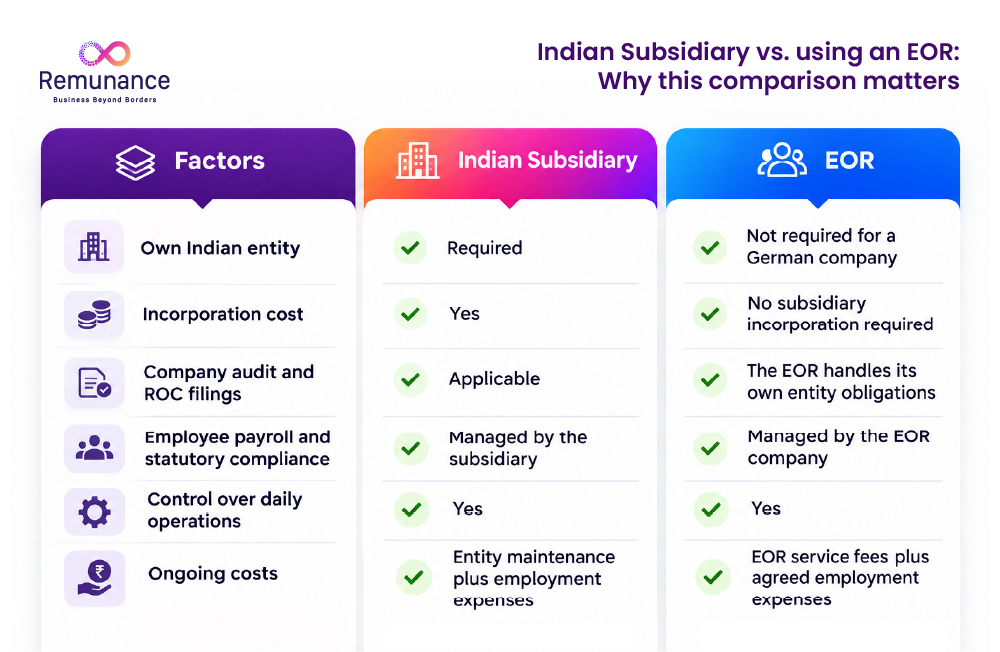
As a German employer, you may be unsure whether to set up an Indian subsidiary or use an EOR to hire employees in India. As a German employer planning to hire employees in India, you have two common options.
This detailed comparison will help your company understand the operational responsibilities involved in each route.
Key Rules and Requirements for German Employers Hiring in India
As a German company, you must meet the following key compliance requirements after hiring employees in India.
-
- Local currency disbursement: Disbursing Indian employees’ salaries and applicable employment contributions in Indian Rupees.
- Employer-of-Record Service fee: The EOR service fee may be charged in either Indian Rupees (INR) or Euros (EUR), depending on the provider’s billing policy and the agreement between the EOR provider and the client.
- Compliance and TDS withholding: German employers must comply with Tax Deducted at Source (TDS) and other compliance requirements.
- Statutory deductions: Employers must calculate and deposit contributions such as TDS (Tax Deducted at Source) and employee contributions like PF (Provident Fund) and ESI (Employees’ State Insurance).
Why Remunance Makes Hiring Employees in India Easier
The real cost of hiring an employee in India goes beyond what foreign companies initially expect. While most EOR providers charge foreign companies a service fee between $200 and $700, Remunance charges a starting fee of about $99 per employee per month. This makes it more cost-effective for German companies planning to hire employees in India.
Estimate your India hiring cost through the cost calculator
To calculate the exact fee, you only need the EOR Cost Calculator. With this cost calculator, you only need to share the proposed salary, employee location, and your hiring plan. We calculate your estimate based on the actual package and role within seconds.
Understand EOR Costs with our pricing guide
Remunance’s India EOR cost guide covers the complete cost of hiring employees in India through an Employer of Record. It covers EOR service fees, statutory employment costs, hidden EOR charges and total employment cost.
Their guide helps German companies understand what they need to pay beyond an employee’s monthly salary.
Conclusion
India offers European nations access to a large pool of talented professionals. This makes India an attractive hiring hub for companies looking to expand their network and operations.
Many European countries face skilled labour shortages, so German companies have started hiring in India through compliant workforce solutions.
EOR services are one option German employers use to hire in India without registering a local entity. Establishing an Indian subsidiary may work for companies with larger teams in India.
Hiring independent contractors suits project-based requirements. On the other hand, an EOR is a reliable option for companies that need to hire full-time permanent employees in India without setting up a local entity.
Remunance Employer of Record
Hire Skilled Employees in India Without Setting Up a Subsidiary
Expand your team in India with Remunance's EOR services. Hire full-time employees, simplify payroll and statutory compliance, and avoid the cost of establishing a local entity in India.
Talk to an EOR Expert
FAQs
Can I hire in India from Germany?
Yes, you can. You can hire independent contractors, hire full-time employees directly by forming a local Indian entity, or use an employer of record service to hire an employee.
What is an EOR (employer of record) service?
An EOR is a third-party organization that becomes the legal employer of the employees who do not have their own legal entity in India. The EOR handles compliance, payroll, and employee benefits on behalf of the client company.
Is it possible to work remotely for a German company?
Yes. German companies do hire Indian professionals who work remotely from India.
What is TDS in the Indian taxation system?
TDS stands for Tax Deducted at Source. It is a system in India where the person or organization making a specified payment (the deductor) cuts a set percentage of tax before paying the remaining amount to the receiver (the deductee). The deductor then deposits this tax directly with the Indian Government.
What are employee benefits in India?
Employee benefits in India are non-wage compensations provided to employees in addition to their regular salary or wages. Benefits include paid time off (paid leave), health / medical insurance, flexible work arrangements, and other perks.
What is the best way to hire employees in India from Germany?
The best way to hire employees in India depends on whether you have a local legal entity. If you don’t, an EOR service is the most cost-efficient and fastest way to hire employees in India.
What does it cost to hire an employee in India through an EOR?
To hire an employee in India through an experienced EOR provider, fees start at $99 per employee per month. The hired Indian employee can start in 3 to 4 days once the payment and the required documents is received.

Related Posts

How Much Does an Employer of Record Cost in India? Full Breakdown

What Is an Employer of Record (EOR)? A Complete Guide