When Does Setting Up an Indian Entity Become Cheaper Than EOR?
An Employer of Record simplifies international hiring by managing local payroll, compliance, contracts, statutory benefits, and HR administration. Explore 10 key Employer of Record benefits and how businesses can use EOR services to expand into India.
Setting up an Indian entity becomes cheaper than an employer of record (EOR) once the EOR fees you stop paying cover the entity’s yearly running cost, plus its setup and exit cost spread over the years you plan to stay.
On October 2026 numbers, that point arrives at about 7 to 12 employees if you pay $249 per employee per month. Against a $599 global platform, it arrives at 3 to 5. Against a $99 India-specialist fee, it doesn’t arrive until 19 to 34.
That spread is the whole story of EOR vs entity in India. The fee you pay decides the answer more than anything else.
But cost parity isn’t the moment to switch. A private limited company can’t pay anyone until it’s incorporated with the Ministry of Corporate Affairs, has a bank account and holds its labour registrations. That usually takes 10 to 16 weeks.
It also needs a director who lives in India for at least 182 days a year, a full statutory audit every year and transfer pricing compliance on every invoice to your parent.
So this guide does two jobs. It gives you the formula, the 2026 inputs and a sensitivity table you can rerun with your own quotes. Then it covers the triggers that override the maths, from equity grants to GST.
Why do published crossover points range from 5 to over 100 employees?
Because each source feeds different assumptions into the same equation, and few of them show you which ones.
We reviewed nine crossover claims that EOR providers, payroll firms and advisers had live in 2026. Here’s what sits behind each number.
| Who published it | Crossover claimed | The assumption doing the work |
| An Indian company-formation firm | 5 to 7 employees | A $150 EOR fee against a $9,000 a year bundled entity package |
| A UK-based global EOR | 8 to 15 employees | $200 to $700 EOR fees and $25,000 to $80,000 a year to run an entity, over 18 months or more |
| An India-focused EOR platform | 15 to 20 employees | A $200 fee against $24,000 to $42,000 a year of in-house payroll, HR and compliance |
| A CA firm and an EOR blog | 15 to 25 employees | “Industry consensus”, with no stated fee |
| A Gulf and India payroll provider | 30 to 50 employees | EOR fees priced at 8% to 15% of gross salary |
| An India-specialist EOR’s calculator | 31 to 62 employees | A low flat fee; 31 with outsourced overhead, 62 once HR and finance move in-house |
| An Indian payroll software company | 60 to 90 employees | When companies actually switched, not where costs crossed |
| An India-specialist EOR’s sales page | Over 100 employees | A positioning claim |
 None of these is wrong on its own terms. They’re answering different questions at different prices.
Hence the only crossover worth trusting is the one you calculate with your own quotes.
What actually moves the crossover?
Six inputs move it, and the EOR fee moves it most.
- Your EOR fee and how it’s priced. A flat $99 fee and a 15%-of-salary fee can differ by four to eight times on a senior engineer, so the crossover moves just as far.
- How you run the entity. Outsourcing every filing to a CA and CS firm costs roughly half of hiring an in-house finance manager and HR lead.
- Your planning horizon. Setup and exit costs spread over two years weigh twice as much per year as the same costs spread over four.
- Your exit cost. If there’s a real chance you leave India, a liquidation budget belongs in the sum.
- The exchange rate. Most EOR fees are billed in dollars, while entity overheads are paid in rupees.
- GST on the EOR invoice. Zero-rated or not, this single line can outweigh the fee itself.
How do you calculate your own EOR-to-entity crossover?
Divide everything the entity costs you per year by what each employee saves you per year once you stop paying the EOR.
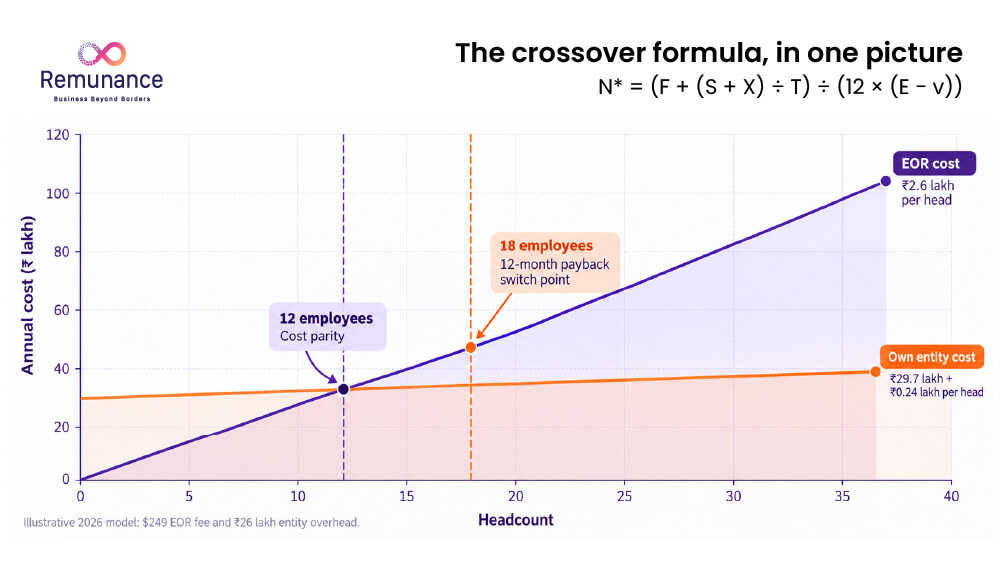
Below N*, the EOR is cheaper. Above it, the entity is.
Let’s say F is ₹26 lakh, S is ₹6 lakh and X is ₹5 lakh. T is three years, E is $249 (₹23,655 at ₹95 to the dollar) and v is ₹2,000.
The top line comes to ₹29.67 lakh a year. Each employee saves you ₹2.6 lakh a year. So N* is 11.4, which means 12 employees.
You can run the same sum in Remunance’s EOR vs entity cost calculator, or swap your own quotes into the tables below.
What goes into an Indian entity’s fixed overhead?
Everything you pay for whether you employ two people or forty. That’s the real private limited company compliance cost, and most comparisons only show the incorporation fee.
| Line item (₹ lakh a year) | Lean | Standard | Staffed |
| Statutory audit (no small-company relief for a foreign company’s subsidiary) | 1.8 | 3.0 | 5.0 |
| Bookkeeping, monthly close and reporting | 2.1 | 4.2 | 16.0 (in-house finance manager) |
| Company secretarial: board meetings, AOC-4, MGT-7, FEMA annual return | 1.8 | 3.0 | 3.5 |
| Direct tax: returns, TDS returns, transfer pricing | 1.5 | 4.0 | 6.0 |
| GST returns, LUT and export refunds | 0.9 | 1.2 | 1.5 |
| Resident director | 3.0 | 4.8 | 4.8 |
| HR, payroll policy and labour code registrations | 1.2 | 3.6 | 7.2 (in-house HR and payroll executive) |
| Registered office, insurance, banking and software | 1.7 | 2.2 | 4.0 |
| Total fixed overhead (F) | 14.0 | 26.0 | 48.0 |
These are illustrative 2026 planning ranges for a single-state private limited company in an Indian metro, built from typical CA and CS retainer bands. They aren’t quotes. Swap in yours.
Two lines surprise most foreign founders.
First, an Indian subsidiary of a foreign company can never be a “small company” under Section 2(85) of the Companies Act, 2013, however small it is. The exclusion covers every holding and subsidiary company, so you file the full audit, cash flow statement and annual return.
Second, Section 149(3) needs at least one director who stays in India for 182 days or more in the financial year. If nobody on your team qualifies, you pay a nominee or hire one.
What does it cost to set up a private limited company in India in 2026?
About ₹3.5 lakh to ₹15 lakh all-in for a foreign-owned company, even though the government’s incorporation fee is often nil.
The Ministry of Corporate Affairs charges no filing fee on SPICe+ for authorised capital up to ₹15 lakh. Stamp duty depends on your state.
So the real Pvt Ltd company registration cost for a foreign parent sits elsewhere. It’s in professional fees, apostilled parent documents and the FEMA paperwork a foreign shareholder triggers.
| One-time item | Typical range |
| SPICe+ filing fee (authorised capital up to ₹15 lakh) | Nil, plus state stamp duty |
| Digital signature certificates | ₹1,500 to ₹6,000 per director |
| Apostille and notarisation of parent documents | Depends on your home country |
| Incorporation professional fees | ₹40,000 to ₹1.5 lakh |
| GST, EPF, ESIC, Shops and Establishments and professional tax registrations | ₹25,000 to ₹75,000 |
| Share allotment and FC-GPR filing with the RBI | ₹15,000 to ₹50,000 |
| Employment contracts and policies aligned to the labour codes | ₹50,000 to ₹1.5 lakh |
| Tax and legal structuring advice | Nil to ₹8 lakh |
Plan on ₹3.5 lakh for a lean setup, ₹6 lakh with mid-tier advisers and ₹15 lakh or more with a large advisory firm. That’s the true cost of setting up a company in India as a foreign parent.
Watch two FEMA clocks. Shares must be allotted within 60 days of the capital landing, and the FC-GPR filing is due within 30 days of allotment.
Miss either and you’re paying late-submission fees before you’ve hired anyone. For the full sequence, see our guide on how to set up a subsidiary in India and the things to know before forming a subsidiary company in India.
What does it cost to leave India if the bet doesn’t pay off?
An EOR exit is a notice period. An entity exit is a project.
Striking a company off under Section 248 costs a ₹10,000 government fee on Form STK-2, and the Centre for Processing Accelerated Corporate Exit (C-PACE) handles it centrally. But you can only use it once the company has no assets or liabilities left.
If employees, leases or receivables remain, you’re into voluntary liquidation under Section 59 of the Insolvency and Bankruptcy Code. That typically takes 12 to 18 months.
Add a final audit, tax and GST clearances and professional fees. The model in this guide uses a ₹5 lakh exit provision.
Employee exit costs don’t belong in X. Notice pay, gratuity and retrenchment compensation cost the same whoever employs your team, because an EOR passes them through.
Our guides on termination of employment in India and closing a foreign subsidiary in India cover both sides.
Why should statutory employment costs stay out of the formula?
Because they cost the same on both routes. Adding them changes nothing except how small the real difference looks.
Employer EPF at 12%, ESI at 3.25% for wages up to ₹21,000 a month, statutory bonus and gratuity all apply, whether the employer is your subsidiary or an EOR.
The EPF wage ceiling also stays at ₹15,000 a month. The Centre retained it in a 29 May 2026 notification under the Code on Social Security, despite a Supreme Court direction in January to decide on a revision.
The labour codes’ rule that wages can’t fall below 50% of total remuneration raises the PF and gratuity base on both sides equally. So it lifts your cost per head. It doesn’t move the crossover.
Many comparison tables add about 20% of salary as “statutory cost” to both columns. That isn’t wrong. It just buries a ₹2.6 lakh difference inside a ₹30 lakh total.
Our payroll compliance in India guide and the employer of record cost in India breakdown show every statutory line in full.
Ready to Expand Without Setting Up an Entity?
Explore how Remunance can help you hire employees in India, manage local compliance and payroll, and build your team without the immediate cost and complexity of setting up a subsidiary.
What does the crossover look like on 2026 numbers?
Anywhere between 3 and 62 employees, depending almost entirely on your EOR fee and how you staff the entity.
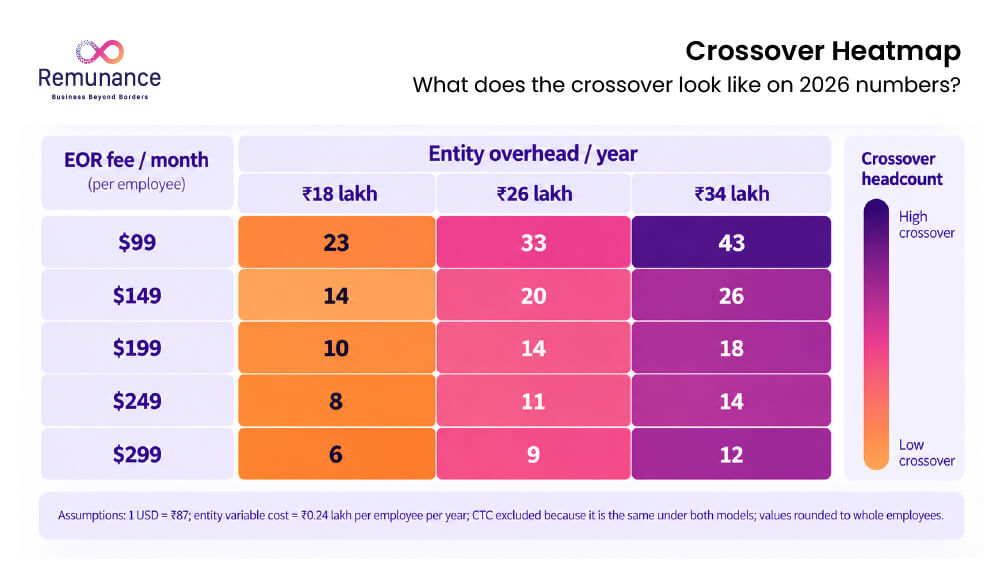
Assumptions: three-year horizon, ₹5 lakh exit provision, ₹2,000 per-head entity variable cost, ₹95 to the dollar. Setup cost of ₹3.5 lakh, ₹6 lakh and ₹15 lakh for lean, standard and staffed. The switch point assumes six months of overlapping entity overhead before the transfer.
Read across the $249 row. Cost parity arrives at 12 employees with a standard overhead.
But switching at 12 means paying for two structures while you build the second one. A 12-month payback on setup and overlap needs about 18.
So don’t switch at the crossover. Start the entity when you’re confident of passing it, and move people when you’re roughly one and a half times past it.
Notice how this table reconciles the market. The $599 row explains the “5 employees” claims. The $99 staffed column explains the “31 to 62” and “60 to 90” claims. Everyone was right about their own price.
What does a three-year model show for a 12-person team in Pune?
That at 12 people, the entity’s saving is a rounding error on payroll, and delay costs far more.
Suppose a US software company wants 12 engineers in Pune at an average CTC of ₹24 lakh. It’s on an India-specialist EOR at $249 and would run a standard ₹26 lakh overhead if it incorporated.
| Route | Three-year non-salary cost | What it includes |
| EOR throughout | ₹1.02 crore | $249 fee × 12 employees × 36 months |
| Entity from day one | ₹92.6 lakh (₹97.6 lakh if you later exit) | ₹6 lakh setup, ₹78 lakh overhead, ₹8.6 lakh per-head costs |
| EOR for 12 months, then entity | ₹1.11 crore | One year of EOR fees plus 30 months of entity overhead |
The entity saves about ₹9.6 lakh over three years. That’s 1.1% of an ₹8.64 crore payroll.
Now price the wait. An entity built from scratch usually pays its first salary 10 to 16 weeks after you start.
If each engineer’s output is worth just their CTC, a three-month delay on 12 hires costs ₹72 lakh of output. That’s more than seven times the saving.
Scale the same team to 25 people and the picture flips. The entity saves about ₹87 lakh over three years, even after adding ₹8 lakh a year for an in-house HR and payroll executive.
That’s the zone where a switch pays for itself fast. Our EOR cost versus direct hire comparison runs similar maths per employee.
How much has the rupee moved the crossover?
About two employees earlier since the rupee traded near ₹83 to the dollar.
Most EOR fees are billed in dollars. Entity overheads are paid in rupees. So when the rupee weakens, every dollar of EOR fee costs more rupees while your CA’s retainer stays put.
At ₹83, the $249 standard-entity crossover sits at 14 employees. At ₹95, roughly where the rupee traded through August and September 2026, it’s 12.
At least one widely cited 2026 crossover guide still converts at ₹83. Check the rate before you trust the output.
Which 2026 rule changes shift the entity-versus-EOR maths?
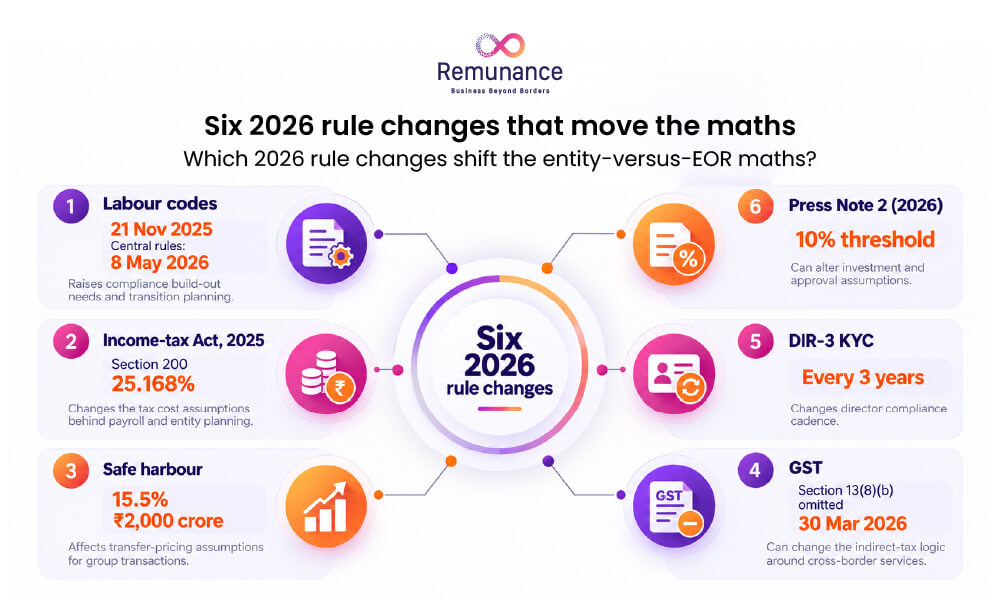
Six changes matter: the labour codes, the new Income-tax Act, transfer pricing safe harbour, GST on cross-border services, director KYC and the FDI rules for land-border investors.
Do the four labour codes change the crossover?
Barely, because they raise employment costs on both routes. What they change is how much compliance you own if you incorporate.
The four codes took effect on 21 November 2025, and the Centre notified its final rules under all four on 8 May 2026, as PRS Legislative Research tracks. States are still notifying their own rules. Karnataka’s final rules, for example, were still awaited in mid-2026.
On your own entity, you own every new obligation. That includes the 50% wage floor in salary structures, gratuity for fixed-term staff after one year and full-and-final settlement within two working days of exit.
Under an EOR, the provider carries that load. Our explainer on India’s four labour codes covers what changed.
What did the Income-tax Act, 2025 change for a new subsidiary?
The section number, not the rate. A domestic company can still elect 22% tax, an effective 25.168% with surcharge and cess.
The Income-tax Act, 2025 replaced the 1961 Act from 1 April 2026. The concessional regime that sat in Section 115BAA now sits in Section 200, and companies on it stay outside minimum alternate tax. PwC’s India tax summary sets out the current rates.
Foreign companies pay 35% before surcharge and cess, down from 40% since the 2024 budget. That rate matters later in this guide for branch offices and permanent establishment exposure.
How does the 2026 safe harbour cut transfer pricing costs?
It lets a small captive skip a full benchmarking study by accepting a 15.5% margin on its operating costs.
Budget 2026 merged software, IT-enabled services, KPO and contract software R&D into one IT services category with a single 15.5% safe harbour margin. The threshold rose from ₹300 crore to ₹2,000 crore, and an election can now lock in for five years, as KPMG’s summary of the rules explains.
For a subsidiary billing its parent on cost plus, that’s the cheapest route to transfer pricing in India compliance. It’s why the lean overhead model budgets only ₹1.5 lakh a year for direct tax.
The markup itself is rarely a net cost to your group. Your parent deducts the service fee it pays. What changes is where the profit sits and how long the cash waits in India before you repatriate it.
Does GST on your EOR invoice change the answer?
It can change it more than any other input. If your EOR’s invoice isn’t zero-rated as an export, 18% GST on the full invoice can pull the crossover down to about four employees.
Where GST applies to an EOR invoice, it has generally been charged on the whole invoice, salaries included, not just the fee. A foreign client can’t claim it back. On a ₹24 lakh CTC employee, that’s about ₹4.8 lakh a year per head.
The good news is that a properly structured EOR invoice to an overseas client can qualify as an export of services and be zero-rated.
2026 also removed a long-running trap. The Finance Act, 2026 omitted Section 13(8)(b) of the IGST Act from 30 March 2026, so intermediary services now follow the general rule that the place of supply is the recipient’s location. ICAI’s journal analyses the omission.
Ask your EOR to confirm in writing that its invoice meets the export conditions in Section 2(6) of the IGST Act, including payment in convertible foreign exchange. Our note on zero-rated GST for EOR services explains the conditions.
What else changed for directors and foreign shareholders?
Three smaller shifts, and one of them can block an entity outright.
- Director KYC is now every three years. From 31 March 2026, DIR-3 KYC moved from an annual filing to once every three financial years, per ICAI’s announcement. That’s one less yearly filing for your resident director.
- Land-border investors now have a 10% threshold. Press Note 2 (2026) lets non-controlling beneficial ownership of up to 10% from countries sharing a land border with India use the automatic route, as India Corporate Law explains. Above that, or with control, you still need government approval before you can capitalise a subsidiary.
- The EPF wage ceiling held at ₹15,000. Your payroll cost per head under ₹15,000 basic didn’t change in 2026, on either route.
Remunance Employer of Record
Want to Build a Better International Hiring Experience?
With Remunance, you can hire and support employees in India while managing payroll, compliance, benefits, and HR responsibilities through one EOR partner.
Talk to our EOR Expert
When should you set up an entity even below the crossover?
When the structure, not the cost, is the constraint. Four triggers justify a wholly owned subsidiary in India before the fee maths does.
Do you want to give your India team parent-company equity?
Then you’ll probably need your own Indian entity.
Under Schedule III of the Overseas Investment Rules, 2022, a resident can take foreign-parent ESOPs as an employee or director of that parent’s Indian office, branch or subsidiary, or of an Indian entity it holds equity in. An EOR’s employee meets none of those tests on paper.
Some EORs offer workarounds. Get FEMA advice before you promise options in an offer letter. This explainer on ESOPs from an overseas parent sets out the conditions.
Will your India team sell, sign or make decisions for the parent?
Then permanent establishment risk can outweigh every fee saving. If India-based staff habitually conclude contracts for your foreign company, Indian tax authorities can treat it as having a taxable presence here.
Profits attributed to that presence are taxed at the foreign company rate. That’s 35% plus surcharge and cess, an effective 36.4% to 38.22%.
A subsidiary taxed at 25.168% with a clean cost-plus arrangement is usually the tidier answer for revenue-facing teams. Read our pieces on EOR risks and the tax implications of using an EOR before you put sales leaders on an EOR.
Do you need contracts, leases or licences in your own name?
Then you need an entity, because an EOR can’t sign them for you.
Long-term Grade A or SEZ leases, government tenders, regulated licences and Indian customers who want a GST invoice from an Indian supplier all need your own legal person.
If office space is the only gap, flexible options can bridge it for a while. See our guide to office space for EOR teams in India.
Are you building a capability centre rather than a team?
Then plan the entity from day one and use EOR as the bridge. A GCC with a 50 to 100 person plan will pass every crossover in the table within its first year or two.
Many companies still build a GCC in India through the EOR model while the subsidiary is incorporated, then transfer. Our breakdown of the cost of setting up a GCC in India covers the bigger line items.
When should you stay on EOR even above the crossover?
When the entity’s hidden costs are risk, time and reversibility rather than fees.
Is India still a test you might reverse?
Then stay on EOR in India. An EOR exit is a notice period, while an entity exit can take 12 to 18 months if anything is left on the balance sheet.
Plenty of companies go the other way, too. Some switch from a subsidiary to EOR in India, and cost-centre subsidiaries in particular can find tax advantages in switching to EOR.
Do investors from a land-border country hold more than 10%?
Then incorporation needs government approval, with a 60-day timeline promised only for a few manufacturing sectors. An EOR involves no FDI, so hiring can start while you wait.
Can you staff a resident director and a compliance owner?
If not, the lean overhead model isn’t real for you.
Someone in India has to sign filings, chase the auditor and answer notices. A nominee director costs money. An unprepared one costs more.
Is your team spread across several states?
Then each state adds its own Shops and Establishments registration, professional tax and labour welfare fund filings. An EOR already holds those registrations. Your entity would need a set per state.
Remunance Employer of Record
Ready to Hire Employees in India?
Skip the complexity of setting up local employment processes. Remunance can help you hire, onboard, pay, and support your India team through a compliant EOR model.
Talk to our EOR Expert Is there a cheaper middle path between EOR and a full subsidiary?
Rarely for hiring. A private limited subsidiary company in India usually beats the other structures on tax, and a build-operate-transfer deal is the main real alternative.
| Structure | Can it hire and earn in India? | Tax on profits | Main catch |
| Liaison office | Can employ liaison staff, but can’t earn income | None, as it can’t trade | No commercial activity at all |
| Branch office | Yes, for RBI-permitted activities | 35% plus surcharge and cess | Taxed as a foreign company |
| LLP | Yes | 30% plus surcharge and cess | No ESOPs; FDI only in sectors open to 100% automatic route without performance conditions |
| Private limited subsidiary | Yes | 22% plus surcharge and cess (25.168%) | Full Companies Act compliance |
| Build-operate-transfer | A vendor hires and runs the team, then hands it over | The vendor’s | You pay a margin until transfer |
| EOR, then entity | Yes, from week one | The EOR’s | You pay EOR fees until you switch |
A build-operate-transfer deal suits teams that want a vendor to build the operation before handover. Our explainer on build-operate-transfer contracts covers the mechanics.
If you’re still weighing the two main routes in broad terms, start with EOR or subsidiary for global expansion.
How long does it take to move from EOR to your own entity?
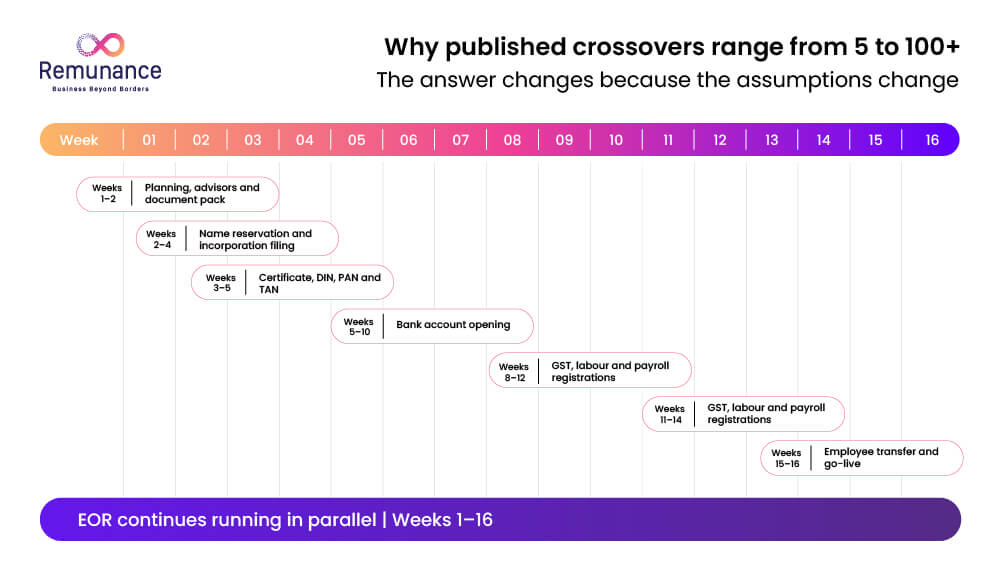
Usually 10 to 16 weeks to your first payroll, then a planned transfer date.
| Weeks | Step |
| 0 to 3 | Digital signatures, apostilled parent documents, name approval and SPICe+ incorporation |
| 3 to 12 | Bank account for a foreign-owned company, often the slowest step |
| 4 to 14 | Capital infusion, share allotment within 60 days and FC-GPR within 30 days of allotment |
| 4 to 12 | GST, EPF, ESIC, Shops and Establishments and professional tax registrations |
| 10 to 16 | Policies, payroll set-up and the first salary run on your own entity |
Keep the EOR running in parallel until the entity can pay. That’s the overlap cost the switch-point column prices in.
How do you move employees without breaking their benefits?
With their consent, fresh contracts that recognise past service, and no gap in EPF or ESI.
- EPF carries over. The employee’s UAN stays the same, so your entity registers them and the balance moves with them.
- Gratuity needs a decision. Service with an EOR is service with a different employer, so recognise it in the new contract or knowingly leave it out.
- Leave balances and notice terms should match. Carry them over in writing so nobody feels the move as a downgrade.
- Say why, early. People worry when an employer’s name changes, and a clear note on the reason goes a long way.
The principles in our guide to minimising employee disruption in a subsidiary-to-EOR switch apply in reverse. Our EOR switch strategies cover provider-to-provider moves.
How does Remunance help you decide, and switch when the maths flips?
By running this formula with your real quotes, employing your team now and forming your subsidiary when it pays.
Remunance is a Pune-based India specialist. We act as your employer of record in India from week one and set up your subsidiary when your numbers justify it.
After that, we can keep running payroll and HR on your new entity as a PEO. That shrinks the overhead line F in your formula.
We’ve done this before. One client used EOR to simplify its subsidiary formation in India, and companies such as Loylogic and CXO Systems built their Indian entities with our support.
Our leadership includes a Fellow Chartered Accountant. The tax and FEMA questions in this guide are ones we answer every week.
What else do foreign employers ask about EOR versus an Indian entity?
At what headcount is an Indian entity cheaper than an EOR?
Usually between 7 and 21 employees at a $249 monthly EOR fee, depending on how you run the entity. At $99 it’s 19 to 62, and at $599 it’s 3 to 9. Use N* = (F + (S + X) ÷ T) ÷ (12 × (E − v)) with your own quotes.
How much does it cost to set up a private limited company in India in 2026?
About ₹3.5 lakh to ₹15 lakh all-in for a foreign-owned company. The SPICe+ filing fee is nil up to ₹15 lakh authorised capital, so most of the cost is professional fees, registrations and FEMA filings. Running it then costs roughly ₹14 lakh to ₹48 lakh a year.
How long does it take a foreign company to start payroll on its own Indian entity?
Typically 10 to 16 weeks. Incorporation takes two to three weeks, and a bank account for a foreign-owned company often takes another four to ten. An EOR can usually onboard within days.
Does a foreign-owned subsidiary in India need a resident director?
Yes. Section 149(3) of the Companies Act, 2013 needs at least one director who stays in India for 182 days or more in the financial year. A private company also needs at least two directors in total.
Can employees move from an EOR to your own entity without losing gratuity?
They can, if the new contract recognises their prior service. EPF moves cleanly because the UAN stays the same. Gratuity doesn’t carry over automatically, so decide and document it.
Is GST charged on EOR services in India?
It depends on whether the invoice qualifies as an export. An EOR invoice to an overseas client, paid in foreign exchange, can be zero-rated. If it isn’t, 18% GST on the full invoice can make your own entity cheaper at just a few employees.
Does using an EOR create permanent establishment risk in India?
It can, if India-based staff habitually conclude contracts or make core decisions for your foreign company. Profits attributed to a permanent establishment are taxed at 35% plus surcharge and cess. Execution roles such as engineering and support carry far less risk.
Is a branch office cheaper than a subsidiary for hiring in India?
Rarely. A branch is taxed as a foreign company at 35% plus surcharge and cess, while a subsidiary on the concessional regime pays an effective 25.168%. A branch also needs approval through your bank under RBI rules and can only do permitted activities.

Related Posts

Employer of Record (EOR) for Small Businesses: All You Need to Know

Hire Employees in India: Complete Guide for Global Companies

Employer of Record India (2026): Hire Employees Without an Entity

What is an Employer of Record (EOR)? A Complete Guide

EOR Compliance Checklist: What You Need to Know Before You Hire