10 Benefits of Using an Employer of Record in 2026
An Employer of Record simplifies international hiring by managing local payroll, compliance, contracts, statutory benefits, and HR administration. Explore 10 key Employer of Record benefits and how businesses can use EOR services to expand into India.
What You Need to Know
The business world has changed. Discrimination between big and small businesses in terms of expansion no longer exists. Global hiring is now also accessible to small companies.
Today, businesses of all sizes hire talent beyond their borders. This gives access to skilled employees, reduced costs, and entry to new markets.
However, it is not as easy as it seems. Global hiring comes with employment laws, payroll, taxes, contracts, benefits, and employee records.
Now is the time to introduce the biggest help: an employer of record (EOR). An EOR can help remove the obstacles in your path.
In this blog, you will learn about:
-
- Most importantly, all the benefits of an employer of record
- Why do businesses use an employer of record?
- Benefits of EOR in business expansion
- How EOR can help to expand in India
This blog covers everything you need to understand about employer of record. So, read this till the end. Now let’s cover some basic information about employer of record.
What is An Employer Of Record?
An employer of record is a third-party organization that can legally employ candidates on your behalf in your specific country.
In that country, you don’t need a legal entity. An employer of record becomes your employee’s official employer. It manages compliance, payroll, tax withholdings, statutory benefits, and labor-law obligations.
Meanwhile, you get control of the person’s day-to-day activities.
Simply put, an EOR handles the paperwork and legal responsibilities, and business owners manage the working relationship.
Why Are Businesses Using Employer of Record Services in 2026?
How businesses form teams has changed over time.
Common Business Strategies are
-
- Remote work
- International hiring
- Specialized talent
- Faster market expansion
Businesses are also trying new markets without making heavy investments.
Setting up a subsidiary is time-consuming and involves legal, financial, and administrative costs. In this situation, the business will always look for other ways, and an EOR provides a better one.
Companies are showing interest in EOR when they want to:
-
- Hire employees in new countries
- Enter markets faster
- Reduce compliance risks
- Manage international payroll
- Build remote teams
- Test local talent
- Expand without immediately creating an entity
- Give employees locally compliant benefits
An employer of record service is a useful option when you want to expand, enter new markets, experience an organized process, and grow your business.
Ready to Expand Without Setting Up an Entity?
Explore how Remunance can help you hire employees in India, manage local compliance and payroll, and build your team without the immediate cost and complexity of setting up a subsidiary.
10 Key Benefits of Using an Employer of Record in 2026
1. Hire Employees Without Setting Up a Local Entity
As we mentioned before, EORs don’t need you to set up a legal entity in that specific country.
Setting up a subsidiary can involve
-
- Registration
- Legal work
- Banking
- Accounting
- Tax requirements
- Ongoing administration
This may not make sense when a company only wants to hire a small team.
An EOR already has the required local employment structure. This lets the company hire employees without having to establish its own entity at the start.
2. Enter the New Market Faster
Traditional market entry can take many months.
Companies must create
-
- A corporation
- Set up payroll
- Create HR procedures
- Comprehend local laws
An EOR can reduce some of the initial workload. Once the necessary information is in place, the organization can begin hiring and onboarding through the EOR.
This can help organizations get up and running faster and respond to market possibilities.
When organizations compete for highly skilled individuals, speed becomes especially critical.
3. Reduce Employment Compliance Risks
Employment laws differ by country.
Rules such as
-
- Contracts
- Working hours
- Leave
- Social security
- Taxes
- Termination
Employee benefits can also change over time.
Getting these requirements wrong can lead to penalties, disputes, or unexpected costs.
An EOR manages employment responsibilities based on local requirements. Its local knowledge can help companies avoid common compliance mistakes.
Businesses should still review the EOR’s compliance capabilities carefully before choosing a provider.
4. Simplify Payroll and Statutory Payments
International payroll can become complicated very quickly.
Different countries have different
-
- Tax systems
- Social security requirements
- Payroll deadlines
- Statutory deductions
Managing these operations internally can be tedious and time-consuming.
An EOR oversees payroll for employees in the country in which they operate. It can compute salaries, manage needed deductions, and facilitate statutory payments.
This provides firms with a more systematic way to manage international payroll.
5. Provide Locally Compliant Employment Contracts
Employment contracts need to meet local legal requirements. A contract that works in one country may not meet the rules of another.
Issues can arise around
-
- Probation
- Notice periods
- Leave
- Benefits
- Termination
- Working conditions
An EOR creates employment agreements based on local job requirements. Employees have contracts tailored to the country in which they work.
It also eases the strain on the client’s HR and legal departments.
6. Provide Statutory Benefits Without Building an HR Infrastructure
Employees expect benefits that comply with local employment laws.
Depending on the country, these may include
-
- Social security
- Retirement contributions
- Paid leave
- Insurance
- Gratuity
- Other statutory benefits
An EOR helps manage these obligations without forcing the client company to establish a full-fledged local HR function.
This is especially useful for organizations starting with a small multinational workforce.
7. Reduce the Administrative Burden on Your HR Team
International hiring creates a long list of administrative tasks.
HR teams may need to manage
-
- Onboarding
- Employee records
- Payroll coordination
- Leave administration
- Compliance documents
- Employee queries
An EOR handles many of these local job-creation activities.
This enables the internal HR team to concentrate on more strategic issues such as
-
- Recruitment
- Employee engagement
- Workforce planning
- Performance management
8. Hire and Test Local Talent Before Making a Long-Term Commitment
Businesses do not always know whether a new market will work for them.
An EOR lets companies hire local employees and test operations before investing heavily in a permanent local structure.
For example, a company may start with three employees in a new market. If the business grows, it can later establish its own entity.
This creates a more flexible approach to international expansion.
9. Scale Your International Team More Easily
International growth often starts with a small team and expands over time.
An EOR can help businesses add employees as their needs grow. The company does not have to build an entire HR and payroll infrastructure for every new market.
This makes EOR services useful for businesses that expect their international workforce to change over time.
10. Make It Easier to Transition to a Local Entity
An EOR does not always need to be a permanent solution.
A company may initially use an EOR to enter a market, understand local operations, and build a team. Once the business reaches a certain scale, it may decide to establish its own entity.
The EOR can support the employment process during the early stage and help make the transition more organized.
This gives businesses flexibility as their international operations mature.
Benefits of Hiring Through an Employer of Record
An EOR not only benefits the company. It can also improve the employment experience for workers.
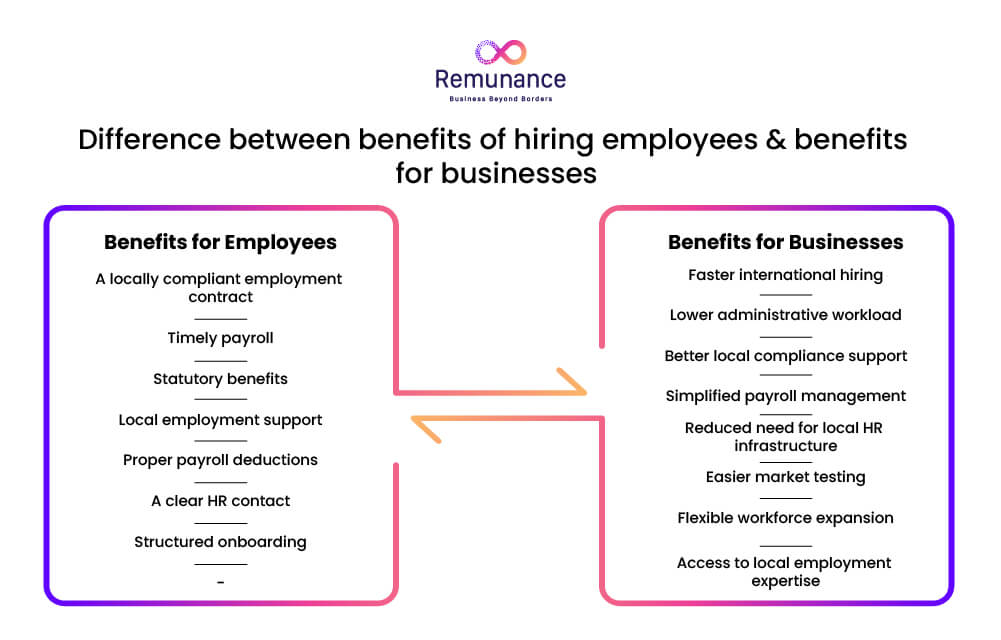
Benefits for Businesses
Businesses can benefit from an EOR through:
-
- Faster international hiring
- Lower administrative workload
- Better local compliance support
- Simplified payroll management
- Reduced need for local HR infrastructure
- Easier market testing
- Flexible workforce expansion
- Access to local employment expertise
The biggest advantage is that businesses can focus on their core operations while the EOR manages many local employment responsibilities.
Benefits for Employees
Employees can also benefit from being hired through an EOR.
They can receive:
-
- A locally compliant employment contract
- Timely payroll
- Statutory benefits
- Local employment support
- Proper payroll deductions
- A clear HR contact
- Structured onboarding
For remote employees working for an overseas company, having a local employment structure can also provide greater clarity about their employment terms.
Remunance Employer of Record
Want to Build a Better International Hiring Experience?
With Remunance, you can hire and support employees in India while managing payroll, compliance, benefits, and HR responsibilities through one EOR partner.
Talk to our EOR Expert
How an EOR Can Help Companies Expand Into India
India is one of the best destinations for international companies to expand. It has a large talent pool, a growing economy, and abundant technology.
India is also known for engineering, finance, research, business services, and other industries.
However, if you want to hire in India, you should have thorough local knowledge of employment and payroll requirements.
An India-focused EOR can help global businesses with:
-
- Hiring Indian employees
- Employee documentation
- Compliance management
- Payroll processing
- Tax and statutory deductions
- Employee benefits
- Employee onboarding
- Background verification
- Preparing employment contracts
- Ongoing HR support
Instead of setting up a local Indian entity, a company can use an EOR to hire and understand the market.
This is a great plan for businesses that want to establish a small team first and then scale after fulfilling the plan.
With an experienced EOR, it becomes easier to gain local knowledge that an international team may not have.
Why Choose Remunance as Your EOR Services Provider in India?
Choosing the right EOR services provider in India matters because your employees, payroll, compliance, and local employment processes depend on it.
Remunance helps international businesses hire and manage employees in India through an India-focused EOR model.
Its support covers key areas of the employment lifecycle, including hiring, onboarding, payroll, compliance, background verification, and benefits monitoring.
Remunance focuses on:
-
- Local expertise: Support from a team familiar with India’s employment environment.
- Compliance-focused processes: Employment and payroll processes designed around applicable Indian requirements.
- Human-first support: Employees and clients have access to responsive HR support.
- Transparent pricing: Clear pricing with no hidden fees.
- Technology-enabled HR: Digital tools help manage employee and payroll information.
- End-to-end support: Businesses can manage their Indian workforce through one EOR partner.
For a company planning to hire in India, an EOR can remove much of the early complexity involved in international employment.
The right EOR partner in India can help you hire faster, manage employees more efficiently, and build your Indian team with greater confidence.
Remunance Employer of Record
Ready to Hire Employees in India?
Skip the complexity of setting up local employment processes. Remunance can help you hire, onboard, pay, and support your India team through a compliant EOR model.
Talk to our EOR Expert FAQs
What are the main benefits of using an Employer of Record?
The main benefits include hiring employees without setting up a local entity, faster market entry, reduced employment compliance risks, simplified payroll, locally compliant contracts and benefits, lower HR administration, easier talent testing, and more flexible international expansion.
Can an EOR help a company hire employees without setting up a local entity?
Yes. An EOR can legally employ workers in a country where the client company does not have its own local entity. The EOR manages local employment responsibilities while the client directs the employee’s day-to-day work.
How does an EOR make international hiring faster?
An EOR already has a local employment structure and processes for payroll, contracts, statutory requirements, and onboarding. This can remove much of the initial administrative work involved in establishing a local employment setup.
How does an EOR reduce employment compliance risks?
An EOR manages employment-related responsibilities according to local requirements, including contracts, payroll, statutory deductions, benefits, and other employment obligations. Businesses should still evaluate an EOR provider’s compliance capabilities before choosing one.
Can businesses use an EOR to test a new market?
Yes. An EOR allows businesses to hire a small local team before committing to their own entity. This can help companies evaluate market opportunities and local talent before making a larger investment.
Can an EOR help businesses scale an international workforce?
Yes. An EOR can support the addition of employees as business needs change, allowing companies to expand their workforce without immediately building separate local HR and payroll infrastructure.
What benefits can employees receive through an EOR?
Employees can receive locally compliant employment contracts, timely payroll, statutory benefits, appropriate payroll deductions, structured onboarding, and access to local HR support.
How can an EOR help a company expand into India?
An India-focused EOR can help international businesses hire employees, prepare employment documentation, manage payroll and statutory deductions, support compliance, administer benefits, conduct background verification, and provide ongoing HR support without requiring the company to immediately establish an Indian entity.

Related Posts

Employer of Record (EOR) for Small Businesses: All You Need to Know

Hire Employees in India: Complete Guide for Global Companies

Employer of Record India (2026): Hire Employees Without an Entity

What is an Employer of Record (EOR)? A Complete Guide

EOR Compliance Checklist: What You Need to Know Before You Hire