Best Ways to Pay Independent Contractors and Freelancers
Hiring remote workers and contractors is extremely important for many businesses in this day and age. In this context, this blog discusses how to pay independent contractors and freelancers in a legal, efficient, and economical manner.
What You Need to Know
Many businesses hire independent contractors and freelancers worldwide. They employ contractors in their own country and also from abroad.
Before hiring them, it’s important to understand how to pay independent contractors/freelancers.
If there are issues with payment, it affects the working relationship with a contractor. Worse, it may even result in a legal issue and can harm a business’s reputation.
This is why we explain in detail how to pay independent contractors and freelancers in this blog.
What is an Independent Contractor or a Freelancer?
Wondering how to pay independent contractors/freelancers? Before we discuss that, let’s talk about what these terms mean.
An independent contractor or a freelancer can be an entity or a self-employed individual. They provide services to a company, an individual, or an institution under an agreement.
Compared to an organization’s employees, independent contractors tend to have more autonomy. They set their working hours and use their own equipment, such as laptops and an internet connection.
They can work for multiple clients, unless there’s a conflict of interest. They are usually hired for a specific project or a requirement, which can be short-term or long-term.
What are the Best Practices for Paying Independent Contractors & Freelancers?
A large part of how to pay contractors/freelancers is about the best practices you need to follow. So, let’s talk about this aspect in detail.
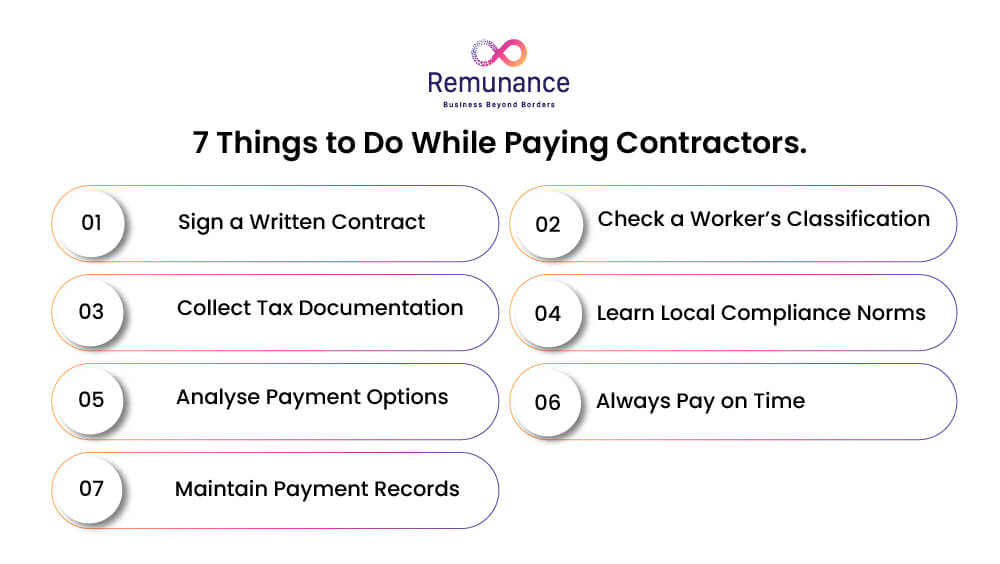
How to Pay Contractors? Check Contracts, Tax Docs, & Compliance
A business should ensure that all contracts, tax papers, and legal requirements are in place before paying freelancers or independent contractors.
This helps avoid payment disputes and reduces the possibility of legal risks. If you employ a contractor in another country, it ensures smooth cross-border transactions. These are the steps you should follow:
- Sign a written contract: You should sign a written contract with a contractor in which you must establish the scope of work. You should also define payment terms, project timelines, expected output, and IP rights in the contract.
- Check the classification of a worker: You must ensure that an individual is correctly classified as an independent contractor. Any mistake regarding classification may result in penalties, fines, or even back taxes.
- Collect the tax documentation: You must collect the required tax documents and invoices. Such documentation is usually required by local regulations. That said, tax documents may vary based on a contractor’s country.
- Read local compliance norms: It’s very important to understand the local legal compliance norms of a contractor’s country of residence. These norms are about tax, invoicing, & data protection.
- Check payment details: You need to check the payment details of contractors/freelancers. These include bank account information, currency, & preferred payment method. Otherwise, it can result in a failed transaction.
- Keep correct records: This is of the utmost importance for audits and regulatory requirements. So, you should always maintain copies of contracts, invoices, receipts, and tax documents.
How to Pay Contractors? Select Secure & Cost-Effective Modes of Payment
A business should ensure that contractors and freelancers are paid accurately and on time. For that, it must select the right payment method with minimal transaction costs. Here are the steps you should follow in this regard:
- Analyze payment options: You must compare various payment options. These options include bank transfers & digital wallets. You should check their cost, speed, safety, and availability in the contractor’s country.
- Select secure payment methods: Rely on secure and trusted contractor payment methods and financial institutions to make payments. Ensure that these methods offer safety features to protect the important payment information. These features include fraud protection, encryption, and authentication.
- Always pay on time: Stick to the payment schedule, as that helps to build trust and create a good working relationship between an employer and a contractor.
- Consider all the fees: Transaction and currency conversion fees may need to be paid for contractors in another country. So, you should choose a player with competitive fees in this regard.
- Maintain payment records: You should keep a record of payment confirmations. For that, you must store receipts and transaction histories. It will help resolve disputes if they arise. It can also help you in financial reporting.
Having discussed how to make payments to contractors, let’s discuss the best ways to pay them.
Pay Contractors in India With Confidence
Simplify contractor payments, compliance, and classification with Remunance’s expert support in India.
Which are the Best Methods to Pay Independent Contractors & Freelancers?
After learning how to pay contractors, let’s talk about the best ways to pay them.
So, here are the best ways to pay independent contractors and freelancers:
-
- Local Bank Transfers
- International Bank Transfers
- Digital Payment Platforms & Wallets
How Do Local Bank Transfers Help Pay Contractors?
One of the best and most cost-effective ways to make payments to contractors is local bank transfers. This is an efficient way to make payments to freelancers who have a bank account in the same country as the business they work for.
Local transfers use the domestic banking network of a country. Hence, they are a fast and economical payment mode.
Examples of local bank transfers are as follows:
-
- India: Companies often pay independent contractors through National Electronic Funds Transfer (NEFT), Real Time Gross Settlement (RTGS), Immediate Payment Service (IMPS), or Unified Payments Interface (UPI). These are all methods of making local bank transfers in India.
- Europe: Firms often use Single Euro Payments Area (SEPA) transfers in order to pay independent contractors/freelancers who are in European countries. SEPA lets them make payments fast and at a low cost.
- United States: Many businesses use the Automated Clearing House (ACH) network to make direct deposits into the bank accounts of contractors in the US. Such transfers are not expensive and are most suited for recurring payments.
Benefits of local bank transfers include:
-
- Lower transaction fees vis-à-vis international payment methods.
- Fast processing times. Many payments get settled within minutes.
- Secure payments because transactions get processed through efficiently regulated domestic banking systems.
- Ease of tracking, as banks issue transaction references.
- Best-suited for recurring payments. Hence, these methods are ideal for contractors that work on long-term projects.
Now that we have discussed how to pay contractors using local banks, let’s talk about how to pay overseas contractors.
How do Companies Use International Bank Transfers to Pay Contractors & Freelancers?
Let’s say a company is located in one country, but the contractor it employs is located in another country. In this case, it can use international bank transfers to pay the contractor directly into his bank account.
Such payments are usually processed through the SWIFT network. It enables banks to exchange payment instructions securely across the world.
This mode of transfer is typically preferred when the transaction value is high. It’s also preferred when parties prefer direct bank-to-bank payments.
This is how international bank transfers work. When a contractor submits his invoice, the hiring company begins the process of an international transfer through its bank.
The bank uses the SWIFT network to send payment instructions. This is how the money is transferred to the contractor’s bank account.
The contractor can receive the payment in his local currency. He can also receive it in the currency of his hiring company.
Benefits of international bank transfers include:
-
- Global reach: Companies can pay freelancers in many countries through this mode.
- Security of payments: Payments are made through secure banking protocols.
- Good for large payments: This mode is suitable for high-value payments. It’s also good for long-term engagements with contractors/freelancers.
- Direct bank deposits: Payments are directly credited to a contractor’s bank account. It doesn’t require a separate payment app.
International bank transfers have some limitations, too. For example, such transfers may involve higher transaction fees than local bank transfers. They may also involve currency conversion costs. It can take 1-5 days to process such payments.
How to Pay Contractors Using Digital Payment Platforms & Wallets?
Digital payment platforms and wallets are a convenient way to pay contractors and freelancers. This is especially the case when working with remote contractors located in different countries.
This mode offers faster processing times and competitive currency exchange rates compared to international bank transfers.
Prominent examples of digital payment platforms are as follows:
-
- PayPal: PayPal allows companies to pay contractors/freelancers in many countries. It’s one of the most popular payment platforms in the world. Besides, it supports multiple currencies. Many freelancers and small firms also use it to receive payments.
- Wise: Wise specializes in international money transfers using the mid-market exchange rate. It helps send payments to bank accounts in many countries. It’s also reputed for transparent fees and competitive currency conversion rates.
- Payoneer: Payoneer is meant for global businesses and freelancers. It allows firms to pay contractors in many currencies. Independent contractors/freelancers can receive funds in their Payoneer account. Then, they can withdraw the funds to their local bank account. Besides, they can use a Payoneer card where available.
Advantages of using digital payment platforms are as follows:
- Quick international payments: These platforms allow transactions to get completed within minutes or a single business day.
- Competitive forex rates: They help lower currency conversion costs due to competitive foreign exchange rates.
- Pay contractors in their own currency: These platforms allow firms to pay contractors in their preferred currency, if possible.
- Robust security: They offer strong security measures. These include encryption and two-factor authentication, ensuring the safety of financial transactions.
- Better tracking of payments: Digital payment platforms offer real-time notifications and transaction histories, enabling improved payment tracking.
How Important Are Country-Specific Compliance Considerations When Paying Independent Contractors?
To know how to pay contractors, you should learn the country-specific compliance requirements.
If you don’t follow these regulations, you may face a legal suit or you may be required to pay a penalty. So, let’s discuss this aspect.
Follow Local Tax and Legal Requirements
Regulations regarding taxes, invoices, and reporting are different in different countries. Hence, it’s essential to understand the local rules before you pay contractors.
Failure to follow such rules may result in compliance issues or penalties. So, watch out for the following:
- Collect the necessary tax documents: You should get all relevant tax documents required in a country. Such documents help you understand the tax status of a consultant.
- Review invoicing requirements: You must review invoicing requirements. Sometimes, contractors have to provide invoices with certain information. They may need to provide their business’s name and tax identification number. You should ensure that all the necessary details are provided in the invoices.
- Understand withholding tax obligations: Some countries have rules that make it necessary for a business to withhold tax from contractor payments. This is especially the case for cross-border services. So, you should know such rules.
- Maintain correct records: You must maintain accurate records of documents related to contracts, invoicing, and taxes. This supports accounting and audits.
Let’s talk about the compliance requirements to keep in mind in the US and in India.
- United States: Firms that hire independent contractors based in the US are often required to collect Form W-9. This helps get the details about a contractor’s taxpayer identification. Companies may also be required to file Form 1099-NEC with the Internal Revenue Service (IRS). This is to report eligible nonemployee compensation.
- India: When a business pays an independent contractor in India, it may be required to deduct Tax Deducted at Source (TDS) under the Income-tax Act. This depends on the nature of payment and applicable thresholds. If a contractor is registered under the Goods and Services Tax (GST) regime, he may be required to issue GST-compliant invoices where required.
Avoid Worker Misclassification and Contractor Compliance Risks
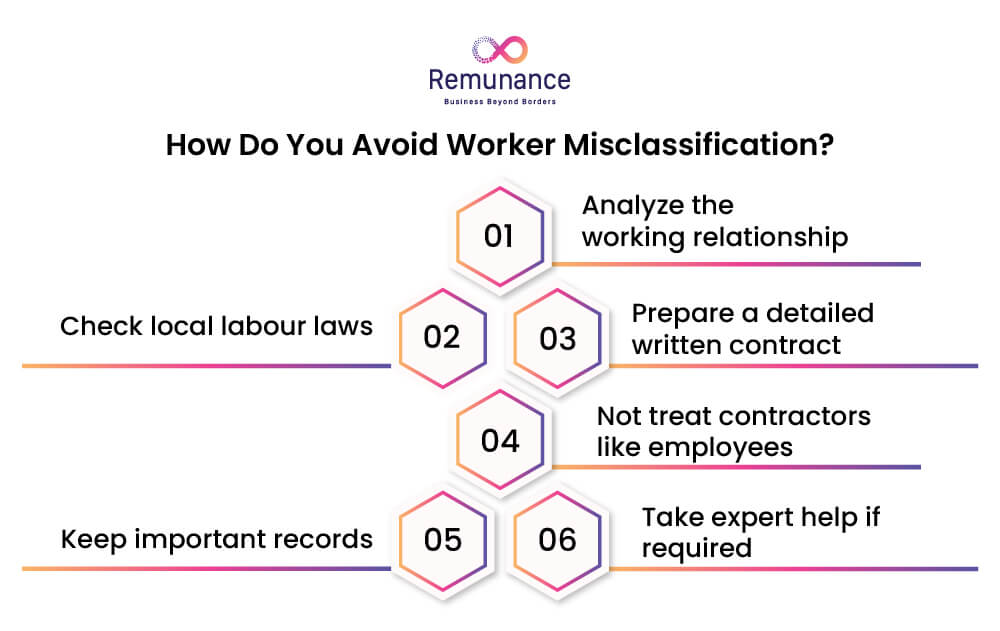
Before learning how to pay contractors, you should know how to correctly classify workers. A company must ensure that a person meets the legal criteria for the status of an independent contractor.
If a worker is misclassified as an independent contractor, a company may have to pay penalties. It may be told to pay back taxes and unpaid employee benefits, too.
This is what a business must do to reduce compliance risk:
-
- Analyse the working relationship: You must consider the level of control over a contractor’s work. Then, you should see whether a contractor can work for multiple clients and whether he uses his own equipment for work. This will help you decide whether he’s a contractor. Bear in mind that worker classification rules may vary by country.
- Read local labour laws: The rules governing independent contractors may vary across countries. So, if you’re hiring internationally, you should read local labour laws and regulations.
- Prepare a detailed written contract: You should draft a comprehensive written contract. In that, you must define the scope of work, payment terms, assignment duration, IP rights, and any other important clause.
- Don’t treat contractors like employees: To reduce misclassification risk, you shouldn’t expect contractors to work fixed hours. You shouldn’t provide them with employee benefits. You should also not supervise their work extensively on a daily basis.
- Keep important records: You must maintain supporting documents like contracts, invoices, and payment histories. It will help you establish the nature of the working relationship with a contractor when a regulator asks.
- Take expert help if required: You should consider taking the help of a legal or tax professional for engaging foreign contractors when required. If needed, you can also take the help of a Contractor of Record (COR), who can guide you with compliance.
How Can Remunance Help You Pay Independent Contractors in India?
Remunance has built an enviable reputation for helping companies engage with Indian contractors legally and efficiently.
Its expertise helps companies structure contracts with Indian contractors in a compliant manner. Besides, it provides TDS and GST-related guidance.
Remunance offers cross-border payment support so that businesses can pay Indian contractors correctly and on time. Its tech-savvy systems ensure that its client firms never face payment-related issues.
Most importantly, it can also help its client firms understand when a contractor becomes an employee. As a result, it helps reduce misclassification risk to a great extent.
If you’re thinking about how to engage and pay contractors in India, you should contact Remunance now!
Remunance Employer of Record
Ready to Pay Contractors in India With Confidence?
Simplify contractor payments, TDS, GST, contracts, and classification with Remunance’s expert support.
Get Contractor Support
FAQs
How to pay contractors legally in different countries?
To pay contractors in multiple countries, you need to verify whether they are actually an independent contractor. Then, you must prepare a compliant contract.
You need to comply with relevant tax and labour laws. Finally, you should select a secure payment method.
How to pay contractors without setting up a local entity?
If you aren’t sure how to pay contractors without setting up a local entity, then don’t worry because you can do so. You can work with independent contractors directly and pay them using international bank transfers. You can also pay them using digital payment platforms.
Can a Contractor of Record (COR) help you learn how to pay contractors?
A COR can help you pay contractors in a legal manner. It can handle compliant contracts, tax documentation, and contractor classification. It can also help you follow local regulations.
How to pay contractors securely while minimizing payment fees and delays?
You need to use reliable global payment platforms to pay contractors while minimizing payment fees and delays.
To reduce conversion costs, you should pay in a contractor’s local currency if possible. Apart from that, you must automate payments.
How can you pay independent contractors in different currencies?
You can pay contractors/freelancers in different currencies through global payment platforms, like Wise, Payoneer, etc.
You can also use international bank transfers for the same. When you pay a contractor in his local currency, it can reduce conversion costs. It can also improve transaction speed.
How to pay contractors while avoiding worker misclassification?
You must assess the employment status of an individual correctly under local laws. Apart from that, you should use compliant agreements and maintain proper documents. These practices will help you avoid misclassification risk.
How to pay contractors on time across multiple countries?
Knowing how to pay independent contractors across multiple countries on time is very important. To do that, you should automate payment schedules and pay in a contractor’s local currency if possible. These measures will help you reduce payment errors and delays.
What are the benefits of digital payment platforms for paying independent contractors?
If you’re thinking about how to pay contractors quickly and in a secure way, then digital payment platforms can help you. These platforms allow you to pay contractors within minutes. Besides, they offer robust security measures, like encryption and two-factor authentication.
Their other benefits include competitive forex rates and efficient payment tracking.
Are there any limitations to using international bank transfers to pay independent contractors?
International bank transfers may make you pay higher transaction fees than local bank transfers. They may also require you to incur currency conversion costs. Such transfers may even take 1-5 days to process.
What are the benefits of local bank transfers for paying independent contractors/freelancers?
If you’re thinking about how to pay contractors in your own country, then local bank transfers can be the best way to do so.
Such bank transfers offer lower transaction fees than international bank transfers. Besides, due to fast processing times, your payment will get settled within minutes.
How can you pay contractors without creating payroll in your company?
Independent contractors are not your company’s employees. Hence, you can pay them without having to add them to your firm’s payroll. To pay them, you can use local or international bank transfers or global payment platforms.
You can even go through a Contractor of Record (COR), who can ensure that contracts, tax documents, and compliance are in place.
Which are the famous digital payment platforms & wallets that can help pay consultants and freelancers?
PayPal, Wise, and Payoneer are popular digital payment platforms that have helped many businesses pay consultants and freelancers.

Related Posts

Contractor of Record vs. Employer of Record : Which to Choose? (2026)

Contractor Benefits: How Enterprises Can Offer Them Without Increasing Risk

What is a Contractor of Record? Complete Guide

How Does Remunance Manage Independent Contractors in India Better?