How to Hire Employees in India from the US?
US companies can hire employees in India through contractors, an Employer of Record (EOR), or an Indian subsidiary. This guide compares these options, explains the benefits of hiring in India, and outlines illustrative salary and EOR costs to help businesses choose the right hiring route.
What You Need to Know
Every year, India produces over 10.7 million new graduates, as per Data for India, an official public data and research platform. This means foreign companies hiring in India can access a large talent pool. To hire employees in India from the US, you may choose one of the routes below:
-
- By hiring independent contractors
- Via Employer of Record (EOR)
- By establishing an Indian subsidiary or Global Capability Center (GCC)
Outsourcing talent from India depends on your hiring needs and budget. This guide helps you hire employees in India from the US as cost-effectively as possible.
Why is India a Preferred Outsourcing Destination for the US?
India has approximately 4.2 times the population of the US. The world increasingly looks at India as a strategic global business hub because of its growing technology ecosystem and potential to reduce hiring costs.
It offers global employers significant opportunities to:
-
- Access skilled talent
- Enable simple Market Entry
- Provides digital infrastructure
- Support long-term growth.
India’s large population, wide range of professional skills, and mature GCC clusters make it a preferred hub for outsourcing talent. India benefits greatly from outsourcing talent because it boosts economic growth and human capital development. Now let’s look at the benefits of hiring in India.
How Do US Companies Benefit From Hiring In India?
For most of the US companies, the potential cost difference is the key factor in exploring hiring in India. This creates opportunities to hire professionals with the skills needed to build products, manage operations, and support customers. US companies benefit from hiring employees in India due to:
-
- Large talent pool: According to Federal Reserve research from April 2026, India had approximately 2.6 million bachelor’s-level or higher STEM graduates in 2020. This was one of the largest pools of STEM graduates among the countries examined. India offers a wide range of professionals in technology, engineering, finance, data analytics, and across all sectors.
- Skilled professionals at lower costs: Demand for Indian IT professionals is surging worldwide, particularly in engineering and technology sectors. Hiring in India may cost less than hiring for the same role in the US because it provides access to skilled Indian professionals at a lower cost. For example, the average salary for a software engineer in India is around 8 LPA to 12 LPA. This calculates to $9,300–$13,950 per year.
- Evolved Global Capability Centers (GCC) clusters: India has a well-developed network of Global Capability Centers set up by international companies. India’s established GCC ecosystem shows that global companies can manage a wide range of operations from the country. According to the Economic Survey, India reported 1,700 GCCs employing nearly 1.9 million professionals in 2024. Cities such as Bengaluru, Mumbai, Hyderabad, Pune, Chennai, and Delhi NCR have become GCC hubs due to global corporate presence.
- Longer operating coverage: Different time zones enable planned handovers and sufficient overlap between teams. team across time zones enable extended software testing, customer support, and other workflows beyond US business hours. This benefit requires planned handovers and sufficient overlap between teams, which boosts long-term business growth.
Ready to Build Your Team in India?
Access India's skilled talent pool while reducing hiring costs. Remunance helps US companies hire employees in India through compliant EOR services, without setting up a local entity.
How To Hire Employees In India From The US?
You can implement a well-planned hiring strategy for employees in India in three ways:
Hiring Independent Contractors or Freelancers:
This route is ideal if you want to engage a few workers directly from India for a set period. As a legal employer, you are responsible for their pay and compliance. For example, if you are a US software company, you may require two developers for a six-month project. You can engage these two developers as independent contractors temporarily for a definite task.
Best for: Hiring 1-3 independent contractors for project-based work that does not require regular employment.
Via Employer of Record (EOR) Route:
An employer of record (EOR) in India lets you expand your business or build remote teams in India. The EOR providers offer end-to-end compliance services for real-time employee management in India.
The EOR route is one of the most convenient options for legally employing your chosen candidate in India while your US company manages their daily tasks. It is a third-party organization that works on your behalf, and it is cost-efficient as it minimizes the initial hiring and administrative cost of setting up a local entity.
The EOR handles the employment contracts, onboarding, payroll, and applicable tax deductions. It also helps you comply with Indian employment laws.
Best for: Hiring employees without immediately establishing an Indian local entity.
Setting Up a Subsidiary in India:
Setting up an Indian subsidiary gives you direct employment relationships. It involves a setup cost and ongoing administrative responsibilities.
As an employer, you will have to manage the payroll, registrations, HR management, and compliance of the employees. These responsibilities are yours because you are the legal employer of these employees
Best for: Companies planning to build long-term operations and expand their team in India.
Why Should a US Company Consider an EOR Provider For Hiring In India?
Using an EOR service is convenient because it reduces the administrative workload involved in managing employment, payroll, and compliance.
Here are important reasons why US companies must consider choosing an EOR to hire in India:
-
- Flexibility to test the Indian market: If US companies want to test hiring 2 or 3 employees in India, an EOR helps them build a team immediately without setting up a local office. Later, if the team grows significantly, the company can decide to set up a Global Capability Center (GCC) or a local entity.
- Faster hiring process: Onboarding of chosen candidates and establishing a legal entity consume a lot of time. With an EOR, companies can hire candidates without waiting to set up their own Indian entity.
- Compliance with Indian employment laws: India has its own employment rules and tax-deduction policies. An EOR manages payroll and employee-related benefits, helping companies reduce compliance risks.
Remunance Employer of Record
Hire in India Without the Compliance Hassles
Build your Indian team faster with Remunance. Our EOR services handle employment contracts, payroll, onboarding, and statutory compliance, so your US business can focus on growth without setting up a local entity.
Talk to Our EOR Experts
How Much Do U.S. Companies Save By Hiring In India?
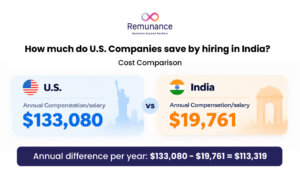
According to the U.S. Bureau of Labor Statistics, an average software developer in the U.S. earns $133,080 a year.
Meanwhile, in India, an average software developer earns $19,761 / year.
How much did the US company save?
-
- Annual difference: $113,319
- Percentage difference: ($113,319 ÷ $133,080) × 100 = 85.15%
Based on these figures, a U.S. company can save up to $113,319 by hiring a developer in India. But this is just the wage, not the employer’s total cost. These figures illustrate why salary alone understates employment costs.
Now let us explore what the cost structure looks like if the US company considers hiring through an Indian EOR.
US vs. India Hiring Costs: An EOR Cost Comparison
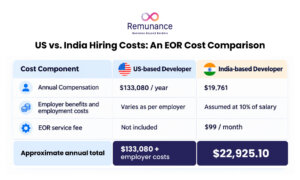
Hiring in India may cost less than hiring for the same role in the US. Using an EOR to hire employees is more cost-effective than hiring local candidates directly.
Here is the calculated comparison, assuming employer costs in India are 10% of annual salary and the EOR fee is $99 per employee per month.
-
- Annual cost difference: $133,080 − $22,925.10 = $110,154.90
- Approximate cost reduction: 82.77%
Estimated annual India hiring cost through an EOR provider: $22,925. It is far less than $133,080. This is 82.77% lower than the annual salary of a US-based software developer.
The above is an example, not a claim. Actual salaries depend on experience, location, specialist skills, and the hiring company.
How Does Remunance Make Hiring in India More Cost-Effective?
Hiring in India may cost less than hiring for the same role in the US. When deciding whether to trust an Indian EOR over a local hire, the large talent pool isn’t the only factor.
Using an EOR to hire employees is more cost-effective than hiring local candidates directly. You should also consider how much you save on employment costs compared with hiring locally in the US.
Most EOR providers in India charge about $200–$600 per employee per month in service fees. This is a common cost structure, but some EOR providers, like Remunance, charge even less than $200. Their published starting price is $99 per employee per month for their EOR service in India.
Estimated India Hiring Cost via an EOR Provider
Let us use the same example of a software developer. To compare the hiring cost of the software developer through an EOR provider, consider:
-
- Average salary of an Indian software developer: $19,761 / year
- Assumed employment costs at 10%: $1,976
- Illustrative EOR fee: $99 monthly or $1,188 annually
- Estimated annual total: $22,925 (about $22,900)
- Estimated employment cost saved: $110,155 /year
Estimated annual India hiring cost through an EOR provider: $22,925. However, this salary difference is for illustration only the actual salary may vary based on job role and Indian tax rules.
Additionally, the India EOR cost guide covers monthly services, pricing models, and compliance expenses.
Conclusion
An Employer of Record lets US companies access Indian talent without setting up a local subsidiary. With global employment outsourcing, hiring through an EOR is easy, fast, and fully compliant, so businesses can scale without limits.
To hire employees in India from the US, evaluate your cost structure, compliance requirements, and long-term goals. Whether you want to hire through an EOR, set up a local entity, or engage independent contractors depends on your budget, team size, and geographic presence. Reviewing the benefits of each route is essential to choosing your next best hire in India.
Remunance Employer of Record
Ready to Hire Employees in India Without Setting Up a Subsidiary?
Access India's skilled talent while reducing hiring costs and compliance complexities. Partner with Remunance for end-to-end EOR services, from onboarding and payroll to statutory compliance. Build your Indian team with confidence.
Get Started With Remunance FAQs
What is an EOR (Employer of Record)?
An EOR is the legal mechanism that lets you access talent in India without setting up a local subsidiary.
Can a US company Hire Employees in India?
Yes, a US company can hire employees in India by using an EOR (employer of record) service, by setting up its own local entity, or by hiring an independent contractor in India.
How much does it cost to hire an employee in India?
Hiring an employee in India typically costs 1.15 to 1.5 times their base salary, depending
on employer contributions, benefits, and other employment expenses.
How do US companies pay Indian employees?
US companies typically pay Indian employees in Indian rupees (INR) through a local entity or an EOR provider that manages payroll and converts the company’s funds to INR as needed.
What is the best way to hire employees in India?
The best way to hire employees in India depends on whether you have a legal entity and the talent you need. You may use an EOR for faster and compliant hiring or set up your own legal entity if you plan to build a team long-term.

Related Posts
How to Hire Employees in India Without an Entity: 4 Routes, Real Costs and a Day-One Checklist for 2026

Building a Remote Team in India: Benefits, Challenges & EOR Solutions

Hire Employees in India: Complete Guide for Global Companies

Employer of Record India (2026): Hire Employees Without an Entity

How Much Does an Employer of Record Cost? Full Breakdown