How 6 Cities Made India The Global Capability Center Capital
India’s GCC ecosystem is led by Bangalore, Hyderabad, Pune, Chennai, Mumbai, and Delhi NCR. Explore each city’s talent, industry strengths, infrastructure, and costs to identify the right location for your Global Capability Center expansion.
What You Need to Know
Would you believe it if I told you that 6 Indian cities host a staggering 92% of Global Capability Centers (GCC’s)? Is it surprising? So, let me explain to you how!
India is the most popular and preferred destination for Global Capability Centers (GCCs) in the world. This started as a potential way for international companies to hire cost-effective employees. Now, this has become a huge ecosystem focused on:
-
- Technology
- Research
- Product Development
- Analytics
- Finance
- Innovation
As per the report for FY2024, India has 1700+ GCCs and employs 1.9 million professionals. This helped India generate about $64.6 billion in revenue.
Many of these centers have also shifted their focus from traditional support work to transformation and portfolio-related roles.
Making India the GCC powerhouse wouldn’t have been possible without the contribution of the major 6 cities.
-
- Bangalore
- Hyderabad
- Pune
- Chennai
- Mumbai
- Delhi NCR
These six major Indian cities played a central role in building this ecosystem. Let’s understand more about this.
What is a Global Capability Center?
A Global Capability Center is a foreign unit. MNCs establish and own them to support significant global operations.
Earlier, many GCCs focused on activities such as
-
- IT support
- Finance processing
- Customer service
- Other back-office functions
But now the GCC model has changed significantly.
Today, GCCs can manage
-
- Software development
- Artificial intelligence
- Cybersecurity
- Engineering research
- Product development
- Data analytics
- Finance
- Risk management
- Supply chain operations
- Other strategic functions
According to NASSCOM’s GCC report, about 90% of Indian GCCs function as multinational centers. They support areas such as technology, operations, and product engineering. The research also says that more than half have moved toward portfolio and transformation roles.
This change shows that foreign companies are no longer exploring India to reduce costs. India is also preferred for its talented candidates.
Ready to Build Your GCC in India?
Move beyond cost savings and build a strategic GCC with the right talent, structure, compliance, and local support from day one.
How Did India Become a GCC Capital?
India’s GCC growth isn’t the result of a single factor, but of several factors working together.
The country has:
-
- A large technology and engineering talent pool
- A mature IT services ecosystem
- Established business infrastructure
- Strong educational institutions
- Experience working with global companies
India has six leading cities behind this GCC growth. Each city is known for its expertise in particular industries and functions. This approach has created more opportunities for foreign companies to choose their preferred city for a GCC setup in India.
All these top cities have developed different and significant strengths,
-
- Bangalore leads overall GCC activity
- GCC in Hyderabad has emerged strongly in healthcare and biotechnology
- Chennai has benefited from its manufacturing and automotive base
- Delhi NCR has developed into a corporate services hub
- Mumbai remains important for financial services
- Pune has a strong position in BFSI and automotive-related GCC activity
Let’s understand how each city drives GCC success.
Bangalore: The Technology and Innovation Powerhouse
Whenever a Global Capability Center in India is mentioned, Bangalore automatically comes to mind. It has become central to India’s GCC story.
Even before the multinational companies approached this city, it had a strong technology ecosystem. This growth is driven by that advancement.
Bangalore attracted more technology companies and allowed them to create teams. Those companies hired talented and efficient workers. This has been a great environment for startups and technology businesses.
Universities and training institutes have helped supply more talent. Because of this ecosystem growth and better environment, many multinational companies have started operations in India.
According to JLL’s GCC guide, Bangalore now accounts for 34% to 39% of total GCC activity in India, with over 900 GCC units.
Hyderabad
Over the last decade, Hyderabad has emerged as one of India’s most important Gulf Cooperation Council destinations.
The city has built a robust technology ecosystem that is bolstered by
-
- Modern commercial districts
- Talent availability
- Infrastructure
- Government backing
GCC in Hyderabad is known for its strong presence in healthcare and biotechnology.
Strong Digital Infrastructure
HITEC City and the Financial District have become key hubs for global corporations.
These business areas include large office campuses and infrastructure, enabling businesses to expand and spread out their teams.
GCCs in Hyderabad have also contributed by providing talent in areas such as:
-
- Software engineering
- Cloud computing
- Enterprise technology
- Data science
- Artificial intelligence
- Cybersecurity
These major technology companies have powered the ecosystem of talent.
Pune
In Pune, GCC has a stronger presence due to fields like engineering, automotive, manufacturing, technology, and financial services.
Pune city has a great industrial history that has played an important role. Pune has a brief history with automotive and manufacturing companies. Due to this association, Pune has the best engineers and professionals. This is a great treasure of talent for the foreign companies that have established GCCs in Pune.
Pune has particular strengths in BFSI and automotive-related operations.
Pune’s education system is very well known in the whole country. It has contributed to great engineering talent.
This is something attractive about the city for foreign companies who are looking for professionals with expertise in:
-
- Mechanical engineering
- Automotive engineering
- Industrial technology
- Software development
- Product engineering
- Data analytics
- Financial technology
Strong Automotive Ecosystem
Large automotive and industrial enterprises have helped build a strong engineering culture.
Ensure having access to engineers who understand:
-
- Manufacturing processes
- Product design
- Embedded systems
- Digital technologies
It can be extremely beneficial to global automotive companies.
Chennai
Chennai is known for its unique position in India’s GCC ecosystem. It combines manufacturing strength with technological expertise.
Just like Pune, Chennai also has a long history in automotive and industrial manufacturing. Chennai has a vast talent pool and a mature IT services ecosystem.
Since 2023, Chennai has witnessed a substantial increase in GCC demand, building on its established position as a manufacturing and automotive hub.
An Established Manufacturing Base
Chennai’s automotive ecosystem is one of its primary assets.
Global manufacturers and suppliers have established facilities around the city, resulting in a network of engineering, supply chain, manufacturing, and technology expertise.
The following factors make Chennai suitable for GCCs supporting:
-
- Automotive engineering
- Industrial technology
- Product development
- Supply chain management
- Manufacturing analytics
- Enterprise technology
A Mature Technology Ecosystem
Chennai has also established a large technology and IT infrastructure.
This gives companies access to professionals across:
-
- Software development
- Finance
- Analytics
- IT infrastructure
- Business operations
Chennai as a destination and port infrastructure is also advantageous for the international supply chain and logistics requirements.
Mumbai
Mumbai’s status as the nation’s financial hub is directly related to its place in India’s GCC ecosystem.
The city is home to
-
- Large banks
- Financial institutions
- Insurance companies
- Stock market infrastructure
- Other financial industries
This naturally creates a robust environment for GCC costs services.
Global organizations creating finance-focused competency centers can benefit from access to experts with expertise in:
-
- Banking
- Financial analytics
- Risk management
- Accounting
- Compliance
- Investment operations
- Insurance
- Fintech
Financial Ecosystem
Mumbai’s main advantage is its concentration of financial institutions.
A GCC specializing in banking technology, risk management, financial analytics, or compliance could tap into a vast network of industry specialists and enterprises.
In addition, the city has a robust fintech sector, which strengthens its capabilities.
At the same time, Navi Mumbai has expanded the region’s ability to establish large corporate infrastructure.
Modern business districts and office infrastructure give companies more options for building large teams.
Delhi
Delhi NCR, particularly Gurugram and Noida, has developed into another major GCC destination.
Its strengths are different from Bangalore and Pune.
The region has a strong presence of consulting companies, financial services firms, technology businesses, consumer companies, and multinational corporations.
This has created a broad ecosystem for enterprise services.
Consulting and analytics
Delhi NCR is particularly strong in areas such as:
-
- Consulting
- Business analytics
- Finance
- Customer experience
- Enterprise operations
- Digital transformation
- Business process management
The region’s proximity to India’s national capital also gives companies access to a large corporate and institutional ecosystem.
Corporate Infrastructure
Gurugram and Noida have developed large commercial districts and technology parks that support multinational operations.
Companies can establish large offices, hire specialized teams, and scale operations within established corporate ecosystems.
Delhi NCR’s position also shows an important part of India’s GCC success: the ecosystem doesn’t depend on technology alone.
Companies need finance, consulting, analytics, HR, customer operations, legal support, and other enterprise functions. Delhi NCR has developed capabilities across many of these areas.
Remunance Employer of Record
Which Indian City Is Right for Your GCC?
Choose the right location based on your GCC’s functions, talent needs, industry, and growth plans. Get local support to set up and scale your India operations.
Plan Your GCC Setup
How the 6 Cities Compare: Top Cities for GCC Investments
India’s six leading GCC cities each offer different strengths.
Bangalore is known for
-
- Technology
- Software
- AI
- Product development
GCC in Hyderabad has strong capabilities in
-
- Technology
- Healthcare
- Life sciences
GCC in Pune is well known for
-
- Engineering
- Automotive
- Financial services
GCC in Chennai combines
-
- Manufacturing
- Automotive
- IT expertise
GCC in Mumbai stands out for
-
- Financial services
- Banking
- Fintech
GCC in Delhi NCR has a strong presence in
-
- Consulting
- Analytics
- Finance
- Enterprise services
| City | GCC Strength | Talent Focus | Cost Context | Common GCC Functions |
| Bengaluru | Largest GCC ecosystem | AI, software, product engineering | Higher | Technology, R&D, product |
| Hyderabad | Large, scalable ecosystem | Cloud, BFSI, life sciences | Moderate | Technology, analytics, BFSI |
| Pune | Engineering-led hub | R&D, automotive, enterprise tech | Moderate | Engineering, automotive, IT |
| Chennai | Engineering and industrial depth | Engineering, healthcare, automotive | Moderate | ER&D, manufacturing, shared services |
| Delhi NCR | Business-facing ecosystem | Consulting, BFSI, analytics | Higher | Shared services, consulting, corporate functions |
| Mumbai | Financial-services hub | BFSI, capital markets | Highest | Banking, finance, corporate services |
When it comes to choosing the right destination, the right choice depends on industrial requirements, talent requirements, operating costs, and plans for expansion. Unfortunately, there is no single city that fulfills every GCC model.
What Makes These Cities Attractive to Global Companies?
These 6 cities offer several benefits that make them attractive to global companies. One of the biggest factors is access to skilled talent.
Companies can find professionals across
-
- Technology
- Engineering
- Finance
- Analytics
- Research
- Business operations
Their established business ecosystems are another advantage. Global companies can work with existing technology providers, professional services firms, universities, startups, and industry networks.
These cities have established business ecosystems, which is the biggest advantage.
Global companies can easily find,
-
- Technology providers
- Professional services firms
- Universities
- Startups
- Industry networks
The cities also have strong infrastructure, which plays a significant role in attracting foreign businesses.
These cities have established
-
- Commercial districts
- Office spaces
- Airports
- Digital infrastructure
- Other facilities needed to support large global teams
Cost is one of the biggest factors making India a preferred destination for expansion. Particularly when comparing India with other developed countries, India stands out as the best option.
However, GCC establishment depends heavily on the location’s quality and talent pool.
Are GCCs Expanding Beyond These 6 Cities in India?
Yes. While Bangalore, Hyderabad, Pune, Chennai, Mumbai, and Delhi NCR continue to dominate India’s GCC landscape, companies are increasingly exploring Tier-II cities.
Cities such as,
-
- Ahmedabad
- Jaipur
- Coimbatore
- Kochi
- Indore
- Bhubaneswar
- Visakhapatnam
These cities are attracting foreign companies because of their low operational costs and strong talent pool.
How Should Companies Choose the Right Indian City for a GCC?
Choosing a GCC location should start with the company’s business needs, not the city’s attractiveness.
Companies should first determine the talent and functions they require. A technology corporation may prioritize Bangalore or Hyderabad, whereas an automobile manufacturer may choose Pune or Chennai.
A financial services company may consider Mumbai, Pune, or the National Capital Region of Delhi.
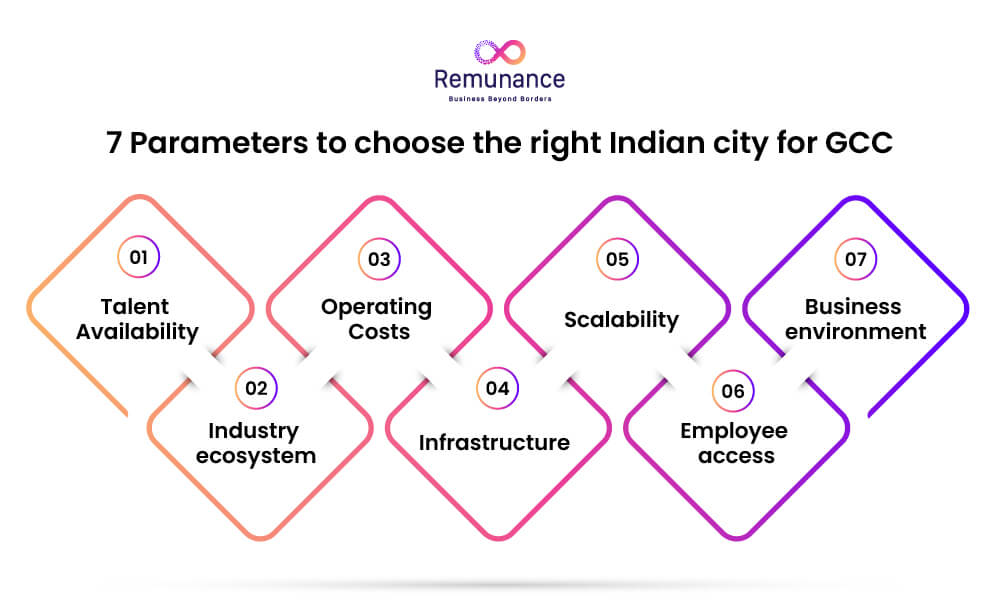
Companies should also evaluate:
-
- Talent availability: Can the city deliver the essential skills on a large scale?
- Industry ecosystem: Is there already an ecosystem of similar companies and service providers?
- Operating Costs: How do salaries, office space, and other expenses compare?
- Infrastructure: Are office facilities, digital infrastructure, and connectivity sufficient?
- Scalability: Is the city prepared to accommodate future hiring and expansion?
- Employee access: Will the organization be able to attract and retain professionals in this location?
- Business environment: Local regulations and processes in the business environment: Are they manageable?
Conclusion
In conclusion, for companies exploring India for the first time, an employer of record can be the best option. When it comes to GCC vs EOR in India, EOR helps you hire employees without setting up a local entity.
This helps companies test markets, build a small team, and learn local employment requirements before making a big investment. With EOR, businesses can focus on their core tasks.
EOR can efficiently handle,
-
- Payroll
- Employee onboarding
- Statutory compliance
- HR administration
Over time, you will understand the Indian talent market and decide whether setting up a legal entity would help your business. With the right city and the right model, companies can ace the market and grow beyond expectations.
Remunance Employer of Record
Ready to Start Hiring in India Without Setting Up a GCC?
Test the Indian market, build your first team, and manage payroll and compliance with an EOR before committing to a full GCC or local entity.
Talk to our EOR Expert FAQs
What is a Global Capability Center (GCC)?
A Global Capability Center is a foreign entity established and operated by a multinational corporation to carry out critical business functions for its global operations.
Which are the top GCC cities in India?
The blog covers six important GCC cities:
-
- Bangalore
- Hyderabad
- Pune
- Chennai
- Mumbai
- Delhi-NCR
Why is India a preferred destination for GCCs?
India has a big pool of technology and engineering expertise, a mature IT services ecosystem, established infrastructure, excellent educational institutions, and extensive experience working with global corporations.
Which Indian city is known for technology and innovation GCCs?
Bangalore is closely associated with technology, software, artificial intelligence, and product development, making it a key technology and innovation hub for the GCCs.

Related Posts

How Much is the Cost of Setting Up a GCC in India?

GCC Setup in India: A Complete Guide

GCC Hubs in India: Top Cities for Global Business Setup

What Are the 10 GCC Benefits for Enterprises Expanding Internationally?