German Companies in India: The 2026 Trade, Investment, and Hiring Guide
German Companies in India are expanding rapidly in 2026 as trade, investment, and hiring opportunities grow. This guide covers India-Germany trade data, hiring costs, Labour Code changes, key business hubs, business risks, and the best entry routes for German companies entering India.
What You Need to Know
Over 2,000 German companies in India are trading today, per the Indo-German Chamber of Commerce.
Germany is India’s largest trading partner in the European Union and its eighth largest overall. Cumulative German foreign direct investment stands at USD 15.50 billion between April 2000 and December 2025. Bilateral trade in goods and services touched an all-time high of USD 52.13 billion in 2025.
Three things reset this corridor in 2026.
The EU-India Free Trade Agreement was concluded on 27 January 2026. Chancellor Friedrich Merz made India his first Asia trip and brought 23 chief executives with him. And India’s four Labour Codes came into force on 21 November 2025, with final Central Rules notified on 8 May 2026.
That third one is the sleeper. It changes what every employee in India costs you.
So the question for a German company in 2026 is not whether to enter India. It is how fast, and through which structure.
This guide covers who is already here and what the corridor is worth. Then what it costs to hire employees in India against German benchmarks, what the Labour Codes now demand, and the four entry routes ranked by speed and risk.
How Many German Companies Are in India, and Who Are They?
The Indo-German Chamber of Commerce counts more than 2,000 active German companies in India.
That number undersells the relationship, because it counts entities and not footprint. Robert Bosch alone employs tens of thousands of engineers here. SAP runs its largest research and development hub outside Germany in India.
German capital concentrates in transportation, electrical equipment, metallurgy, insurance, chemicals, construction, trading, and automobiles, per the Embassy of India in Berlin.
These companies anchor those sectors.
| Company | Sector | India footprint |
| Robert Bosch | Engineering, software | Largest Bosch software development base outside Germany, centred on Bengaluru and Coimbatore |
| SAP | Enterprise software | Largest R&D hub outside Germany. EUR 100 million committed to double the campus and workforce by 2027 |
| Siemens | Industrial, mobility, energy | EUR 100 million allocated in May 2024 to expand a 32-factory network. EUR 3 billion Siemens Mobility order for 1,200 electric locomotives, Dahod plant inaugurated May 2025 |
| Mercedes-Benz | Automotive | Entered India in 1994. Manufacturing at Chakan, Pune, plus its largest development centre outside Germany in Bengaluru |
| Volkswagen Group | Automotive | Manufacturing and R&D at Pune and Chakan across the VW, Skoda, and Audi brands |
| BASF | Chemicals | Present since 1943. Production at Mangalore, Dahej, Chennai, and Thane |
| Bayer | Life sciences | Pharmaceuticals, consumer health, and crop science operations across India |
| Deutsche Bank | Financial services | EUR 571 million invested in November 2024 to strengthen India operations and capital base |
| Carl Zeiss | Optics, technology | EUR 334 million Global Capability Centre in Bengaluru, focused on cloud and cyber security |
| DHL | Logistics | EUR 250 million committed through 2030 for fleet, hubs, and acquisitions |
| Schaeffler | Automotive components | Roughly EUR 200 million invested between 2022 and 2024 in capacity and e-mobility |
| RENK Group | Defence | EUR 10 million defence production site in the Tamil Nadu industrial corridor |
Behind the household names sits the German Mittelstand.
These are the family-owned and mid-sized manufacturers that make up over 90% of German manufacturing. The Embassy of India’s Make in India Mittelstand programme, running since September 2015, currently facilitates 262 German member companies with a combined declared investment of USD 2.3 billion. More than 30 of them are hidden champions, meaning global market leaders in a narrow niche.
This is the segment where entity-free entry matters most.
After all, a company with 200 employees in Baden-Wurttemberg cannot justify a subsidiary company in India to test a five-person engineering team in Pune.
Ready to Expand Your Business in India?
Build your India presence faster with local hiring, compliance, and market-entry support tailored to your expansion plans.
What Does the India-Germany Trade Corridor Look Like in 2026?
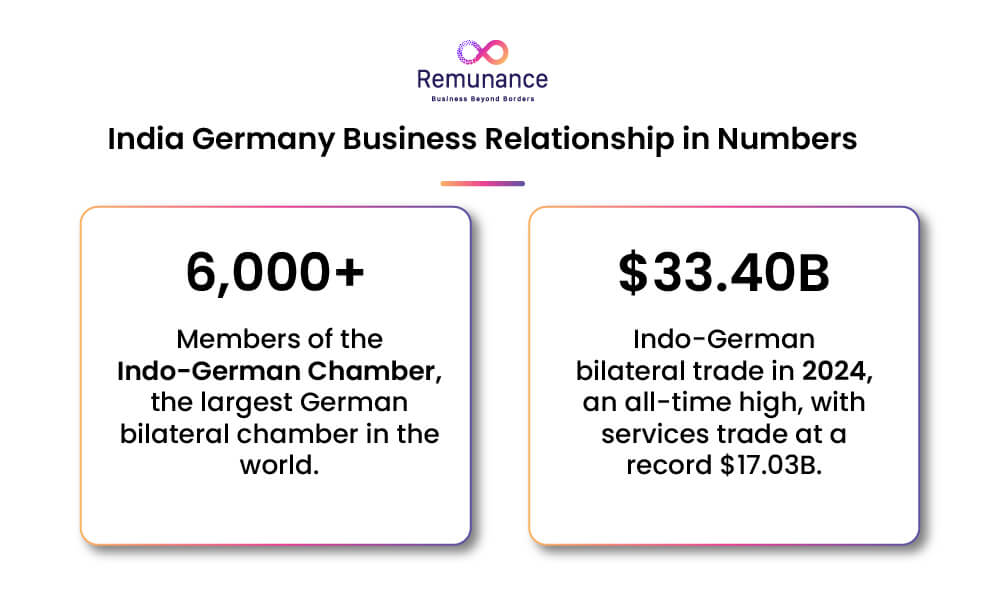
Most articles on this topic still quote 2019 figures.
Here is the corridor as it actually stands, drawn from the Embassy of India in Berlin’s bilateral brief dated 15 June 2026.
| Metric | Value | Detail |
| Total bilateral trade (goods and services), 2025 | USD 52.13 bn | All-time high |
| Bilateral trade in goods, 2025 | USD 35.37 bn | All-time high. Indian exports USD 16.95 bn, Indian imports from Germany USD 18.43 bn |
| Bilateral trade in services, 2025 | USD 16.76 bn | Indian services exports USD 10.36 bn, imports USD 6.40 bn |
| Goods trade, April to December 2025 | USD 26.83 bn | Up 3.36% year on year. Indian exports up 11.02%, imports down 2.75% |
| Cumulative German FDI in India | USD 15.50 bn | April 2000 to December 2025. Germany is India’s 10th largest foreign direct investor |
| German FDI inflow, FY 2024-25 | USD 469 mn | Against USD 505 mn in FY 2023-24 and USD 547 mn in FY 2022-23 |
| Fresh German investment commitments since 2024 | Over USD 6.91 bn | Automotive, chemicals, manufacturing, services |
| Germany’s rank as India’s trading partner | 8th overall, 1st in the EU | Roughly a quarter of India’s trade with the European Union |
| Germany’s share of India’s foreign trade | 2.37% (FY 2024-25) | Up from 2.29% in FY 2023-24 and 2.24% in FY 2022-23 |
| India’s real GDP growth, FY 2025-26 | 7.60% | Up from 7.1% in FY 2024-25 (MoSPI, base year 2022-23) |
Notice the FDI line against the commitments line.
Annual inflow is drifting down. Fresh commitments since 2024 cross USD 6.91 billion. Hence, the money is pledged but not yet landed, which is exactly the window where entry speed decides who captures the first-mover position.
What Changed for German Companies in 2026?
The EU-India Free Trade Agreement was concluded on 27 January 2026
Eleven formal rounds, and then it closed at the 16th India-EU Summit.
India secured market access for more than 99% of its exports to the EU by trade value. The EU-India free trade agreement also covers services, trade remedies, rules of origin, social security arrangements, a mobility framework for skilled professionals, SMEs, and digital trade.
German backing was broad, for three reasons that had nothing to do with sentiment. The deal excludes sensitive agricultural products, so it dodged the political resistance that hit Mercosur. It serves Germany’s supply-chain diversification away from China. And rising American protectionism made closing it urgent.
In the German-Indian Business Outlook 2026 from KPMG and AHK India, 96% of surveyed companies expect the FTA to help their business, with 34% expecting very significant effects.
A quarter are already moving. Expanding local production (26%), increasing exports from India (25%), and forming new joint ventures with Indian companies (21%).
That said, concluding negotiations is not entry into force.
Ratification follows, and tariff schedules phase in over years. So model the ratification timeline. Do not budget as though the EU-India free trade agreement is already operating.
Chancellor Merz came to India first, and brought 23 CEOs
Friedrich Merz visited India from 12 to 13 January 2026, his first Asia trip as Chancellor.
He went to Ahmedabad and Bengaluru, held talks with Prime Minister Narendra Modi, and joined a CEO Forum with 23 German chief executives.
The visit produced 27 deliverables: 19 MoUs and joint declarations plus 8 announcements. The ones that matter for planning:
-
- A semiconductor ecosystem agreement. German industrial expertise meets India’s fabrication build-out.
- A critical minerals partnership. This feeds automotive and battery supply chains directly.
- A declaration of intent on defence industrial cooperation, covering technology partnerships, co-development, and co-production.
- EUR 1.24 billion in fresh funding under the Green and Sustainable Development Partnership, for renewable energy, green hydrogen, PM e-Bus Sewa, and climate-resilient urban infrastructure.
- Visa-free airport transit for Indian passport holders, effective 3 June 2026.
- An offtake agreement for up to 500,000 tons a year of green ammonia, from AM Green to Uniper Global Commodities.
The 8th Inter-Governmental Consultations are expected in Germany later this year. 2026 is also the 75th anniversary of diplomatic relations, established on 7 March 1951.
Germany named India its first Skilled Labour Strategy country
On 16 October 2024, Berlin published a Skilled Labour Strategy: India.
India is the first and still the only country to get one. It covers targeted outreach, better matching of Indian skilled workers to German companies, German language support in India, and faster recognition of Indian qualifications.
Here is the part most coverage misses. The corridor runs both ways now.
Around 60,000 Indian students study in Germany, a figure that has tripled in five years, and they are the largest international cohort in German universities. Roughly 322,000 Indian passport holders and people of Indian origin live in Germany.
So a German company hiring in India buys more than cost arbitrage. You are building a two-way talent pipeline under the Migration and Mobility Partnership Agreement, in force since 7 March 2023.
Where in India Do German Companies Cluster?
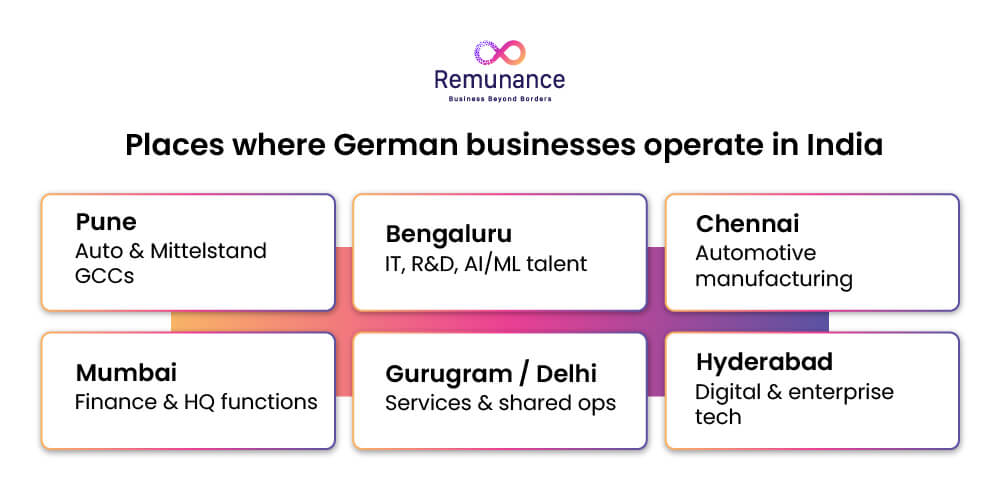
Location is not a detail you settle later.
It fixes which state labour rules govern your payroll, which talent pool you fish in, and what your attrition looks like.
| Hub | German presence | Why it works |
| Pune | The single largest concentration of German companies in India. The Indo-German Chamber of Commerce calls it the “Wolfsburg-Sindelfingen of India” | Automotive and engineering ecosystem at Chakan and Talegaon. Mercedes-Benz and Volkswagen manufacture here. Karlsruhe keeps a representative office in Pune, and Pune has an informal cooperation agreement with Bremen |
| Bengaluru | Bosch, SAP, Mercedes-Benz R&D, Carl Zeiss GCC, Siemens | Deepest software and R&D talent pool in India. Berlin opens a foreign office here in 2026, and Karnataka renewed a joint declaration of intent with Berlin in July 2025 on startups, innovation, and talent exchange |
| Chennai | Automotive components, chemicals, logistics, defence (RENK) | Port access, the East Coast Economic Corridor, and a dense automotive supply chain |
| Mumbai | Financial services, insurance, trading, corporate headquarters | Twinned with Stuttgart. Bavaria and Hamburg both maintain representative offices |
| Gujarat (Dahod, Dahej) | Siemens locomotive manufacturing, BASF production | Industrial corridor infrastructure, and among the earliest states to notify final Labour Code rules |
State-level links reinforce the clusters.
Karnataka is twinned with Bavaria. Maharashtra is twinned with Baden-Wurttemberg. Coimbatore and Esslingen have run twin-city relations since 2016, and North Rhine Westphalia keeps close ties with West Bengal.
Suppose you are torn between German companies in Pune territory and the German companies in Bangalore cluster, with a shortlist that reads identical on cost and talent.
Check the twinning. It comes with introductions, and introductions in India are worth more than a spreadsheet row.
What Does It Cost a German Company to Hire Employees in India?
This is where most comparisons go wrong.
They quote a headline salary differential and stop. But the structural difference between the two systems matters far more than the salary gap, because it widens as you move up the seniority ladder.
Germany charges a percentage, with high ceilings
German employer social insurance runs to roughly 21% of the employee’s gross wage, per Germany Trade and Invest, the federal economic development agency.
Accident insurance sits on top, and the employer covers it all.
| Contribution (2026) | Total rate | Employer share | Annual ceiling |
| Pension insurance | 18.60% | 9.30% | EUR 101,400 |
| Unemployment insurance | 2.60% | 1.30% | EUR 101,400 |
| Health insurance (general) | 14.60% | 7.30% | EUR 69,750 |
| Health insurance (average supplementary) | 2.90% | 1.45% | EUR 69,750 |
| Long-term care insurance | 3.6% (4.2% if childless, age 23+) | 1.80% | EUR 69,750 |
| Statutory accident insurance | 1.2% to 3.0% | 100% employer | No ceiling |
India charges less, and caps it at a low wage figure
| Contribution (2026) | Employer share | Applies to |
| Employees’ Provident Fund (EPF) | 12% of basic plus DA | Mandatory only up to a wage ceiling of INR 15,000 per month, so a statutory maximum of INR 1,800 per month. Of this, 8.33% goes to the pension scheme (EPS), capped at INR 1,250 per month |
| EDLI (life insurance) | 0.50% | Employer only, on the same capped wage base |
| EPF administrative charges | 0.50% | Employer only. Minimum INR 75 per month per establishment |
| Employees’ State Insurance (ESI) | 3.25% of gross | Only where gross wages are INR 21,000 per month or less (INR 25,000 for employees with disability). Unchanged since 1 July 2019 |
| Gratuity | Accrues at 15 days’ wages per completed year | Roughly 4.81% of basic plus DA as an accrual. Formula: last drawn wages x 15/26 x years of service |
Read those two tables against each other and the real gap appears.
Germany applies a percentage until a high ceiling. India applies a percentage until a very low one. The provident fund stops mandating at INR 15,000 of monthly basic. ESI switches off above INR 21,000 of monthly gross.
Hence the senior the hire, the wider the effective gap. A German engineering manager carries employer contributions up to EUR 101,400 of pay. Their Indian counterpart carries INR 1,800 a month, full stop.
One live watch item. On 9 January 2026, the Supreme Court directed the Central Government and EPFO to raise the EPF wage ceiling, or explain why not, within four months. The figure on the table is INR 21,000 or INR 25,000, up from INR 15,000.
No notification has been issued at the time of writing. If it lands, employer EPF costs rise for every employee above the current ceiling. So model both scenarios rather than one.
For a live calculation on your own headcount plan, use the India EOR cost calculator. For the full cost of hiring in India picture, read the breakdown of what it costs to hire remote employees in India.
Besides, the KPMG and AHK India survey offers a reality check on the whole cost narrative.
49% of German companies cite low labour costs as a top location advantage in 2026, down from 53% in 2025. Availability of skilled workers fell from 53% to 44%.
Cost is still an advantage. It is no longer the headline, and a business case resting purely on wage arbitrage is arguing last decade’s position.
Remunance Employer of Record
Calculate Your India Hiring Costs
Compare salaries, statutory contributions, and EOR costs to estimate the true cost of building your team in India.
Get Your India Hiring Cost Estimate
What Do India’s Labour Codes Demand From You Now?
This is the largest change to Indian employment law in decades, and it is already live.
On 21 November 2025, the Ministry of Labor and Employment notified all four labor codes as enforceable in a single stroke, repealing 29 central labor laws. Draft Central Rules followed on 30 December 2025. The final Central Rules were notified on 8 May 2026.
| Code | Replaces | What it changes for you |
| Code on Wages, 2019 | Minimum Wages Act, Payment of Wages Act, Payment of Bonus Act, Equal Remuneration Act | Uniform “wages” definition and the 50% rule. National floor wage. Gender pay parity |
| Industrial Relations Code, 2020 | Trade Unions Act, Industrial Employment (Standing Orders) Act, Industrial Disputes Act | Retrenchment threshold raised from 100 to 300 workers. Model standing orders. Worker re-skilling fund |
| Code on Social Security, 2020 | EPF, ESIC, Gratuity, Maternity Benefit, Employees’ Compensation (9 acts) | Pro-rata gratuity for fixed-term employees after one year instead of five. Gig and platform worker coverage |
| OSH and Working Conditions Code, 2020 | Factories Act, Contract Labour Act, Inter-State Migrant Workmen Act and others | Single registration. Mandatory appointment letters. Annual health check-ups. Creche facilities |
The 50% Wage Rule is the One That Costs Money
Under the new definition, wages means basic pay plus dearness allowance plus retaining allowance.
Excluded components such as HRA, conveyance, and bonus cannot together exceed 50% of total remuneration. Where they do, the excess gets added back into the wage base.
Indian salary structures have been engineered for decades to keep basic low and allowances high, precisely to suppress the provident fund and gratuity base.
That arbitrage is over.
Restructuring pushes up PF, gratuity, bonus, and leave encashment at the same time. Reported impact runs from roughly 3% to 15% of gross CTC, depending on how aggressive the old structure was. A company running basic at 30% of CTC will feel this far more than one already sitting at 45%.
What actually changes on your payroll
-
- Restructure CTC now, not at the first inspection. The 50% rule is legally active today, and most large firms have already moved.
- Budget pro-rata gratuity for fixed-term staff. Fixed-term employees qualify for gratuity after one year rather than five, which changes the maths on every project-based hire.
- Issue appointment letters to every worker. Mandatory across all categories, including audio-visual workers. This is a compliance artifact now, not an HR courtesy.
- Check your working-hours configuration. A normal day is eight hours and the week may not exceed 48. Where a daily wage is fixed, divide by eight for the hourly rate and multiply by 26 for the monthly rate.
- Fund the re-skilling account on retrenchment. You must transfer 15 days of the worker’s last drawn wages to a designated Labour Commissioner account within 10 days, and it reaches the worker within 45.
- Track your state as closely as the Centre. Labour sits on the Concurrent List. Central Rules apply only where the central government is the appropriate government, which varies by sector and establishment.
Point six is the one that catches German head offices.
The labour codes are national. The rules under them are not uniformly notified yet, so your Pune payroll and your Bengaluru payroll can sit under different requirements in the same month.
Which Entry Route Should a German Company Pick?
Four realistic structures exist.
They differ on setup time, permanent establishment exposure, and how much compliance you carry yourself. Most German entrants shortlist two of them, and it is almost always EOR India against a subsidiary.
| Route | Setup time | Entity needed | PE risk | Best for |
| Employer of Record (EOR) | 2 to 4 weeks | No | Low. The EOR is the legal employer of record | Testing the market, hiring 1 to 50 people, GCC pilots, Mittelstand entrants who need speed without commitment |
| Independent contractor | Days | No | High if misclassified. India applies control and integration tests | Genuinely independent specialists only |
| International PEO | 2 to 4 weeks | Varies by model | Depends on structure | Companies wanting co-employment with more HR control than a pure EOR. Search PEO India and you will mostly find EOR providers using the label loosely |
| Indian subsidiary | 3 to 6 months plus | Yes | Full. You are the employer, taxpayer, and filer | Committed long-term operations, manufacturing, 100+ headcount, IP-heavy R&D centres |
The misclassification trap deserves its own paragraph, because it is where German companies get hurt most often.
Engaging Indian contractors who work fixed hours, use your systems, report to your managers, and hold no other clients is not a contractor relationship. Indian authorities look at the substance and not the contract.
Besides, the Code on Social Security widened worker coverage. It did not narrow it.
Reclassification brings back-dated PF, ESI, gratuity, interest, and penalties, all at once. Read the risks of expanding a business internationally before you default to contractors on cost grounds.
For the full structural comparison, see EOR or subsidiary: which one to choose. For operating without incorporating, see how to start a business in India without entity formation. If a subsidiary company in India is genuinely on the table, the complete guide to setting up a subsidiary company in India covers the incorporation path.
One India-specific detail worth knowing
EOR services supplied to a foreign company qualify as an export of services under India’s GST framework.
That means they can be zero-rated. For a German parent, this removes 18% GST from the service-fee line.
Many providers never structure for it. Many buyers never ask. See zero-rated GST in India for Employer of Record services for the mechanism and the documentation it needs.
Remunance Employer of Record
Choose the Right Route for India
Compare EOR, contractors, PEO, and subsidiary options to find the right structure for your India expansion goals.
Find Your Best India Entry Route Which Sectors Are Open to German Companies in 2026?
The KPMG and AHK India survey shows German firms now use India across the whole value chain.
69% treat it as a relevant sales market, up 18 points on 2025. 63% use it as a production location for the regional market, up 14 points. 55% source services here, and 44% run a global capability centre or shared service centre.
- Semiconductors and electronics: The January 2026 ecosystem agreement is fresh ground, and German strength in equipment, materials, and process control maps onto India’s fabrication build-out.
- Automotive and e-mobility: Supplier density around Pune and Chennai, plus the critical minerals partnership securing battery inputs.
- Defence: The cooperation roadmap from the Merz visit, TKMS as frontrunner for six Indian Navy submarines, and RENK already building in Tamil Nadu.
- Green hydrogen and renewables: EUR 1.24 billion in fresh GSDP commitments, the Indo-German Green Hydrogen Roadmap, and the AM Green to Uniper ammonia offtake at up to 500,000 tons a year.
- Global capability centres: Carl Zeiss put EUR 334 million into exactly this in Bengaluru. See challenges and solutions of the IT industry in 2026 for the operating picture.
- Railways and mobility: Siemens Mobility holds a EUR 3 billion order for 1,200 electric locomotives with 35 years of maintenance, plus a USD 475.2 million NHSRCL contract for India’s first high-speed rail project.
The global capability center line is the one to watch.
It went from a cost-center story to a capability story in about four years, and Carl Zeiss did not spend EUR 334 million on back-office work.
What Risks Do German Companies Actually Report?
An honest guide names the problems.
These are the obstacles German companies report themselves in the KPMG and AHK India survey, and not a competitor’s talking points.
| Obstacle | Cited by | What it means in practice |
| Bureaucratic hurdles | 58% (down from 65%) | Still the biggest single complaint. Multi-state registration, overlapping filings, inspection regimes |
| Volatile U.S. trade policy | 56% | The top external risk in 2026, ahead of anything India-specific |
| Military conflicts outside India | 47% | Middle East conflict has lifted oil prices, weakened the rupee, and raised import costs for a major energy importer |
| Corruption | 34% (up from 33%) | Effectively flat year on year |
| Quality Control Orders | 27% (down from 32%) | Product certification requirements that can delay market entry |
| Indian competitors becoming superior | 46% expect this within 5 years | Only 17% believe it today. German firms fear an India repeat of the China effect and are investing partly to avoid being caught twice |
Two more that the survey misses, and every operator meets.
Attrition in Bengaluru and Pune routinely crosses 20% a year. So retention and employer branding are not optional line items in your India budget.
And cultural distance cuts both ways. German directness reads as brusque in Indian workplaces. Indian relationship-first norms read as inefficient to German managers.
Neither side is wrong. Both cost time when nobody manages them.
See bridging the cultural gap of cross-border remote teams and doing business in India: advantages and disadvantages for the fuller view on doing business in India.
How Does Remunance Help German Companies Hire in India?
Remunance is an India-specialist Employer of Record India provider.
We are not a global platform with an India tab. India is the whole business. Hence, we track state Labor Code notifications as they are issued, rather than publishing a chart once a quarter and hoping it holds.
- Hire in two to four weeks with no Indian entity: We become the legal employer of record. You direct the work.
- Labour Code compliance built in: CTC restructuring under the 50% wage rule, appointment letters to the OSH standard, pro-rata gratuity accrual for fixed-term staff, and state-level notification tracking.
- Zero-rated GST structuring: Our Employer of Record India fees qualify as an export of services to your German parent, removing 18% GST from the fee line where the conditions are met.
- Pune-based, inside the German cluster: Our office sits in Kothrud, Pune, the largest single concentration of German companies in India. Chakan and Talegaon are a short drive away.
- Payroll, HR, benefits, and compliance on one contract: No coordination overhead between a payroll vendor, a compliance consultant, and a recruiter.
Remunance Employer of Record
Ready to Hire in India Without an Entity?
Get India-focused EOR support for hiring, payroll, Labour Code compliance, benefits, and ongoing HR management—all under one contract.
Talk to an India EOR Expert FAQs
How many German companies are in India?
More than 2,000 German companies are active in India, per the Indo-German Chamber of Commerce, employing several hundred thousand people. Pune holds the largest single concentration, followed by Bengaluru, Chennai, and Mumbai. The Make in India Mittelstand programme separately facilitates 262 German SMEs with USD 2.3 billion in declared investment.
How much does it cost to hire an employee in India compared to Germany?
The gap is structural rather than a flat percentage. German employer social insurance runs to roughly 21% of gross wages, up to ceilings of EUR 101,400 and EUR 69,750. India’s employer contributions cap out at very low absolute wage figures instead. EPF is mandatory only on the first INR 15,000 of monthly basic, and ESI stops above INR 21,000 of monthly gross, so the more senior the hire, the wider the effective gap.
Can a German company hire in India without setting up a subsidiary?
Yes. An Employer of Record India provider hires the employee as the legal employer on your behalf and handles payroll, PF, ESI, gratuity, and Labour Code compliance. Setup takes two to four weeks against three to six months or more for a subsidiary, and it avoids permanent establishment exposure.
How do India’s new Labour Codes affect German employers?
All four Labour Codes took effect on 21 November 2025, repealing 29 central laws, with final Central Rules notified on 8 May 2026. The costliest change is the 50% wage rule. It caps excluded allowances at half of total remuneration, which lifts the PF, gratuity, and bonus base by roughly 3% to 15% of gross CTC. Fixed-term employees now earn pro-rata gratuity after one year rather than five.
What is the EU-India Free Trade Agreement and how does it affect German companies?
It was concluded on 27 January 2026 at the 16th India-EU Summit, after 11 rounds. It secures market access for over 99% of Indian exports to the EU by trade value, and covers services, rules of origin, social security, and skilled-professional mobility. In the KPMG and AHK India survey, 96% of German companies expect a positive impact. Ratification and phased tariffs follow, so it is concluded but not yet fully in force.
Where should a German company set up its India team?
Pune is the default for automotive and engineering, with the largest German concentration and a mature supplier ecosystem at Chakan and Talegaon. Bengaluru leads for software, R&D, and global capability centres, and Berlin opens a foreign office there in 2026. Your choice also fixes which state Labour Code rules govern your payroll.

Related Posts

Best EOR Service Providers in India (2026) for Easy Hiring

Employer of Record India (2026): Hire Employees Without an Entity

Benefits of Hiring International Employees for Business Growth

Hiring Internally vs Externally: Pros and Cons

A Guide for Hiring International Employees