
Summary
The risks of expanding a business internationally vary from financial to economic risks. The other risks involve talent shortages, skill gaps, and hiring issues. Companies need to be aware of these risks prior to the expansion. They need to mitigate risks effectively to smooth the expansion process.
The risks of expanding a business internationally are diverse and often hard to cope with. Companies have to deal with factors like financial risks, talent shortages, hiring challenges, and operational barriers.
This can significantly hurt profit and make international team management difficult. Hence, we’ve come up with a blog where we’ll address all these factors thoroughly.
We’ll help you learn the global business problems up close so that you don’t falter later. In this blog, we’ll cover:
-
- The risks of expanding a business internationally
- How do these risks affect international expansion growth?
- What is risk mitigation in global expansion?
- Why is risk mitigation important?
- How do companies mitigate risks during global expansion?
So, let’s get started.
What Are the Key Risks of Expanding a Business Internationally?
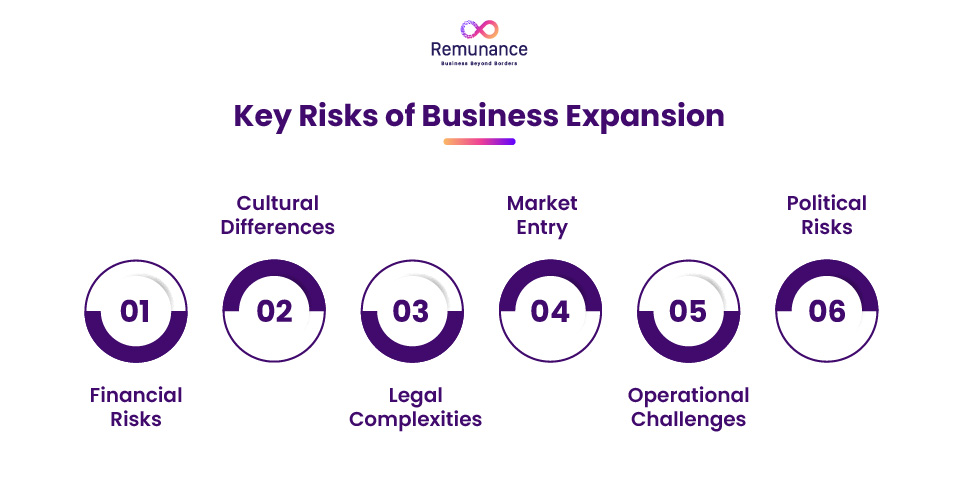
There are certain risks of expanding a business internationally, along with numerous opportunities. Some of them include financial risks, legal complexities, and operational challenges.
Let’s look into them in detail.
- Financial risks: Expansion has big financial risks like currency swings, high costs, and poor planning. This can quickly kill profits.
- Cultural differences: Cultural gaps pose serious risks of expanding a business internationally. It can be the language, etiquette, or workplace norms.
- Regulatory and legal complexities: Legal complexities are key business impacts of global expansion. It includes labor laws, IP protection, and investment rules.
- Competitive landscape and market entry: One major business impact of global expansion is intense competition. Here, poor research and wrong entry strategies fuel global business problems.
- Operational and logistical challenges: The risks of expanding a business internationally often show up as weak infrastructure, supply chain breakdowns, and rising costs.
- Political and reputational risks: Political and reputational risks include unstable policies and bad press. This can quickly damage profits and brand trust.
Let’s explore each risk in detail to understand how it can impact international growth.
Financial Risks
Financial risks are one of the biggest risks of expanding a business internationally. Currency swings can wipe out profits overnight.
You can derive examples from Medtronic, which lost $104 million. There’s more like e.l.f. Beauty lost $7 million in the process.
It also involves economic volatility, high investment costs, and tough capital access. All these factors combined or individually can cause serious global business problems.
Without solid financial planning, these risks turn into costly setbacks.
Cultural Differences
One big chunk of the risks of expanding a business internationally is cultural differences. A wrong word, missed gesture, or tone-deaf employee onboarding process can backfire fast.
Local customs and employee preferences shape how your brand is received.
Managing local teams isn’t simple. There are multiple things that can clash, such as different work styles and expectations.
These aren’t small hiccups; they’re real global business problems that need sharp cultural awareness to avoid major mistakes.
Regulatory and legal complexities
When we talk about the business impacts of global expansion, the legal side often hits hardest. Every country comes with its rules.
They include labor laws, investment restrictions, and compliance checklists. Then there’s shaky IP protection and messy contract disputes.
All these factors pose major global business problems. Even one overlook can cost you fines or even force a shutdown.
Hence, staying compliant is the survival mode of expanding internationally.
Competitive landscape and market entry
When talking about the business impacts of global expansion, competition is a big one. New markets are often crowded.
Additionally, global business problems usually show up when foreign companies underestimate local rivals who know the ground better. If you skip proper research, you’ll risk hiring the wrong people. Or worse, deciding the wrong compensation for the right people.
Hence, picking the right entry mode is very necessary. Be it outsourcing, hiring freelancers, or using an EOR, the choice is yours. This choice can make or break you.
Read how to reshape business expansion with an EOR in emerging markets.
Operational and logistical challenges
Operational and logistical hurdles are some of the biggest business impacts of global expansion. The risks of expanding a business internationally show up everywhere.
That includes weak infrastructure, hiring delays, and rising costs. Supply chains? One strike, disaster, or political mess, and they’re down.
Managing teams across countries burns time and money. Then there’s planning and scheduling chaos, and the complexity spikes.
Without tight management, these challenges slow operations, push costs up, and drain efficiency.
Political and reputational risks
Political and reputational risks are major business impacts of global expansion. A sudden regime change, new tax rule, or employment policy can shake profits overnight.
Talent shortage? That’s another crisis foreign firms usually face. And let’s not forget reputational damage.
The risks of expanding a business internationally include boycotts, bad press, or NGO backlash that can hit a brand harder than any tariff.
Learn about the impacts of geopolitical risks for businesses.
In short, the risks of expanding a business internationally are significant and diverse. It can cause serious economic and operational hazards if not dealt with properly.
Our team can guide you through the journey of global expansion risks.
Ready to dive into it?
Book a free consultation with us now!How Do Global Business Problems Affect International Growth?
Global business problems affect international growth significantly due to a range of interconnected factors.
The major ones include talent shortages, hiring struggles, high turnover rates, etc. Let’s discuss them further in this section.
Decreased profitability
Going global isn’t always a profitable party; it can get pricey fast. Currency swings, tricky tax rules, and the cost of hiring or setting up shop eat into margins. And if politics or disasters mess with supply chains, those profits thin out even more.
Global hiring struggles
Hiring across borders is tough with inconsistent recruitment practices and salary expectations. Time zones complicate collaboration, slowing meetings and evaluations. Then there are legal and cultural barriers, which make managing global teams even more difficult.
Talent shortages & skill gaps
Skill gaps slow innovation and hurt competitiveness. They disrupt workflows and reduce efficiency. Additionally, global competition makes it more challenging to hire talent and develop future leaders.
High turnover, low retention
High turnover drains expertise and raises hiring costs. It hits morale, causing stress and disengagement. Teams struggle to stay stable and deliver long-term growth.
Managing global diversity challenges
Global teams often hit walls with language gaps and cultural biases. Misunderstandings spark conflicts, and clashing work styles slow things down. Different expectations around hierarchy and balance make managing people even trickier.
Capability & agility disruptions
Skill gaps slow adaptability and make companies sluggish to market changes. Consequently, missed opportunities arise when firms can’t pivot fast or embrace new tech. Additionally, overstretched teams and rigid systems choke innovation and fresh ideas.
Brain drain & IP loss
When talent leaves, companies lose skills they can’t easily replace. And worse, IP often walks out the door with them. Hence, economies take a hit with fewer skilled workers paying taxes.
In short, managing global business problems effectively is extremely important for smooth international growth.
What is Risk Mitigation in Global Business Expansion?
What is risk mitigation really?
It is simply about planning for trouble. It means spotting possible problems, figuring out how big they are, and cutting down their impact.
The risks of expanding a business internationally can sink growth if ignored. The risks include money issues, reputation hits, or operational slowdowns.
Therefore, risk mitigation makes sure the company is protected while moving into new markets.
Why is Risk Mitigation Important for International Growth?
Risk mitigation is important because global business problems need damage control.
Let’s see how exactly risk mitigation helps to solve the risks of expanding a business internationally.
-
- Financial losses: Planning shields profits from surprises like currency swings or taxes.
- Legal issues: Following local laws keeps fines and shutdowns away.
- Operational disruptions: Backups keep things running despite politics, disasters, or supply hiccups.
- Reputational damage: Knowing local norms protects your brand and trust.
- Project failure: Spotting risks early makes expansion actually work.
- Financial losses: Planning shields profits from surprises like currency swings or taxes.
Now that we are aware of what risk mitigation is and why it is important for global expansion, let’s move on to our next section. There, we’ll learn how companies mitigate risks of international expansion.
How can Companies Mitigate Risks of International Expansion?
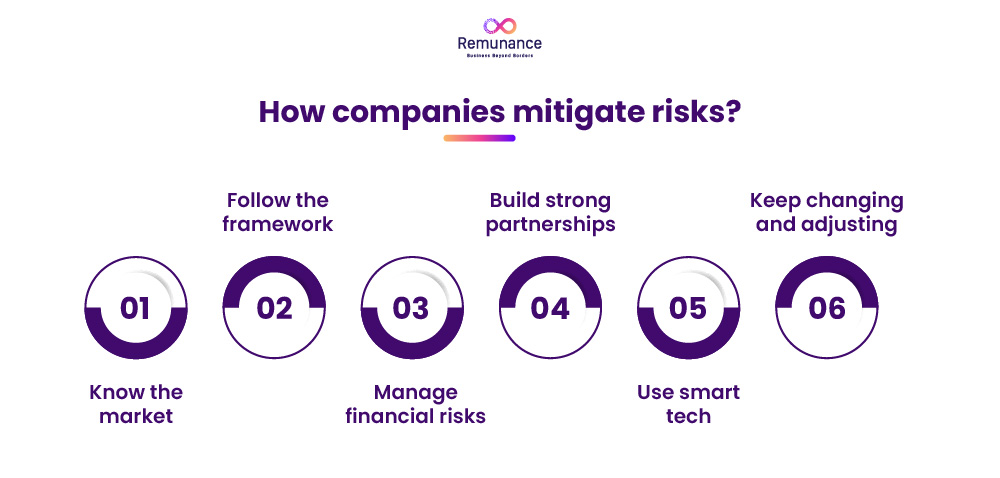
Companies usually mitigate risks by knowing the new market of expansion thoroughly.
Additionally, they manage financial risks properly and use the latest technologies to cope with the global business problems. Let’s look into these areas thoroughly.
Know the market
-
- They pick markets with strong growth and stability.
- They learn local culture and customer habits.
- They check rules, taxes, and legal requirements.
- They pick markets with strong growth and stability.
Follow the framework
-
- They set clear policies that match local and global rules.
- They train employees regularly on laws and ethics.
- They monitor and audit to catch risks early.
- They set clear policies that match local and global rules.
Manage financial risks
-
- They use hedging to protect against currency swings.
- They secure payments with trade finance tools.
- They spread risk by diversifying markets and teams.
- They use hedging to protect against currency swings.
Build strong partnerships
-
- They partner with local businesses for market know-how.
- They use EOR services to handle hiring and compliance.
- They build ties with government and community leaders.
- They partner with local businesses for market know-how.
Use smart tech
-
- They use data and AI to track trends and risks.
- They rely on cloud and automation to boost efficiency.
- They strengthen cybersecurity to keep data safe.
- They use data and AI to track trends and risks.
Keep checking and adjusting
-
- They keep track of market and industry changes.
- They use feedback to adjust plans quickly.
- They promote a culture of constant improvement.
- They keep track of market and industry changes.
Thus, companies can mitigate the risks of expanding a business internationally by following a few simple steps. Steps like knowing and staying updated with the market trends.
Conclusion
Now, we’re thorough with the risks of expanding a business internationally and how to mitigate them. We know that currency fluctuations, skill gaps, and limited market knowledge can be dangerous during expansion.
Hence, to eradicate these business impacts of global expansion, you need to act fast. You need to conduct deep research about the country you’re expanding into.
You need to know the employment laws and culture of the country. You need to assess the talent potential of the market.
And finally, you need to use the latest trends and technology to stay ahead of the game.
And if you’re too busy or too worried to manage all these alone, there’s always a simple solution. Partner with an employer of record who will take care of all these on your behalf.
About Remunance
Remunance is an Employer of Record (EOR) services provider in India, helping global companies hire, manage, and support full-time employees without setting up a local entity. We take care of HR, payroll, compliance, and benefits so businesses can focus on growth while building their teams in India with confidence.
Remunance enables businesses from UK, Australia, Canada, France, US, and the Middle East to recruit, hire, and manage workforce and benefits in India.



Recent
FAQs
What are the risks associated with international business?
International business poses various cross-cultural challenges. Some of them are salary expectations, talent demands, industry trends, etc. Other risks involve currency fluctuations and time-zone differences, among others.
What are the negative effects of global expansion?
The negative effects of global expansion include financial and political instability. The other impacts are social unrest and economic volatility.
Why do companies mitigate risks during global expansion?
Companies tend to mitigate risks during global expansion to find financial and economical stability. They mitigate risks to ensure a smooth expansion process with no skill shortages or reputational damage.
How to be aware of the global business problems?
Companies can be aware of the global business problems by following the latest market trends. They can learn about the industry insights, cultural norms, and legal frameworks of the country they’re expanding into.
Author’s Bio