Top 10 Emerging Information Technology Trends in 2026
The current trends in information technology include Edge AI, spatial computing, sustainable technology, and many more. Whereas, the emerging IT trends include multi-agent systems, preemptive cybersecurity, DSLMs, among others. EOR helps you keep up with these trends easily.
Up until the end of 2022, all we cared about were internet telecommunications networks and software. Then something shifted in the IT industry. We witnessed many revolutionary trends in information technology.
Data centers and AI infrastructure are the core of this revolution. Platforms like Gemini, ChatGPT, and Claude have completely changed our perspective on the IT industry.
And with this change, existing employees and new talent had to update themselves with the latest skills.
However, it’s not always easy to find the right match for your company when the required skills are both broad and niche.
Hence, we came up with a resource describing every current and emerging information technology trend and how to find the right talent to keep up with these trends.
In this blog, we’ll cover:
-
- Current trends in information technology
- Emerging trends in information technology
- How are businesses dealing with these trends?
- How should businesses leverage EOR to capitalize on these trends?
Let’s get started.
What Are the Current Trends in Information Technology?
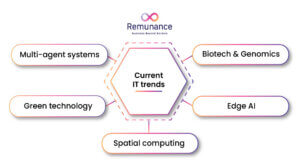
Before jumping into the emerging trends in information technology, let’s first see what information technology industry trends are already in practice and heavily used by the business community.
-
- MAS: Multiple AI agents work together here.
- Sustainable Technology: Focused on greener technology alternatives.
- Spatial Computing: Used mainly for 3D design visualization.
- Edge AI: Used to improve privacy within AI models.
- Biotech and Genomics: Used in the healthcare industry.
Multi-agent Systems (MAS)
This trend in information technology is well known for integrating multiple AI systems.
Teamwork is always better than individual efforts, right? Well, the same happens here. Multiple AI agents collaborate with each other and work together.
Suppose one is conducting intensive research; the other will process that information, and yet another will automate the execution. This way, the tasks are distributed evenly, and organizations can get the best out of AI agents.
This process is eventually becoming the norm in information technology trends.
Sustainable and Green Technology
With the revolution of AI comes huge data centers. These centers demand an enormous amount of energy resources. This is taxing for the environment, which is why world leaders are now taking extensive measures for sustainability.
So, the current trends in information technology include:
-
- Energy-efficient chips
- Green data centers
- Renewable energy resources
Spatial Computing
The newest trend in information technology, spatial computing, is like giving digital ideas a body. Instead of living inside a laptop screen, they step out into the room with you. Technologies like augmented and virtual reality make that possible.
So a designer isn’t just dragging a model around with a mouse anymore. They can stand inside the design, walk around it, almost like walking through a house that hasn’t been built yet. Suddenly, the idea isn’t flat; it’s something you can explore.
Common uses include:
-
- 3D design visualization
- Virtual training environments
- Immersive retail experiences
Edge AI
Instead of sending all data to the cloud, many organizations are now processing information closer to where it is generated.
Edge AI is used across multiple types of devices where the model works locally, and devices respond faster. Most day-to-day usage is through smartphones, cameras, any kind of sensors, etc.
Common features include:
-
- Low-latency processing
- Improved privacy
- Reduced cloud dependence
As connected devices grow worldwide, Edge AI is becoming a practical part of everyday information technology trends.
Biotech and Genomics
AI is not limited only to the IT sector now. It is making huge contributions to the health and medicine industry.
Scientists are now using AI day in and day out to speed up research by processing humongous biological data. The health industry uses AI in:
-
- Genomic data analysis
- CRISPR-based research
- Personalized vaccine development
Top talent in the market are highly skilled in these current IT trends.
Want to get access to those talents
What Are the Emerging Trends in Information Technology?
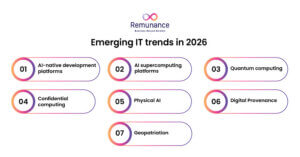
Let’s see how the most talked-about trends in information technology are proving to be revolutionary in the business industry.
-
- AI-Native Development Platforms: AI has become an independent software system now.
- AI Supercomputing Platforms: AI will replicate human intelligence much better in the upcoming days.
- Quantum computing: Mainly used for financial modelling and supply chain optimization.
- Confidential computing: Used to strengthen privacy controls.
- DSLMs: Cater to niche industries like renewable energy, health and wellness, etc.
- Physical AI: Brings virtual and real-world technologies together.
- Preemptive Cybersecurity: Used for any kind of threat or vulnerability detection.
- Digital Provenance: Used for content and data verification.
- AI Security Platforms: Used mainly for monitoring AI models.
- Geopatriation: Used to localize cloud infrastructure.
AI-Native Development Platforms
AI has reshaped itself from being just a tool to an independent development system. You don’t need to feed everything manually to AI now.
There are independent AI platforms that help developers build applications automatically.
Once you describe the logic to AI, it presents you a ready-made and tested code for your ideation. They even suggest improvements for your ideation.
Now, because a lot of things have been made automatic by AI, engineers feel threatened in their jobs. Well, that is not at all the case.
If anything, AI will only create new jobs required for more automation, faster development cycles, and software governance.
AI Supercomputing Platforms
In the upcoming days, AI intelligence will be much smarter and faster. Not only that, it will replicate human intelligence much better than now.
Hence, the demand for such supercomputing AI platforms is growing by the day.
More reasons for the demand? These platforms use highly efficient GPUs, CPUs, and AI-optimized chips.
These information technology trends help in processing loads of data at a time effectively.
Quantum Computing Progress
Though this trend in information technology is not yet widely used by industries, some companies are already experimenting with it.
There has been extensive research going on quantum systems and their ability to execute complex calculations. The research includes:
-
- Drug discovery simulations
- Financial modeling
- Supply chain optimization
While mainstream adoption is still years away, it continues to sit firmly among emerging information technology industry trends.
Confidential Computing
Most security models protect data when it’s stored or moving across networks. But what about the moment it’s actually being processed? That gap is what confidential computing addresses.
It protects sensitive data even during computation. It uses trusted execution environments (TEEs) built into processors. These create isolated spaces where data can be handled securely. The most common features of confidential computing are:
-
- Secure processing environments
- Hardware-level protection
- Stronger privacy controls
This approach has tighter data regulations. Hence, it’s gaining attention across information technology trends.
Domain-Specific Language Models (DSLMs)
This emerging trend in information technology is used to fill the gaps of generic AI models. When it comes to niche subjects, you need the utmost precision.
This level of precision and clear focus on a dedicated industry can only be offered by DSLMs.
These types of AI models are trained on niche industries like renewable energy, health and wellness, etc.
Organizations are chasing this latest trend in information technology for yet another reason. And that is highly efficient compliance management by this model.
Physical AI
It is safe to say that AI models are no longer just software. Organizations use AI in more tangible tasks like industrial robots, drones, infrastructure, logistics, and more such autonomous machines.
Hence, physical AI is the future of information technology trends across industries.
Preemptive Cybersecurity
Cybersecurity is slowly moving away from the old “detect and respond” approach. New AI models assume any sort of threat long before it appears.
AI platforms dedicated to cybersecurity assess any suspicious or malicious patterns in early stages. Common features of this information technology trend:
-
- Threat prediction
- Vulnerability detection
- Automated response systems
Digital Provenance
AI revolution continues to crowd digital content resources, be it text-based, images, or video content. With that, it has become increasingly difficult to differentiate between what is authentic and what is AI-generated.
Here’s where emerging trends in information technology, like digital provenance, help. They’re mainly used for:
-
- Content verification
- Data traceability
- Integrity tracking
This information technology trend is significantly curbing the spread of misinformation across the internet.
AI Security Platforms
Sure, AI is growing at a remarkable rate, and companies are profiting a great deal from it. But with that comes risks. AI faces a considerable amount of risk of manipulation and misuse on a daily basis.
Hence, AI security platforms are designed to monitor and protect these systems.
-
- Prompt protection
- Model monitoring
- Data leakage prevention
Protecting AI itself is quickly becoming one of the most important information technology industry trends.
Geopatriation
A quieter but important development in trends in information technology is geopatriation. This is the shift toward storing and processing data within regional or sovereign cloud environments.
Governments and organizations want more control over where their data lives. The common features of this model include:
-
- Data sovereignty compliance
- Regional cloud infrastructure
- Reduced geopolitical risk
As regulations get stricter globally, geopatriation is becoming a strategic part of many companies’ technology decisions.
Remunance Employer of Record
Wish to expand your business globally in these emerging IT trends?
Let our team help you with that
Book a free consultation session
How Businesses Are Dealing With the Changing Trends in Information Technology?
Expanding to another country used to be a big, slow project. Companies had to open offices, set up servers, and build teams on the ground before doing any real business.
That’s not really the case anymore.
Most companies now start with the cloud. Instead of building IT infrastructure in every country, they simply run their systems online and enter into new markets from there. It saves time, money, and a lot of operational headaches.
Language and localization are also easier to handle. Marketing content, websites, and support channels can be adapted for local audiences much faster than before through AI models.
Regulations still matter, of course. But many companies now rely on specialized platforms that help them deal with local compliance and data rules without spending months figuring it out.
To add to the good news, there’s one model that makes these processes all the easier. Yes, I’m talking about an EOR.
Let’s discuss how EOR adapts to the latest information technology industry trends and helps businesses expand faster.
Learn the IT outsourcing challenges and how EOR provides effective solutions.
How Should Businesses Leverage EOR to Keep Up with the Emerging Trends in Information Technology?
Finding the right skill and talent in 2026, especially in the AI and IT field has become challenging.
The reason behind this is that these industries have become way too crowded with the same level of talent. Hence, standing out is really difficult.
Now, an employer of record (EOR) helps companies avoid some of this difficulty.
Instead of opening a legal entity in every country, which can drag on for months, businesses can simply hire people where the talent already is. India, Brazil, Eastern Europe, you name it.
The other advantage of using an EOR? Speed. Good developers don’t stay on the market long. If hiring takes three months, they’re already gone. With an EOR, companies can bring someone on board in weeks.
It also keeps things easy on the compliance side. Governments are getting stricter about contractor misuse and payroll rules.
An EOR handles all crucial documentation on behalf of businesses to comply rightly with labor laws.
For many growing tech teams, it’s just the easier way to hire globally.
Learn the IT service industry challenges in 2026 and effective solutions for business growth.
Conclusion
With every new trend in information technology, businesses face both opportunities and challenges.
However, businesses can convert these challenges into opportunities with the help of an EOR.
All they need to do is find the right skill through an employer of record. The rest will fall into place automatically.
Worried about find the right IT talent globally?
Follow the easy path thousand other founders are following

FAQS
What are the IT trends in 2026?
The current IT trends in 2026 include multi-agent systems, sustainable and green technology, spatial computing, Edge AI, etc.
What is the next big IT trend in 2026?
The upcoming IT trends include physical AI, confidential computing, AI security platforms, quantum computing, etc.
Will the IT sector boom in 2026?
The IT sector is already booming with multiple current and emerging trend in information technology. The real challenge is finding the right talent to cater to these trends. And, that can be easily found with the help of an EOR.
About Remunance
Remunance is an Employer of Record (EOR) services provider in India, helping global companies hire, manage, and support full-time employees without setting up a local entity. We take care of HR, payroll, compliance, and benefits so businesses can focus on growth while building their teams in India with confidence.
Remunance enables businesses from UK, Australia, Canada, France, US, and the Middle East to recruit, hire, and manage workforce and benefits in India.




Related Posts

IT Outsourcing Challenges: How an EOR Provides Effective Solutions

IT Services Industry Challenges 2026: Business Growth Solutions