Staff Augmentation vs Outsourcing: Differences & Best Fit
In the staff augmentation vs outsourcing theory, staff augmentation helps businesses hire specific, skilled talent into the team and saves costs at the same time. Outsourcing mainly helps businesses to reduce the workload of the in-house team and scale up and down whenever necessary.
Staff augmentation vs outsourcing comes up on business tables because they feel something is off. It can be the workload, lack of skilled personnel, or lack of diversity in the team.
To address these challenges, businesses are researching these models more and more. You’ll be surprised to learn that the staff augmentation and outsourcing markets are expected to reach USD 1.22 trillion and USD 133 billion, respectively, by 2030. Pretty ambitious numbers, right?
As these markets continue to rise, we don’t want you to miss any opportunity.
Hence, we’ve curated this detailed guide to help you make decisions when the time comes.
In this blog, we’ll cover:
-
- What is staff augmentation and outsourcing?
- What are the different model categories, and how do they work?
- Pros and cons of both models.
- The key differences between them.
- Lastly, the right time and situation to choose each model.
So, let’s get started. Shall we?
What is Staff Augmentation?
Staff augmentation is a hiring model where a company temporarily brings in external professionals to work alongside its internal team. It helps businesses fill skill gaps, handle extra workload, or scale faster for specific projects without the long-term cost or commitment of full-time hiring.
This process involves no official handovers or a proper team setup. They work on your tools, follow your workflows, and report to your managers.
Usually, it starts with a skills gap or a deadline that is burdening you. So, you partner with a vendor, scan through pre-vetted profiles, and start hiring to take off your load. Once selected, your piled- up tasks get a flow.
In many cases, they’re contributing within days. At the same time, you stay in charge of priorities, reviews, and delivery. That’s a big difference in staff augmentation vs outsourcing.
Outsourcing shifts control outside. Staff augmentation keeps decision-making where it belongs, inside your business, with your team. But more on that later.
What Are the Different Types of Staff Augmentation?
Now that we’re clear on what staff augmentation is, let’s look at the different types.
-
- Onshore (Onsite) Staff Augmentation: You hire talent from your own country. Same work hours. Same business context. Fewer “Ccan we take this offline?” moments.
- Nearshore Staff Augmentation: Talent comes from nearby countries. Time zones line up. Conversations move faster. Costs don’t shoot up either. This is a practical middle ground.
- Offshore Staff Augmentation: This is where you scale internationally. Teams from places like India or Eastern Europe help you move faster and spend smarter. Work doesn’t stop when your day ends.
- Hybrid Staff Augmentation: One location isn’t enough? Fine. Mix local, nearshore, and offshore teams based on urgency and workload. Many companies do this without even naming it.
- Commodity Staff Augmentation: This includes straightforward work and clear instructions. No deep domain thinking needed. Just execution that doesn’t break under volume.
- Skill-Based Staff Augmentation: Need a QA tester? A frontend developer? You hire for a skill, not a job title. They start working for your team from day one without any training.
- Expert-Based Staff Augmentation: You don’t hire junior talent here. They are specialists in AI, cloud, and security. They’re mostly hired for special projects or clients.
- Short-Term Staff Augmentation: Use this model when deadlines are approaching and the team is stretched. You add help, finish the work, and offboard the hires.
- Long-Term Staff Augmentation: These hires are skilled in niche areas and are often expensive. This type of hiring is often used during digital transformation or steady product growth.
- Dedicated Team Model: A team that works only for you, follows your processes, and feels internal. This is what staff augmentation looks like at its clearest.
- Project-Based Augmentation: Hired for a defined scope and timeline. This is where staff augmentation vs project outsourcing usually gets mixed up. However, the ownership still stays with you.
- On-Demand (Fractional) Augmentation: Need an expert, but not full-time? You bring them in for hours or weeks. You pay them for results and not for the time invested.
- Functional Staff Augmentation: Strengthen one function without rebuilding teams. DevOps, UI/UX, product, whatever needs support gets it.
- Domain-Specific Staff Augmentation: You hire people with experience in that industry. This type of hiring is critical in regulated sectors.
So knowing all the different categories of staff augmentation is non-negotiable to know the difference in staff augmentation vs. outsourcing clearly.
What Are the Pros and Cons of Staff Augmentation?

Let’s now get into the pros and cons of staff augmentation in detail:
-
- Pros: Multiple pros, including cost optimization, global talent access, flexible hiring, etc.
- Cons: Few but exist, including multitasking, lack of IP security, and knowledge of local labor laws, etc.
Pros of Staff Augmentation
-
- Quick and obstacle-free scaling: Staff augmentation lets businesses ramp teams up or down fast, without the long-term baggage of full-time hires. It’s perfect for sudden projects or tight deadlines.
- Specialized skills on demand: Need AI, cybersecurity, or blockchain expertise immediately? This model opens doors to global talent you won’t easily find locally.
- You own your team: Unlike outsourcing, you are in charge of your team. This level of control gives a huge confidence in your team’s productivity.
- Optimal costs: You save on benefits, infrastructure, and training. Compared to permanent hiring, the math often works in your favor.
- Faster onboarding: Skip long hiring cycles and get people onboarded in weeks, sometimes days. In international hiring, speed matters, which is why staff augmentation becomes the perfect fit.
Cons of Staff Augmentation
-
- More to manage: Since the team reports to you, managers need time and attention to balance everything smoothly for a new team.
- Culture takes effort: External talent may need time to blend into internal workflows and communication styles.
- No IP security: When contracts end, so can critical know-how, unless documentation demands otherwise.
- Security needs extra care: Giving system access to outsiders raises valid concerns around data and IP protection.
- Long-term costs can rise: In the staff augmentation vs outsourcing debate, this model wins in the short term. However, extended use may cost more than in-house.
Let’s now move on to our next sections, where we’ll discuss the advantages, disadvantages, and what outsourcing is.
Want to know the entire list of pros and cons of the model?
We can guide you through it.
What is Outsourcing?
Outsourcing is when a business hires an outside company or professional to handle specific tasks or services rather than doing them in-house.
It helps companies reduce costs, work more efficiently, and focus on their core business while using specialized skills from external experts.
But the picture has changed entirely today.
Today, it covers IT, operations, marketing, and pretty much anything that doesn’t need to sit inside your office walls.
The discussion has shifted from the question of why to outsourcing to the advantages and disadvantages. This is mainly because results depend on how you use it.
Many teams debate staff augmentation vs IT outsourcing when they want speed but still need control. Others compare staff augmentation vs project outsourcing to avoid long hiring cycles.
But the main point of focus is that outsourcing can cut costs, speed things up, and bring you hard-to-find skills. But it can backfire if you ignore communication and ownership. Done right, outsourcing is just smart business hygiene.
What Are the Different Types of Outsourcing?
Outsourcing usually falls into three buckets, based on where the work gets done. Each model comes with its own outsourcing advantages and disadvantages.
-
- Onshoring: It involves hiring locally within the country.
- Nearshoring: It involves hiring internationally, but close to the home country.
- Offshoring: It involves international hiring, but from a faraway location.
Onshoring
You hire a partner within your own country. Communication is smooth. Expectations are clear, and there are fewer surprise elements in the process.
It’s great for sensitive work, but yes, it can cost more. Convenience has a price tag.
Nearshoring
Work goes to a nearby country with a similar time zone. Collaboration feels easier. Meetings don’t overburden you in any way. Costs drop a bit, though talent depth may vary by region.
Offshoring
Tasks are moved far away to cut costs significantly and quickly. It offers big savings and massive talent pools. But time gaps and coordination need serious planning to avoid confusion.
Remunance Employer of Record
Thinking of outsourcing HR services to India?
You’re at the right place.
Know more about HR outsourcing here.
What Are the Pros and Cons of Outsourcing?
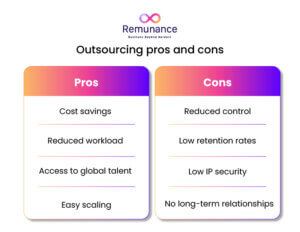
Let’s discuss the detailed advantages and disadvantages of outsourcing in this section.
Advantages
-
- Cost saving is usually where the conversation starts. You cut fixed salaries, benefits, and office costs. The math works.
- Your core team gets breathing room. Less time on routine work, more time on real business priorities.
- Global talent access becomes a shortcut when local hiring drags or budgets get stretched.
- Scaling feels easier. You grow when needed and pull back when work slows, without long-term baggage.
- Turnaround speeds up when work moves across time zones rather than waiting until the next day.
These factors favour outsourcing when choosing between staff augmentation and project outsourcing.
Learn the costs of HR outsourcing.
Disadvantages
-
- You give up some control. You manage deliverables, not every daily move.
- Communication can get tough at times due to large time gaps and cultural differences.
- Quality can fluctuate if a vendor is handling too much at once.
- Data security concerns increase once sensitive information is shared outside the company.
- Internal teams may feel uneasy if outsourcing is seen as a replacement rather than support.
- Hidden costs creep in through coordination time, contract changes, and rework.
We’ll discuss the elephant in the room in our next section: staff augmentation vs. outsourcing.
What Are the Key Differences between Staff Augmentation vs Outsourcing?
Let’s look at the key differences between Staff Augmentation vs Outsourcing.
| Factor | Staff Augmentation | Outsourcing |
| Primary Goal | Adding specific skills or capacity | Delegating entire outcomes |
| Control | High: You manage the team daily | Low/Strategic: Vendor manages execution |
| Responsibility | Client: You are responsible for outcomes | Vendor: Vendor owns delivery and risks |
| Integration | High: Blends into your team/workflows | Low: Operates as a separate entity |
| Cost Model | Time & Materials: Hourly/monthly per person | Fixed Price: Milestone-based for scope |
| Flexibility | High: Scale individuals up/down quickly | Lower: Requires contract/scope changes |
Now comes decision time. We’ll explore that in detail in our next section.
When to Choose Outsourcing in Staff Augmentation vs Outsourcing?
Choose outsourcing when you want results, not day-to-day involvement.
-
- You want hands-off execution. While choosing staff augmentation vs outsourcing, this is where outsourcing fully own delivery.
- You’re buying outcomes, not hours. So, expect the finished product, not time sheets.
- The work isn’t core to your strategy. Payroll, support, and IT upkeep are important, but not differentiating.
- You lack internal bandwidth or tech leadership to manage a new team end-to-end.
- You need predictable costs. Fixed pricing is always better than hidden costs in staff augmentation vs IT outsourcing decisions.
- You’re tackling large, end-to-end builds where staff augmentation vs project outsourcing clearly favors outsourcing.
I hope this gives you the right direction towards choosing the suitable model between staff augmentation vs project outsourcing.
When to Choose Staff Augmentation in Staff Augmentation vs Outsourcing?
This section breaks down what really influences the choice between staff augmentation vs outsourcing.
-
- Pick staff augmentation if control matters more than convenience. You manage everything; the vendor just executes.
- It works best when you already have solid leadership. Without clear ownership, things can fall apart sooner than you expect.
- Need a niche skill for a short time? Staff augmentation beats full-time hiring, every time.
- Scaling up or down quickly is easier here than in outsourcing contracts.
- Changing requirements? This model is much more flexible and wins easily in the choice between staff augmentation and project outsourcing.
- Security stays on edge since talent works within your systems.
- The learning doesn’t walk out the door when the contract does.
So whether it’s staff augmentation vs IT outsourcing or staff augmentation vs project outsourcing, staff augmentation usually comes out on top.
Conclusion
So, staff augmentation vs outsourcing both help solve business problems, but in very different ways. One model saves costs; the other significantly reduces workload.
One gives you full control over your team; the other owns the team and gets your job done. One gives you the flexibility to scale up or down any time. The other might hold back on flexibility.
It’s you that have to assess the requirements your business demands and then decide accordingly. And if you’re confused along the way, this guide can be your roadmap anytime.
Choose the Right Hiring Model for Your Business
Still deciding between staff augmentation and outsourcing? Let our experts help you evaluate your needs, costs, and control—so you choose the model that fits your growth goals.

FAQS
Are staff augmentation and outsourcing the same?
No. Both models help businesses reduce costs and workload, but in very different ways.
How are the two models different?
Staff augmentation helps you hire niche experts for your team for specific projects. Outsourcing takes tasks off your shoulders by assigning them to an external team.
Which option is right for you: payroll, HR, or both?
The main benefit of the model is that once you hand off your tasks to the vendor, you don’t need to worry about it. They manage and control everything for you.
When to choose outsourcing or staff augmentation?
Choose outsourcing if you need to hand off certain tasks entirely to an external team. Choose staff augmentation if you wish to add niche talent to your in-house team to diversify team skills.

Related Posts

Staff Augmentation: What It Is, How It Works, and Pros & Cons

The Ultimate Guide to HR Outsourcing Services for Startups