Employer of Record vs Staffing Agency in India: Key Differences Explained
Understand the difference between an Employer of Record (EOR) and a staffing agency in India. Compare their services, hiring models, costs, payroll responsibilities, and compliance coverage to determine which solution best fits your workforce needs and international expansion plans.
What You Need to Know
“We need to hire in India. We already have candidates, but we don’t have an entity. Should we use a staffing agency or an EOR?” Are you in this situation too? If yes, then you are not alone.
Both an employer of record (EOR) and a staffing agency help businesses hire people, but they serve different purposes. While an EOR simply focuses on legally employing and managing your employees, a staffing agency, on the other hand, primarily helps local companies find and place talent for temporary, contract, or seasonal workers.
Understanding these differences will help you choose the right hiring model and avoid unnecessary compliance risks. Let us break down the differences between EOR and a staffing agency in India.
What Exactly is an EOR in India?
An Employer of Record, or EOR, is a third-party organisation that legally employs workers on behalf of another company. The EOR becomes the legal employer and handles the employment-related responsibilities.
An EOR in India handles the following services:
-
- Employee onboarding
- Payroll processing
- HR administration
- Tax withholding
- Statutory employee benefits
- Contracts and service agreements
- Employee offboarding
- Labor law compliance
An employer of record in India lets you expand your business or build remote teams in India. The EOR providers offer end-to-end compliance services for real-time employee management in India. The
For example, if a U.S. company wants to hire a Software Engineer in India, it doesn’t need to establish an office in India. The company can hire and legally employ the engineer directly without opening a local entity. EOR providers handle legally hiring employees.
However, this candidate is an employee of the client company. Therefore, the client company can assign work and review the employee’s performance.
What is a Staffing Agency in India?
A staffing agency in India is a medium that connects businesses with workers seeking short- or long-term employment. They act as middlemen between these two entities, the business and the worker. Likewise, they are third-party companies that find, screen, and hire the right talent.
Primarily, staffing agencies in India source and recruit people. They help companies identify qualified candidates faster. They have limited control over payroll or the employee’s compliance coverage.
The staffing agencies in India offer the following services:
-
- Candidate sourcing
- Placement support
- Interview scheduling
- Resume screening
- Skill assessments
- Candidate shortlisting
Staffing agencies in India offer these services to their client companies. Based on the client’s needs and the duration of the job, they mainly offer three types of placements:
-
- Temporary placement: The hired candidate starts their assigned work for the client for a defined period of time only.
- Permanent placement: The staffing agency sources the candidate, and the client company employs the candidate directly from day one.
- Temporary to permanent placement: A worker starts as a temporary employee of the staffing agency but later becomes a permanent employee of the client company.
What’s the Difference Between EOR vs Staffing Agency in India?
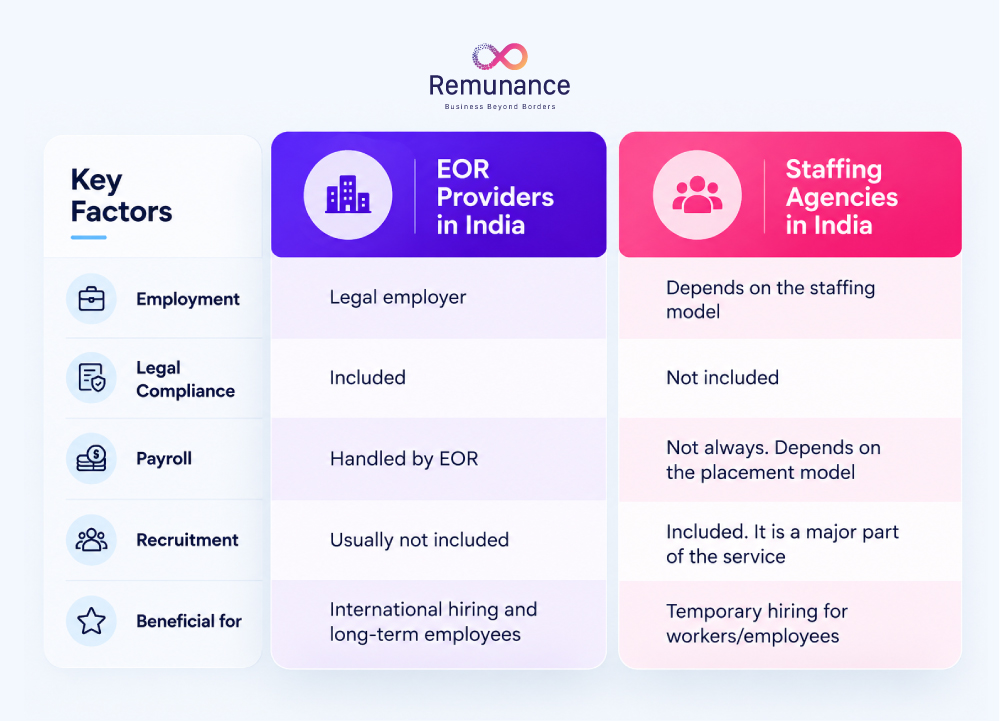
The easiest way to tell the difference between an EOR and a Staffing Agency is to ask yourself one question: Do I need help sourcing talent, or do I need someone to legally employ and manage the candidate I have already chosen?
The core difference between an EOR and a staffing agency is clear;
One helps you find people and the other legally employs and manages the employment and its compliance for you.
Both EORs and staffing agencies can help businesses hire talent, but they differ in their core roles, legal responsibilities, and coverage of compliance management in India.
Think of it in this way;
Suppose Jacob owns a company in the US and wants to hire a Research Analyst in India. A staffing agency will help Jacob find a suitable candidate. Once the candidate is hired permanently, Jacob’s company takes care of the employee’s salary, payroll, and employment-related compliance.
An EOR, on the other hand, legally employs the research analyst on behalf of Jacob’s company. It handles payroll, taxes, statutory benefits, and employment-related compliance, while Jacob manages the analyst’s daily work.
In simple terms, a staffing agency helps Jacob find the right person, while an EOR helps him legally employ and manage that person without setting up a company in India.
Need Help Choosing Between an EOR and a Staffing Agency?
Already found the right talent in India? Remunance helps you manage legal employment, payroll, and ongoing compliance without setting up a local entity.
EOR Vs Staffing Agency in India: Cost Comparison
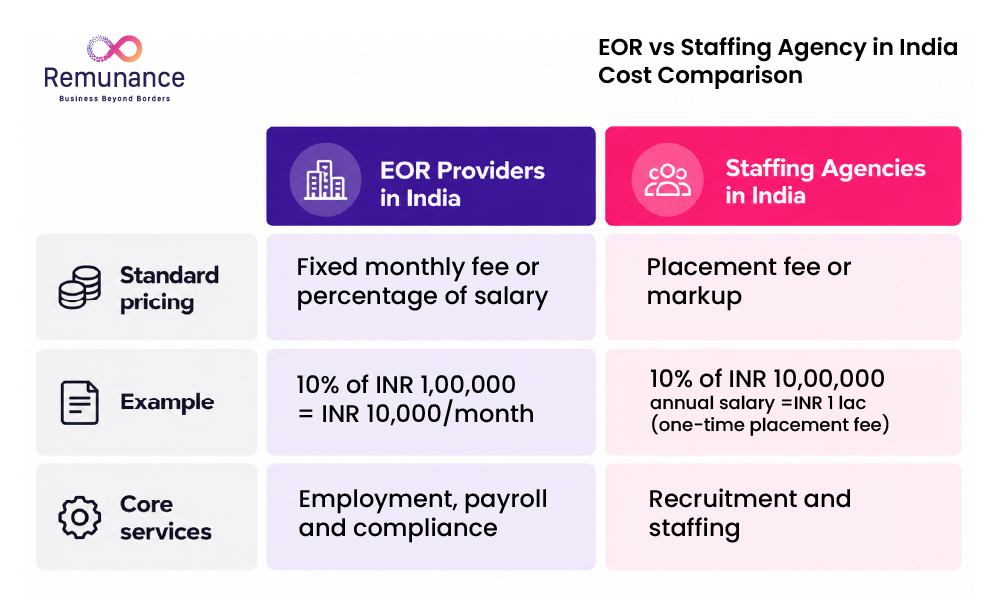
If we were to compare the fees charged by an Employer of Record vs a staffing agency, the cost structure will look something like this:
EOR providers in India typically charge a per-employee fee. This may be a fixed monthly fee or a percentage of the employee’s salary and employment costs.
For your understanding, here are some common pricing models EOR providers use:
-
- Fixed monthly fee per employee
-
-
-
- For example: $500 per employee per month.
- Considering you have 5 employees, then the EOR fee would be $2,500 per month.
-
-
-
- Percentage of the employee’s salary
-
-
- For instance: the EOR charges 10% of the employee’s monthly salary.
- If the salary is INR 1,00,000, the 10% EOR fee would be ₹10,000 / month.
- Salary + employment costs + EOR fee
So your total cost would look like:
Employee salary + statutory benefits/taxes + EOR service fee = Total monthly cost.
-
Staffing agencies: They commonly charge a placement fee or a markup on the worker’s salary / hourly rate.
These are the common pricing models for staffing agencies in India as per the following arrangement:
- Permanent placement: The staffing agency in India charges a one-time recruitment fee. It is often calculated as a percentage of the employee’s annual salary.
For example, if the employee’s annual salary is INR 10 lacs and if the agency charges 10% then 10% of INR 10,00,000 is INR 1,00,000. (1 lac)
So, the client pays INR 1 lac as the recruitment fee, usually once the candidate is hired. - Temporary staffing: For temporary workers, the staffing agency may charge a markup on the worker’s salary or hourly rate.
For instance, let’s assume a worker’s salary is INR 50,000/month. The agency markup could be 20%
That means 20% of INR 50,000 is INR 10,000/month. Hence, the client’s monthly cost will be INR 60,000. The exact percentage varies as per the agency, industry, role, contract duration, and services provided.
We can compare the cost-effectiveness of both models in the table below:
So which one is cost-effective?
-
- For a long-term hire: An EOR can be affordable because you have already found the candidate, and you are paying only for the employment infrastructure such as payroll, statutory benefits and compliance.
- For a short-term or temporary hire: A staffing agency can be cheaper because you will pay a one-time recruitment fee only.
- For international hiring without a local entity: An EOR is highly recommended for international hiring because it provides the local employment infrastructure, whereas any other staffing agency’s recruitment service does not automatically provide that.
EOR vs Staffing Agency: Which one best suits your business?
To determine which model works best for your business, consider this situation: your company has found an excellent sales manager in India. But you do not have an Indian entity to legally hire this employee or manage his payroll.
In the above situation, you will definitely require an EOR service because it will help you handle payroll, employment, and other statutory benefits. This example shows that an EOR is best suited for businesses that have already found their talent but need help with legal employment and compliance.
However, if your company needs to hire 20 employees at once but doesn’t want hiring managers spending weeks finding and screening candidates, a staffing agency is a better choice. The reason is that recruitment and workforce supply are your larger goals.
These two examples show that the right model depends on your business needs and the problem you want to solve.
Remunance Employer of Record
Find the Right Hiring Model for Your Business
Whether you need help recruiting talent or employing your chosen candidates in India, Remunance can guide you toward the right solution for your workforce and compliance needs.
Talk to Our EOR Experts
What Does an EOR Offer That a Staffing Agency Doesn’t?
If you carefully look at the permanent placement model again, it clearly shows the major difference between a staffing agency and an EOR.
An EOR offers:
-
- Global compliance management
- Long-term legal employment infrastructure
- Continued liability assumption
Whereas a staffing agency only focuses on:
-
- Recruiting
- Sourcing
- Placing the candidates
Unlike an EOR, a staffing agency’s role usually ends once a candidate is successfully hired. The client then handles the employee’s payroll, taxes, benefits, and other compliance requirements.
But, an EOR works differently. It legally employs the worker on the client’s behalf and manages payroll, taxes, benefits, and employment-related compliance throughout the employee’s time with the company.
Simplify EOR Hiring with Remunance
At Remunance, we help businesses to choose the right hiring model. We not only deal in EOR services but also help businesses to switch EOR from their current EOR provider with structured guidance.
Depending on workforce, classification, and compliance requirements, we offer services tailored to your needs. From onboarding to payroll processing and ongoing compliance, Remunance provides end-to-end support for managing talent in India.
Apart from the EOR- specific services, we also support businesses in:
-
- Talent acquisition and onboarding
- International hiring without setting up a subsidiary
- India-specific compliance
- Statutory compliance and risk management
Conclusion
When expanding your business globally, understanding the difference between an EOR and a staffing agency is crucial to choosing the right hiring solution.
While both EORs and staffing agencies help companies expand their teams, they differ in scope. An EOR manages the full legal responsibility for an employee, including payroll, benefits, taxes, and compliance.
In contrast, a staffing agency primarily focuses on recruiting talent, leaving the hiring company to handle the legal and operational aspects of employment. Both the models involve a third party, but they solve different hiring problems.
In case you are planning to hire employees across multiple countries, you may even avail yourself of the services of both hiring models. You can use a staffing agency to find candidates and an EOR provider to manage their employment and compliance. But this approach works well only when you have no budget constraints.
While EOR providers offer comprehensive solutions for managing your global workforce, staffing agencies in India are recommended for temporary hiring. Based on your business’s hiring needs, choosing the right model can significantly impact your success.
Remunance Employer of Record
Simplify Hiring and Compliance in India with Remunance
Choose the right hiring model for your business expansion. Remunance helps you employ talent in India, manage payroll, and navigate employment compliance without setting up a local entity.
Talk to Our EOR Experts FAQs
Is an EOR the same as a staffing agency?
No. An EOR and a staffing agency are not the same. A staffing agency helps you source, recruit, and hire candidates on your behalf but an EOR legally employs and manages compliance of the candidate you have already chosen.
Is EOR more expensive than a staffing agency?
Not necessarily. An EOR is not always more expensive than a staffing agency. It depends on what service you need and how the provider charges you. For highly paid professionals, the staffing agency fee can be substantially higher than an EOR fee. Whereas for low-paid workers, the staffing agency model may be more economical.
Can we move a worker from a staffing agency to an EOR without breaking continuity?
Yes. You can move a worker from a staffing agency to an EOR without disrupting their work, provided the transition is properly planned and the existing contract allows it.
Which model works better for hiring five or more engineers at once in India?
A staffing agency model will be a better fit because sourcing and recruitment are its core services. However, to handle the employment of those hired engineers you can later avail EOR service to legally employ them and manage their compliances.
Who carries the legal and tax liability for EOR and staffing Agency?
For an EOR, the EOR generally handles the employment-related liabilities since it is the legal employer. And for a staffing agency, the client company becomes the employer and is responsible for tax liability and legal compliance. This is because the staffing agency’s role is to only source and place candidates for their clients.

Related Posts

Hire Employees in India: Complete Guide for Global Companies

Employer of Record India (2026): Hire Employees Without an Entity

International Recruitment: How to Adapt Your Hiring Process Across Countries

How to Choose the Best Employer of Record?

Labor Laws in India: An Essential Guide for Employers