How Do You Hire Employees in India from the UAE in 2026?
Learn how UAE companies can hire employees in India in 2026 without setting up a local entity. Explore EOR services, hiring costs, Indian employment laws, payroll compliance, India-UAE tax treaties, permanent establishment risks, and data protection requirements to build your Indian team efficiently.
ce que vous devez savoir
Can a UAE company hire employees in India without an Indian entity?
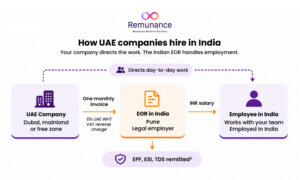
Yes. A mainland LLC, or a free zone company in DMCC, JAFZA, DIFC or ADGM, can embaucher des employés en Inde legally through an employer of record India provider. The provider owns the Indian entity and signs the employment contract under Indian law.
You keep control of the work. The EOR carries payroll, statutory filings, and employer liability in India.
That’s the short version. The longer version is that “no entity” doesn’t mean “no Indian law”. Your hire still gets an Indian appointment letter, provident fund, tax deducted at source, and Indian leave rules.
The EOR simply owns those duties, so your HR team in Dubai doesn’t have to. Our guide to Comment fonctionne une EOR en Inde covers the model in full, from payroll to exits.
The corridor is one of the busiest anywhere. About 4.3 million Indians live in the UAE, and two-way trade reached roughly US$100 billion in 2025, according to the Ministry of External Affairs’ April 2026 brief. The same brief ranks the UAE as India’s seventh-largest foreign investor.
Notre guide Dubai companies in India covers the market itself. This one covers the hiring.
What Are the Legal Ways to Hire in India From The UAE?
There are five realistic routes. Only two of them give you a full-time employee in India on an Indian contract.
| Itinéraire | Qui signe avec le travailleur | Time to first person in India | Meilleur pour | Risque principal |
| Employeur de référence (EOR) | L'entité indienne de l'EOR | Days, plus the candidate’s notice period | 1 to 20 hires, testing India | Des frais mensuels par employé |
| Filiale indienne | Your own Indian private limited company | Often 8 to 16 weeks before payroll runs | A long-term team of 20 or more, or Indian customers | Fixed compliance cost and a slow exit |
| Entrepreneur indépendant | Nobody. It’s a B2B contract | jours | Short projects with a clear end | Misclassification under Indian law |
| Secondment from the UAE | Your UAE company | Weeks, plus an Indian employment visa if the person isn’t Indian | One senior profile to seed the team | Indian tax after 183 days, plus PE exposure |
| Relocation to the UAE | Your UAE company | Weeks to months, for the work permit, visa and notice | Roles that must sit in the UAE | Visa costs, health insurance, gratuity and a bigger Emiratisation base |
If you’re weighing the first two, our Guide du seuil de rentabilité EOR vs filiale sets out where each one wins. For project work, see Entrepreneur officiel contre employeur officiel.
Why Can’t You Put Your Indian Hire On Your UAE Payroll?
Because India still treats that person as employed in India, and nobody would be meeting India’s employer duties.
Your UAE payroll is built for people with a UAE work permit and residence visa. Someone living in Pune has neither. India, meanwhile, needs TDS, provident fund registration, and a compliant appointment letter.
Pay someone straight from a UAE bank account, and three problems land at once. Nobody deducts Indian tax at source. Nobody registers the person with EPFO. And a full-time person taking daily direction from Dubai starts to look like a UAE business operating in India.
That last one is the permanent establishment question, covered below. It’s also how many teams drift into erreur de classification des employés without meaning to.
There’s a mindset trap too. It catches most first-time employers. UAE salaries carry no personal income tax, so gross and net pay are close. An Indian offer loses TDS, provident fund, and professional tax, so quote and compare in gross rupees.
Salary for work done in India is paid in rupees into an Indian bank account. An EOR converts your payment and pays the team every month. See comment payer les employés en Inde pour les mécaniciens.
Planning to Hire Employees in India From the UAE?
Hire employees in India from the UAE without setting up an entity. Remunance manages payroll, employment contracts, taxes, and compliance while you focus on growing your team.
How Do You Hire Employees In India From The UAE, Step By Step?
You can finish the legal side in about a week. The candidate’s notice period sets the calendar, not the paperwork. Our complete guide to hiring employees in India covers the India-wide process, so this section sticks to what changes when you hire from the UAE.
Here’s how to hire employees in India from a UAE base:
-
- Set the role and salary in rupees. Benchmark against Indian pay for the same city and seniority, not against Dubai. Our guide des salaires moyens en Inde breaks pay down by city and experience, and the calculateur de salaire pour l'Inde turns a CTC into take-home pay.
- Pick your hiring route. For one to 20 people, an EOR is usually faster and cheaper than a subsidiary. You can still move to your own entity later without losing the team.
- Source candidates. Naukri and LinkedIn dominate professional hiring in India, and referrals from your first hires often become your best channel. Your EOR can also run recruitment for you.
- Issue the offer through the EOR. Written appointment letters became compulsory under the labour codes from 21 November 2025.
- Sign the data and IP paperwork. Put IP assignment, confidentiality and your data transfer clauses in place before day one.
- Onboard and register. Exécutez n'importe quel vérification des antécédents en Inde with the candidate’s written consent. The EOR then collects PAN, Aadhaar, bank details and the employee’s UAN, and registers them for EPF and, where wages qualify, ESI.
- Run payroll. You pay one monthly invoice that covers salary, employer contributions and the EOR fee. The EOR pays salary in rupees, deducts TDS and issues the annual Le formulaire 130, qui a remplacé le formulaire 16 from tax year 2026-27.
How Long Does It Take for an Indian Hire to Start Work?
Plan on 30 to 90 days from offer to first day for an experienced hire. Indian tech employees commonly serve 60 to 90 days’ notice, and buyouts are negotiated case by case.
UAE law sets notice at 30 to 90 days too, so the wait won’t surprise your hiring managers. The EOR is rarely the bottleneck. If you want someone starting on 1 February 2027, you need to send the offer in November 2026.
Where Should UAE Companies Find Candidates In India?
Start with Naukri, LinkedIn, and employee referrals, then add a specialist recruiter for senior or niche roles where the pool is thin.
Don’t overlook professionals heading home from the Gulf. They already know how UAE businesses run, and many want a role that keeps that link.
Hire for English. It’s the working language of Indian tech and of most UAE offices. Add Arabic only when the role faces Arabic-speaking customers, because it narrows the pool sharply. For engineering roles, our guide to recrutement de développeurs en Inde lists the skills to screen for.
How Is An Indian Employment Contract Different From A UAE One?
It follows Indian law and the law of the state where your employee works. Your MOHRE contract template, the UAE gratuity formula, and UAE non-compete rules don’t carry over.
Your EOR issues the contract, but check the commercial terms against this table before the offer goes out.
| Long | The UAE rule your HR team knows | The Indian rule your EOR applies |
| Type de contrat | Fixed-term only, with no maximum length since a modification de 2022 | Permanent or fixed-term. Fixed-term staff get the same benefits as permanent staff |
| Probation | Jusqu'à six mois | No statutory cap. Three to six months is normal. See how probation works under an EOR |
| Avis | Entre 30 et 90 jours | Set in the contract at or above the state minimum. Thirty to 90 days is normal in tech |
| Congé annuel | 30 calendar days a year after the first year | Set by the OSH Code and the state Shops and Establishments Act |
| Congé maternité | 60 days: 45 at full pay and 15 at half pay | 26 weeks of paid congé de maternité pour les employés admissibles |
| Leaving payment | Gratuity of 21 days’ basic pay per year for five years, then 30 days, capped at two years’ pay | Gratuity of 15 days’ wages per year after five years, or after one year for fixed-term staff |
| Clause de non-concurrence | Allowed for up to two years if limited in scope | Post-exit restraints are void under Section 27 of the Indian Contract Act |
| Pay system | The Wage Protection System, for UAE work permit holders | Monthly payroll with TDS, EPF and, where eligible, ESI |
UAE rules in the table come from Pinsent Masons’ guide to Federal Decree-Law No. 33 of 2021, which took effect on 2 February 2022.
Two more clauses belong in every Indian contract. Add IP assignment and confidentiality, so code, designs and documents belong to your company from day one. And use non-solicitation during employment instead of a post-exit non-compete. Our guide to the contrat d'employeur officiel couvre le reste.
What Does It Cost to Employ Someone in India Compared With Dubai?
Expect statutory employer costs of roughly 3% to 5% of gross salary for a mid-level professional, plus your EOR Inde provider’s monthly fee.
The UAE looks cheap on paper because there’s no income tax and no social security for expatriates. But you still accrue end-of-service gratuity, buy mandatory health insurance and pay visa and work permit fees.
India’s employer charges stay low because provident fund sits on a capped wage base, even after the EPF ceiling rose to ₹25,000 a month on 17 September 2026. Here’s the full stack.
| Élément de coût | L'employeur paie | S'applique lorsque | Attention à |
| Caisse de prévoyance des salariés (EPF) | 12% of basic wages, usually on a ₹25,000 monthly ceiling | Covered establishments | ₹3,000 a month at the ceiling. ₹2,083 of it goes to the pension scheme |
| EDLI and EPF admin charges | About 0.5% each, on the same base | Alongside EPF | About ₹250 a month at the ceiling |
| Assurance maladie des salariés (ESI) | 3.25% du salaire brut | Gross pay of ₹21,000 a month or less | Rarely applies to engineers |
| pourboire | A provision of about 4.81% of basic wages | Payable on exit after 5 years, or 1 year for fixed-term staff | 15 days’ wages per year of service |
| Taxe professionnelle | Deducted from pay and remitted by the employer | Cela dépend de l'État | Up to ₹2,500 a year in Maharashtra |
| Retenue à la source sur salaire | Deducted from pay and deposited by the employer | All salaried staff | Quarterly returns and the annual Form 130 |
Vérifiez la EPF contribution rates on EPFO et ESI rules on ESIC before you budget. Our Conformité de la paie en Inde guide explains each filing, and the Calculateur de coûts EOR pour l'Inde runs the numbers for your roles.
What Does A Pune Engineer Cost Compared With A Dubai Hire?
A mid-level backend engineer in Pune costs about 30% of a Dubai software engineer once statutory employer costs are added on both sides.
Let’s say you hire in Pune on a gross salary of ₹24 lakh a year. That’s the middle of the ₹18 lakh to ₹32 lakh band our salary guide gives for mid-level roles at product companies and GCCs. Basic wages are set at 50% of gross to meet the labour codes.
The Dubai column uses AED 312,042, the Levels.fyi median for software engineers in the Greater Dubai Area across 208 salaries, updated on 22 October 2026. It’s total compensation, including bonus and stock, and it leans towards tech employers. So treat it as the price of competing with funded tech firms, not every Dubai offer.
UAE gratuity accrues at 21 days’ basic pay a year for the first five years. That works out at 5.83% of annual basic, and we assume basic is half the package. Health insurance, visa and work permit fees, flights and housing are left out, so the Dubai column is a floor.
| Élément de campagne | Pune (₹ a year) | Pune (AED a year) | Dubai (AED a year) |
| Salaire brut | 24,00,000 | 92,723 | 312,042 |
| Employer EPF (capped at ₹25,000 a month) | 36,000 | 1,391 | n/a |
| Frais EDLI et administratifs | 3,000 | 116 | n/a |
| Gratuity provision (India 4.81%, UAE 5.83% of basic) | 57,720 | 2,230 | 9,101 |
| Total before EOR fee and benefits | 24,96,720 | 96,459 | 321,143 |
Rates: AED 1 = ₹25.88. We derived it from the ECB’s 15 October 2026 reference rates for the roupie (₹106.54 to the euro) and the Dollar américain ($1.1208). Then we applied the dirham’s fixed peg of AED 3.6725 to the dollar. Figures are rounded, so columns may not add exactly.
That’s a gap of about AED 224,700 a year for one hire. Even at the Levels.fyi 25th percentile of AED 230,000, the Pune engineer costs about 41% of the Dubai one. Add the EOR’s monthly fee to the Pune column and the difference still runs to six figures in dirhams.
The peg matters for budgeting too. Because the dirham tracks the dollar, your real currency exposure on an Indian payroll is the dollar-rupee rate. Our EOR cost breakdown shows what’s usually bundled and what’s billed extra.
The fee rarely changes the decision. Benefits, retention and manager time do.
Which Benefits Should You Budget For Beyond Statutory Costs?
Budget for group health insurance, a laptop and annual pay reviews, because Indian professionals compare offers on all three. Health cover is usually the first thing candidates ask about, since ESI rarely applies above ₹21,000 a month.
Notre guide assurance maladie pour les employés en Inde covers typical sums insured and family cover. Variable pay, internet allowances and wellness budgets aren’t mandatory, but they often decide whether you win the candidate. See what’s standard in our list of avantages sociaux des employés en Inde.
What Changed In India’s Payroll Rules In 2026?
Five changes reset how an Indian salary is costed this year. If your provider’s last quote predates September 2026, ask for a fresh one.
-
- The labour codes are live: The four labour codes took effect on 21 November 2025ainsi que, central rules followed on 8 May 2026.
- The 50% wage rule: Allowances excluded from “wages” can’t exceed half of total pay, so provident fund and gratuity now run on a bigger base. Our guide to structure salariale en Inde shows a compliant breakup.
- A new EPF scheme: Le Employees’ Provident Funds Scheme, 2026 replaced the 1952 scheme from 1 July 2026, under the Code on Social Security.
- A higher EPF ceiling: The wage ceiling went from ₹15,000 to ₹25,000 a month on 17 September 2026. At the cap, employer EPF rises from ₹1,800 to ₹3,000 a month.
- Nouveaux formulaires fiscaux : Under the Income-tax Act, 2025, Form 130 replaces Form 16 as the annual salary TDS certificate.
Gratuity for fixed-term staff also kicks in after one year of service rather than five, so short contracts carry a real exit cost. States are still finalising their own rules, so state Shops and Establishments Acts still shape notice periods and working hours. Our lois du travail en Inde guide tracks the detail.
Employeur officiel de rémunération
Compare Your India Hiring Costs With Remunance
See how much you can save by hiring skilled Indian talent. Use our India EOR cost calculator to estimate payroll costs, statutory contributions, and EOR fees before you expand.
Calculez vos coûts de recrutement en Inde
Which UAE Tax Rules Apply to an India-Based Hire?
Very few, if the person lives and works in India and is employed by an Indian EOR. India taxes the salary, and the UAE has no personal income tax to apply anyway.
Your UAE exposure shifts from payroll to three narrower questions: withholding on the fee, VAT on the invoice, and UAE corporate tax. The next section covers permanent establishment.
Which Article of the India-UAE Tax Treaty Covers Salaries?
Article 15, dependent personal services. Under the India-UAE DTAA, salary earned by an India resident for work done in India is taxable only in India. Article 14 covers independent professionals, and Article 16 covers directors’ fees.
The agreement was signed in New Delhi on 29 April 1992 and entered into force on 22 September 1993. It was amended in 2007 and 2013.
Short trips to Dubai don’t usually change that. Under Article 15(2), the salary remains taxable only in India if three tests are met. The employee spends no more than 183 days in the UAE in the relevant year. The employer isn’t a UAE resident. And no UAE PE or fixed base bears the pay.
An Indian EOR meets the employer test by design. Track visit days anyway, because a few long workshops in Dubai add up faster than most managers expect.
Does The UAE Withhold Tax On Payments To An Indian EOR?
Non le Ministère des Finances confirms that withholding tax on payments to non-residents without a UAE permanent establishment is 0%.
So the full fee reaches the EOR. On the Indian side, an EOR’s services to an overseas client are generally an export of services and are zero-rated for GST when the conditions are met. Nous expliquons comment zero-rated GST applies to EOR services.
How Do You Treat the EOR Invoice for UAE VAT?
Treat it as an imported service. If your business is VAT-registered, you account for 5% VAT yourself under the reverse charge. You report it in Box 3 of your return, as the FTA’s VATP044 clarification se met en route.
You can usually recover the same amount as input tax if the service supports taxable supplies. Net cost: usually nil.
One thing changed this year. From 1 January 2026, you no longer need to issue a tax invoice to yourself for imported services, according to the FTA’s VATP046 clarification of 4 September 2026. Keep the supplier’s invoice and your supporting records instead.
Can You Deduct EOR Fees For UAE Corporate Tax?
Yes, in most cases. UAE corporate tax applies at 9 % sur les bénéfices imposables supérieurs à 375 000 AED under Federal Decree-Law No. 47 of 2022, for financial years starting on or after 1 June 2023. An EOR fee for staff who work on your business is a normal business expense.
Two caveats. If you recharge the cost to another group company, transfer pricing rules apply.
The second caveat is for free zone companies. If you’re a Qualifying Free Zone Person, your core income-generating activities must be carried out in a free zone, under Décision du Cabinet n° 100 de 2023. Move that core work to an India team and your 0% rate could be at risk. Support and back-office roles usually sit outside that core, but ask your tax agent before you move anything that earns your qualifying income.
Notre note sur Implications fiscales de l'EOR va plus loin.
Will Hiring in India Create a Permanent Establishment for Your UAE Company?
Not usually, if an EOR employs your team and they do engineering, data, design, support, or back-office work for your own business. But the India-UAE treaty has a sharper edge than most guides admit. Read this part twice.
Article 5(2)(i) creates a permanent establishment when a UAE company furnishes services in India, including consultancy, through employees or other personnel. It applies once those activities run for more than nine months within any 12-month period, for the same or a connected project.
The service PE bites when your company delivers services in India, typically to Indian customers. An EOR team building your own product in Pune isn’t furnishing services to anyone for you. A delivery team serving your Indian clients is.
Two rulings show how Indian authorities read this treaty:
-
- Remote work can count: In ABB FZ-LLC, a UAE free zone company, the Bengaluru bench of the Income Tax Appellate Tribunal counted services rendered from abroad toward the nine months. Staff had spent only 25 days in India, as BCAJ reports.
- Control can create a fixed place PE: On 24 July 2025, the Supreme Court held that Dubai-based Hyatt International Southwest Asia had a PE through continuous and substantive control over Indian hotels’ operations. Losses elsewhere in the group didn’t wipe out Indian tax on the PE’s profits, as Alerte d'EY explique.
So the risk sits in four places. An Indian office kept at your disposal. People who habitually conclude contracts in your name. Services furnished to Indian customers over the past nine months. And day-to-day control over an Indian business you work with.
Which Roles Carry The Highest PE Risk?
Sales and business development roles carry the most risk, because they can negotiate or sign contracts for you. Customer-facing delivery teams come next, because of the nine-month clock.
| Role or set-up | Risque de capital-investissement | Pourquoi | Que faire |
| Sales or business development | Haute | May conclude contracts for the UAE company | Keep pricing approval and signature in the UAE |
| Country head with signing authority | Haute | Authority to bind the company | Limit authority in writing |
| Delivery team serving your Indian customers | High after nine months | Service PE under Article 5(2)(i) | Contract Indian customers through an Indian entity or partner |
| Managers who run an Indian partner’s operations | Moyen à élevé | Hyatt-style control over premises and operations | Keep oversight strategic and documented |
| Engineering, data, design for your own products | Low | Internal work, no services to Indian customers | Standard EOR set-up |
| Customer support, finance operations | Low | Internal service delivery | Standard EOR set-up |
Write these limits into the role description and the EOR agreement, so the paper trail matches how the role works day to day. Our guide on how to éviter le risque d'établissement permanent en Inde covers the wider checklist. If you’re building a sales team, read our guide to building a sales team in India d'abord.
Did the MLI change the India-UAE Tax Treaty?
Only lightly. The MLI synthesised text adds an anti-abuse preamble and a principal purpose test that replaces the treaty’s limitation of benefits article. It also gives taxpayers three years to start a mutual agreement case and adds corresponding adjustments.
Article 5 stays in its original form. So the MLI’s wider agent test, anti-fragmentation rule and contract-splitting rule don’t apply. An agent still creates a PE only by habitually exercising authority to conclude contracts. For India, the changes apply to taxable periods from 1 April 2020.
Employeur officiel de rémunération
Protect Your UAE Business From India PE Risks
Hiring in India doesn't have to create unnecessary tax exposure. Remunance helps you structure EOR employment, define role responsibilities, and manage local compliance as you grow your Indian team.
Parlez à notre expert en récupération assistée du pétrole (EOR).
Is There A Social Security Agreement Between India And The UAE?
No. India has no social security agreement with any GCC country, including the UAE, as The Policy Edge notes in its review of an ILO-commissioned paper. So there’s no India-UAE social security agreement to coordinate contributions.
For Indian employees in India, that changes nothing. They join EPF as normal.
The gap matters in two other cases:
- A non-Indian manager you move onto an Indian payroll: Someone you second from Dubai who isn’t an Indian national becomes an “international worker” for EPF. With no India-UAE agreement to rely on, they contribute on full salary, not the ₹25,000 ceiling. Read Comment un EOR aide les employés expatriés before you plan it.
- An Indian national moving from your Dubai office to India: Their UAE gratuity crystallizes when the UAE contract ends, and Indian service starts fresh. More on that below.
On the UAE side, expatriates get end-of-service gratuity rather than a state pension. Cabinet Resolution No. 96 of 2023 lets employers pay into an approved savings fund instead.
Contributions run at 5.83% of basic pay for under five years’ service and 8.33% after, as Bracewell’s summary of MOHRE’s guidance sets out. That scheme covers your UAE staff only, not your India team.
Does Hiring In India Affect Your Emiratisation Targets?
Pas directement. Émiratisation rules on u.ae cover companies with 50 or more employees. They must raise the share of Emiratis in skilled roles by 2% a year, reaching 10% by the end of 2026.
Companies with 20 to 49 employees in 14 listed sectors had to hire one Emirati in 2024 and another in 2025.
Those targets are measured on your UAE workforce. An India team employed by an Indian EOR sits on that EOR’s payroll, not yours, so it doesn’t enlarge the base the 2% applies to. That’s a quiet advantage.
Relocation works the other way. Every skilled expatriate you bring to Dubai adds to that base. Missing the 20-to-49 rule cost AED 96,000 for 2024 and AED 108,000 for 2025.
What If Your UAE-Based Employee Wants To Move Back To India?

Treat it as a new Indian hire, not a remote-work arrangement. Don’t improvise. Many Indian professionals in Dubai eventually head home, and keeping them on the UAE payroll from India creates problems on both sides.
On the UAE side, the residence visa lapses. The Portail du gouvernement des Émirats arabes unis says a visa is canceled automatically once the holder lives outside the UAE for more than six months in a row.
On the Indian side, they become tax resident once they spend 182 days in India in a tax year, under article 6 de la Loi de l'impôt sur le revenu de 2025. Their salary for work in India is then taxed in India, and nobody is deducting TDS.
The clean route has four steps:
-
- Close the UAE contract properly: Pay end-of-service gratuity within 14 days of termination if they’ve served a year or more, settle leave and cancel the visa.
- Re-hire through an Indian EOR: Issue an Indian appointment letter with Indian notice, leave, and gratuity terms.
- Reuse their UAN if they have one: Many returning professionals held an EPF account before they left India.
- Recognize their history where it helps: You can honor Dubai tenure for leave or seniority in the offer. Indian statutory gratuity still counts from the Indian start date.
Returning professionals may also be “not ordinarily resident” for a while. Under section 6(13), that covers someone who was non-resident in nine of the previous ten years, or spent 729 days or fewer in India over the previous seven. It mainly shields foreign income, not the Indian salary.
Voici Comment Remunence soutient les employés qui retournent en Inde, from contracts to payroll.
How Do UAE Data Rules And India’s DPDP Act Apply To Your Indian Team?
It depends on where your UAE company is licensed. Check your license first. When your Indian team accesses customer or employee data held in the UAE, that usually counts as a transfer out of the country, and three regimes set the rules.
-
- Mainland and most free zones: Le UAE PDPL, Federal Decree-Law No. 45 of 2021, allows transfers to countries with adequate protection and otherwise under safeguards. But its executive regulations still hadn’t been issued as of March 2026, according to Chambers’ 2026 UAE data protection guide. So there’s no adequacy list yet, and contractual safeguards are the practical route.
- DIFC : The DIFC Data Protection Law No. 5 of 2020 doesn’t list India as an adequate jurisdiction. Use the DIFC Commissioner’s standard data protection clauses, as Al Tamimi explains.
- ADGM : The ADGM Data Protection Regulations 2021 set their own transfer rules, so follow ADGM’s requirements rather than the federal ones.
Health and banking data sit under separate federal laws, so check those first if you’re in either sector. If your business also holds EU personal data, the Clauses contractuelles types 2021 apply on top.
What Do You Need Before An Indian Engineer Touches Customer Data?
Four things, ideally signed before day one:
-
- A transfer agreement between your UAE company and the data importer, using DIFC or ADGM clauses where they apply. Agree in writing whether that’s the EOR or another party.
- A data processing agreement with the EOR that covers employee and customer data.
- An updated record of processing that lists the India transfer.
- Tight access controls. Use masked data in test systems and log production access.
Don’t skip this because “it’s only code”. Logs, crash reports and test databases often hold personal data, even when nobody meant them to.
When Do India’s DPDP Rules Apply To Employee Data?
In stages. The rules under the Loi DPDP were published on 13 November 2025. Only consent manager registration starts on 13 November 2026. Most duties, including notices, security safeguards, breach reporting and data principal rights, apply from 13 May 2027, as The Privacy Labs sets out.
MeitY floated cutting that runway to 12 months in January 2026. As of early October 2026, no amendment had been published, so 13 May 2027 still stands.
Your EOR is responsible for employee data in India. Hold it to that. Ask how its notices, breach reporting and retention policies will be ready by then. Our guide to the DPDP Act for employers in India covers the HR side in detail.
Should You Relocate Indian Talent to the UAE or Hire Them in India?
Hire in India unless the role must physically sit in the UAE. Relocation brings a MOHRE work permit, a residence visa, mandatory health insurance, end-of-service gratuity, and a bigger Emiratisation base.
Health insurance is now employer-funded across every emirate. Since 1 January 2025, the basic package costs AED 320 a year and is a prerequisite for issuing or renewing residence permits, according to MOHRÉ. Dubai and Abu Dhabi already ran their own schemes, and plans for professionals usually cost more than the basic package.
India adds a step for some candidates too. Holders of an “Emigration Check Required” passport need emigration clearance through eMigrate before taking a job in the UAE. It’s one of 19 such countries on the Ministry of External Affairs’ list.
The upside is real. Your employee pays no UAE income tax, which makes a Dubai offer look generous. But your cost doesn’t fall, because gratuity, insurance and visa fees land on you.
| Facteur | Hire in India through an EOR | Relocate to the UAE |
| Salary benchmark | Indian market rate | UAE market rate, often with housing and travel allowances |
| Employer statutory cost | Environ 3% à 5% | Gratuity at 5.83% of basic in the first five years, plus health insurance and visa fees |
| Émiratisation | Not part of your UAE base | Adds to your skilled workforce base |
| Il est temps de commencer | The notice period, 30 to 90 days | Work permit, visa, medical test and notice |
| Où ils travaillent | India, with about eight hours of daily overlap | The UAE, on site |
| Who runs the admin | L'EOR | You, plus MOHRE, WPS and visa renewals |
When Does Relocation Make More Sense?
When the work needs someone physically present: a client site, a warehouse, a store, or a regulated role your UAE license requires on the ground.
For software, analytics, finance operations and customer support, hiring in India usually wins on cost and speed. If you’re torn, our note on immigration vs expatriation sets out the costs of each path.
Employeur officiel de rémunération
Build Your Team in India Without Relocation Costs
Hire skilled Indian professionals without the added expense of UAE visas, insurance, and relocation. Remunance manages employment, payroll, and compliance so you can focus on growing your business.
Rémunération des contacts
What is the India-UAE Time Difference, And How Much Overlap Do You Get?
The India-UAE time difference is 1.5 hours, with India ahead, and it doesn’t change during the year. Neither country uses daylight saving time.
That gives you one of the widest overlaps of any India corridor. It’s rare. A 9:00 to 18:00 Dubai day runs from 10:30 to 19:30 in Pune. Against a 9:30 to 18:30 Pune day, you share about eight hours.
Weekends mostly line up too. The UAE government moved to a Saturday and Sunday weekend on 1 January 2022, with a half day on Friday. Private employers could choose their own pattern, as Ius Laboris notes, so check whether your Dubai office works Friday afternoons.
How Should You Plan Holidays Across The Two Countries?
Agree a shared holiday calendar up front. Both countries mark Eid, but the dates can differ by a day because each follows its own moon sighting.
UAE National Day falls on 2 December. India’s Republic Day is 26 January, Independence Day is 15 August, and Diwali usually falls in October or November. Our guide to Politiques de vacances en Inde helps you plan the year.
Feedback norms differ more than time zones do. Our pieces on work culture in India et gestion d'équipes multiculturelles cover the softer side.
When Should a UAE Company Set Up Its Own Indian Subsidiary Instead?
Consider a subsidiary once you pass roughly 15 to 25 people in India with a multi-year plan. It also makes sense when you need to sign contracts with Indian customers or invoice them in rupees, which an EOR can’t do on your behalf.
The service PE adds a UAE-specific trigger. If a team will serve Indian customers for more than nine months, contracting through an Indian entity is often cleaner than letting your UAE company furnish those services. Plan for it early.
Below that size, an Indian company’s fixed costs usually outweigh the EOR fee. A private limited company needs incorporation with the Ministry of Corporate Affairs, a resident director, statutory audits, and annual filings. It also needs transfer pricing files for its dealings with the UAE parent.
Notre guide sur quand une entité indienne devient moins chère qu'un EOR shows where the breakeven sits. When you’re ready, our guide on Comment créer une filiale en Inde walks through each filing. Planning a larger center? Compare GCC contre EOR en Inde d'abord.
How Do You Choose an EOR in India as a UAE Company?
Choose an EOR that owns its Indian entity, prices in a way your finance team can predict, and understands the UAE treaty’s service PE. The headline price per head matters less than what happens when something goes wrong.
Ask every provider on your shortlist these seven questions:
-
- Do you own the Indian entity, or use a partner?: A partner adds a layer between you and the legal employer.
- Which currencies can you invoice in, and what conversion margin applies?: The dirham’s dollar peg means a dollar quote and a dirham quote should match closely. Ask for both.
- Which fees sit outside the monthly price?: Termination, off-cycle payroll and conversion are the usual extras.
- Will you sign data transfer clauses that fit our licence?: Mainland, DIFC and ADGM each need something different. Ask which certifications de sécurité the provider holds too.
- Are your contracts and payroll updated for the labour codes and the ₹25,000 EPF ceiling?: Ask to see a sample appointment letter and salary structure.
- How do you flag PE risk in role design?: A good provider spots a customer-facing delivery team heading for the nine-month line.
- Can you help us move staff to our own entity later?: You want a provider that doesn’t trap your team.
Notre guide sur comment choisir le meilleur employeur officiel walks through each test, and our note on risques liés à l'employeur officiel explique ce qu'il faut éviter.
What Mistakes Do UAE Companies Make When Hiring In India?
Most mistakes come from treating an Indian hire like a UAE one, with the same contract, the same pay logic and the same assumptions about exits. These six cost the most:
-
- Copying a UAE contract: The 21-day gratuity formula and a two-year non-compete don’t work in India. A grafted UAE clause creates confusion, not protection.
- Thinking in net pay: A Dubai salary is close to take-home pay. An Indian salary loses TDS, provident fund and professional tax.
- Calling a full-time person a freelancer: Indian law looks at control, hours and exclusivity, not the label on the contract.
- Letting a delivery team serve Indian clients past nine months: That’s the treaty’s service PE.
- Letting a Dubai employee “just work from India”: The visa lapses after six months away, Indian tax residence starts and nobody runs TDS.
- Ending employment the UAE way: India has its own règles de résiliation, including notice, due process and full and final settlement.
Utilisez notre Liste de contrôle de conformité EOR to test any provider you shortlist.
Why Do UAE Companies Hire Through Remunance?
Because you get an India-only EOR with its own Indian entity in Pune, not a reseller network. Remunance’s des services d'Employeur Officiel employ your team, run payroll and statutory filings, and keep your Indian contracts current with the labour codes.
Qu'est-ce que vous obtenez:
-
- Labour-code-ready contracts: Appointment letters and salary structures built for the 50% wage rule and the ₹25,000 EPF ceiling.
- One invoice, every statutory duty: EPF, ESI, gratuity, Professional Tax and TDS handled.
- A clear onboarding process: Découvrez notre fonctionnement intégration client transparente.
- Equipment and workspace: Nous organisons Partage de fichiers et réseau et espace de bureau when your team needs it.
- A route to your own entity: We support the move from EOR to a subsidiary when you outgrow the model.
Employeur officiel de rémunération
Ready to Hire in India With Remunance?
Build your Indian team with a dedicated EOR partner. From compliant employment contracts to payroll and statutory filings, Remunance manages the process from onboarding to ongoing support.
Contactez nos experts en recrutement en Inde
FAQ
Can a UAE company hire employees in India without registering a company there?
Yes. An employer of record employs your hire through its own Indian entity, so you don’t register a company in India. You direct the work and set targets, exactly as you would for a team member in Dubai. The EOR runs payroll, deducts TDS and remits EPF and ESI.
Can a Dubai free zone company hire employees in India?
Yes. A free zone company hires through an EOR the same way a mainland LLC does. If you’re a Qualifying Free Zone Person, keep your core income-generating activities in the free zone, because moving them to India could put your 0% corporate tax rate at risk.
How much does it cost to hire an employee in India from the UAE?
Statutory employer costs run about 3% to 5% of gross salary for most professionals, plus the EOR fee. A ₹24 lakh engineer in Pune costs about AED 96,459 a year before the fee. A Dubai software engineer on the Levels.fyi median costs about AED 321,143 once gratuity is accrued.
Which article of the India-UAE DTAA covers salaries?
Article 15, dependent personal services. Salary earned by an India resident for work done in India is taxable only in India. The agreement was signed on 29 April 1992 and has been in force since 22 September 1993.
Does the India-UAE tax treaty have a service PE clause?
Yes. Article 5(2)(i) creates a PE when a UAE company furnishes services in India through employees or other personnel for more than nine months in any 12-month period. It mainly affects teams that serve Indian customers, not EOR staff working on your own products.
Is there a social security agreement between India and the UAE?
No. India has no social security agreement with the UAE or any other GCC country. Indian employees in India pay into EPF as normal, while non-Indian staff on an Indian payroll contribute as international workers on full salary.
Do you pay UAE VAT on an Indian EOR's invoice?
Yes, if your UAE business is VAT-registered. You self-account 5% VAT under the reverse charge and can usually recover it as input tax. Since 1 January 2026, you don’t need to issue yourself a tax invoice.
What is the time difference between the UAE and India?
India is 1.5 hours ahead of the UAE all year, because neither country uses daylight saving time. A standard working day in each country overlaps by about eight hours.

Articles similaires

Comment payer les employés en Inde en 2026 : procédures, étapes de la paie et nouvelles règles relatives aux fonds de prévoyance

Comment éviter les risques liés à l'établissement stable en Inde

Recruter des employés en Inde : Guide complet pour les entreprises internationales

Employeur officiel en Inde (2026) : Embaucher des employés sans entité juridique

Droit du travail en Inde : Guide essentiel pour les employeurs