What is Fully Managed Payroll in India? A Complete Business Guide
Fully managed payroll in India covers salary processing, tax compliance, statutory filings, and employee support under one model. It helps businesses reduce compliance risk, manage multi-state regulations, ensure payroll accuracy, and scale operations efficiently while staying fully compliant with Indian labor laws.
📑 Table of Contents
Payroll in India is rarely just about salary processing. It lies at the junction of taxation, labor law, compliance, employee experience, and audit readiness.
As businesses grow, payroll becomes more complex. This happens when they expand to new states or hire diverse teams. Fully managed payroll shifts from a back-office task to a strategic function.
Fully managed payroll in India goes beyond basic calculations. It hands off all payroll tasks to a dedicated provider. This includes compliance, filings, reporting, and regulations. The employer keeps control over decisions about people and compensation strategy.
More Indian businesses, fast-growing startups, and global firms are using this model. It’s especially popular where accuracy, compliance, and operational continuity matter most.
Understanding Fully Managed Payroll in the Indian Context
Fully managed payroll is when a payroll service provider handles all payroll tasks for the employer.
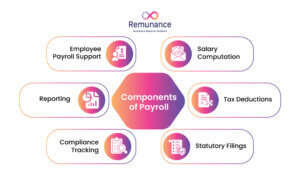
In India, payroll management is particularly complex due to the layered regulatory framework.
Payroll processing depends on several factors:
-
- Central laws
- State labor rules
- Regular tax updates
- Various statutory bodies
Fully managed payroll simplifies complexity. It turns it into a clear, compliant, and auditable process.
A fully managed payroll model is different from partial payroll outsourcing. With partial outsourcing, only tasks such as salary calculations and payslip generation are handled.
In contrast, a fully managed model acts as an extension of the employer’s HR and finance teams.
What Does Fully Managed Payroll in India Actually Include?
A fully managed payroll setup handles all key payroll tasks. This includes operations and compliance. The scope is comprehensive by design.
Salary Processing and Payroll Computation
The provider handles monthly payroll. This includes gross-to-net calculations, variable pay, bonuses, incentives, reimbursements, arrears, and deductions.
Salary structures follow Indian tax laws and company policies. This ensures fairness for all employees.
Leave data, attendance inputs, overtime, and LOP calculations all fit into payroll processing. They have clear validation controls.
Statutory Compliance and Deductions
Indian payroll compliance is defined by multiple statutory deductions and contributions, including:
-
- Provident Fund (EPF)
- Employee State Insurance (ESI)
- Professional Tax (PT)
- Income Tax (TDS)
- Labour Welfare Fund (LWF), where applicable
A fully managed payroll provider handles calculations, deductions, deposits, and reporting. They ensure everything is done on time.
They also track threshold applicability, wage ceilings, exemptions, and state-specific variations.
One key reason companies switch to fully managed payroll is compliance. In India, mistakes can result in penalties, interest, audits, and legal risks.
Income Tax Management and TDS Filing
Payroll providers manage employee tax declarations, collect required documentation, and ensure tax compliance. They also handle monthly TDS deductions, quarterly TDS returns, and issue Form 16.
They keep an eye on changes to the yearly budget, tax rates, exemptions, and new compliance rules. This helps ensure payroll tax accuracy year-round.
Payroll Disbursement and Payslip Management
Fully managed payroll covers salary disbursements via bank transfers. It also involves making compliant payslips. Employees get secure access to their payroll records.
Payslips follow legal rules but are also simple for employees to read.
Employee Payroll Support and Query Resolution
Employees often have questions about payroll. They might ask about deductions, tax calculations, PF balances, or payslip details.
In a fully managed model, the provider handles these queries. This cuts HR workload and boosts employee experience.
This layer is great for growing teams. As headcount rises, payroll questions grow as well.
Payroll Reporting, Audits, and Documentation
The provider maintains detailed payroll registers, statutory reports, compliance summaries, and audit-ready documentation. This supports internal audits, statutory inspections, investor diligence, and financial reporting.
For companies seeking funding, M&A, or facing regulatory checks, this documentation is key.
Need Help Managing Payroll in India?
Get expert guidance on payroll processing, statutory compliance, and employee payroll support—all in one place.
How Fully Managed Payroll Differs from Traditional Payroll Outsourcing
Many companies confuse payroll software or partial outsourcing with fully managed payroll. The difference lies in ownership and accountability.
In traditional payroll setups, internal teams handle compliance interpretation. They also manage filings, follow-ups, and error resolution. Software may automate calculations, but responsibility remains with the employer.
Fully managed payroll transfers operational responsibility to the provider. The provider doesn’t just process data. They ensure accuracy, meet timelines, follow compliance, and align with regulations.
This distinction matters most when things go wrong. In a fully managed model, the provider handles issues. They fix problems and work to prevent them from happening again.
Why Fully Managed Payroll Is Becoming the Preferred Model in India
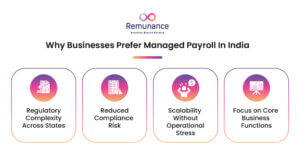
Indian payroll has become more complex, not simpler. Increased regulations, digital compliance tools, and more scrutiny have raised payroll error costs.
Fully managed payroll addresses these realities directly.
Regulatory Complexity Across States
India’s labor laws are not uniform. Professional tax rates differ by state. Labour Welfare Fund applicability varies. Shops and Establishment Acts impose different compliance norms. Fully managed payroll providers are built to handle this fragmentation at scale.
Reduced Compliance Risk
Late filings, incorrect deductions, or misclassification can trigger penalties and audits. Fully managed payroll cuts this risk. It adds compliance experts to daily operations.
Scalability Without Operational Stress
As teams grow, payroll does not remain linear. Each new hire adds layers of compliance, tax, and documentation. Fully managed payroll allows companies to scale without building large internal payroll teams.
Focus on Core Business Functions
Payroll is critical but non-differentiating. Fully managed payroll lets leadership, HR, and finance teams focus on growth, strategy, and people. They can leave transactional processing behind.
Who Should Consider Fully Managed Payroll in India?
Fully managed payroll is not limited to large enterprises. It is increasingly relevant across business stages.
High-growth startups adopt it to avoid compliance debt during rapid scaling. Mid-sized companies use it to professionalize payroll operations. Enterprises rely on it to standardize processes across locations.
Global companies hiring in India usually choose fully managed payroll. This makes it easy for them to manage Indian compliance without using local payroll systems.
Organizations that value accuracy, compliance, and efficiency can benefit from this model.
Remunance Employer of Record
Simplify Your Payroll in India Today
Whether you’re a startup, mid-sized company, or global enterprise, fully managed payroll ensures compliance, accuracy, and efficiency—so you can focus on growth without payroll headaches.
Get Started Now
Fully Managed Payroll vs Employer of Record: Understanding the Boundary
It’s key to separate fully managed payroll from the Employer of Record (EOR) model.
In fully managed payroll, employees are on the company’s payroll. The employer is legally responsible. The provider handles payroll and ensures compliance.
In an EOR model, the provider acts as the legal employer. They take on employment liability. Payroll is one component of a broader employment solution.
Fully managed payroll works well for companies with a legal entity in India. It offers operational relief while maintaining ownership of employment.
Key Considerations Before Choosing a Fully Managed Payroll Provider
Not all payroll providers deliver true end-to-end management. Businesses should evaluate providers on compliance depth, process ownership, reporting transparency, and responsiveness.
A good provider needs to know Indian labor laws well. They should have clear ways to handle issues, be ready for audits, and ensure data is secure.
Payroll is a trust-heavy function. The right partner behaves less like a vendor and more like an extension of the company’s HR and finance teams.
Fully Managed Payroll vs In-House Payroll in India
| Aspect | Fully Managed Payroll | In-House Payroll |
| Payroll Ownership | End-to-end owned by payroll partner | Owned by internal HR / finance team |
| Compliance Responsibility | Provider manages filings, timelines, and regulatory adherence | Company tracks laws, deadlines, and updates internally |
| Statutory Filings | EPF, ESI, PT, LWF, TDS handled and filed by provider | Filed internally, often with manual follow-ups |
| Regulatory Updates | Continuously monitored and applied | Dependent on internal awareness and expertise |
| Multi-State Compliance | Built-in handling for state-wise variations | Complex to manage, higher error risk |
| Payroll Accuracy | Process-driven with validation controls | Heavily dependent on internal checks |
| Scalability | Scales smoothly with headcount growth | Becomes resource-heavy as team grows |
| Employee Payroll Queries | Managed by provider support team | Handled by internal HR |
| Audit Readiness | Audit-ready reports and registers maintained | Often prepared on demand |
| Risk of Penalties | Significantly reduced | Higher if compliance gaps occur |
| Internal Bandwidth Required | Minimal | High |
| Cost Structure | Predictable service-based cost | Fixed salaries + tools + compliance risk |
| Business Focus | Teams focus on strategy and growth | Teams tied up in operations |
Fully Managed Payroll as a Strategic Enabler
In today’s regulatory environment, payroll accuracy is not optional. It directly impacts employee trust, compliance posture, and financial integrity.
Handling payroll in India moves it from a usual risk to a more controlled and steady system. It replaces reactive compliance management with proactive governance.
For businesses that care about scale, certainty, and focus, fully managed payroll is now more than just outsourcing. It is an operational strategy.
How Remunance Delivers Fully Managed Payroll in India
Fully managed payroll is only as strong as the system and accountability behind it. Remunance views payroll as part of a larger system. It’s not just a service; it’s vital for compliance. It works well with HR, finance, and legal requirements.
The core difference lies in ownership. Remunance does not operate as a processing vendor. It operates as a payroll compliance partner.
End-to-End Ownership, Not Task-Based Support
Remunance manages payroll as a closed-loop system. This means that salary processing, deductions, filings, returns, and payroll support are all done in a single system. There is no fragmentation between calculation, compliance, and reporting.
Each payroll cycle has clear checkpoints, validations, and reconciliations. This ensures no deviation from statutory norms.
Built for Indian Compliance at Scale
Remunance’s payroll operations are designed around Indian regulatory realities not adapted later. This includes:
-
- Central and state-wise statutory applicability
- Dynamic updates for tax law changes and compliance circulars
- State-specific Professional Tax and Labour Welfare Fund handling
- Audit-ready registers and compliance documentation
A compliance-first design is key for businesses in various Indian states or for remote teams.
Seamless Integration with HR and Finance Teams
Remunance offers fully managed payroll. It links to attendance systems, leave management, pay structures, and finance reports.
Payroll data flows cleanly into accounting and reporting frameworks without reconciliation gaps.
This alignment reduces internal dependencies and eliminates last-minute payroll corrections.
Employee-Facing Payroll Support
Remunance deals with employee payroll inquiries. This includes questions about payslips, tax deductions, PF contributions, and Form 16.
This reduces HR bandwidth pressure while improving employee confidence in payroll accuracy.
For growing organizations, this support layer becomes essential.
Compliance Accountability That Scales with Growth
As headcount increases, payroll complexity grows exponentially. Remunance absorbs this growth without adding operational stress.
As you grow from 20 to 200 employees or lead teams in various locations, payroll governance stays reliable and effective.
This is where fully managed payroll moves from operational convenience to strategic control.
Take Control of Payroll Without the Hassle
Remunance manages end-to-end payroll in India—compliance, reporting, HR integration, and employee support—so your business can focus on growth while we handle the details.

FAQS
What is fully managed payroll in India?
Fully managed payroll in India is an outsourcing model. A specialized provider handles the whole payroll process. This includes salary calculations, statutory deductions, filings, reporting, and employee support. They ensure full compliance with Indian labor and tax laws.
Is fully managed payroll suitable for small and mid-sized companies?
Yes. Fully managed payroll is crucial for small and mid-sized companies. They often don’t have enough in-house compliance skills. Yet, they need accurate and audit-ready payroll as they grow.
How is fully managed payroll different from payroll software?
Payroll software does calculations. However, employers need to understand compliance, file documents, and take responsibility. Fully managed payroll transfers operational responsibility and compliance ownership to the service provider.
Does fully managed payroll include tax filing and the issuance of Form 16?
Yes. Managed payroll takes care of income tax deductions. It files TDS returns each quarter and issues Form 16 annually. It also manages employee tax declarations.
Can fully managed payroll handle multi-state employees in India?
Yes. A major benefit of fully managed payroll is that it meets state-specific needs. This covers Professional Tax, the Labour Welfare Fund, and local labor laws in various areas.
Is fully managed payroll the same as Employer of Record (EOR)?
No. In fully managed payroll, employees remain on the company’s payroll. The provider manages payroll operations and compliance. In an EOR model, the provider becomes the legal employer.
How does fully managed payroll reduce compliance risk?
The provider keeps track of regulatory updates. They file on time, check deductions, and maintain records that are ready for audits. This helps reduce the risk of penalties, notices, and compliance issues.
What happens if there is a payroll error?
In a fully managed payroll model, the provider handles payroll errors. They find, fix, and prevent mistakes. This helps keep things running smoothly for employees and operations.

Related Posts

What is Global Payroll Services?

Employer of Record Payroll Services: How It Works, Benefits & Compliance (2026)

How Does the Payroll Calendar in India Work?

How to Pay Employees in India

Payroll Services in India: Complete Payroll Glossary & Compliance Guide