Spanish Companies in India 2026: Trade, Investment, and Hiring Guide
Explore Spain-India trade, leading Spanish companies in India, investment opportunities, hiring costs, labour codes, tax exposure, and entry routes. Learn how Spanish businesses can hire Indian employees through an EOR without setting up an Indian entity.
What You Need to Know
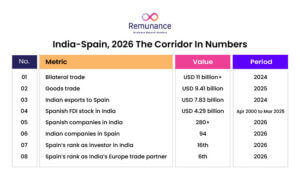
Over 280 Spanish companies in India are trading, making, or hiring, says the Embassy of India in Madrid.
Spain is India’s sixth largest trading partner in Europe. It is also India’s sixteenth-largest foreign investor overall. Cumulative Spanish investment in India hit USD 4.29 billion from April 2000 to March 2025.
So the corridor is old. What is new is that three separate things reset it within eighteen months.
Pedro Sánchez made history as the first Spanish leader to visit India in 18 years. He arrived in Vadodara in October 2024. He came back in February 2026 for the India AI Impact Summit. India and the European Union finished a free trade agreement. They had been negotiating it since 2007.
This guide covers who is already here and what the corridor is worth. It also addresses a key gap that surprises Spanish employers. It outlines hiring costs based on Spanish benchmarks. Plus, it explains how to bring people on board without needing an entity.

What Does The India-Spain Trade Picture Actually Look Like In 2026?
Numbers first, because most articles on this topic still quote figures from 2022.
Bilateral trade crossed USD 11 billion in 2024. India’s exports stood at USD 7.83 billion and its imports at USD 3.29 billion. Goods trade in 2025 came in at USD 9.41 billion, with Indian exports of roughly USD 7.02 billion.
India runs a large surplus in this relationship. That matters for a Spanish exporter, because it means the tariff lines that hurt you most are the ones the India-EU trade agreement is designed to unwind.
The Trade Balance Is Lopsided In India’s Favor
India exports to Spain:
-
- Mineral fuels
- Chemicals
- Iron and steel
- Textiles
- Machinery
- Seafood
- Leather
Spain sends back fewer items. This includes mechanical appliances, chemicals, plastics, and mineral fuels. This trade has stayed mostly the same for a decade.
Around 94 Indian companies work in Spain. They focus on software services, pharmaceuticals, chemicals, and logistics. They have invested about USD 900 million. Over 280 Spanish businesses work in India. They bring in USD 4.29 billion in investment. This shows the clear direction of capital flow.
The India-EU Agreement Was Concluded, Not Implemented
On 27 January 2026, at Hyderabad House in New Delhi, India and the European Union concluded the India-EU free trade agreement after nearly two decades of talks.
Read that verb carefully. Concluded is not the same as in force.
The text now goes through legal scrubbing and translation into every EU language, after which it needs approval by the Council of the European Union, consent of the European Parliament, and clearance from India’s Union Council of Ministers. India’s side skips parliament. Trade agreements fall under executive competence there.
Realistic entry into force is early 2027. Tariff cuts then phase in over as much as ten years. That said, the direction of travel is settled, and pricing your India strategy against it now is reasonable. Anyone telling you Spanish exports get preferential access today is wrong.
2026 is the India-Spain Dual Year
Modi and Sánchez agreed in October 2024 to mark 2026 as the Year of India and Spain in Culture, Tourism and Artificial Intelligence. It coincides with 70 years of diplomatic relations between India and Spain, which began in 1956.
Behind the cultural programming sits a Fast Track Mechanism for mutual investment, agreed during the same visit. Besides that, both sides signed memoranda on rail transport, customs cooperation, and investment finance.
Which Spanish Companies In India Are Already Here, And Where?
Naming real operations tells you more about viability than any market-size projection.
Defense And Aerospace Anchor The Relationship
Airbus Spain and Tata Advanced Systems co-produce the C-295 transport aircraft at a final assembly line in Vadodara, Gujarat. Modi and Sánchez inaugurated it together in October 2024.
The contract covers 56 aircraft worth roughly USD 2.5 billion. Forty of them are being built in India. It was the first Make in India project in the defense aircraft sector, and the first Made in India C-295 was scheduled to roll out during 2026.
Retail Runs Through Inditex
Inditex India operations are the most visible Spanish presence in the country. The group now holds 80 percent of Inditex Trent Retail India, the Zara joint venture with Tata’s Trent. It went from 51 to 65 percent in 2024, then to 80. A call option covers the rest.
Massimo Dutti, Bershka, and Zara Home all sit inside the same India perimeter now.
Engineering And Technology Centers Are Quietly The Bigger Story
Amadeus, a travel tech group based in Madrid, has an India Technology Center in Bengaluru. It opened in 2009 and now has about 2,600 employees. Headcount is planned to reach 3,200 by 2027, with hiring focused on AI and software engineering. Secondary sites sit in Gurugram and Hyderabad.
That’s a global capability centre in all but name. Most Spanish firms should study this pattern. Spanish companies in Bangalore are not chasing cheap labor anymore. They are buying engineering depth at a price European salary bands cannot reach.
Indra works in air traffic management. Roca is embedded in bathroom products. Prosegur operates in cash management and security services. Acciona India focuses on infrastructure and renewables. They work with Iberdrola in wind and solar projects.
Edibon is a Spanish company. It makes technical education equipment. In February 2024, Edibon signed a deal with the Tamil Nadu government. They plan to invest ₹540 crore in the state. That deal is one reason Spanish companies in Chennai have formed a distinct group.
Where Spanish Investment Concentrates
Maharashtra, Tamil Nadu, Gujarat, Andhra Pradesh, and Karnataka absorb most Spanish investment in India. Metallurgy, renewable energy, automotive components, ceramics, and infrastructure lead by sector. Those five states also happen to be where most GCC hiring in India already sits.
Ready To Build Your India Team?
Explore a faster way to hire employees in India without setting up a local entity or managing complex compliance alone.
Which Sectors Offer Real Opportunity for Spanish Companies in India?
Spain’s industrial strengths align unusually well with India’s stated priorities. That alignment is the commercial case.
Renewable Energy
India targets 500 GW of non-fossil capacity by 2030. Spanish firms carry deep operating experience in wind, solar, and grid infrastructure. Iberdrola and Acciona’s activity in India already gives both a foothold. Storage and transmission hold the near-term contracts. India’s renewable energy demand curve makes the pipeline durable rather than tender-by-tender.
Infrastructure and Mobility
Tunnels, metro stations, transmission lines, and highways are the categories where Spanish contractors have won work globally. India’s urban transit pipeline is one of the largest in the world. The rail transport memorandum signed in October 2024 exists precisely to open that door.
Water and Environmental Technology
Spain is a world leader in desalination and water reuse, born of its own drought exposure. India invited attention to this during Sánchez’s visit, and Spain has invited India into the International Drought Resilience Alliance.
Global Capability Centers
This is the underrated one. India’s GCC market is heading toward roughly USD 110 billion by 2030. Amadeus proved the model works for a Spanish parent. Engineering, finance operations, and AI research all transfer cleanly. Most parents now start with a GCC built through the EOR model and convert later, once the function has proved itself. Run the numbers on what a GCC in India costs to set up before you commit to the entity route.
Automotive Components and Machinery
Grupo Antolín, Gestamp, and CIE Automotive sit in an Indian supply chain that already exports globally. Tier-one component work is the natural entry point.
What Does The Missing Social Security Agreement Cost A Spanish Employer?

Here is the item almost nobody writes about, and it is the one that shows up on your first payroll run.
India has operational Social Security Agreements with eighteen countries. In Europe, that list covers Austria, Belgium, Czech Republic, Denmark, Finland, France, Germany, Hungary, Luxembourg, Netherlands, Norway, Portugal, Sweden, and Switzerland.
Spain is not on it.
India has been pursuing an agreement with Spain for years. As of 2026, it is not operational.
What That Means In Practice
A Spanish national posted to India cannot obtain a detachment certificate. So there is no exemption from Indian provident fund contributions, and no way to avoid paying into two systems at once.
International workers contribute EPF on full salary with no ceiling. Indian employees are capped at the EPF wage ceiling of ₹15,000 per month. Your Spanish expatriate is not.
Take a Spanish manager on ₹5,00,000 a month. Combined employee and employer provident fund runs to roughly ₹1,20,000 a month. An Indian colleague on the identical salary generates about ₹3,600. That is a gap of over ₹14 lakh a year on one person.
The Withdrawal Trap Is Worse Than The Contribution
International workers from non-agreement countries can only withdraw provident fund balances at age 58, on permanent incapacity, or for a short list of specified illnesses.
Completing the India assignment does not trigger withdrawal.
Suppose you send a 36-year-old engineer from Madrid to Pune for three years. She accumulates ₹25 lakh in provident fund. When she flies home, that money stays locked in India for another twenty-two years. She also needs to keep an active Indian bank account with valid KYC to eventually claim it.
Nationals from Germany, France, or Portugal walk out with theirs on assignment completion. If you are running assignments in both directions, our guide on how an EOR handles expat employees sets out what changes on each leg.
The Legal Challenge Route Is Closed
On 4 November 2025, the Delhi High Court dismissed writ petitions from several multinationals challenging the constitutional validity of the 2008 and 2010 international worker notifications. The bench upheld full-salary contributions and rejected fixed-term assignment as grounds for exemption.
Companies that withheld contributions pending the outcome now face retrospective liability, plus damages and interest.
Hence, the practical answer for most Spanish businesses. Hire Indian nationals for Indian roles through an employer of record in India, and keep expatriate deployment short and deliberate.
What Do India’s Labour Codes Now Require Of You?
India replaced twenty-nine central labour statutes with four codes. This is the single biggest change to Indian employment law in seventy years, and stale articles will mislead you about where it stands.
The Dates That Matter
The four labour codes came into force on 21 November 2025. Draft central rules were published on 30 December 2025 for consultation. The government notified final central rules under all four codes on 8 and 9 May 2026.
Labour sits on India’s Concurrent List, so each state frames its own rules separately. Gujarat, Haryana, Madhya Pradesh, Karnataka, Maharashtra, and Arunachal Pradesh had notified final rules across all four codes by early 2026. Many states remain at draft stage. Your compliance obligations under local employment law therefore depend on where your people sit.
The Wage Definition Changes Your Payroll Maths
Basic pay must now make up at least half of gross wages, breaking a convention Indian payroll has run on for decades. Salary structures here traditionally kept basic low and allowances high, and the effect of that was to suppress both provident fund and gratuity liability across the whole workforce.
That structure no longer works. Rebalancing pushes statutory costs up for existing headcount, and many employers have not run the numbers yet. Model your own before the next cycle with our salary calculator for India.
Other Changes With A Direct Cost
Fixed-term employees now earn gratuity after one year, not five. Maternity leave of 26 weeks is codified. Appointment letters are mandatory for every worker. Annual health check-ups, crèche facilities, and grievance committees appear in the final rules on employee benefits.
Gig and platform workers gain a social security framework under the Code on Social Security, with scheme-level detail still emerging.
The Penalty Regime Was Rewritten In 2024
Provident fund damages moved to a flat 1 percent of arrears per month with effect from 14 June 2024. The old slab structure of 5 to 25 percent per annum is gone, and so is the 25 percent ceiling.
Read that second part carefully. Shorter delays now cost less. But a default running past twenty-five months exceeds anything the old regime could impose, because nothing caps it. Interest under section 7Q remains 12 percent per annum on top.
Remunance Employer of Record
Stay Compliant With India’s New Labour Codes
Navigate changing wage rules, benefits, state-level requirements, and payroll compliance while building your India team.
Get Compliance Support
What Does It Cost To Hire Employees In India Against Spanish Benchmarks?
Spanish employers carry one of the heaviest statutory loads in the European Union. That’s what makes India interesting.
Spain’s Employer Burden
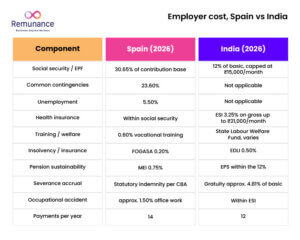
The employer social security rate for an indefinite contract runs to 30.65 percent of the contribution base in 2026. That breaks down as 23.60 percent common contingencies, 5.50 percent unemployment, 0.60 percent vocational training, 0.20 percent FOGASA, and 0.75 percent MEI.
Add a variable occupational accident rate, typically around 1.50 percent for office work. The maximum monthly contribution base is €5,101.20, and a solidarity contribution of 1.15 to 1.46 percent applies above it. Fourteen monthly payments a year are standard.
India’s Employer Burden
| Component | Employer rate | Applied to |
| Employees’ Provident Fund | 12% | Basic pay, statutory cap ₹15,000/month |
| Employees’ State Insurance (esi) | 3.25% | Gross wages up to ₹21,000/month |
| EDLI | 0.50% | Capped basic |
| EPF administrative charges | 0.50% | Capped basic, minimum ₹500/month |
| Gratuity accrual | approx. 4.81% | Basic pay, payable after qualifying service |
| Labour Welfare Fund | State-specific | Varies by state and headcount |
Statutory employer add-on on a mid-level Indian salary typically lands between 13 and 16 percent of cost to company. Spain’s clears 32 percent before benefits. Roughly half the load, on the same headcount. Our breakdown of the full cost of hiring remote employees in India shows where the rest comes from.
The caps matter more than the rates. India’s provident fund ceiling of ₹15,000 a month means the statutory load falls as salary rises. A senior engineer in Bengaluru costs proportionally less in statutory terms than a junior one.
The Labour Welfare Fund Catch
Karnataka dropped its Labour Welfare Fund threshold from 50 employees to 10 with effect from 7 January 2026. If you are running a small global capability center in Bengaluru, you may have crossed into coverage without noticing. Thresholds and rates vary by state, and they move. Work through an EOR compliance checklist for each state you employ in.
What Tax Exposure Should A Spanish Company Plan For?
Two items sit above everything else. One is a saving. The other is a risk.
The Data Rate On Royalties And Technical Fees Fell To 10 Per Cent
On 19 March 2024, India issued Notification No. 33/2024 invoking the most-favored-nation clause in the protocol to the India-Spain double taxation avoidance agreement.
Withholding on royalties and fees for technical services dropped from 20 percent to 10 percent, importing the rate from India’s treaty with Germany. It applies where the Spanish recipient is the beneficial owner.
If your India entity pays a Spanish parent for technology, licenses, or technical support, that halving is real money. Many Spanish groups are still withholding at the old rate. The wider employer-of-record tax implications are worth reading alongside it.
Permanent Establishment Risk Is The Expensive Mistake
Permanent establishment exposure is what turns a hiring decision into a corporate tax event.
A Spanish company with no Indian entity can still create a taxable presence. Three routes do it. A fixed place of business, a dependent agent habitually concluding contracts, or a service permanent establishment triggered by employee presence over a threshold period.
Once India asserts permanent establishment, profits attributable to it become taxable here. Add transfer pricing documentation, withholding obligations, and filing duties.
Contractor Misclassification Feeds The Same Risk
Paying an India-based individual as a contractor when the working relationship looks like employment is the most common route to trouble. Contractor misclassification brings back-dated provident fund and ESI liability, gratuity exposure, damages, and interest.
It also strengthens the argument that you have a dependent agent in India. So a contractor arrangement chosen to avoid entity setup can produce the exact permanent establishment outcome you were trying to dodge. Our note on employer liability for independent contractors covers where the line sits.
The four labor codes tightened worker classification tests. Anyone relying on contractor status to avoid Indian employment law should re-examine that position now.
Which Entry Route Should You Choose For Setting Up A Business In India?
Four routes exist. They differ in speed, cost, control, and risk.
Employer of Record
An employer of record service in India hires your people on its own Indian entity and seconds them to your team. You direct the work. It handles payroll, provident fund, ESI, gratuity, tax withholding, and labor code compliance.
Setup takes days rather than months, and it creates no entity, share capital, board, or permanent establishment through the employment relationship itself. This is the route most Spanish businesses should take for their first ten to fifty India hires. Our guide offers a fuller walkthrough on starting operations in India without entity formation.
Wholly Owned Subsidiary
Incorporating a subsidiary company in India gives you full control, the ability to contract locally, and a permanent balance sheet presence.
It also brings incorporation timelines, FEMA and RBI reporting, statutory audit, board composition rules, transfer pricing documentation, and wind-down costs that land on you if the India plan changes shape in year two. Sensible once headcount and revenue justify the overhead. Our EOR versus subsidiary comparison sets out the crossover point.
International PEO
A PEO India arrangement sits close to the employer of record model and suits companies that want co-employment structures. The distinction matters less in India than the quality of the compliance operation behind it.
Independent Contractors
Fast and flexible for genuinely project-based work. Dangerous as a substitute for employment, for the reasons above. If the work is truly project-scoped, a contractor-of-record arrangement gives you a compliant way to engage independent contractors in India without taking on the exposure yourself.
How The Routes Compare
| Route | Time to first hire | Entity needed | PE risk from hiring | Best for |
| Employer of Record | Days | No | Low | First 10 to 50 hires, market testing, GCC pilots |
| Subsidiary | 3 to 6 months | Yes | Managed via entity | Scale operations, local contracting, manufacturing |
| International PEO | Days to weeks | No | Low | Co-employment preferences |
| Contractors | Days | No | High if misclassified | Genuine short project work |
How Does Remunance Help Spanish Companies Build Teams in India?
Remunance is an India-focused employer of record provider, headquartered in Pune, working exclusively in the Indian market rather than across a hundred countries at shallow depth.
That focus matters when the compliance detail is this specific. Spain’s absence from India’s social security agreement list. The Karnataka welfare fund threshold change. The wage definition shift under the labor codes. A generalist platform running a hundred countries will miss all of it.
Here is what working with us covers:
-
- Remunance hires your India team on our entity, runs payroll, and files provident fund, ESI, professional tax, and TDS returns on time
- We structure salaries against the new 50 percent basic pay rule so your statutory exposure is correct from month one
- We map state-level obligations for wherever your people actually sit, whether that is Bengaluru, Pune, Chennai, Hyderabad, or Gurugram
- We advise on permanent establishment boundaries so your India presence stays a hiring decision and not a tax event
- We handle onboarding, benefits, statutory leave, and exit formalities under the four labor codes
- We support the transition to your own subsidiary company in india when headcount justifies it, including employee transfer
You can model the numbers before committing using our EOR cost calculator for India.
Benchmarking across Europe? Read the parallel guides on Italian companies in India and French companies in India.
Remunance Employer of Record
Build Your India Team With India-First EOR Support
Hire employees in India faster while Remunance manages payroll, labour compliance, and local employment requirements.
Talk To Our India EOR Experts FAQs
How many Spanish companies operate in India?
More than 280, according to the Embassy of India in Madrid. They concentrate in metallurgy, renewable energy, automotive components, ceramics, and infrastructure, with Maharashtra, Tamil Nadu, Gujarat, Andhra Pradesh, and Karnataka taking most of the investment.
Does India have a social security agreement with Spain?
No. India has operational agreements with eighteen countries and Spain is not among them. Negotiations have been under way for years without an operational outcome as of 2026. Spanish nationals posted to India therefore cannot obtain a detachment certificate and must contribute to Indian provident fund on full salary with no ceiling.
Is the India-EU free trade agreement in force?
Not yet. Negotiations concluded on 27 January 2026. The text still needs legal scrubbing, translation, approval by the Council of the European Union, consent of the European Parliament, and clearance from India’s Union Council of Ministers. Entry into force is expected in early 2027, with tariff reductions phased in over up to ten years.
What does it cost to employ someone in India compared with Spain?
Statutory employer contributions in India typically add 13 to 16 per cent to cost to company. Spain’s employer social security rate is 30.65 per cent of the contribution base in 2026, before the occupational accident tariff and the solidarity contribution on high salaries. India’s provident fund ceiling of ₹15,000 a month means the proportional load falls as salaries rise.
Can a Spanish company hire in India without a subsidiary?
Yes. An employer of record hires your staff on its Indian entity and handles payroll and statutory compliance while you direct the work. Setup takes days instead of the three to six months an incorporation needs, and the employment relationship itself does not create a permanent establishment.
What is the withholding tax on payments from India to Spain?
Royalties and fees for technical services are capped at 10 percent of the gross amount where the Spanish recipient is the beneficial owner. India notified this under Notification No. 33/2024 dated 19 March 2024, invoking the most-favored-nation clause and importing the rate from the India-Germany treaty. The previous cap was 20 percent.

Related Posts

Best EOR Service Providers in India (2026) for Easy Hiring

Employer of Record India (2026): Hire Employees Without an Entity

Benefits of Hiring International Employees for Business Growth

Hiring Internally vs Externally: Pros and Cons

A Guide for Hiring International Employees