Swedish Companies in India: Expansion Opportunities & Market Entry Guide (2026)
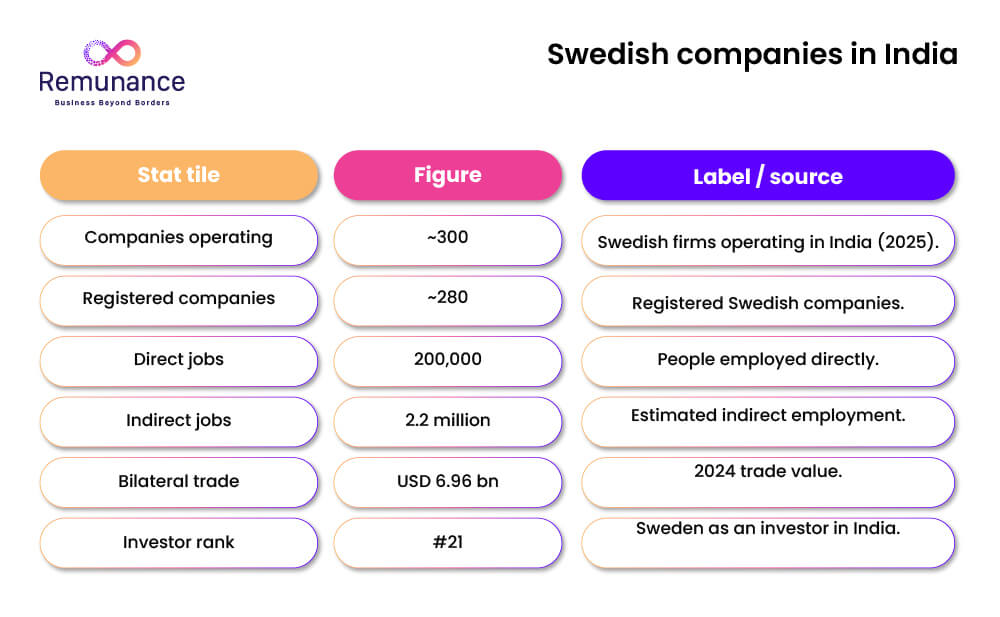
Nearly 300 Swedish companies operate in India in 2026, employing around 200,000 people directly. With bilateral trade near USD 7 billion and the EU-India Free Trade Agreement concluded in January 2026, the conditions for Swedish firms entering India are the strongest they have been in two decades.
What You Need to Know
For Swedish companies, India isn’t an experiment anymore. Close to 300 of them run operations here now. Telecom, heavy industry, retail, software, and a fair bit in between. Plenty have come to depend on the place, and the trade figures climb just about every year.
The history goes back a long way. Ericsson was selling switchboards to India in 1903. SKF has run a plant in Pune for over a century. None of that is why a Swedish firm would expand here in 2026, though.
The real reasons are recent. Trade just set a record. After years of false starts, the EU and India actually signed a big trade deal. And the cost of getting in has dropped, because you no longer need a legal entity just to hire your first engineer in Bengaluru.
Let’s have a look at the numbers, the trade deal, the sectors with room, and the quickest way to put a team on the ground.
Swedish Companies in India at a Glance (2026)
A quick snapshot first.
-
- About 280 Swedish companies are registered here. Count subsidiaries and joint ventures and the operating number is closer to 300.
- They employ roughly 200,000 people directly. Another 2.2 million or so indirectly.
- Bilateral trade hit about USD 6.96 billion in 2024, up from USD 2.86 billion in 2016. That’s near 11% growth a year, compounded.
- Sweden sits at number 21 among India’s investors, with cumulative equity FDI of roughly USD 2.59 billion between April 2000 and December 2024.
- More than 100 of these firms cluster in the west: Maharashtra, Gujarat, and Goa.
Here’s the number that’s easy to miss. Over the past year, the company count actually dipped a touch, even while trade value went up. Read it the right way.
The firms already here are growing, not getting swapped out for a wave of newcomers. That’s normal once a market matures. So the opening now suits someone focused and well prepared, not a gold rush.
What the EU-India FTA Means for Swedish Firms
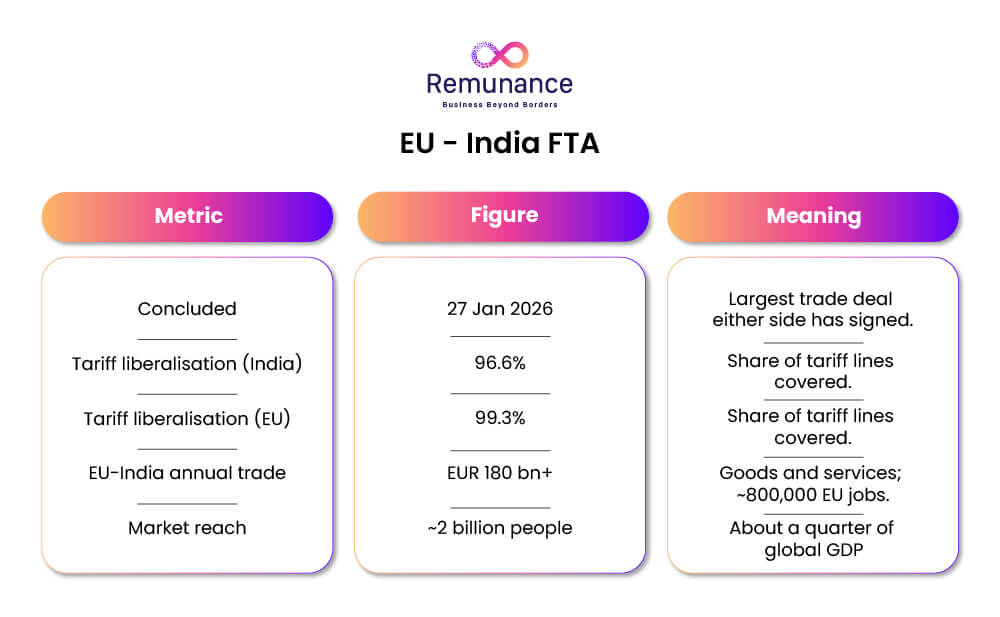
On 27 January 2026, after almost twenty years of on-again, off-again talks, the EU and India closed their Free Trade Agreement.
The Commission called it the biggest deal either side has ever done. Two billion people, give or take. Roughly a quarter of world GDP.
Sweden is in the EU, so Swedish companies are covered, full stop. Worth pinning down, because there’s a second deal people keep confusing it with.
India also signed a Trade and Economic Partnership Agreement with EFTA, live since October 2025. EFTA means Switzerland, Norway, Iceland, and Liechtenstein. Sweden isn’t a member. So the agreement that actually applies to a Swedish business is the EU-India FTA. Not the EFTA one.
What changes, in practice:
-
- On tariffs, liberalization covers 96.6% of India’s tariff lines and 99.3% of the EU’s. Over time, that pulls down the landed cost of moving goods either way.
- European firms get broader access across industrial and agri-food markets, and in several of them the EU walks in with an edge.
- The relationship is already enormous. EU-India trade tops EUR 180 billion a year in goods and services, and it props up close to 800,000 jobs across the EU.
One thing to remember when you plan. The negotiation is done, but the text still has to clear legal scrubbing, translation, and sign-off from the Council and the European Parliament before it’s in force.
So 2026 is the year to get positioned. It is not the year every tariff line flips. Set up in India now, and you’re ready the moment the schedule starts.
Ready to Enter India Before the FTA Takes Effect?
The EU–India FTA is expected to create significant opportunities for Swedish businesses. Get ahead of the competition by building your India team now.
Remunance helps Swedish companies hire employees and operate in India without setting up a local entity.
Sweden-India Trade: The Numbers Behind the Relationship
Trade tells the story better than anything else. USD 2.86 billion in 2016. USD 6.96 billion by 2024. Call it two and a half times bigger in eight years, and the climb has been steady rather than jumpy.
India is now Sweden’s third-biggest trading partner in Asia, behind China and Japan. Sweden ships mostly machinery, paper, and steel. Coming the other way, increasingly: software services, components, engineered goods. The figures behind the trend are in the table below.
| Year | Trade (USD bn) | Note |
| 2016 | 2.86 | Baseline (verified, Business Sweden 2025). |
| 2022 | ~5.50 | Commonly cited mid-point. Reverify against the commerce series before publishing. |
| 2024 | 6.96 | Latest verified (Business Sweden 2025). |
Which Sectors are Open to Swedish Companies in India
You’ll find Swedish firms across automotive, telecom and IT, retail and e-commerce, healthcare and pharma, renewables, defense, and apparel.
The ones with the most headroom in 2026? The sectors where Swedish strengths line up with what India keeps saying it wants.
- Clean energy and sustainability. India is chasing climate neutrality and needs renewable capacity, circularity, and green manufacturing. Swedish expertise drops straight in.
- Defence and aerospace. The 100% FDI route works, and Saab proved it. More on that in a second.
- Smart manufacturing. Automation, robotics, electromobility. The kind of work Volvo and Atlas Copco already run R&D centers for.
- Digital and software. India’s engineering talent makes it an obvious base for product and platform teams. Spotify and Truecaller went that way.
- Retail. India’s home furnishing market is tipped to grow about 50% in value by 2030, which is exactly why IKEA keeps pouring money in.
India is on track to be the world’s third-largest economy by 2030. In the 2024 World Investment Report, it drew the fourth-most greenfield project announcements anywhere, 1,058 of them. For a Swedish company, the opportunity isn’t in doubt. The only real question is which sector to start with.
Swedish Companies are Already Winning in India
These names aren’t just keeping a desk in India. Several have turned it into a global hub, not a side office.
-
- IKEA: Planning to more than double its India investment to over USD 2.2 billion across five years, going from six stores to thirty and lifting local production for stores and exports to EUR 800 million. India sales rose 6% to about INR 1,861 crore in the year to August 2025.
- Saab: First foreign company to win 100% FDI in an Indian defense project. It’s building a wholly owned Carl-Gustaf M4 factory in Jhajjar, Haryana, the first foreign-owned defense plant in the country.
- Ericsson: Here for more than 120 years now, central to the 5G rollout and building use cases with Indian universities and tech firms.
- Volvo Group: Active since 1996 in trucks, buses, and construction equipment, with a Bengaluru competency center on electromobility and robotics.
- And the rest. H&M, SKF, Atlas Copco, AstraZeneca, Electrolux, SSAB, Autoliv, Spotify, and Truecaller fill out a presence that touches nearly every major sector. SKF has run its Pune operation for over a hundred years.
How Swedish Companies Can Enter the Indian Market
There’s no single correct way in. It comes down to how committed you are, how fast you want to move, and whether you’re hiring people or shipping goods. Three routes show up most: an Employer of Record, a wholly owned subsidiary, and a branch or liaison office. On speed, cost, and risk, they’re miles apart.
The table breaks it down. Short version: an EOR puts a team to work in weeks, no entity, no capital tied up.
A subsidiary hands you full control, but it takes months and real money to build. A branch office lands in the middle, with tight limits on what it’s allowed to do.
Most Swedish firms that are still testing start with an EOR in India, then incorporate later once India has earned it.
Remunance Employer of Record
Start Hiring in India Without a Local Entity
Test the Indian market faster with Remunance's Employer of Record solution. Hire talent, manage compliance, and scale your team while we handle the local employment requirements.
Schedule a consultation today.
Hiring Indian Talent Without Setting up an Entity
The painful part of entering India used to be the sequence. Register a company. Open bank accounts. Stand up payroll and statutory compliance. Only then could you hire anyone. Months of work and a chunk of money before a single person turned up to do a job.
An EOR turns that around. It already owns the Indian entity, runs the payroll, and handles compliance, the whole PF, ESIC, gratuity, professional tax, and TDS stack.
Your hire sits on the EOR’s books but works only for you. You get the person and the output. You skip the entity. And if the bet works out, you incorporate later, with real knowledge instead of guesswork.
Challenges to Plan For
India isn’t frictionless, and saying it is would help nobody. Business Sweden lists the same obstacles year after year: red tape, rules that move fast, IP protection, and the odd bit of resistance to foreign money in sensitive sectors.
-
- Compliance is fiddly: Labour and tax rules vary by state and change often. Exactly the spot where a local partner or an EOR takes the sting out.
- Talent is competitive. The good engineers and managers get chased, so a clear employer brand and a quick offer count for a lot.
- Timelines will test you: Approvals, especially in regulated sectors, run longer than a Swedish plan tends to assume.
None of this is a dealbreaker. It’s just a reason to come in with someone who knows the ground, rather than learning it the expensive way.
Conclusion
Stack it all up, and 2026 is a genuinely good year to begin. Trade is at a record. The FTA is signed and heading toward force. India is climbing toward the world’s number three economy by 2030. And entry costs less than it used to, because an EOR lets you hire and operate before you commit to an entity.
Location is a plus. Sit in India, and you’re next door to the rest of South Asia and within reach of much of East Asia. The firms that move while the framework is still settling are the ones who’ll be ready the day the FTA schedule kicks in.
Remunance Employer of Record
Ready to Expand into India?
The best time to enter a growing market is before everyone else does. Build your India team quickly and compliantly with Remunance's Employer of Record solution—without setting up a local entity.
Talk to our experts FAQs
How many Swedish companies operate in India in 2026?
A. Around 280 Swedish companies are registered in India, and close to 300 operate there once subsidiaries and joint ventures are counted. Together they employ roughly 200,000 people directly and an estimated 2.2 million indirectly.
Does the EU-India Free Trade Agreement cover Swedish companies?
Yes. Sweden is a member of the European Union, so Swedish companies are covered by the EU-India FTA concluded in January 2026. They are not covered by the separate India-EFTA agreement, since Sweden is not an EFTA member.
What is the easiest way for a Swedish company to enter India?
For most firms testing the market, an Employer of Record is the fastest route. It lets you hire and run an India team in weeks without forming a local entity or locking up capital, and you can incorporate later if the business grows.
How large is Sweden-India bilateral trade?
Bilateral trade reached about USD 6.96 billion in 2024, up from USD 2.86 billion in 2016. India is Sweden’s third-largest trading partner in Asia after China and Japan.
Which sectors offer the best opportunities for Swedish firms in India?
Clean energy and sustainability, defence and aerospace, smart manufacturing, digital and software, and consumer retail all have strong 2026 runways, because they match Swedish strengths with India’s stated priorities.
Can a Swedish company hire in India without a registered entity?
Yes. Through an Employer of Record such as Remunance, the EOR holds the Indian entity and manages payroll, benefits and statutory compliance, while your hire works entirely for you.

Related Posts

What is an Employer of Record (EOR)? A Complete Guide

Why India is a Strategic Choice for International Business Expansion?

Business Expansion Strategy: A Step-by-Step Guide to Success

A Complete Guide to Doing Business in India

What Are the Advantages and Disadvantages of Doing Business in India?