What should Saudi Companies in India Know Before They Expand in 2026?
Saudi companies in India have growing opportunities across energy, technology, infrastructure, healthcare and manufacturing. This 2026 guide covers trade, investment, labour codes, provident fund risks, tax considerations, hiring routes and how an EOR can simplify India expansion.
What You Need to Know
Saudi companies in India are looking at a market where the political groundwork is finished, and the compliance details are still being written.
That gap is where money gets lost.
Riyadh and New Delhi have spent seven years building the scaffolding that Saudi companies in India now stand on. The Strategic Partnership Council was signed in 2019. Crown Prince Mohammed bin Salman came to Delhi for the G20 in September 2023. Prime Minister Modi went to Jeddah on 22 April 2025 for the second leaders’ meeting.
What came out of Jeddah matters more than the handshakes.
The two governments confirmed the USD 100 billion Saudi investment commitment, agreed to build two oil refineries in India, and added defense and tourism committees to the Council. That is more institutional plumbing than india saudi arabia relations have ever carried. They also recorded progress on taxation, which most coverage skipped.
So the commercial opportunity is real and well documented. The friction is real too, and it sits in employment law rather than in trade policy.
How Big Is India-Saudi Arabia Trade In 2026?
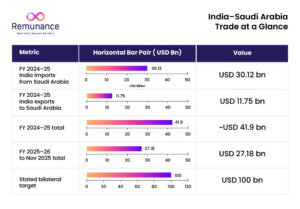
It is large. It is lopsided. And for the first time in a decade, it is slowly rebalancing away from crude.
The headline numbers are energy-heavy
In FY 2024-25, India imported goods worth USD 30.12 billion from the Kingdom and exported USD 11.75 billion back. Total india saudi arabia trade for that year came to roughly USD 41.9 billion.
For FY 2025-26, the picture through November 2025 showed about USD 27.18 billion in two-way trade, with India’s exports at USD 6.76 billion.
Saudi Arabia ranked as India’s fifth-largest source of imports. It was the ninth-largest export destination.
The non-oil side is where growth is
Crude and petrochemicals still dominate the flow in both directions. That is changing at the edges, and the edges are where a new entrant can compete.
India’s exports to the Kingdom in FY 2025-26 were led by vehicles and auto components at USD 1.12 billion, cereals at USD 680 million, and machinery at USD 623 million.
Commerce Minister Piyush Goyal has publicly targeted doubling india saudi arabia bilateral trade to USD 100 billion. Reaching that number will need services, manufacturing and technology rather than more barrels of crude.
Hence the hiring question arrives sooner than most Saudi boards expect.
Investment lags trade by a wide margin
Here is the number nobody quotes. Saudi Arabia sits 20th in India’s FDI equity inflow rankings, with cumulative inflows of about USD 3.29 billion between April 2000 and September 2025.
Against a USD 100 billion pledge, that is a rounding error.
The gap is the opportunity. Saudi Arabia’s investment in India has been announced far faster than it has ever been deployed, and the groups that move first will find considerably less competition on the ground than the headlines suggest.
Which Sectors Offer Saudi Companies the Strongest Opening in India?

Six sectors are genuinely open to Saudi companies in India, not just listed in joint statements.
Refining and Petrochemicals
The Jeddah agreement covers two refineries of roughly nine million tonnes a year each. Aramco is expected to take equity positions. This is the single largest committed channel for Saudi Arabia companies in India.
Renewable Energy
Alfanar already runs a 506.5 MW wind portfolio in Gujarat with more under construction, and has publicly signaled interest in green hydrogen once offtake rules firm up. ACWA Power, Aljomaih and Nesma have all been courted by India’s power ministry. India’s renewable energy build-out needs capital of exactly this kind.
Technology and Global Capability centers
India hosts more than two thousand GCC in India operations. A Saudi group can stand up an engineering, finance or analytics team here for a fraction of the Gulf cost base.
Infrastructure and Logistics
The India Middle East Europe Corridor puts Saudi ports and rail on the same map as Indian ones. Suppose your group already handles freight between Jeddah and Dammam. The corridor makes an Indian arm a logical extension rather than a leap.
Pharmaceuticals and Healthcare
Saudi Arabia’s Vision 2030 health targets and India’s manufacturing depth line up neatly.
Agribusiness and Food Processing
India is positioning itself as a food security partner to the Kingdom. Cold chain, processing and packaging are all short of capital.
Besides these, financial services and telecom are opening through GIFT City, where the Public Investment Fund has been invited to base an India office.
Planning Your India Expansion?
Build teams across India’s growing technology, renewable energy, infrastructure, healthcare, and manufacturing sectors with local hiring and compliance support.
What Changed In Indian Employment Law That Saudi Employers Must Know?
This is the part that catches most Gulf employers off guard, usually about two payroll cycles in.
The four labor codes are now live and detailed
India’s four labor codes came into force on 21 November 2025. They replace 29 older central statutes. On 8 May 2026, the government notified the central rules that make them operational.
Three practical shifts matter most to a Saudi employer. Basic wages must now form at least half of total remuneration, which lifts provident fund, ESI contribution and gratuity liabilities. Gratuity accrues to fixed-term staff on a pro-rata basis without the old five-year wait. Appointment letters are mandatory for every employee.
Employers restructuring old salary formats are seeing statutory costs rise by roughly three to fifteen per cent. Our guide to labor laws in India breaks the codes down further.
That said, labor is a concurrent subject. States are still notifying their own rules at different speeds, so your compliance calendar depends on where your team sits.
Your Saudi staff in India face a provident fund trap
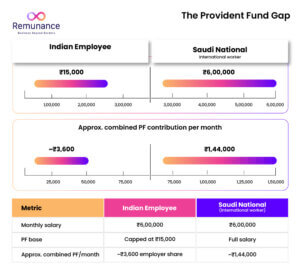
This one is specific to the Kingdom. Almost nothing written for Saudi companies in India covers it, and the cost lands on the employer rather than the employee.
India has social security agreements in force with 18 countries. Australia, Canada, Germany, France, Japan and South Korea are on the list. Saudi Arabia is not.
That absence has immediate, hard consequences for anyone posting staff from Riyadh or Jeddah.
A Saudi national employed by an India-registered establishment becomes an “international worker” under the EPF Scheme. Without a detachment certificate, they contribute to the provident fund on their entire salary. The ₹15,000 monthly wage ceiling that protects Indian colleagues does not apply to them.
Then comes paragraph 69. An international worker’s PF balance ordinarily cannot be withdrawn until the age of 58, even if the person leaves India after two years.
Some employers hoped that rule would fall away. In April 2024, the Karnataka High Court struck down the international worker provisions as unconstitutional.
But on 4 November 2025, the Delhi High Court upheld them in SpiceJet Ltd. v. Union of India and expressly declined to follow Karnataka.
So the obligation stands. The divergence between the two High Courts may yet reach the Supreme Court, but until it does, an Indian establishment employing Saudi nationals is expected to deduct and deposit on the full salary. Budget for it either way. It will not go away this financial year.
Let us put a number on it. Suppose you post a Saudi manager to Bengaluru on ₹6,00,000 a month. Employer and employee provident fund together run at roughly 24 percent of that full figure, or about ₹1,44,000 every month. An Indian colleague on the same package attracts around ₹3,600 in employer contribution. That is not a rounding difference.
An employer of record in India handles this correctly from the first payroll cycle, not after an EPFO inspection.
How Do Saudi Companies Avoid Permanent Establishment Risk In India?
Permanent establishment is where the India-Saudi Arabia tax treaty behaves differently from most others.
The treaty has no article on technical service fees
Look closely at the 2006 convention between the two governments. It caps dividends at 5 percent, interest at 10 percent, and royalties at 10 percent.
The protocol includes no separate article on fees for technical services. The protocol instead recorded that both sides would revisit the question later.
The consequence is significant. Where no FTS article exists, technical service fees generally fall under Article 7 as business profits. India taxes business profits only where the Saudi enterprise has a permanent establishment here.
So your India tax exposure turns almost entirely on whether you have created a PE. Confirm the treatment with your own tax advisers before relying on it, since characterization disputes in this area are common.
What creates a PE without you noticing
A fixed place of business in India does it. So does a dependent agent who habitually concludes contracts in your name, whether or not you call them an agent.
The quieter trigger is people. A team of engineers, quietly delivering work for a Riyadh parent from a Bengaluru co-working desk, will not feel to you like a taxable presence, and that is exactly why assessing officers keep finding them. A team of Indian staff taking direction from Riyadh, working on your systems, and representing your brand can look very much like a fixed place of business to an assessing officer.
Our detailed guide to avoiding permanent establishment risk in India walks through the tests. The tax implications of an EOR arrangement are covered separately.
Getting this wrong is expensive twice over. You attract Indian corporate tax on attributed profits, and you lose the shelter Article 7 gave you.
What Are the Entry Routes for Saudi Arabian Companies in India?
Four routes exist in practice, and all four are perfectly legal. They differ in speed, cost, and risk rather than in permissibility.
| Route | Time to first hire | PE exposure | Best suited to |
| Employer of record | 1 to 2 weeks | Low | Teams of 1 to 50, market testing, GCC pilots |
| Wholly owned subsidiary | 3 to 6 months | High by design | Committed operations with revenue booked in India |
| Liaison office | 2 to 4 months | Moderate | Representation only, no commercial activity |
| Independent contractors | Days | High if control is exercised | Genuine project work, short engagements |
Employer of Record
Remunance employs your Indian staff on its own registered entity while you direct their day-to-day work. Payroll, provident fund, gratuity and filings sit with us. You get people working without foreign company registration in India. No incorporation, no registered office, no director appointments.
Subsidiary
A private limited company gives you full control and a balance sheet in India. It also brings statutory audits, director obligations and a multi-month incorporation runway. Read our guide on setting up a subsidiary in India before you commit capital and management time to it.
Liaison office in India
Useful for representation. Restricted from earning income, which limits it badly for most commercial plans.
Independent Contractors
Fast and flexible. Also the fastest route to an employee misclassification finding if you set hours, supply equipment, and supervise output. A properly structured independent contractor engagement is a different thing from a disguised job.
Many Saudi groups start with an EOR India engagement, prove the unit economics, then convert. That sequence is also how many firms now set up a GCC in India without a two-year entity project.
Remunance Employer of Record
Ready To Hire In India Without Setting Up An Entity?
Start your India operations faster with an EOR, or choose the right entry route based on your hiring goals, timeline, and risk.
Explore EOR Services
What Does It Actually Cost To Hire Employees In India?
Considerably less than Riyadh, and the gap is wider than most Saudi finance teams assume before they run the numbers.
Salary is only part of the picture. Often it is the smaller surprise. On top of gross pay, you carry provident fund at 12 percent of basic from the employer side, ESI where wages fall under the threshold, gratuity accrual, and professional tax in several states.
The 50 percent basic wage rule under the codes has pushed those accruals up. Our breakdown of the cost of hiring remote employees in India sets out the components line by line, and the EOR cost calculator for India will give you a figure for your own headcount in a few minutes.
For expatriate staff moving from the Kingdom, add the visa route and the provident fund exposure described above. India does not issue a general work permit-style document to private-sector hires. It issues an employment visa, and the salary threshold and documentation attached to it catch employers out. Our note on supporting expat employees covers the practical side of employment visa India processing and onboarding.
One more line item that works in your favor. EOR service fees billed to an overseas client can qualify as zero-rated supply under GST, which removes a tax layer many providers quietly leave in the price.
Where Should Saudi Companies In India Place Their First Team?
Talent depth should decide this question far more than state incentives do, because a subsidy that saves you two lakh a year is worthless if the third hire takes nine months to find.
Bengaluru remains the default choice for engineering and product roles. Hyderabad has become the strongest global capability center location for pharma and life sciences. Pune suits engineering, automotive and manufacturing back offices. Chennai supports hardware, logistics, and supply chain. Gurugram and Noida serve finance, consulting and shared services.
If you are hiring technical staff, our guide to hiring developers in India sets out realistic salary bands and lead times.
Wherever you land, get the exit rules right at the start. Termination of employment in India follows notice and process requirements that differ sharply from Saudi labour law, and the codes have tightened parts of it.
How Does Remunance Help Saudi Companies In India?
Remunance has built India teams for foreign employers since 2004, operating out of Pune.
Here is what that experience means in practice for Saudi companies in India.
-
- Remunance employs your India staff on our registered entity, so you hire in one to two weeks with no incorporation.
- We run payroll, provident fund, ESI, gratuity, and every statutory filing under the four labor codes, including the international worker treatment your Saudi expatriates now need.
- We structure engagements to keep permanent establishment exposure contained, which matters more under a treaty with no FTS article.
- We recruit, onboard, provide IT and office support, and manage the whole employee lifecycle.
- When you are ready for your own entity, we handle subsidiary formation and transition your people across without breaking service continuity.
You keep the work and the relationships. We carry the compliance.
Talk to our India team about what your first Indian hires would cost and how quickly they could start.
Remunance Employer of Record
Build Your India Team With Confidence
Hire, manage, and support your Indian workforce while Remunance handles payroll, compliance, and the employee lifecycle.
Talk To Our India Team FAQs
Do Saudi companies need an entity to hire employees in India?
No. You can hire employees in India through an employer of record, which employs staff on its own entity while you direct their work. Most Saudi groups use this to start, then incorporate once volumes justify it.
Is there a social security agreement between India and Saudi Arabia?
No. India has social security agreements in force with 18 countries and Saudi Arabia is not among them. So a Saudi national working for an India-registered employer contributes provident fund on full salary, with no wage ceiling and no detachment certificate.
How much is India Saudi Arabia trade worth?
Bilateral trade was roughly USD 41.9 billion in FY 2024-25. Through November 2025 in FY 2025-26 it stood at about USD 27.18 billion. Saudi Arabia is India’s fifth-largest import source.
Have India’s labour codes actually come into effect?
Yes. All four codes came into force on 21 November 2025, and the central rules were notified on 8 May 2026. States are still notifying their own rules, so timing varies by location.
How long does it take to start operations in India?
Through an employer of record india partner, one to two weeks. Through a wholly owned subsidiary, three to six months once approvals, registrations and banking are complete.

Related Posts

Best EOR Service Providers in India (2026) for Easy Hiring

Employer of Record India (2026): Hire Employees Without an Entity

Benefits of Hiring International Employees for Business Growth

Hiring Internally vs Externally: Pros and Cons

A Guide for Hiring International Employees