Immigration vs. Expatriation: What Many Global Employers in India Overlook
Global employers often confuse immigration vs expatriation in India, leading to tax exposure, payroll errors, and compliance risks. Understanding intent, role design, and duration helps prevent costly mistakes and ensures compliant hiring, smoother audits, and predictable workforce costs.
Most multinationals looking for talent in India think they have a handle on global mobility. They discuss visas, relocation packages, shadow payrolls, and tax treaties. They also discuss expat perks, such as being experienced travelers, since they’ve hired people from all over the world.
This area can be tricky, and even experienced organizations can make costly mistakes. The problem isn’t with choosing the wrong visa or missing a document. It’s a fundamental misunderstanding of what the move really means.
Many organizations see immigration and expatriation as the same thing, just two sides of the same coin.
But India sees things differently. This distinction isn’t just a theory. It can cause real problems, including tax issues, payroll errors, and compliance challenges. You might face delays or awkward conversations during audits.
This blog aims to stop these problems before they start.
How Technical Jargons Play out in India with Expatriation
When internal stakeholders discuss these issues, the terminology can get confusing.
“Someone might say, ‘We’re moving an expat to India.’ Then someone might say, “It’s a long-term assignment, but not permanent.” Everyone agrees, yet no one examines the underlying legal issues.
The assumption is that these details can be sorted out later. But India isn’t a place where you can just “sort it out later.” The country looks at intent from the start and watches behavior over time. If reality doesn’t match what was represented, there can be consequences later.
Understanding these differences is crucial in the Indian context.
Difference Between Immigration and Expatriates?
Immigration means moving toward integration, while expatriation is about moving through a country. Immigrants join the community. Expatriates live here for a short time to finish a job.
From this understanding, tax treatment, payroll structures, and employer responsibilities are clear.
Most companies start with the wrong questions, asking about visa categories first. They often overlook the intent behind the application, demonstrating flawed thinking.
| Aspect | Immigration in India | Expatriation in India |
| Core intent | Build long-term presence | Provide temporary support |
| Nature of role | Structural and ongoing | Assignment-based |
| Expected duration | Indefinite or long term | Fixed and time-bound |
| Exit plan | Not clearly defined | Clearly defined at entry |
| Role replaceability | Hard to replace | Easily replaceable after assignment |
| Authority level | High decision-making power | Limited, scoped authority |
| Leadership positions | Common | Rare and risky |
| Payroll structure | Local Indian payroll | Offshore or split payroll |
| Tax residency risk | Planned and managed early | Often unplanned, emerges over time |
| Tax treatment | Predictable and aligned | Prone to retroactive exposure |
| Labour law alignment | Full compliance expected | Conditional and limited |
| Social security obligations | Clearly applicable | Often misjudged |
| Permanent establishment risk | Anticipated and structured | Often ignored until too late |
| Cost visibility | Upfront and budgetable | Hidden and delayed |
| Regulatory interpretation | Based on integration | Based on temporality |
| Compliance posture | Stable | Fragile if extended |
| Typical industries | Tech, leadership, long-term ops | Manufacturing, process transfer |
| Risk if misused | Over-compliance | Under-compliance |
| Biggest mistake | Delaying localisation | Letting “temporary” become permanent |
Unsure About Immigration vs. Expatriation in India?
Misclassification can lead to tax risks, payroll gaps, and compliance issues. Speak with our experts to structure your hiring correctly from day one.
What Hiring in India Really Looks Like with Immigration
Immigration isn’t just about saying you plan to stay forever. In practice, we can infer immigration from various factors. These include role design, job structure, authority levels, and the ease with which a person can be replaced.
When a global business hires for a long-term role in India, it counts as immigration. This is true, regardless of what HR calls it.
The role includes housing and ongoing responsibilities with no clear exit plan. This is especially common in tech hiring, where a company brings in a senior engineer or product leader and relocates them.
Their role is crucial, and they’re expected to build continuity and manage local teams for the long haul. They’re not just “supporting India”; they’re becoming part of India. Family relocations follow, housing becomes permanent, and compensation aligns with local standards. There’s no exit plan in sight.
That’s immigration in action, even if the person has a foreign passport or the company calls them an expat. India looks at the structure, not the label.
The Resistance to Labeling as Immigration
There’s a psychological barrier to using the term “immigration.” It feels weighty, permanent, and demanding, while “expatriation” seems flexible, reversible, and comfortable. So, companies stretch the expat label too far.
They assume that as long as the visa allows entry, the classification doesn’t matter. However, in India, classification concerns operational reality, not merely entry permission.
Remunance Employer of Record
Not sure whether your foreign hire qualifies as immigration or expatriation in India?
Get a classification assessment before compliance gaps appear.
Assess Your India Hiring Structure
Perfect Expatriation
Expatriation works when it’s precisely designed and supervised. India welcomes expatriates for clear roles. They provide expertise, transfer knowledge, stabilize processes, and guide transitions.
This acceptance depends on the stay being temporary in purpose and action. Manufacturing and industrial companies often handle expatriation better than tech firms.
In manufacturing, assignments are straightforward, with clear deliverables, timelines, and exit plans. That’s the picture-perfect way of doing Expatriation.
The Fracture of Expatriation or Silent Immigration
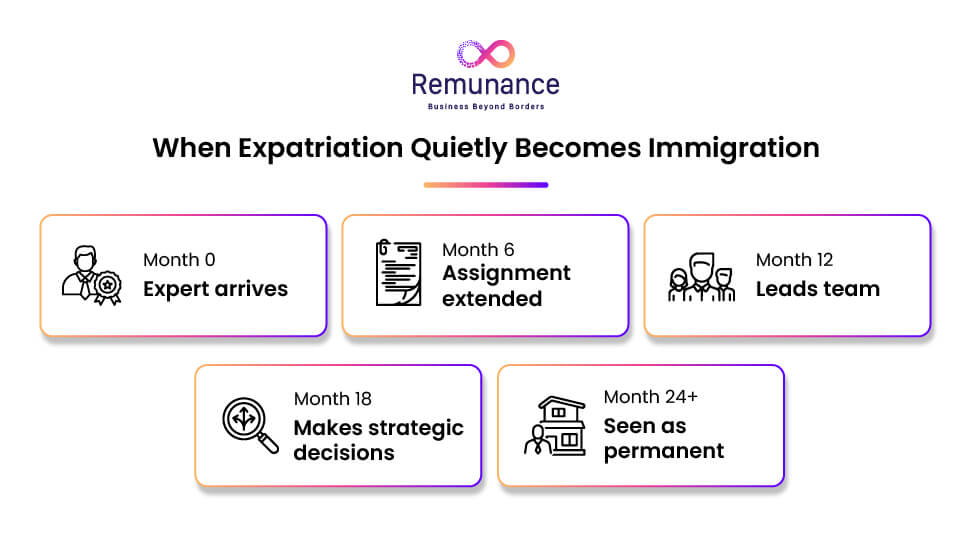
Trouble starts when temporary roles become structural necessities. A person is assigned for six months. But then, the project grows, and local resources struggle.
Extensions become the norm, and eventually, this person isn’t just supporting the system; they are the system.
This is where expatriation quietly becomes immigration, unacknowledged and unaddressed. India doesn’t need formal notices for this change. It simply adjusts its expectations to match reality.
How EOR helps bridge the gap between Expatriation and Immigration
At this point, companies usually realise something uncomfortable. They didn’t design the role to become permanent. But it did. And now they’re stuck between two bad options: retrofitting compliance or pretending the shift didn’t happen.
This is where Employer of Record becomes relevant not as a hiring shortcut, but as a structural correction.
An EOR allows companies to localise employment without rewriting the entire organisation overnight. It creates a compliant employment layer in India while the business figures out whether the role will remain permanent, transition to local leadership, or evolve further.
The key value here is not speed. It’s containment. Containment of tax risk, labour exposure, and role ambiguity.
Leadership Roles and Expatriation Perception
Global firms often err in senior leadership roles, where consequences can be severe. Choosing a foreign national as India Head, Country Lead, or Operations Director can feel permanent even if the initial plan is for a shorter term.
If a person makes hiring plans, chooses revenue streams, and sets company goals, India considers this immigration.
Keeping leaders as expatriates and paying them offshore can cause compliance gaps. Delaying Indian payroll creates more problems.
These issues often come up during audits, acquisitions, or funding rounds.
For leadership roles, Employer of Record often acts as a governance buffer.
It allows foreign leaders to operate in India with clear employment alignment, Indian payroll, and labour law compliance without forcing the company to prematurely restructure its entity or compensation architecture.
In other words, EOR doesn’t make leadership roles temporary. It makes them defensible.
Remunance Employer of Record
Hiring a foreign national as India Head or Country Leader?
Structure payroll, tax, and compliance correctly from day one.
Talk to an India Hiring Expert
Where Immigration vs Expatriation Becomes a Cost Problem in India
Many companies think immigration and expatriation are just about visas. They believe these terms only matter for paperwork. In India, it shows up first in costs. Not right away, but as time goes on, roles change, and habits form.
India isn’t a place where costs suddenly rise. They can creep up on you, especially if someone asks the wrong question at a bad time. And when they surface, they surface backward.
Cost Reality Immigration vs Expatriation
This is counterintuitive for many global employers.
Immigration feels heavier, more expensive, and like a bigger commitment.
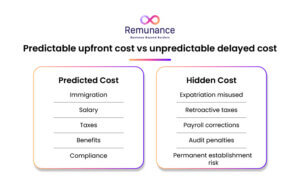
In India, immigration tends to be more predictable. Expatriation often comes with hidden costs.
Why?
Immigration requires early steps. You need local payroll. You must have clear tax residency. Indian benefits and compliance are also necessary.
Once that structure is in place, costs are visible, budgetable, and defensible.
Expatriation lives in exceptions, and exceptions cost money.
Tax is Where India Forces Clarity
India’s tax system is one of the clearest indicators of how the country views presence. Tax residency in India depends on time spent, continuity, and economic activity. It’s not about job titles or HR labels.
A person can become a tax resident if they stay long enough, earn income from India, or have local authority. This can happen even if it wasn’t planned. This is especially dangerous for expatriates whose assignments quietly extend.
From a company’s viewpoint, this is where assumptions fail. India uses immigration rules, leading to retroactive exposure.
India Does Not Separate Immigration From Labour Law
Many employers worldwide mistakenly believe immigration compliance and labor compliance are separate issues.
In India, they intersect; India wants labor laws to align when someone is part of the workforce. This includes working hours, benefits, termination protections, and social security contributions.
If someone appears to be an immigrant but is treated like an expatriate, gaps can arise. These gaps may not show up right away, but can become clear during disputes, exits, or inspections.
This is important for leadership roles. Senior foreign employees often work outside standard HR rules. If not set up correctly, this can increase compliance risks.
Permanent Establishment Risk
PE risk is a major concern for the finance team. They must focus on reducing it. Expatriates in India who sign contracts or manage revenue might cause an investigation. The country will check if the company has a taxable presence.
This risk increases when:
-
- The role is long-term.
- Decision-making power is held locally.
- The role has a direct impact on revenue.
Immigration structures usually anticipate and manage this risk through local entities. Expatriation structures often don’t exist because they assume the assignment is temporary. When the assignment is no longer temporary, the protection also ends.
Why “We’ll Fix It Later” Is the Most Expensive Strategy in India
Many global employers delay decisions to keep their options open. They don’t want to set up an Indian payroll too early, redesign compensation, or overcommit. So, they put off making a clear decision.
In India, delaying a decision is not a neutral action. It sends mixed signals, with different structures for entry, practice, accounting, and tax filings. When things finally get sorted out, it’s often under pressure, that’s when costs skyrocket.
The Counterintuitive Truth About Cost Control in India
Immigrating early can save money in the long run, even if it seems expensive at first. Choosing expatriation without a clear plan can lead to higher costs, even if it seems easier initially.
The problem isn’t the model itself, but rather a mismatch between the model and the situation. India penalizes mismatches more than it penalizes commitment.
Immigration in India comes with a long-term cost, but it’s clear. Expatriation in India comes with a short-term cost, but it has conditions. When these conditions are met, expatriation works well. When they’re stretched, costs add up quietly.
How Mature Companies Handle This Differently
Successful companies in India don’t ask whether immigration or expatriation is cheaper.
They ask which one is more accurate. They design roles honestly, set clear timelines, and review their assumptions early on. They know that staying permanently has a price. Pretending it’s temporary can cost even more.
Payroll is Not Just an Administrative Detail in India
Many global employers view payroll as a back-office task that can be optimized later.
In India, payroll indicates intent.
Local payroll points to long-term integration. In contrast, offshore payroll with shadow structures indicates a temporary presence. Neither option is right nor wrong. However, if the payroll structure doesn’t align with the actual role design, it can cause issues.
If someone appears to be a permanent employee but is paid offshore, questions arise. If someone appears to be temporary but stays for years, questions also arise. India expects alignment.
Remote Work Did Not Remove These Distinctions. It Made Them Harder to Ignore.
Remote work created a false sense of security. Many foreign workers in India believe they can skip immigration rules. They think this applies if they aren’t officially relocated.
India doesn’t see it that way; if work is ongoing, valuable, and done in India, your presence matters. You don’t need a relocation letter. Over time, behavior becomes evidence of intent, replacing documentation.
Companies often expose themselves to immigration risks here, even without planning.
Why Global Employers Hiring in India Must Decide Early
The biggest mistake companies make is delaying the classification decision. They tell themselves they’ll “see how it goes” and assume flexibility is safer. In reality, ambiguity is the riskiest position in India.
The moment someone starts working in the country, India begins observing. The longer the ambiguity lasts, the harder it is to clearly defend any classification. Deciding early doesn’t reduce flexibility; it creates control.
The One Question That Changes Everything
Before moving a foreign professional to India, the question isn’t:
Which visa should we use?
The question is:
- Is this role meant to build a long-term presence in India or provide temporary support?
- If it’s meant to build, immigration is the honest framework.
- If it’s meant to support, expatriation must be intentionally designed and managed.
Everything else flows from that decision.
Conclusion
Immigration versus expatriation isn’t just a documentation issue; it’s a design issue. Immigration is about committing to India, while expatriation is about engaging with India.
Both are valid and powerful, but using them interchangeably can have consequences. Global employers succeed in India when they make clear decisions, structure fairly, and respect India’s view of intent.
Remunance Employer of Record
Avoid costly immigration and expatriation mistakes in India
Book a Consultation
FAQS
What is the difference between immigration and expatriation in global hiring?
Immigration is a journey aimed at embracing local life and work. Expatriation is a brief voyage with a clear role and exit plan. In India, intent and role design often matter more than mere labels or visa names.
When should companies choose expatriation over local immigration in India?
Companies should pick expatriation for short-term tasks like project launches and process transfers. But if the role is crucial to the business, then local immigration is the only choice.
What are the legal requirements for expatriates working in India?
Expatriates in India must have an employment visa. They can only work in approved roles. Employers handle tax reporting, payroll, and labor law compliance.
How does taxation differ for expatriates and immigrants in India?
Immigration is straightforward: when employees arrive in India, they are fully taxed on every rupee earned. But for expatriates, it’s different. They can either split their payroll or use an offshore payroll. The extension for expatriated employees isn’t favorable and could lead to retroactive taxes.
What compliance risks do global employers face when managing expatriates in India?
Global employers face common risks like misclassification, payroll gaps, and labor law violations. These challenges often emerge during audits, exits, or funding events, creating potential pitfalls.
How can an Employer of Record help manage expatriates and immigrants in India?
An EOR steers payroll, tax, and labour compliance from the start. It sets up temporary expatriate roles. This ensures full compliance for long-term immigrant hires. It also helps minimize legal and tax issues.

Related Posts

A Comprehensive Salary Calculator India and Payroll Optimization

How to Pay Employees in India