India vs Other Outsourcing Destinations: What Makes India Attractive in 2026
In 2026, outsourcing destinations are judged by scalability, stability, and execution strength. Among global outsourcing destinations, India leads with deep talent pools, cost-efficient growth, strong leadership, and seamless global collaboration—making it the most reliable choice for long-term outsourcing success.
A decade ago, outsourcing was largely transactional. Companies shifted specific tasks offshore. They measured output by volume and centralized decision-making. Offshore teams executed. Headquarters decided.
That model no longer works.
In 2026, outsourcing is expected to function as distributed ownership.
Global businesses operate across different time zones, markets, and rules. They can’t be managed by constant central control. Offshore teams are no longer extensions of a process. They are extensions of the organization.
This changes what companies expect from an outsourcing destination.
Today, global companies expect offshore teams to understand business context, not just instructions. Teams are expected to make judgment calls without waiting for approvals. They must absorb growth, attrition, and restructuring without breaking delivery.
They need to scale from small teams to large operations. This should happen without requiring a complete redesign of their workflows.
This expectation has eliminated many destinations from serious consideration.
Regions that were effective for controlled execution struggle when ownership is required. They perform well when tasks are narrow and teams are small.
But when decision-making, leadership depth, and continuity become critical, structural limitations emerge.
India has evolved alongside these expectations.
India has built its outsourcing advantage around this reality. India still meets modern outsourcing expectations while many other options fall short.
Cost Comparison Across Outsourcing Destinations: India vs Eastern Europe vs Southeast Asia
Cost still matters. But in 2026, cost predictability matters more than headline savings.
Global companies have learned this the hard way. A low starting salary matters less if wage inflation is high. It’s less crucial when talent turnover happens often or when restructuring is ongoing.
What leaders now evaluate is not cost per hire. It is the cost per stable unit of output over time.
This is where the differences between India, Eastern Europe, and Southeast Asia become clear.
India as an Cost Efficiency Outsourcing Destination
India’s cost advantage in 2025 is no longer about hiring cheaply. It is about maintaining efficiency as teams grow and mature.
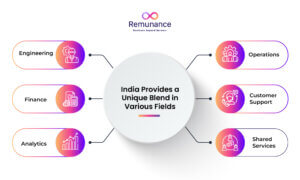
Reasonable entry-level costs, Moderate senior-level premiums, Lower cost escalation over multi-year horizons
What makes this sustainable is role elasticity. Indian professionals often operate across wider scopes. One person handles tasks that many roles share in other areas. This cuts down on layering. It limits unnecessary management and keeps costs flatter as teams grow.
Another critical factor is ramp-up economics. Indian hiring ecosystems are deep and liquid. Companies can onboard talent quickly without overpaying for urgency. This matters when growth is uneven or demand spikes unexpectedly.
Attrition is often cited as a concern. But in mature setups, attrition no longer translates directly into disruption. Strong middle management, internal mobility, and clear replacement pipelines have lowered churn costs.
In 2026, India is no longer “cheap labor.” It is a cost-efficient execution that survives scale.
Eastern Europe as a High Quality Outsourcing Destination
Eastern Europe continues to offer strong technical capability, particularly in engineering-heavy roles. However, its cost structure has fundamentally changed over the past few years.
Several pressures now define the region:
-
- Salary convergence with Western Europe.
- Talent mobility into EU hubs.
- Smaller talent pools are driving faster wage inflation.
For small, senior-heavy teams, Eastern Europe can still make sense. But when companies attempt to scale beyond a limited headcount, costs rise disproportionately.
Each new hire costs more than the previous one. Soon, retention bonuses outweigh the productivity gains.
This makes Eastern Europe effective for specialization, but fragile for long-term expansion.
Southeast Asia: Competitive Entry, Fragile Scaling Economics
Southeast Asia often appears attractive in terms of entry-level costs. Vietnam, Indonesia, and the Philippines are competing for customer experience and shared services roles.
The challenge emerges with growth.
Talent availability varies sharply by country and function. As teams expand, companies often need to operate across multiple markets to sustain hiring velocity.
This introduces currency risk, management complexity, and inconsistent compensation structures.
A low-cost setup can quickly lead to hidden costs. This happens due to coordination overhead and operational fragmentation.
Cost Reality Across Outsourcing Destinations in 2026
When companies compare outsourcing to India vs other countries, the real cost question is not who is cheapest today. It’s the one who stays economical after three years, several hiring waves, and leadership changes.
India performs best under those conditions.
It offers:
More stable wage curves Higher role productivity per hire Lower restructuring costs during scale
That’s why, when we view costs as a long-term factor, India shines as the top outsourcing destination.
Build a Cost-Efficient Offshore Team That Scales
Stop losing money to rising salaries and unstable teams. Discover how India delivers predictable costs, scalable talent, and long-term outsourcing efficiency.
Talent Pool Depth Across Outsourcing Destinations

Most outsourcing comparisons talk about talent quality. In 2025, the more important question is talent depth.
Quality helps you start. Depth determines whether you can keep going.
This is where the global talent conversation has shifted. Companies are no longer hiring offshore teams to support isolated functions. They are creating multi-layered teams that need to grow, change, and develop over time. That requires a talent pool that does not thin out after the first hiring wave.
India: Depth That Absorbs Scale
India’s biggest advantage in 2025 is not just the number of professionals it produces each year. It is the density of experienced, mid-level talent.
India has spent decades operating inside global delivery models. As a result, the talent pool is layered. Every entry-level hire brings experienced pros along. They have managed scale, process changes, and complex stakeholders.
This shows up in practical ways:
- Teams keep moving after the first 20–30 hires.
- Mid-level leaders step in to support growth.
- Senior talent doesn’t have to constantly put out fires.
Indian professionals today are not learning outsourcing mechanics. Many have worked with international clients, managed global KPIs, and navigated time zones. That experience shortens onboarding cycles and reduces dependency on constant training.
More importantly, India offers cross-functional depth. Engineering, finance, compliance, operations, analytics, and customer experience can all be scaled within the same ecosystem. This allows companies to grow horizontally without rebuilding operating models for each function.
Eastern Europe: Strong Specialization, Limited Depth
Eastern Europe excels in specialized, senior technical talent. It is particularly effective for advanced engineering, cybersecurity, and architecture-heavy roles.
The limitation is not capability. It is volume.
Talent pools are smaller and more concentrated. As hiring scales, competition increases quickly. Salary pressure rises. Retention becomes harder. Companies often hit practical ceilings sooner than expected.
This makes Eastern Europe well suited for focused, high-impact teams. It is less suited for large, multi-function operations that need to scale over several years.
Southeast Asia: Emerging Depth, Uneven Distribution
Southeast Asia has developed strong capabilities in customer experience and shared services. Certain markets also offer growing tech talent.
The challenge is consistency.
Talent maturity varies significantly by country and function. Senior leadership availability remains limited. As teams grow, companies often need to supplement local talent with heavy training or external management layers.
This slows down scaling and increases dependency on headquarters.
The Talent Reality in 2025
When companies look at global talent in India in 2025, the key factor isn’t if there are great individuals elsewhere. It is whether the ecosystem can support growth without friction.
India’s talent pool does not thin out as teams expand. It absorbs scale.
India is a top choice for companies that want reliable offshore options, not just fast services.
Time Zone Coverage Across Outsourcing Destinations and Operational Continuity
Time zone alignment used to be discussed in terms of overlap. In 2025, it is discussed in terms of continuity.
Global companies no longer operate in clean, linear workdays. Product development, customer support, data operations, and internal decision-making all happen continuously.
The question is not whether teams can attend the same meeting. It is whether work can move forward without stalling.
Time zone strategy is an operational design choice, not just a scheduling detail.
India: Built for Continuous Operations
India occupies a rare and highly practical position on the global clock.
It overlaps with Europe in the afternoon and with the US in the early morning and late evening. This creates natural handoff windows without forcing teams into night-heavy schedules.
For global companies, this enables:
-
- Follow-the-sun workflows to prevent burnout.
- Collaborate in real-time across regions as needed.
- Enjoy asynchronous progress that doesn’t rely on headquarters.
Indian teams are accustomed to operating within these overlaps. This is not an exception-driven model. It is the default. Over time, this has led to the development of robust practices in documentation, handovers, and decision continuity.
The result is momentum. Work does not pause simply because one region logs off.
Eastern Europe: Strong Regional Alignment, Limited Global Reach
Eastern Europe aligns well with Western Europe. For EU-centric operations, this works efficiently.
The limitation appears when companies need consistent engagement with the US or APAC. Overlap becomes narrow. Decisions are delayed. Teams wait for approvals instead of moving forward.
This restricts Eastern Europe’s effectiveness in truly global operating models.
Southeast Asia: APAC Strength, Global Gaps
Southeast Asia aligns well with APAC markets. Supporting both Europe and the US from one team is tough. It often needs split shifts or separate teams.
As operations scale, companies often compensate by creating multiple regional teams. This increases coordination overhead and fragments accountability.
Continuity Factor Across Outsourcing Destinations
In 2025, time zone advantage focuses less on convenience and more on operational resilience. The ability to maintain progress across markets without forcing constant escalation is critical.
India offers this resilience by default.
When continuity is key, India is the best choice for flexible outsourcing in global operations.
Language, Communication, and Business Context
Most outsourcing breakdowns are not caused by capability gaps. They are caused by misalignment in communication and context.
By 2025, offshore teams will participate in decision-making rather than just following orders. That requires more than functional English.
It requires fluency in how global businesses communicate, document, escalate, and resolve problems.
This is where many outsourcing destinations struggle quietly. India does not.
India: Communication as Infrastructure
India’s advantage is not simply that English is widely spoken. It is that English is the operating language of business across industries.
Indian professionals are trained in English-first systems. This training includes engineering documents, compliance reports, internal reviews, and client communication. This creates consistency across roles and seniority levels.
More importantly, communication in India is structured around global business norms. Teams are accustomed to:
-
- Write clear documentation instead of relying on spoken context.
- Manage stakeholders across different time zones.
- Escalate risks early instead of waiting for failure.
This reduces friction in complex workflows. Decisions move faster. Misunderstandings surface earlier. Accountability is clearer.
Indian teams do not just translate instructions. They interpret intent.
Eastern Europe: Strong at the Top, Uneven Below
In Eastern Europe, English proficiency is typically strong at senior levels. Senior engineers and managers communicate well with global stakeholders.
The gap often appears in mid-level and support roles. As teams grow, internal communication becomes uneven. This creates dependencies where information flows upward before it can move outward.
The result is slower execution as scale increases.
Southeast Asia: Variable Fluency, Inconsistent Context
Southeast Asia presents a wide variation by country and function. Some markets perform well in customer-facing English communication. Others struggle with internal business communication, particularly in cross-functional settings.
This inconsistency increases the need for supervision, translation layers, and rework.
Why Business Context Matters Across Outsourcing Destinations
In today’s outsourcing models, teams must understand the purpose of their work, not just the tasks. This requires comfort with ambiguity, business trade-offs, and decision framing.
India’s outsourcing ecosystem has been built around this reality for decades. Teams are trained to operate within global decision-making structures.
India is the top choice for clear, reliable collaboration among multiple stakeholders.
Leadership Availability and Team Ownership Across Outsourcing Destinations
This is the point where many outsourcing strategies quietly fail.
Teams can execute tasks. Few can own outcomes.
In 2025, global companies won’t build offshore teams that just wait for direction. They are building teams expected to plan, prioritize, and deliver with minimal intervention.
That requires leadership on the ground, not just strong individual contributors.
This is where India creates a decisive gap.
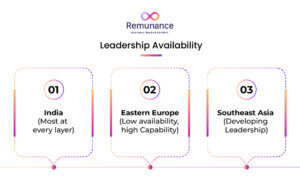
India: Leadership at Every Layer
India’s outsourcing boom has made a unique mark in global talent markets. It has led to a high density of leaders.
India provides skilled managers, functional leads, and delivery heads. They have experience working in global organizations. Many have built teams from the ground up.
They’ve faced attrition cycles. They’ve teamed up with global partners. They also tracked performance metrics tied to business results.
This leadership presence changes how offshore teams function.
Decision-making does not bottleneck at headquarters. Teams can plan capacity, manage risk, and resolve issues locally. Senior leaders in India are willing to push back when priorities clash. They don’t just follow orders without question.
This creates healthier operating models. Offshore teams stop behaving like vendors and start behaving like internal functions.
Eastern Europe: Capable Leaders, Limited Supply
Eastern Europe has strong leadership talent, particularly in technical domains. The challenge is availability and continuity.
Senior professionals are in limited numbers and highly mobile. Many are moving to Western Europe or taking on entrepreneurial roles.
This shift increases turnover among leaders. Companies often have to rebuild their management skills more often than they expect.
This introduces instability as teams grow.
Southeast Asia: Developing Leadership Ecosystems
Leadership capability in Southeast Asia is improving, but still maturing. Many teams require external oversight or strong headquarters involvement to maintain alignment.
As scale increases, this dependency becomes a constraint. Decision latency rises. Accountability diffuses.
Why Leadership Changes Outcomes Across Outsourcing Destinations
In 2026, how organizations are structured will be key to outsourcing success. It’s not just about finding talent anymore. Teams that lack local leadership remain dependent. Teams with leadership evolve into self-sustaining units.
India stands out because leadership is not scarce. It is embedded across levels.
Companies with long-term offshore operations find it easier to scale in India. They don’t need constant help.
Remunance Employer of Record
Build Teams That Lead, Not Just Execute
Stop managing offshore teams that wait for instructions. Build leadership-led teams that take ownership, drive outcomes, and scale with confidence. Discover how India’s deep leadership ecosystem helps global companies create self-sustaining offshore operations.
Talk to an Offshore Leadership Expert
Why Choose India Over Other Outsourcing Destinations in 2026
When companies consider outsourcing to India versus other countries, they rarely rely on a single metric.
On paper, multiple destinations can look viable. In practice, only a few can support growth without forcing repeated structural changes.
The real question decision-makers are asking in 2025 is simple:
Can this destination support scale without constant rework?
India answers that question more consistently than Eastern Europe.
Eastern Europe excels in specialization. It performs well when teams are small, senior-heavy, and narrowly defined. For product-focused or highly technical initiatives, this can work well. But as teams grow, constraints appear quickly.
Talent pools tighten. Costs rise faster. Leadership becomes harder to retain. Scaling often requires redesigning team structures earlier than planned.
India operates differently.
India’s outsourcing ecosystem is built for progressive scale. Teams can begin small, expand in layers, and develop without disrupting their model.
Leadership depth ensures continuity. Communication norms support autonomy. Cost structures remain balanced as headcount increases.
This creates something that matters more than talent quality alone: operational stability.
Companies choosing India in 2025 are not optimizing for the next six months. They are optimizing for the next three to five years. They seek clear growth paths, steady leadership, and teams that handle change smoothly.
India delivers that combination.
When companies view outsourcing as a strategic bet, India often proves a safer long-term choice than Eastern Europe and other options.
Let’s Build Your Offshore Team the Right Way
Planning to scale in India or comparing outsourcing destinations? Talk to our experts to understand how India can support long-term growth, leadership continuity, and operational stability for your business.

FAQS
Why is India preferred over Eastern Europe for outsourcing in 2026?
India is preferred because it supports scale without constant restructuring. Eastern Europe has strong specialized talent, but it faces challenges. Talent depth is limited. Wage inflation is rising quickly. There’s also a lack of leadership as teams grow. India has a large talent pool. It also has strong leadership, clear communication, and stable costs.
Is outsourcing to India still cost-effective in 2026?
Yes, but not in the old sense of low wages. In 2025, India’s advantage lies in cost predictability and cost-to-output efficiency. Companies benefit from broader ownership roles, lower restructuring costs, and slower salary growth than other options.
How does India compare to Southeast Asia for outsourcing?
Southeast Asia works well for specific roles and smaller teams. However, scaling often requires multi-country setups, which increases complexity and management overhead. India provides a single, unified system. This system supports multi-function scaling and reduces operational dependencies.
Does India offer enough senior and mid-level talent?
Yes. One of India’s strongest advantages is experience density. The talent pool has many mid-level and senior professionals. They have worked in global companies, managed offshore teams, and delivered successful outcomes. This reduces training time and dependency on headquarters.
How important is time zone coverage when outsourcing globally?
Time zone coverage is critical for continuity. India connects with Europe and the US. This setup helps with follow-the-sun operations. So, there is less need for heavy night shifts. India is well-suited for global product development. It excels in support operations and distributed decision-making.
Can Indian offshore teams operate with minimal oversight?
Yes, when structured correctly. India offers strong leadership availability across functions. Experienced managers can handle delivery, lead teams, and connect with global leadership. This reduces the need for ongoing involvement from headquarters.
What types of companies benefit most from outsourcing to India?
India is best suited for companies that plan to scale over time. This includes SaaS companies, global enterprises, and GCCs. It also includes businesses that focus on long-term offshore skills, not just short-term teams.
Is India still relevant as automation and AI increase?
Yes. As automation increases, the value shifts from execution to judgment, coordination, and ownership. India has a unique advantage. It can blend its large workforce with skilled professionals. These experts work with automation instead of being replaced by it.

Related Posts
Outsourcing vs Offshoring: Key Differences & Best Model 2026

The 5 Fastest Growing Remote Hiring Destinations in 2026
