Outsourcing vs Offshoring: Key Differences & Best Model 2026
Both models may seem similar, but there is an outsourcing vs offshoring competition to choose the right one. They differ in control, cost, and scalability. This blog explains their meanings, key differences, pros and cons, and how to choose the right model for your business goals in 2026.
Is there a wrestling match between outsourcing vs offshoring in your mind?
Do you want to find the difference between the two terms? Do you want to know which one is correct for your business?
Let’s address all your questions and conclude this wrestling match between outsourcing vs offshoring.
You’re not the only one finding these answers, but many businesses are not sure. Both models look similar but are different in their impact on costs, control, quality, and long-term scalability. 71% of financial service executives outsource or offshore some of their services.
In this blog, you will understand
-
- The meaning of outsourcing and offshoring
- Key differences between outsourcing vs offshoring
- Benefits and disadvantages of both terms
- Which one is right for you?
Let’s break down each pointer and understand which model is the best for your business in 2026.
What is Outsourcing?
Outsourcing is a business practice where a company hires an external service provider to handle specific tasks or operations that were previously managed in-house.
Businesses choose outsourcing to reduce costs, improve efficiency, and focus on their core activities while benefiting from specialized professionals’ expertise.
In outsourcing, the focus is on who performs the work, not where it happens. The person who’s providing the service can be a local or from another country.
The main purpose of outsourcing is to have an external team save the internal team’s effort.
What is Offshoring?
Offshoring is the relocation of business operations to another country. Mostly, the operations are software development, customer service, or financial processes.
Offshoring offers direct control over the team since work is done for the same company at another location. Offshoring is a cost-effective option that provides a larger, skilled workforce.
Key Differences Between Outsourcing vs Offshoring
Now that we know how those concepts work, let’s explore the difference between outsourcing and offshoring.
| Areas | Outsourcing | Offshoring |
| Definition | Hiring a third-party vendor or service provider for particular tasks | Offshoring means relocating business operations to a different country to run the work through a remote/offshore team. |
| Who performs the task? | An external company or contractor handle work | The company’s employee located in another country handles the task |
| Location | This is possible in the same country or a different country | Only possible in another country |
| Level of control | Less control since a third party manages the team | Direct control since the company itself handles its team |
| Primary goal | To streamline operations, access expertise, and improve efficiency | To reduce labor costs, operational costs, and achieve a huge skilled workforce |
| Focus areas | Mainly digital marketing, IT support, software development, or payroll are focused | Here also similar, including manufacturing, customer service, and core operations |
Still Confused Between Outsourcing and Offshoring?
Choosing the right model can impact your cost, control, and long-term growth. Let our experts help you decide the best approach based on your business goals and expansion plans.
Benefits and Disadvantages of Offshoring and Outsourcing
Now that we know the difference between outsourcing and offshoring, let’s understand their benefits and disadvantages.
Benefits of Outsourcing
-
- Outsourcing reduces labor and operational costs due to third-party providers
- Offers access to specialized skills for specific business functions
- Quick scaling is possible without full-time employees
- Help the internal team in a way that they can focus on the main functions and build strategies
- Omits the requirement of infrastructure, tools, or training costs
Disadvantages of Outsourcing
-
- Less control over day-to-day operations and quality
- May face the communication gap and a slower process
- Cultural differences impact collaboration, and expectations
- Over-dependency on a vendor for critical business processes
- Hidden fees can be the reason for an increase in the cost
Benefits of Offshoring
-
- This offers a large talent pool and lower labor costs in growing countries
- Higher control over offshore teams as compared to outsourcing
- Easy access to professionals like software developers, customer support, and core operations
- Long-term cost-effectiveness from offshore operations
- Best option to build more offshore teams and growth
Disadvantages of Offshoring
-
- A difference in time zones may impact work processes
- Cultural differences may affect the workflow and communication
- Demands tough management processes for better quality control
- Requires the right support to set up the overseas operations
- Potential risks from geopolitical changes or compliance requirements
How Do You Choose Between Outsourcing And Offshoring
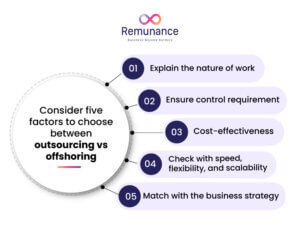
Selecting the right option depends on the requirements. To make this easier, let’s bifurcate into categories such as core factors, control, cost, skill requirements, and time horizon.
Most importantly, consider how deeply the work is required for your core processes.
-
- Define the nature of work: The company should prefer clarity over the nature of work.
- Check the control requirements: Both have different execution methods, which affect the control requirements.
- Cost-effectiveness: Compare the cost of both services
- Give priority to speed, flexibility, and scalability: Consider these factors when choosing between the two.
- Align with your business strategy: Ensure the model you choose supports it.
Let’s break down all the required checkmarks and see who wins the battle between outsourcing and offshoring.
Define the Nature of Work
Outsourcing is an option for a business with non-core processes. If the company is looking for a digital marketer, customer support, or an employee for payroll and administrative tasks, outsourcing is beneficial.
For companies that have long-term plans and core functions, offshoring is a good option. Business functions such as software development, engineering, or operations, where direct control can be established.
Check with the Control Requirement
With outsourcing, you don’t have to manage daily operations, tools, or quality, as a dedicated service provider handles them. With offshoring, you have greater control over workflows, performance, and quality.
Cost-effectiveness
Outsourcing is an affordable option for short-term projects. But with long-term requirements, the cost increases accordingly.
In Offshoring, you get to hire talent from a developing country while saving labor costs and operational expenses.
Give Importance to Speed, Flexibility, and Scalability
Outsourcing speeds up operations by leveraging providers that already have the tools and processes.
Offshoring can be done only with an initial setup, such as an entity or partnering with an employer of record. But this ensures greater scalability and stability, enabling better growth.
Align with your Business Strategy
Outsourcing is a great option if you want to streamline operations, lower workload, and access experts with special skills.
With offshoring, you can expand your business, scale operations, and build dedicated offshore teams that match your business strategy.
Conclusion
When it comes to outsourcing vs. offshoring, the winner is usually determined by the requirements. Both have benefits and drawbacks. But it depends on whether you want a local team or to expand the operations.
Also, outsourcing will help you streamline operations and save costs. But you get the same benefits with offshoring. In fact, offshoring includes expansion with less hassle and greater control.
As we have mentioned before, associating with an employer of record will make it easier and more cost-effective.
EORs can help you create offshore teams and manage them. From payroll to compliance, EOR services cover the full spectrum.
They ensure you focus on your core business operations without worrying about administrative workload.
Remunance Employer of Record
Ready to Choose the Right Model for Your Business?
Make the right choice between outsourcing and offshoring with expert guidance. An Employer of Record helps you expand easily while managing hiring, payroll, and compliance for you.
Talk to Remunance Experts
Frequently Asked Questions
Can a business use outsourcing and offshoring together?
Absolutely yes. Many businesses outsource particular operations while offshoring core operations. This helps them balance flexibility, cost savings, and operational control.
Is offshoring only about reducing costs?
That’s a myth. Cost reduction is definitely a benefit, but it doesn’t stop here. Offshoring also offers a global talent pool, long-term scalability, and greater control over teams.
Does outsourcing affect data security?
Outsourcing can pose data security risks if vendors lack strong compliance practices. Choosing reputable providers with clear SLAs minimizes this risk.
What should companies check before onboarding global employees?
To prevent operational problems, businesses should examine local start-date legislation, documentation requirements, remote work preparedness, mentorship support, and termination policies.

Related Posts

Staff Augmentation vs Outsourcing: Differences & Best Fit

Outsourcing to India: Benefits, Costs & Key Insights

The Ultimate Guide to HR Outsourcing Services for Startups

Key Components for Outsourcing to Employer of Record Switch