How To Manage Cross-Cultural Teams?
Managing cross-cultural teams brings opportunities to hire talent from all over the world. As it brings opportunities, it requires cultural awareness, clear communication, and inclusivity. This blog will make you understand how EOR can be a great help in managing cross-cultural teams.
Now, geographical boundaries cannot stop you from hiring your top-tier candidate. A business can hire cross-cultural teams that can be from different backgrounds
-
- Countries
- Cultures
- Backgrounds
As this seems to be the best opportunity, it also brings challenges. Managing cross-cultural teams is not just about leadership. The business must be aware of cultures, adaptability, and communication.
Cross-cultural teams can drive innovation and growth. But if the company fails to manage teams, it will result in conflicts, misunderstandings, and reduced productivity.
Please do not worry; we are here to help you. This blog will suggest to you the best way to manage cross-cultural teams.
In this blog, we will explore,
-
- What cross-cultural teams are
- How are cross-cultural teams managed?
- Key challenges of cross-cultural teams
- Importance of EOR in managing cross-cultural teams
Let’s start with understanding what cross-cultural teams are!
What Are Cross-Cultural Teams?
The definition is in its name that a team of individuals from different countries, cultures, and ethnic backgrounds working for any business.
The teams can be in different forms, such as:
-
- Remote teams in different countries
- On-site teams filled with people from different cultures
- Hybrid teams with both capabilities
Every individual brings unique perspectives that are aligned with their work culture.
This uniqueness can be measured by communication style, work ethics, decision-making approaches, and expectations from the team.
Discover Indian Workplace Culture
Understand communication styles, business etiquette, holidays, and employee expectations in India before building your team.
Key Challenges In Managing Cross-Cultural Teams
While hiring cross-cultural teams brings diverse perspectives, it also presents challenges.
If the business is not prepared to manage a cross-cultural team, there is a risk of misunderstandings and misaligned teams.
Let’s see what challenges make it difficult to manage cross-cultural teams.
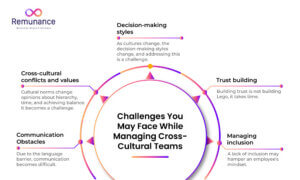
Communication Obstacles
The most important medium of communication is language, and language differences can lead to misunderstandings. Though English is commonly considered the language, it varies across countries.
Every culture’s way of expression is different. Some cultures value directness, while others are indirect or rely on subtlety and nonverbal cues. This has the potential of creating misunderstandings and confusion.
Cross-Cultural Conflicts and Values
People’s opinions on hierarchy, time, and the balance between individual initiative and social responsibility are shaped by cultural norms.
A leader in the United States could promote independent problem-solving, while team members from different countries might expect more direct guidance. Without understanding, these differences can lead to stress or a sense of unfairness.
Decision-Making Styles
Decision-making must consider the organization’s diverse cultures. In some teams, they expect open debate and majority agreement, while in others, they rely on others.
If these styles collide, there is a chance of growing frustration.
Trust Building
Trust is a different concept in different cultures.
In certain circumstances, trust is created through predictability, reliability, and performance. Others develop it through personal ties and common experiences outside of the workplace. Some team members may feel excluded or unappreciated if leaders fail to acknowledge these differences.
Managing Inclusion
Even in diverse teams and workplaces, some people are prioritized over others.
Factors such as
-
- Language confidence
- Cultural norms
- Power dynamics
can be the reason for employees to leave ideas on the table, reducing engagement, and holding back. If this lack of inclusion continues, it will hamper the employees’ morale and eventually affect retention.
How To Manage Cross-Cultural Teams?
Cross-cultural team management is advantageous for businesses. This helps to adapt to diversity, innovation, and creativity. As a result, the company drives growth by building relationships with global clients.
But managing a culturally diverse team is not as easy as it seems. It is difficult to improve communication and adapt to different work styles. I want to ease your worries and share some tips for managing cross-cultural teams.
-
- Recognize cultural differences: Understand and be aware of the local cultural differences
- Foster a culture of inclusivity: Ensure discrimination doesn’t occur in your organization
- Develop cultural awareness: Spread positivity in your team about all the cultures
- Encourage team-building activities: Arrange events that talk about cultural awareness
- Ensure clear communication: leave no room for misunderstanding and keep communication clear
1. Recognize Cultural Differences
There is a possibility of misunderstandings due to cultural differences. Since the cultures are different, the languages or styles would be different. It takes time to adapt to the situation.
To avoid this, the business must be aware of these differences and respect them. Try to make them comfortable and avoid reacting harshly to the misunderstandings. Businesses must be patient and allow time to stabilize things.
2. Foster a Culture of Inclusivity
A workplace where inclusivity takes place encourages collaboration, growth, and engagement. Ensure there is no discrimination and create a peaceful environment for everyone.
3. Develop Cultural Awareness
Arrange programs and educational seminars to develop cultural awareness. These programs will help instill the appreciation of cultural practices, traditions, and customs.
Developing cultural awareness improves interpersonal relationships and mutual respect, and develops long-lasting relationships with customers.
4. Encourage Team-building Activities
Team-building activities will strengthen the team’s bond. These activities help them introduce cultural backgrounds, experiences, and cultural insights.
5. Ensure Clear Communication
Communication is the most important aspect of cross-cultural management. Ensure language barriers are addressed by keeping communication channels open, direct, and specific.
Encourage acceptance of feedback and active listening, and showcase understanding or sensitivity. This will end the cultural gaps.
Role of an Employer of Record (EOR) in Managing Cross-Cultural Teams
When it comes to managing a cross-cultural team, the employer of record plays an important role. It handles local employment complexities and helps in global collaborations.
During the borderless hiring, companies have to tackle labor laws, communication styles, and workplace expectations. EOR takes responsibility for all these barriers, keeping you worry-free.
The EOR takes full responsibility for full compliance with local rules and regulations. This includes payroll, tax, and employment contract requirements. It automatically reduces the risks and helps companies focus on their core tasks.
EOR also provides valuable local insights and enables a better understanding of local cultures. EOR makes businesses understand the differences in work ethics, communication norms, and public holidays.
EOR focuses on enhancing onboarding and overall employee experience by ensuring policies align with local practices. EOR ensures keeping a supportive and inclusive work environment.
Overall, EOR bridges the gap between global companies and local talent by providing smooth, culturally positive team management.
Remunance Employer of Record
Simplify Cross-Cultural Team Management with an EOR
Hire and manage international employees with full compliance, localized payroll, and expert cultural support—without setting up a local entity.
Talk to Our EOR Experts
Conclusion
Cross-cultural teams put you on a path full of challenges that lead you to better opportunities. If the communication, culture, and work styles are managed well, it will only bring immense growth.
The only way to achieve this success is to be aware of and understand differences and diversity. With an employer of record, businesses can more easily address communication, inclusion, and adaptation of leadership styles.
To sum up, managing diversity creates stronger, smarter, and more successful cross-cultural teams.
About Remunance
Remunance is an Employer of Record (EOR) services provider in India, helping global companies hire, manage, and support full-time employees without setting up a local entity. We take care of HR, payroll, compliance, and benefits so businesses can focus on growth while building their teams in India with confidence.
Remunance enables businesses from UK, Australia, Canada, France, US, and the Middle East to recruit, hire, and manage workforce and benefits in India.



FAQS
Why are cross-cultural teams important for businesses?
They bring diverse perspectives, enhance creativity, improve problem-solving, and help businesses expand globally with better market understanding.
How can communication be improved in cross-cultural teams?
Use clear language, avoid jargon, encourage active listening, and adopt collaboration tools to ensure transparency and understanding.
How do cultural differences impact team performance?
Differences in work styles, hierarchy expectations, and communication can cause misunderstandings if not managed properly, affecting productivity.
How does an Employer of Record (EOR) help manage cross-cultural teams?
An EOR manages compliance, payroll, and local regulations while providing cultural insights, enabling smooth global team operations.
Why are US companies looking for alternatives to H1B visa sponsorship?
Companies are increasingly looking for easier, faster, and cheaper means of hiring global talent. That’s why they are switching to H1B visa alternatives like the employer of record model.

Related Posts

Best Collaboration Tools for Remote Teams